
John 4:7-10 is about the encounter between Jesus and the Samaritan woman at the well, illustrating God’s limitless love and grace for all people, regardless of social or cultural barriers.
7 A woman from Samaria came to draw water. Jesus said to her, “Give me a drink.”
8 For his disciples had gone away into the city to buy food.
9 The Samaritan woman said to him, “How is it that you, a Jew, ask for a drink from me, a woman of Samaria?” (For Jews have no dealings with Samaritans.)
10 Jesus answered her, “If you knew the gift of God, and who it is that is saying to you, ‘Give me a drink,’ you would have asked him, and he would have given you living water.”
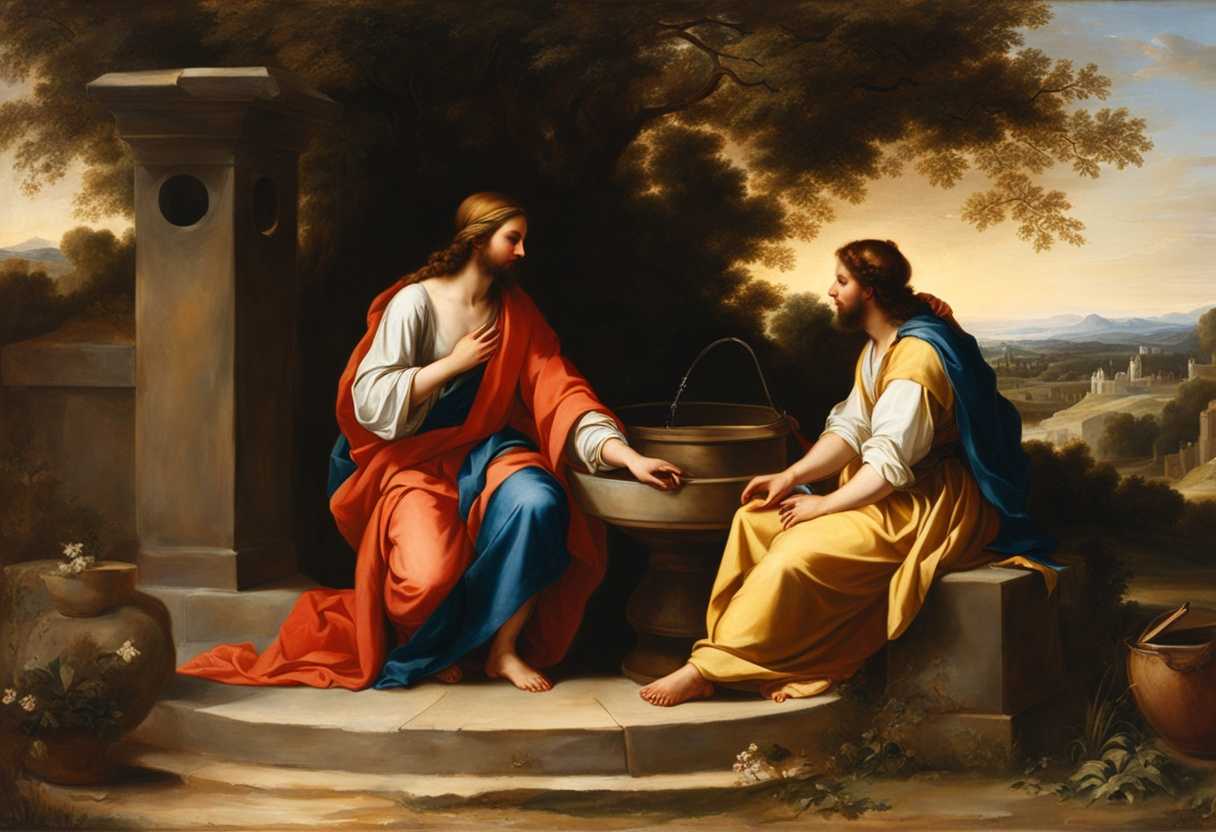
Setting the Scene for John 4:7-10
In John chapter 4, we find Jesus traveling through Samaria on his way to Galilee. Tired from his journey, he stops at a well in the Samaritan town of Sychar while his disciples go into the town to buy food. It is midday, and the sun beats down on the dusty ground as Jesus sits alone by the well, seeking respite from the heat.
As he rests, a Samaritan woman approaches the well to draw water. Her name is not mentioned in the passage, but we learn that she is surprised when Jesus, a Jewish man, speaks to her and asks for a drink of water. This interaction is significant because Jews and Samaritans typically did not associate with one another due to longstanding cultural and religious differences. The woman is taken aback by Jesus’ request but engages in a conversation with him, leading to a profound exchange about living water and true worship.
The scene is set against the backdrop of a quiet well in the midst of a bustling town, with the sounds of daily life echoing in the distance. The encounter between Jesus and the Samaritan woman at the well is a powerful moment of connection and revelation, breaking down barriers of prejudice and revealing the transformative power of Jesus’ message.
What is John 4:7-10 about?
This verse showcases the powerful nature of Jesus’ interactions and teachings. Jesus uses the metaphor of “living water” to convey spiritual truths in this encounter with the Samaritan woman. Water is essential for life, and in this context, it symbolizes the eternal life and nourishment that Jesus offers to all who believe in Him. Through this metaphor, Jesus highlights the transformative and life-giving nature of his message.
Have you ever felt spiritually thirsty or in need of something deeper and more fulfilling? Jesus’s offer of living water speaks to this universal longing for purpose and meaning in life. Jesus offers us spiritual sustenance that can satisfy our deepest longings and provide us with eternal life, just as physical water is essential for our physical well-being. This verse serves as a reminder of the abundance of grace and salvation that Jesus offers to all who seek Him.
Understanding what John 4:7-10 really means
In the Gospel of John, we find a captivating account of Jesus’ encounter with a Samaritan woman at Jacob’s well in Samaria. This setting holds historical and spiritual significance, setting the stage for a profound interaction. As Jesus breaks social norms by initiating the conversation with the woman, we see a glimpse of His willingness to engage with those considered outsiders.
The woman’s incredulous response, “How is it that you, a Jew, ask for a drink from me, a woman of Samaria?” underscores the deep-seated cultural and religious barriers of that time. Jesus’ cryptic statement, “If you knew the gift of God, and who it is that is saying to you, ‘Give me a drink’,” hints at His divine identity and the spiritual gift He offers to all who are willing to receive.
When Jesus mentions giving her “living water,” He symbolically offers eternal life and spiritual sustenance. This living water represents the Holy Spirit, as further elaborated in John 7:37-38, emphasizing the continuous flow of God’s grace and presence in our lives. The imagery of drawing water from the wells of salvation in Isaiah 12:3 and the invitation in Revelation 22:17 to partake of the water of life without cost echo this theme of spiritual abundance.
The relevance of this passage extends to our lives today. Just as Jesus crossed social boundaries to reach the Samaritan woman, we are called to break down barriers of race, gender, and social status. Our spiritual thirst, often overlooked in the busyness of life, requires the nourishment that only Christ can provide. In our daily encounters, Jesus offers us the “living water” of His presence, inviting us into a divine encounter that satisfies our deepest longings.
Consider a modern-day parallel where someone from a marginalized community is approached by a person from a different background. Initial skepticism can give way to connection and understanding through acts of kindness and sharing of valuable resources. This mirrors Jesus’ interaction with the Samaritan woman, illustrating how genuine care and generosity can bridge divides and reveal unexpected blessings.
In conclusion, the encounter at the well challenges us to look beyond societal divisions and recognize the universal need for spiritual fulfillment. Jesus’ timeless offer of “living water” beckons us to experience His transformative love and grace, inviting all to partake in the abundant life He freely gives. Let us heed His call, breaking barriers and embracing the spiritual nourishment that only He can provide.
How can we treat others with genuine love and respect?
Treating others with genuine love and respect entails looking beyond surface interactions and seeing each person as a valuable individual. It involves approaching others with kindness, understanding, and compassion, regardless of our differences or past experiences. This approach allows us to build connections based on empathy and mutual respect, leading to a deeper and more meaningful exchange. We demonstrate a sincere desire to cultivate positive relationships and foster a sense of community by recognizing the inherent worth of every person we encounter. Genuine love and respect involve actively listening, showing empathy, and extending grace, even in challenging situations. When we treat others with genuine love and respect, we create a foundation for meaningful connections and exemplify the kind of selfless love that reflects the values taught in the verse.
Application
Think about how Christ met the woman at the well in John 4:7-10. Just as He showed her love and compassion, consider how you treat others at work or in your family. Can you be that source of kindness and empathy, no matter who they are or where they come from? Take a moment to decide: Will you spread love and understanding to everyone around you, following Jesus’ example?

Reverend Michael Johnson is an experienced Church Minister with a profound expertise in spirituality and guidance. With a serene presence and a compassionate heart, he has faithfully served his congregation for over 20 years, leading them on a spiritual journey towards inner peace and enlightenment. Reverend Johnson’s extensive knowledge of religious philosophies and profound understanding of human nature have made him a trusted confidant and mentor to many, as he seamlessly weaves his profound wisdom into life teachings. Reverend Johnson’s calming demeanor and empathetic nature continue to uplift and heal souls, nurturing a sense of unity and tranquility within his community.