
John 5:1-7 is about an encounter at the Pool of Bethesda where Jesus heals a man who had been unable to walk for 38 years, illustrating the power of faith and the compassion of God to bring about miraculous healing and restoration.
1 After this there was a feast of the Jews, and Jesus went up to Jerusalem.
2 Now there is in Jerusalem by the Sheep Gate a pool, in Aramaic called Bethesda, which has five roofed colonnades.
3 In these lay a multitude of invalids—blind, lame, and paralyzed.
4 for an angel of the Lord went down at certain seasons into the pool and stirred up the water; whoever stepped in first after the stirring of the water was healed of whatever disease he had.
5 One man was there who had been an invalid for thirty-eight years.
6 When Jesus saw him lying there and knew that he had already been there a long time, he said to him, “Do you want to be healed?”
7 The sick man answered him, “Sir, I have no one to put me into the pool when the water is stirred up, and while I am going another steps down before me.”
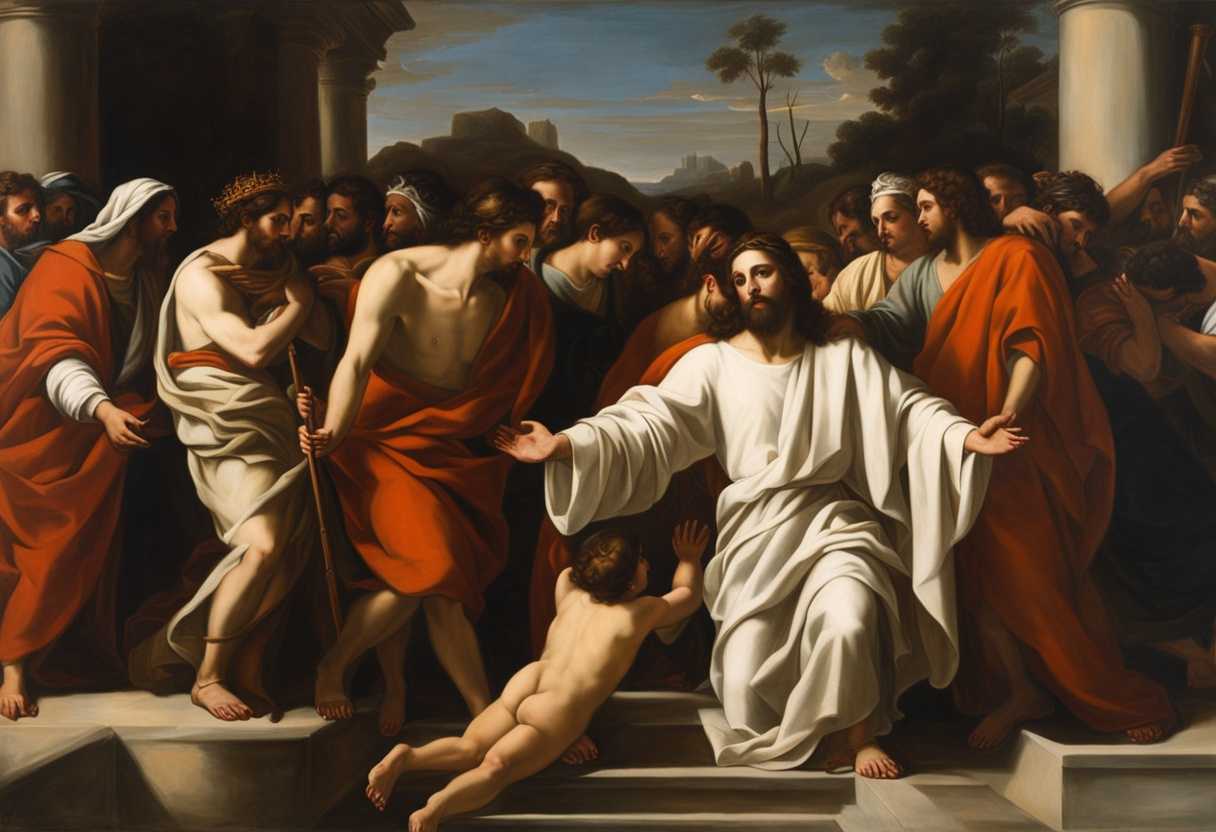
Setting the Scene for John 5:1-7
In John chapter 5, we find Jesus in Jerusalem during one of the Jewish festivals. The scene is set at the Pool of Bethesda, a place known for its healing properties. Surrounding the pool are five covered colonnades where a great number of disabled people, blind, lame, and paralyzed, would gather, hoping to be healed when the water was stirred.
Among the crowd is a man who has been paralyzed for 38 years. He is lying on a mat, surrounded by others who are also seeking healing. Jesus approaches the man and asks him if he wants to get well. The man explains that he has no one to help him into the pool when the water is stirred, and someone else always gets in before him. Jesus then tells him to get up, pick up his mat, and walk. Instantly, the man is healed, picks up his mat, and walks away, rejoicing in his newfound strength.
The atmosphere at the Pool of Bethesda is one of anticipation and desperation, as the sick and disabled wait for a chance at healing. Jesus’ presence brings hope and a miraculous demonstration of his power to heal, showing compassion and mercy to those in need.
What is John 5:1-7 about?
Jesus healing a man at the pool of Bethesda on the Sabbath in this verse is a powerful example of compassion and mercy. Despite the criticism and backlash from religious leaders for performing a healing miracle on the day of rest, Jesus chose to prioritize the well-being and restoration of the man in need. This act challenges us to reflect on our own priorities and values. Should we prioritize rules and traditions over acts of love and kindness? As we delve into this verse, we are faced with the question of what truly matters in our lives. Jesus’s actions remind us of the importance of empathy, understanding, and helping those in need, even if it goes against societal norms or expectations. It prompts us to consider if we are living our lives in a way that reflects love and compassion towards others, or if we are rigidly adhering to rules without considering the human element. This verse ultimately challenges us to examine our hearts and behaviors, urging us to choose compassion over judgment and love over legalism.
Understanding what John 5:1-7 really means
The setting of John 5:1-7 places us in Jerusalem, near the Sheep Gate, at a pool called Bethesda, known for its healing properties. Here, many disabled individuals gathered, hoping for a miraculous cure when the waters were stirred. The scene is vividly painted with the image of the desperate and afflicted— the blind, the lame, the paralyzed—lying by the pool, seeking a remedy for their suffering.
One particular man at the pool had been an invalid for thirty-eight years, showcasing the prolonged agony and seemingly hopeless state he found himself in. When Jesus approached him and asked, “Do you want to get well?” the question delved deeper than mere physical healing, probing the man’s readiness for the life-altering change that healing would bring. The man’s response, “I have no one to help me into the pool when the water is stirred,” reveals his isolation and the stark reality of his situation, underscoring the human need for community and assistance in times of struggle.
This passage resonates with other biblical accounts, such as the healing of the paralytic man in Mark 2:1-12, emphasizing the role of faith and community in seeking healing. Similarly, in Luke 8:43-48, the healing of the woman with the issue of blood highlights personal faith and Jesus’ transformative power. These stories point to the fulfillment of prophecies like Isaiah 35:3-6, foretelling the Messiah’s healing of the afflicted, which Jesus embodies through His miraculous acts.
The relevance of this narrative extends to contemporary society, where many individuals grapple with feelings of isolation and hopelessness in their own struggles. Jesus’ question, “Do you want to get well?” serves as a poignant invitation for introspection, prompting us to evaluate our desires for healing and readiness for change. Moreover, it underscores the importance of seeking support and community, recognizing that we often require assistance from others on our journey towards wholeness.
To illustrate this point, consider someone battling addiction, mirroring the man by the pool. Acknowledging the need for help and accepting support from others can be a pivotal moment in their recovery journey, akin to the invalid man’s situation and Jesus’ offer of healing. In conclusion, John 5:1-7 stands as a compelling testament to Jesus’ compassion and healing power, challenging us to assess our receptiveness to transformation and our reliance on community. Ultimately, it directs us towards the hope and restoration that Jesus extends to all who earnestly seek Him.
How can we recognize and accept help from others?
The story in John 5:1-7 shows us that recognizing and accepting help from others often requires humility and a willingness to admit our own limitations. The man in the story had been paralyzed for 38 years and was unable to get into the pool by himself to receive healing. When Jesus asked him if he wanted to get well, the man immediately mentioned his inability to reach the water on his own, showing vulnerability and an acknowledgment of his need for help.
Similarly, in our own lives, recognizing when we need help and being willing to accept it can be a difficult but important step towards growth and healing. It requires us to let go of our pride, admit our weaknesses, and trust in the care and support of others. We too must be open to receiving help from others in order to overcome our own challenges and obstacles, just as the man in the story had to accept Jesus’ offer of help to experience healing.
Application
Imagine your soul as a computer in need of a reboot. Like a tech upgrade for your life, Christ offers a powerful reset. If your spirit feels cluttered with doubts and fears, now is the time to seek His healing. Approach Him with the same humility and trust you’d give to a trusted mentor or friend. Jesus is the ultimate antivirus for your soul’s struggles. Will you click ‘update’ and let His transformative power in today?

Reverend Michael Johnson is an experienced Church Minister with a profound expertise in spirituality and guidance. With a serene presence and a compassionate heart, he has faithfully served his congregation for over 20 years, leading them on a spiritual journey towards inner peace and enlightenment. Reverend Johnson’s extensive knowledge of religious philosophies and profound understanding of human nature have made him a trusted confidant and mentor to many, as he seamlessly weaves his profound wisdom into life teachings. Reverend Johnson’s calming demeanor and empathetic nature continue to uplift and heal souls, nurturing a sense of unity and tranquility within his community.