
John 6:10-15 is about the miraculous feeding of the multitude with five loaves and two fish, symbolizing Jesus as the provider of sustenance both physically and spiritually for all who believe in him.
10 Jesus said, “Have the people sit down.” Now there was much grass in the place. So the men sat down, about five thousand in number.
11 Jesus then took the loaves, and when he had given thanks, he distributed them to those who were seated. So also the fish, as much as they wanted.
12 And when they had eaten their fill, he told his disciples, “Gather up the leftover fragments, that nothing may be lost.”
13 So they gathered them up and filled twelve baskets with fragments from the five barley loaves left by those who had eaten.
14 When the people saw the sign that he had done, they said, “This is indeed the Prophet who is to come into the world!”
15 Perceiving then that they were about to come and take him by force to make him king, Jesus withdrew again to the mountain by himself.
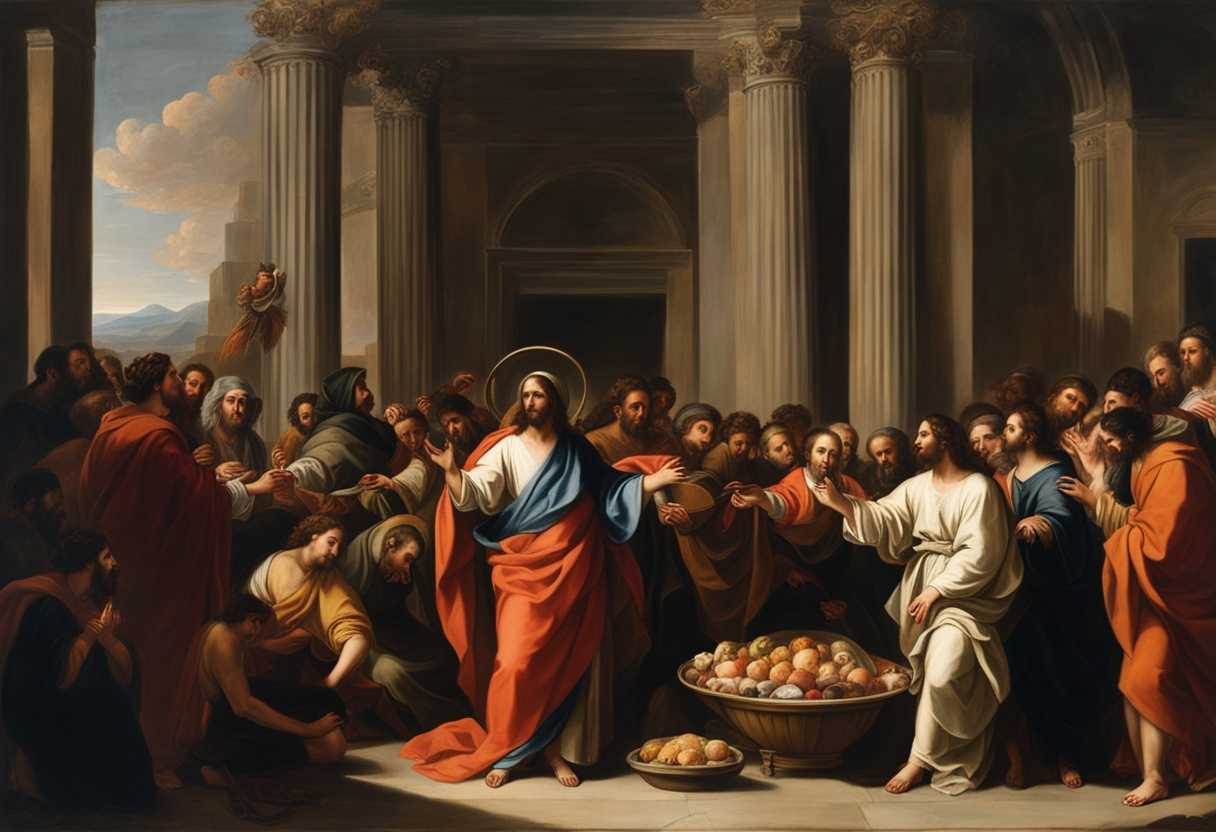
Setting the Scene for John 6:10-15
In John chapter 6, we find Jesus and his disciples in a remote area near the Sea of Galilee. A large crowd had followed Jesus because they had seen the signs he performed on the sick. As evening approached, Jesus asked Philip where they could buy bread for all the people to eat. Philip was unsure how they could afford to feed such a large crowd, but Andrew mentioned a boy who had five barley loaves and two fish.
Jesus then instructed the disciples to have the people sit down on the grass. The scene is set with the Sea of Galilee in the background, its waters gently lapping against the shore. The crowd is buzzing with anticipation as they watch Jesus take the loaves, give thanks, and distribute them to those who were seated. The disciples move among the people, handing out the bread and fish, their faces reflecting a mix of confusion and awe at the miracle unfolding before them.
As the people ate their fill, Jesus instructed the disciples to gather the leftover fragments, filling twelve baskets with the remnants of the miraculous meal. The atmosphere is one of amazement and gratitude as the crowd realizes the magnitude of the miracle they have just witnessed. The disciples, who had been skeptical about how to feed the crowd, now stand in awe of the power and provision of their teacher, Jesus.
What is John 6:10-15 about?
This verse from the Bible shows the miraculous power of Jesus in providing for His followers. Imagine being in the midst of a crowd of 5,000 people with barely enough food to feed a handful. The situation seems impossible and hopeless. But in this account, Jesus multiplies a meager offering of five loaves and two fish to not only feed everyone present but to provide an abundance of leftovers.
Through this miracle, Jesus demonstrates His ability to take what seems inadequate and turn it into more than enough. It is a powerful reminder of His provision and care for His people. This story challenges us to trust in His ability to provide for our needs, even in the face of scarcity or impossibility. It prompts us to reflect on our own lives and consider where we may be limiting God’s power by not fully trusting in His provision. Let the reality that Jesus is not bound by earthly limitations encourage us as we meditate on this verse. He is the ultimate provider who can work miracles in our lives if we have faith in His power. Approach our challenges with a renewed sense of trust and belief in His ability to provide abundantly beyond what we can imagine.
Understanding what John 6:10-15 really means
The passage in John 6:10-15 is a profound account of Jesus feeding the 5,000 with just five barley loaves and two fish. This miraculous event showcases not only Jesus’ compassion but also His divine ability to provide abundantly beyond human limitations. As the crowd gathered near the Sea of Galilee, Jesus instructed them to sit down, setting the stage for a miraculous display of provision and care.
The key phrases in this passage hold significant meanings that resonate with timeless truths. When Jesus instructed the people to sit down, it symbolized order and readiness for the miraculous to unfold. His actions of taking the loaves, giving thanks, and distributing them highlight the importance of gratitude and the act of sharing, no matter how meager our resources may seem. Furthermore, the directive to gather the leftover fragments emphasizes the value of stewardship and appreciating God’s provision without waste.
This narrative finds resonance in other biblical accounts such as Matthew 14:13-21 and 2 Kings 4:42-44, which also depict instances of miraculous provision. The parallel in Philippians 4:19, affirming God’s promise to meet all our needs, echoes the theme of divine provision seen in the feeding of the 5,000. These passages collectively reinforce the message of God’s faithfulness in providing for His people.
Today, this story serves as a beacon of hope and encouragement for believers. It reminds us to trust in God’s provision, even in times of scarcity or uncertainty. The principles of gratitude and stewardship highlighted in this passage urge us to appreciate what we have and use our resources wisely, ensuring that nothing goes to waste. Moreover, the emphasis on community and sharing underscores the importance of coming together and sharing our blessings with others.
To illustrate the relevance of this passage in modern times, consider a scenario where a community faces a crisis with limited resources. Through prayer and unity, they witness a miraculous outpouring of support from unexpected sources, mirroring the abundance seen in the feeding of the 5,000. This anecdote showcases the power of faith, community, and generosity in bringing about unexpected blessings and provision.
In conclusion, the feeding of the 5,000 serves as a powerful reminder of God’s faithfulness and provision. It calls us to trust in His abundance, practice gratitude and stewardship, and embrace the value of community and sharing. Just as Jesus multiplied the loaves and fishes to feed the multitude, may we also witness His miraculous provision in our lives as we walk in faith and obedience.
How can we trust in God’s provision?
We can trust in God’s provision by recognizing that He is a loving and faithful provider. God is able to abundantly meet our needs and even exceed our expectations, just as Jesus multiplied the five loaves and two fish to feed the multitude in the verse mentioned. This passage demonstrates that God cares for His people and is able to work miracles to provide for them.
When we trust in God’s provision, we acknowledge His sovereignty and power over all things. We can release our fears and worries about our needs being met by having faith in His ability to provide for us. This verse reminds us that God is aware of our needs and is willing to provide for us in miraculous ways when we trust in Him wholeheartedly. God, a generous provider, can turn a little into an abundance, and we can hold onto this truth in times of uncertainty or scarcity. Trusting in His provision invites His miraculous intervention into our lives, allowing us to experience firsthand His faithfulness and care for us.
Application
Imagine you’re at your job with only a few tools, yet you need to complete a massive project. Just like that, Jesus took a small lunch and fed thousands, showing us that with faith, even small things can have a big impact. Don’t doubt what you have—offer it up and see how it multiplies. Will you trust in this divine abundance and take that step today? What can you offer to see God’s miraculous work in your life?

Reverend Michael Johnson is an experienced Church Minister with a profound expertise in spirituality and guidance. With a serene presence and a compassionate heart, he has faithfully served his congregation for over 20 years, leading them on a spiritual journey towards inner peace and enlightenment. Reverend Johnson’s extensive knowledge of religious philosophies and profound understanding of human nature have made him a trusted confidant and mentor to many, as he seamlessly weaves his profound wisdom into life teachings. Reverend Johnson’s calming demeanor and empathetic nature continue to uplift and heal souls, nurturing a sense of unity and tranquility within his community.