
John 6:22-69 is about Jesus teaching the profound concept of himself as the Bread of Life, emphasizing the necessity of faith in him for eternal salvation and the significance of partaking in the spiritual nourishment he provides.
22 On the next day the crowd that remained on the other side of the sea saw that there had been only one boat there, and that Jesus had not entered the boat with his disciples, but that his disciples had gone away alone.
23 Other boats from Tiberias came near the place where they had eaten the bread after the Lord had given thanks.
24 So when the crowd saw that Jesus was not there, nor his disciples, they themselves got into the boats and went to Capernaum, seeking Jesus.
25 When they found him on the other side of the sea, they said to him, “Rabbi, when did you come here?”
26 Jesus answered them, “Truly, truly, I say to you, you are seeking me, not because you saw signs, but because you ate your fill of the loaves.
27 Do not work for the food that perishes, but for the food that endures to eternal life, which the Son of Man will give to you. For on him God the Father has set his seal.”
28 Then they said to him, “What must we do, to be doing the works of God?”
29 Jesus answered them, “This is the work of God, that you believe in him whom he has sent.”
30 So they said to him, “Then what sign do you do, that we may see and believe you? What work do you perform?
31 Our fathers ate the manna in the wilderness; as it is written, ‘He gave them bread from heaven to eat.’”
32 Jesus then said to them, “Truly, truly, I say to you, it was not Moses who gave you the bread from heaven, but my Father gives you the true bread from heaven.
33 For the bread of God is he who comes down from heaven and gives life to the world.
34 They said to him, “Sir, give us this bread always.”
35 Jesus said to them, “I am the bread of life; whoever comes to me shall not hunger, and whoever believes in me shall never thirst.
36 But I said to you that you have seen me and yet do not believe.
37 All that the Father gives me will come to me, and whoever comes to me I will never cast out.
38 For I have come down from heaven, not to do my own will but the will of him who sent me.
39 And this is the will of him who sent me, that I should lose nothing of all that he has given me, but raise it up on the last day.
40 For this is the will of my Father, that everyone who looks on the Son and believes in him should have eternal life, and I will raise him up on the last day.”
41 So the Jews grumbled about him, because he said, “I am the bread that came down from heaven.”
42 They said, “Is not this Jesus, the son of Joseph, whose father and mother we know? How does he now say, ‘I have come down from heaven’?”
43 Jesus answered them, “Do not grumble among yourselves.
44 No one can come to me unless the Father who sent me draws him. And I will raise him up on the last day.
45 It is written in the Prophets, ‘And they will all be taught by God.’ So everyone who has heard and learned from the Father comes to me—
46 not that anyone has seen the Father except he who is from God; he has seen the Father.
47 Truly, truly, I say to you, whoever believes has eternal life.
48 I am the bread of life.
49 Your fathers ate the manna in the wilderness, and they died.
50 This is the bread that comes down from heaven, so that one may eat of it and not die.
51 I am the living bread that came down from heaven. If anyone eats of this bread, he will live forever. And the bread that I will give for the life of the world is my flesh.
52 The Jews then disputed among themselves, saying, “How can this man give us his flesh to eat?”
53 So Jesus said to them, “Truly, truly, I say to you, unless you eat the flesh of the Son of Man and drink his blood, you have no life in you.
54 Whoever feeds on my flesh and drinks my blood has eternal life, and I will raise him up on the last day.
55 For my flesh is true food, and my blood is true drink.
56 Whoever feeds on my flesh and drinks my blood abides in me, and I in him.
57 As the living Father sent me, and I live because of the Father, so whoever feeds on me, he also will live because of me.
58 This is the bread that came down from heaven, not like the bread the fathers ate, and died. Whoever feeds on this bread will live forever.”
59 Jesus said these things in the synagogue, as he taught at Capernaum.
60 When many of his disciples heard it, they said, “This is a hard saying; who can listen to it?”
61 But Jesus, knowing in himself that his disciples were grumbling about this, said to them, “Do you take offense at this?
62 Then what if you were to see the Son of Man ascending to where he was before?
63 It is the Spirit who gives life; the flesh is no help at all. The words that I have spoken to you are spirit and life.
64 But there are some of you who do not believe.” (For Jesus knew from the beginning who those were who did not believe, and who it was who would betray him.)
65 And he said, “This is why I told you that no one can come to me unless it is granted him by the Father.”
66 After this many of his disciples turned back and no longer walked with him.
67 So Jesus said to the twelve, “Do you want to go away as well?”
68 Simon Peter answered him, “Lord, to whom shall we go? You have the words of eternal life,
69 and we have believed, and have come to know, that you are the Holy One of God.”
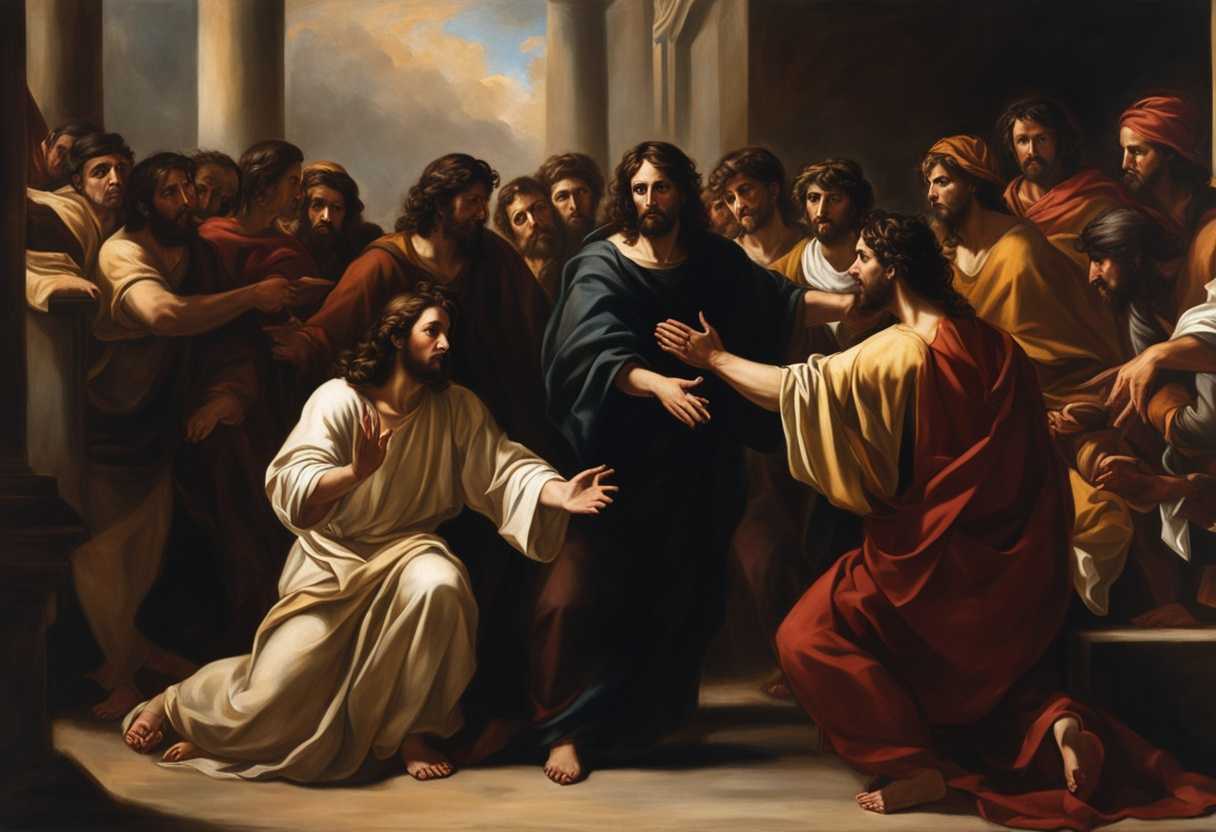
Setting the Scene for John 6:22-69
In John chapter 6, the scene opens with Jesus having just performed the miracle of feeding the 5,000 with five loaves of bread and two fish. The crowd is amazed by this miraculous sign and begins to follow Jesus as he withdraws to a mountain to pray. The next day, the crowd realizes that Jesus and his disciples have left by boat for Capernaum, so they themselves get into boats and go to Capernaum to find him.
As they arrive in Capernaum, they find Jesus teaching in the synagogue. The crowd is eager to hear more from him, and Jesus begins to speak about being the bread of life. He explains that whoever comes to him will never go hungry, and whoever believes in him will never be thirsty. This teaching causes some confusion and murmuring among the crowd, as they struggle to understand the depth of his words.
Among those present are the disciples, including Peter, Andrew, James, and John, who have been following Jesus closely and witnessing his miracles. The Pharisees and other religious leaders are also in attendance, skeptical of Jesus’ claims and teachings. The setting is a bustling synagogue in Capernaum, filled with a diverse crowd of people from all walks of life, gathered to hear the words of this extraordinary teacher who has captured their attention with his signs and wonders.
What is John 6:22-69 about?
This verse, “I am the bread of life. Whoever comes to me will never go hungry, and whoever believes in me will never be thirsty,” from the Bible, highlights the centrality of Jesus in providing spiritual nourishment. Jesus sustains our spiritual life just as bread sustains our physical life. He offers satisfaction for our deepest existential hunger and thirst, promising eternal life to those who believe in Him.
Reflecting on this verse, consider the profound impact of Jesus being the “bread of life” in your own spiritual journey. How does your belief in Him shape the way you view the world and your purpose in it? How does He satisfy your spiritual hunger and thirst in ways that worldly things cannot? May we draw closer to Jesus as we meditate on Him as the ultimate source of sustenance and find fulfillment in His promise of eternal life.
Understanding what John 6:22-69 really means
In the Gospel of John, we encounter a profound discourse known as the “Bread of Life” narrative, where Jesus unveils the spiritual significance behind the miraculous feeding of the 5,000. Following His miraculous walk on water, the crowd pursues Him to Capernaum, seeking more miracles and physical sustenance. It is in this context that Jesus proclaims, “I am the bread of life,” equating Himself to the essential sustenance needed for spiritual nourishment, akin to bread’s role in sustaining physical life. This declaration underscores the centrality of Jesus in meeting our deepest spiritual needs, offering a profound metaphorical understanding of sustenance beyond the physical realm.
Moreover, Jesus emphasizes that the core work of God is to believe in Him, highlighting faith as the fundamental requirement for attaining eternal life. This call to faith is encapsulated in the symbolic imagery of consuming the flesh and blood of the Son of Man, a profound allusion to partaking fully in Jesus’ sacrifice, often interpreted in the context of the Eucharist. Such symbolic language underscores the intimate connection between faith in Jesus and the sustenance of our spiritual life, urging believers to engage in a profound communion with Christ.
Drawing parallels with Old Testament narratives, the provision of manna to the Israelites in Exodus 16:4 foreshadows Jesus as the true bread from heaven, reinforcing the idea of spiritual sustenance provided by God. Additionally, Matthew 4:4 echoes the sentiment that spiritual nourishment surpasses mere physical sustenance, emphasizing the importance of feeding on the word of God for true fulfillment. Paul’s teachings in 1 Corinthians 11:23-26 further solidify the concept of partaking in Jesus’ body and blood through the Lord’s Supper, emphasizing the ongoing significance of this spiritual communion.
In a contemporary context where material pursuits often overshadow spiritual needs, this passage serves as a poignant reminder that genuine fulfillment stems from a relationship with Jesus. It challenges individuals to prioritize their spiritual well-being over transient material concerns, inviting them to partake in the eternal sustenance offered by Christ. Just as the crowd sought physical bread from Jesus, we are called to seek the enduring nourishment of our souls through a transformative relationship with the “bread of life.”
Consider a scenario where a successful individual, despite achieving accolades and wealth in their career, grapples with a profound sense of emptiness that material success cannot assuage. Upon encountering this passage, they realize that their spiritual hunger can only be satiated through a profound connection with Jesus. This revelation sets them on a journey of faith, where they discover a peace and fulfillment that transcends the limitations of worldly achievements, finding true satisfaction in the spiritual sustenance offered by Christ.
In conclusion, the “Bread of Life” discourse challenges us to transcend our immediate physical needs and acknowledge the deeper spiritual hunger that resides within us. It beckons us to place our trust in Jesus as the ultimate source of eternal life, inviting us to find our ultimate satisfaction and sustenance in Him alone. As we navigate the complexities of life, may we heed the call to partake in the spiritual banquet offered by Christ, finding nourishment for our souls in the bread of life.
How can we truly follow Jesus in our daily lives?
To truly follow Jesus in our daily lives means to believe in Him as the Son of God, to accept His teachings, and to strive to live out His commandments with faith and obedience. It involves cultivating a personal relationship with Him through prayer, studying Scripture, and partaking in the sacraments. This ongoing commitment to following Jesus requires surrendering our own will and desires to align with His will, trusting in His wisdom and guidance, and seeking to imitate His love, compassion, and mercy towards others.
Following Jesus also entails being willing to leave behind our old ways of thinking and behaving, and allowing Him to transform us from within. This involves a continuous process of self-examination, repentance, and growth in grace, as we seek to embody the values of the Kingdom of God in our relationships, choices, and actions. We can experience His peace, joy, and power working through us to bring about His purposes in our lives and in the world around us by abiding in Jesus and allowing His Spirit to dwell within us.
Application
Think of your faith like your smartphone, which you rely on daily. Jesus is like the charger, consistently energizing you spiritually. Dive into His teachings, just as you would read important work emails or messages from family. Let Him guide your choices and enrich your relationships. Will you plug in and let Him power your journey?

Reverend Michael Johnson is an experienced Church Minister with a profound expertise in spirituality and guidance. With a serene presence and a compassionate heart, he has faithfully served his congregation for over 20 years, leading them on a spiritual journey towards inner peace and enlightenment. Reverend Johnson’s extensive knowledge of religious philosophies and profound understanding of human nature have made him a trusted confidant and mentor to many, as he seamlessly weaves his profound wisdom into life teachings. Reverend Johnson’s calming demeanor and empathetic nature continue to uplift and heal souls, nurturing a sense of unity and tranquility within his community.