
Jonah 1:1-2:10 is about Jonah’s attempt to flee from God’s call, his subsequent journey of repentance and submission to God’s will, and the realization of God’s mercy and sovereignty over all creation.
1 Now the word of the Lord came to Jonah the son of Amittai, saying,
2 “Arise, go to Nineveh, that great city, and call out against it, for their evil has come up before me.”
3 But Jonah rose to flee to Tarshish from the presence of the Lord. He went down to Joppa and found a ship going to Tarshish. So he paid the fare and went down into it, to go with them to Tarshish, away from the presence of the Lord.
4 But the Lord hurled a great wind upon the sea, and there was a mighty tempest on the sea, so that the ship threatened to break up.
5 Then the mariners were afraid, and each cried out to his god. And they hurled the cargo that was in the ship into the sea to lighten it for them. But Jonah had gone down into the inner part of the ship and had lain down and was fast asleep.
6 So the captain came and said to him, “What do you mean, you sleeper? Arise, call out to your god! Perhaps the god will give a thought to us, that we may not perish.”
7 And they said to one another, “Come, let us cast lots, that we may know on whose account this evil has come upon us.” So they cast lots, and the lot fell on Jonah.
8 Then they said to him, “Tell us on whose account this evil has come upon us. What is your occupation? And where do you come from? What is your country? And of what people are you?”
9 And he said to them, “I am a Hebrew, and I fear the Lord, the God of heaven, who made the sea and the dry land.”
10 Then the men were exceedingly afraid and said to him, “What is this that you have done!” For the men knew that he was fleeing from the presence of the Lord, because he had told them.
11 Then they said to him, “What shall we do to you, that the sea may quiet down for us?” for the sea grew more and more tempestuous.
12 He said to them, “Pick me up and hurl me into the sea; then the sea will quiet down for you, for I know it is because of me that this great tempest has come upon you.”
13 Nevertheless, the men rowed hard to get back to dry land, but they could not, for the sea grew more and more tempestuous against them.
14 Therefore they called out to the Lord, “O Lord, let us not perish for this man’s life, and lay not on us innocent blood, for you, O Lord, have done as it pleased you.”
15 So they picked up Jonah and hurled him into the sea, and the sea ceased from its raging.
16 Then the men feared the Lord exceedingly, and they offered a sacrifice to the Lord and made vows.
17 And the Lord appointed a great fish to swallow up Jonah. And Jonah was in the belly of the fish three days and three nights.
1 Then Jonah prayed to the Lord his God from the belly of the fish,
2 saying, “I called out to the Lord, out of my distress, and he answered me; out of the belly of Sheol I cried, and you heard my voice.
3 For you cast me into the deep,
into the heart of the seas,
and the flood surrounded me;
all your waves and your billows
passed over me.
4 Then I said, ‘I am driven away from your sight; yet I shall again look upon your holy temple.’
5 The waters closed in over me to take my life; the deep surrounded me; weeds were wrapped about my head.
6 I went down to the land whose bars closed upon me forever; yet you brought up my life from the pit, O Lord my God.
7 When my life was fainting away,
I remembered the Lord,
and my prayer came to you,
into your holy temple.
8 Those who pay regard to vain idols forsake their hope of steadfast love.
9 But I with the voice of thanksgiving will sacrifice to you; what I have vowed I will pay. Salvation belongs to the Lord!
10 And the Lord spoke to the fish, and it vomited Jonah out upon the dry land.
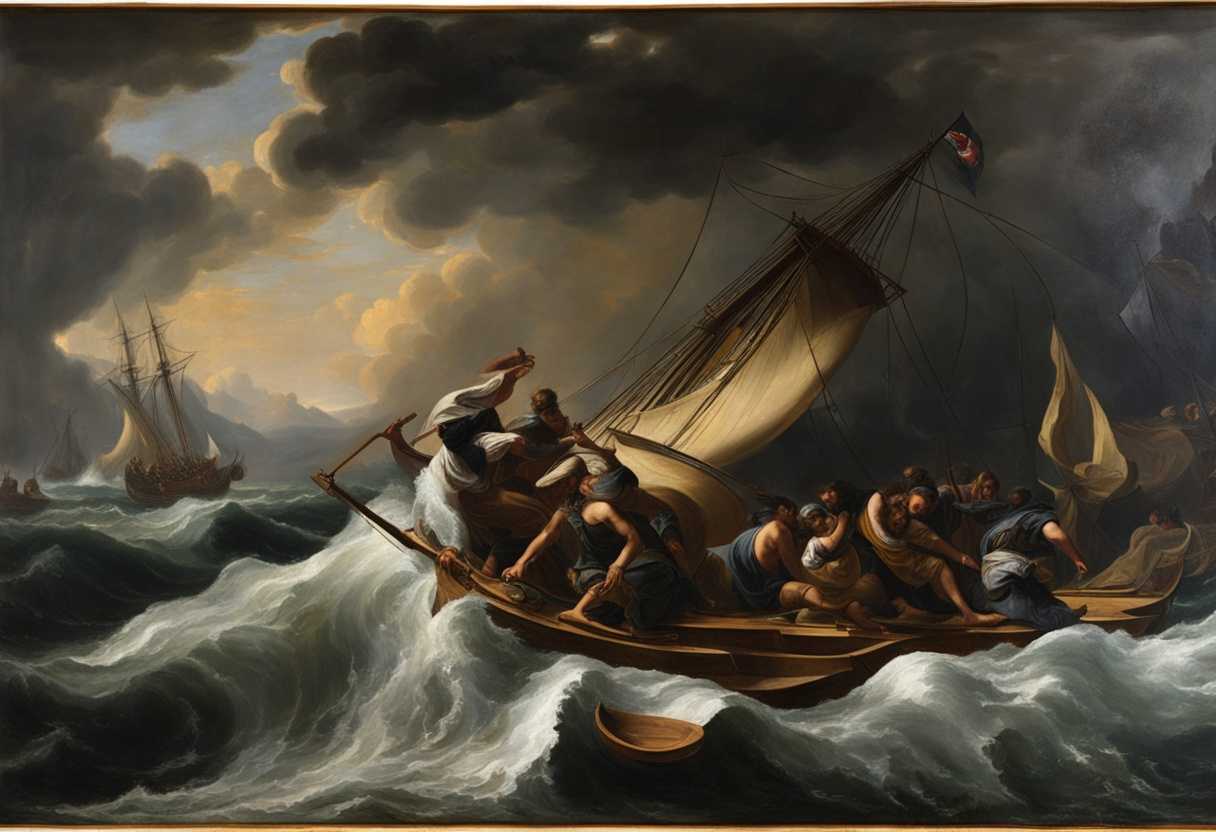
Setting the Scene for Jonah 1:1-2:10
The scene opens with Jonah, a prophet of God, standing on the shores of Joppa, a bustling port city. The sun is setting, casting a warm glow over the horizon as ships bob gently in the harbor. Jonah has just received a divine command from God to go to the great city of Nineveh and preach against its wickedness. However, Jonah, feeling overwhelmed by the task and perhaps harboring some resentment towards the people of Nineveh, decides to flee in the opposite direction, boarding a ship bound for Tarshish.
As the ship sets sail, a fierce storm suddenly descends upon them, with waves crashing against the vessel and threatening to break it apart. The sailors, terrified for their lives, begin to pray to their various gods for salvation. Meanwhile, Jonah, realizing that the storm is a result of his disobedience, confesses to the crew that he is the cause of their troubles and tells them to throw him overboard to calm the sea. Reluctantly, the sailors comply, tossing Jonah into the raging waters where he is swallowed by a great fish.
Inside the belly of the fish, Jonah cries out to God in repentance, acknowledging his wrongdoing and pleading for deliverance. After three days and nights, the fish spits Jonah out onto dry land, and he finally heeds God’s command to go to Nineveh. The miraculous survival of Jonah in the belly of the fish serves as a powerful testament to God’s mercy and the importance of obedience to His will.
What is Jonah 1:1-2:10 about?
This verse from the Book of Jonah highlights the consequences of disobedience and the power of repentance. Jonah’s decision to disobey God’s instructions led him to face a perilous situation, being swallowed by a great fish. This serves as a powerful metaphor for the consequences that can arise from not following God’s will. However, through this experience, Jonah learns the importance of repentance and humility. When he repents and seeks forgiveness, he is given a second chance to fulfill his mission of preaching to the people of Nineveh.
This verse serves as a reminder of the transformative power of repentance and the importance of following God’s will. It demonstrates that even in our moments of disobedience and despair, there is always an opportunity for redemption and forgiveness. Through Jonah’s story, we are encouraged to reflect on our own actions, seek forgiveness for our shortcomings, and embrace the second chances that God graciously offers. It challenges us to consider how we respond to challenges and setbacks in our own lives, and reminds us of the boundless grace and compassion that God embodies.
Understanding what Jonah 1:1-2:10 really means
The Book of Jonah, nestled among the minor prophets, stands out for its unique narrative style and profound lessons. In Jonah 1:1-2:10, we delve into the story of Jonah, a prophet who receives a divine calling to go to Nineveh, a great city, and preach against it. This divine calling highlights the importance of listening to God’s voice and following His instructions, even when they lead us out of our comfort zones. Jonah’s initial reaction of fleeing to Tarshish reflects a common human tendency to avoid challenging tasks and responsibilities, showcasing the struggle between obedience and personal desires.
As Jonah embarks on his escape, God sends a great wind on the sea, demonstrating His control over nature and His ways of capturing our attention. The sailors’ fear and subsequent actions in the face of the storm mirror humanity’s universal search for divine intervention during times of crisis. Through the casting of lots to find the cause of the storm and Jonah’s confession, we witness the ancient practice of discerning God’s will and the importance of taking responsibility for our actions.
The sailors’ reluctance to throw Jonah overboard and the calming of the sea after his sacrifice raise questions about compassion, moral dilemmas, and themes of redemption. Jonah’s subsequent encounter with a huge fish, provided by the Lord, prompts reflection on God’s provision and the concept of divine intervention in our lives. In Jonah’s prayer from inside the fish (Jonah 2:1-10), we see themes of repentance, thanksgiving, and deliverance woven together, emphasizing the power of prayer, God’s responsiveness, and the central message that salvation comes from the Lord.
Related biblical passages such as Psalm 139:7-10, Matthew 12:40, and Romans 10:13 further illuminate the themes of God’s omnipresence, salvation, and mercy found in the story of Jonah. The relevance of Jonah’s narrative to modern readers lies in its timeless lessons on obedience, repentance, and trusting in God’s mercy. By sharing anecdotes of individuals who faced difficult callings but found peace and purpose in following God’s will, we can draw parallels to our own lives and struggles.
In conclusion, Jonah 1:1-2:10 teaches us about the importance of heeding God’s call, the power of prayer in times of distress, and the ultimate source of salvation in the Lord. As we reflect on these lessons, may we be inspired to respond to God’s calling, seek His mercy in repentance, and trust unwaveringly in His saving grace.
How do we respond when God calls us?
When God calls us, it is important for us to listen and obey. Just like Jonah in the Bible, who initially tried to run away from God’s call, we may also struggle or resist following God’s direction at times. However, through Jonah’s story, we learn that God’s plans cannot be thwarted and that ultimately, our best course of action is to submit to His will.
God’s call on our lives may sometimes lead us outside of our comfort zones or require sacrifices on our part. Jonah had to face the consequences of his disobedience, but even then, God showed His mercy and grace towards him. Therefore, when we respond to God’s call with obedience and humility, we can trust that He will guide and provide for us every step of the way, despite any challenges or uncertainties we may face.
Application
Don’t run away from your calling like Jonah did. Just as Jonah faced storms when he tried to evade his duty, we too encounter chaos when we resist what we are meant to do. Reflect on how you respond to your own calling. Will you embrace the unknown, stepping into it with faith in the divine plan? Let’s learn from Jonah’s experience and ask ourselves: What action does God want me to take today?

Reverend Michael Johnson is an experienced Church Minister with a profound expertise in spirituality and guidance. With a serene presence and a compassionate heart, he has faithfully served his congregation for over 20 years, leading them on a spiritual journey towards inner peace and enlightenment. Reverend Johnson’s extensive knowledge of religious philosophies and profound understanding of human nature have made him a trusted confidant and mentor to many, as he seamlessly weaves his profound wisdom into life teachings. Reverend Johnson’s calming demeanor and empathetic nature continue to uplift and heal souls, nurturing a sense of unity and tranquility within his community.