
Luke 20:21-28 is about the religious leaders attempting to trap Jesus by posing a question about paying taxes to Caesar, but Jesus wisely teaches them to give to both God and worldly authorities what is due to each, demonstrating the importance of honoring both earthly and heavenly responsibilities.
21 So they asked him, “Teacher, we know that you speak and teach rightly, and show no partiality, but truly teach the way of God.
22 Is it lawful for us to give tribute to Caesar, or not?”
23 But he perceived their craftiness, and said to them,
24 “Show me a denarius. Whose likeness and inscription does it have?” They said, “Caesar’s.”
25 He said to them, “Then render to Caesar the things that are Caesar’s, and to God the things that are God’s.”
26 So they were unable to catch him in what he said before the people, and marveling at his answer, they became silent.
27 There came to him some Sadducees, those who deny that there is a resurrection,
28 Now there were seven brothers. The first took a wife, and died without children.
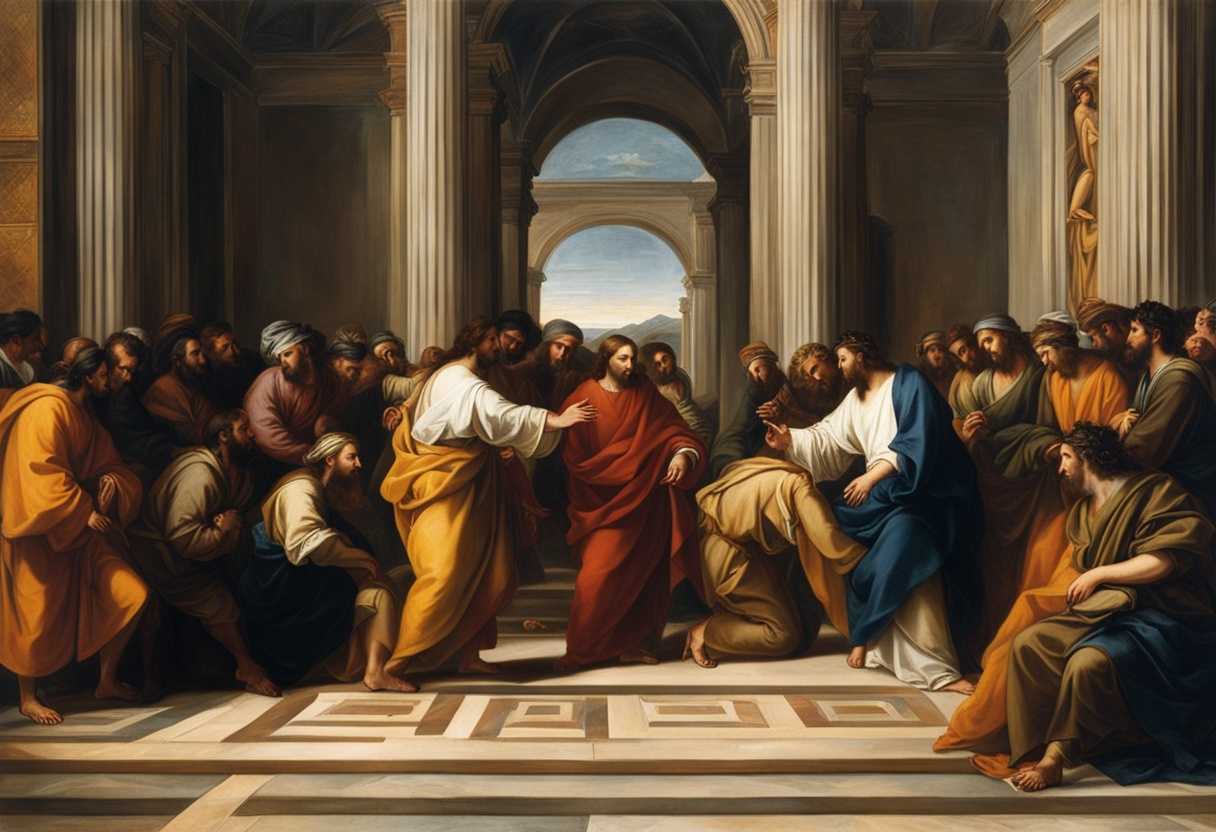
Setting the Scene for Luke 20:21-28
In Luke chapter 20, we find Jesus teaching in the temple in Jerusalem during the final week of his earthly ministry. The religious leaders, including the chief priests, scribes, and elders, are present, seeking to challenge Jesus and undermine his authority. They are determined to trap him with difficult questions in an attempt to discredit him in front of the people.
As Jesus is teaching, a group of Pharisees and Herodians approach him with a question about paying taxes to Caesar. The Pharisees, who were strict observers of Jewish law, despised Roman rule and taxation, while the Herodians supported the Roman-appointed ruler, Herod Antipas. The two groups, usually at odds with each other, come together in an attempt to entrap Jesus with this politically charged question.
The scene is tense as the Pharisees and Herodians stand before Jesus, their motives veiled behind false flattery. The temple courtyard is bustling with activity as people gather to listen to the exchange between Jesus and the religious leaders. Jesus, aware of their malice, responds with wisdom and insight, navigating the delicate political and religious landscape with grace and truth.
What is Luke 20:21-28 about?
This verse from the Bible, attributed to Jesus, is a powerful lesson on the importance of honoring our earthly obligations while also staying committed to our spiritual duties. Jesus is encouraging his followers in this teaching to understand the concept of dual allegiance – recognizing the authority of both secular institutions and divine authority.
Think about it this way – when we fulfill our responsibilities as members of society such as paying taxes or following laws (‘giving to Caesar’), we are contributing to the well-being of our community. At the same time, when we fulfill our spiritual obligations such as prayer, worship, and living in accordance with our values (‘giving to God’), we are nourishing our soul and strengthening our relationship with the divine. Jesus is reminding us of the importance of balance in our lives by emphasizing the idea of giving to both Caesar and to God. We are called to navigate the demands of the material world while also staying grounded in our faith and connection to something greater. This verse challenges us to reflect on how we honor our earthly obligations while remaining true to our spiritual beliefs.
Understanding what Luke 20:21-28 really means
In the narrative of Luke 20:21-28, we witness a moment where the religious leaders attempt to entrap Jesus with a cunning question about paying taxes to Caesar. This inquiry is not merely a query about financial obligations but a strategic move to test Jesus’ stance on Roman authority and potentially alienate Him from the Jewish people. The leaders’ acknowledgment of Jesus’ integrity and impartiality in their address to Him sets the stage for a challenging dilemma: “Is it right for us to pay taxes to Caesar or not?” This question aims to corner Jesus into a position where He must either endorse Roman rule or incite rebellion, a precarious situation designed to discredit Him.
In response, Jesus astutely asks for a denarius, a Roman coin, and prompts the questioners to identify whose image and inscription adorn it. Through this simple yet profound act, Jesus draws attention to the dual nature of human existence – the obligation to fulfill civic duties while also honoring spiritual allegiances. His directive, “Give back to Caesar what is Caesar’s, and to God what is God’s,” encapsulates a timeless principle that delineates the boundaries between earthly responsibilities and divine devotion. This statement underscores the importance of maintaining a delicate balance between our civic obligations and our spiritual commitments.
The passage resonates with contemporary audiences grappling with similar dilemmas of reconciling faith with citizenship in a complex societal landscape. It serves as a poignant reminder of the need for integrity and wisdom in navigating the intricate intersections of social, political, and religious spheres. Drawing parallels to other biblical passages such as Romans 13:1-7, Matthew 22:37-40, and 1 Peter 2:13-17, we find a consistent theme of respecting authority while upholding the primacy of love for God and neighbor.
Consider a scenario where a Christian business owner wrestles with the moral implications of paying taxes that may support causes contrary to their beliefs. The guidance from this passage illuminates the distinction between fulfilling civic duties as a responsible citizen and maintaining unwavering allegiance to God in all actions. Similarly, reflecting on personal anecdotes, like a friend’s struggle with voting in an election lacking ideal candidates, reveals how applying the principles of giving to Caesar what is Caesar’s and to God what is God’s can provide clarity and peace amidst moral quandaries.
In conclusion, Luke 20:21-28 beckons believers to navigate the complexities of societal roles with discernment and faithfulness. It underscores the compatibility of fulfilling civic responsibilities while upholding spiritual integrity, assuring us that our actions in the earthly realm need not compromise our devotion to God. By internalizing and applying the wisdom encapsulated in this passage, we can navigate the tensions between earthly authorities and divine sovereignty with grace and conviction, embodying a harmonious blend of civic duty and spiritual allegiance.
Is loyalty to God greater than allegiance to men?
Jesus is questioned about whether it is lawful to pay taxes to Caesar or not in this passage. Jesus responds by asking whose image and inscription are on the coin used for the tax. Jesus indicates that the coin belongs to Caesar by emphasizing that it bears Caesar’s image, so it is appropriate to give to Caesar what is Caesar’s. However, Jesus also makes it clear that one’s ultimate allegiance should always be to God.
This passage teaches us that while we have obligations to earthly authorities, such as paying taxes, our loyalty and ultimate allegiance should always be directed towards God. We are reminded of the higher spiritual values and principles that should guide our actions and decisions in this world by recognizing and prioritizing our relationship with God. This means that when there is a conflict between following the laws of men and obeying the commandments of God, loyalty to God must take precedence. Our faithfulness to God should ultimately inform and shape all aspects of our lives, including our interaction with human authorities.
Application
Imagine juggling your career and family duties, striving to balance both perfectly. Just like this, Jesus challenges us to respect earthly rules while staying true to our faith. As believers, we’re tasked to follow the laws of our land without compromising our core Christian values. Look at your daily actions and choices—are you aligning them with both civic duties and spiritual integrity? How will you honor both the world’s expectations and God’s commands in your everyday life?

Reverend Michael Johnson is an experienced Church Minister with a profound expertise in spirituality and guidance. With a serene presence and a compassionate heart, he has faithfully served his congregation for over 20 years, leading them on a spiritual journey towards inner peace and enlightenment. Reverend Johnson’s extensive knowledge of religious philosophies and profound understanding of human nature have made him a trusted confidant and mentor to many, as he seamlessly weaves his profound wisdom into life teachings. Reverend Johnson’s calming demeanor and empathetic nature continue to uplift and heal souls, nurturing a sense of unity and tranquility within his community.