
Luke 22:54-62 is about Peter denying Jesus three times, highlighting the struggle between human weakness and faithfulness in times of trial.
54 Then they seized him and led him away, bringing him into the high priest’s house, and Peter was following at a distance.
55 And when they had kindled a fire in the middle of the courtyard and sat down together, Peter sat down among them.
56 Then a servant girl, seeing him as he sat in the light and looking closely at him, said, “This man also was with him.”
57 But he denied it, saying, “Woman, I do not know him.”
58 And a little later someone else saw him and said, “You also are one of them.” But Peter said, “Man, I am not.”
59 And after an interval of about an hour still another insisted, saying, “Certainly this man also was with him, for he too is a Galilean.”
60 But Peter said, “Man, I do not know what you are talking about.” And immediately, while he was still speaking, the rooster crowed.
61 And the Lord turned and looked at Peter. And Peter remembered the saying of the Lord, how he had said to him, “Before the rooster crows today, you will deny me three times.”
62 And he went out and wept bitterly.
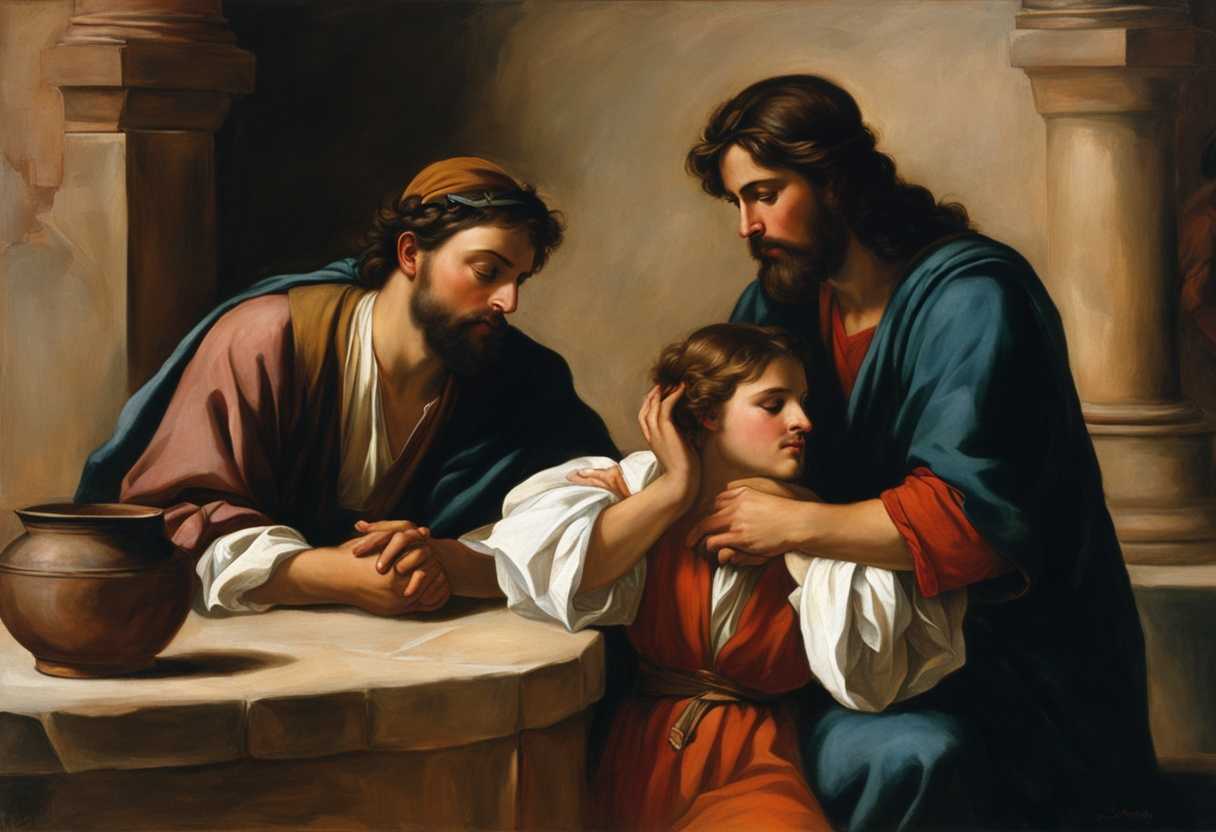
Setting the Scene for Luke 22:54-62
The scene in Luke 22:54-62 takes place in the Garden of Gethsemane, a peaceful olive grove located at the foot of the Mount of Olives, just outside Jerusalem. Jesus, accompanied by his disciples Peter, James, and John, had gone to the garden to pray following the Last Supper. The atmosphere is heavy with anticipation and sorrow as Jesus knows the events that are about to unfold.
As Jesus fervently prays, his disciples struggle to stay awake, overcome by exhaustion and the weight of the moment. Suddenly, a group of soldiers and officials, led by Judas Iscariot, arrives to arrest Jesus. Peter, impulsive and fiercely loyal, draws his sword and cuts off the ear of one of the high priest’s servants in an attempt to defend Jesus. However, Jesus rebukes Peter, reminding him that this is all part of God’s plan.
In the midst of the chaos, Jesus is taken into custody, and Peter, overwhelmed by fear and confusion, denies knowing Jesus three times, just as Jesus had predicted. The scene is filled with tension, betrayal, and the realization that the events leading to Jesus’ crucifixion are now set in motion.
What is Luke 22:54-62 about?
Can you imagine the depth of emotions Peter must have felt in that moment, denying his beloved teacher and friend three times? This verse reminds us of the fallibility of human nature and the struggles we face in times of fear and uncertainty. Despite Peter’s denial, this event serves as a powerful reminder of the importance of humility, repentance, and forgiveness. I see this verse as a valuable lesson in recognizing our own weaknesses and imperfections as a teacher. It prompts us to reflect on our actions and consider how we can learn and grow from our mistakes. Just like Peter, we may stumble and fall, but it is through acknowledging our faults that we can seek redemption and reconciliation. The redemption found in acknowledging our shortcomings and striving to do better is a powerful message that resonates throughout this verse.
Understanding what Luke 22:54-62 really means
In Luke 22:54-62, we witness a poignant moment in Peter’s journey with Jesus. As Jesus is arrested, Peter, filled with fear and uncertainty, follows at a distance, eventually finding himself in the courtyard of the high priest. It is here that Peter’s denial of Jesus unfolds, echoing the prophecy Jesus had made about Peter’s actions.
The phrase “followed at a distance” encapsulates Peter’s inner turmoil – torn between his loyalty to Jesus and his fear of being associated with Him in His time of trial. This inner conflict leads Peter to deny knowing Jesus, a stark contrast to his earlier declarations of unwavering support. The crowing of the rooster serves as a haunting reminder of Jesus’ prediction and Peter’s failure, symbolizing the painful realization of his own weakness and betrayal.
In the midst of Peter’s denial, a profound moment occurs when “the Lord turned and looked at Peter.” This gaze carries a weight of unspoken emotions – understanding, sorrow, and perhaps even forgiveness. It is a moment of deep connection between teacher and disciple, transcending words and conveying a message of love and grace.
This passage resonates with us today on various levels. It reminds us of the human tendency towards weakness and fear, prompting us to reflect on moments where we may have compromised our values out of self-preservation. Yet, Peter’s story also offers hope and redemption. Just as Jesus reinstated Peter in John 21:15-17, we are reminded that failure is not the end of the road; there is always a path to redemption and restoration.
Romans 3:23 reinforces the universality of human failure, emphasizing the need for grace and forgiveness. Like Peter, we all fall short at times, but it is through acknowledging our shortcomings, seeking forgiveness, and realigning ourselves with our faith that we find renewal and purpose.
Consider a scenario where a devout Christian professional, faced with opposition to their faith in a secular workplace, chooses to remain silent or compromise their beliefs to avoid conflict. The ensuing guilt and sense of betrayal mirror Peter’s experience. Yet, through seeking forgiveness and reaffirming their faith, they discover a path to peace and renewed conviction, understanding that moments of weakness do not define their journey.
In conclusion, Peter’s denial and subsequent redemption serve as a poignant reminder of our shared humanity. We are all susceptible to moments of weakness, but through Jesus’ example, we find that forgiveness and restoration are always within reach. This passage calls us to confront our failures, seek reconciliation, and strive to live in alignment with our faith and values, knowing that grace abounds even in our moments of deepest frailty.
Do we deny Jesus in times of fear?
There are times when, in moments of fear or pressure, we may deny our faith or distance ourselves from Jesus, just as Peter did. When faced with challenges or threats, it can be tempting to prioritize our own safety and self-preservation over our beliefs or relationship with Christ. Peter’s denial serves as a reminder for us to be vigilant in our faith, especially in times of trial.
However, despite Peter’s denial, Jesus showed him grace and forgiveness. This offers hope for all of us who may have faltered in our faith during times of fear or uncertainty. It is a reminder that, even in our moments of weakness, Jesus remains faithful to us and is always ready to welcome us back with open arms. This encourages us to turn to Jesus in times of struggle, seeking strength and courage from Him to stand firm in our faith, even when faced with difficult circumstances.
Application
Think about those moments when work pressures, family obligations, or personal challenges test your resolve. Just as Peter faltered and denied knowing Jesus, it’s easy to waver when life gets tough. Yet, it’s in these trying times that staying true to your faith matters most. Can you find the strength to trust and hold steady, even when everything around you seems uncertain? Will you take a stand and commit to your beliefs, no matter what? How will you show your faithfulness today?

Reverend Michael Johnson is an experienced Church Minister with a profound expertise in spirituality and guidance. With a serene presence and a compassionate heart, he has faithfully served his congregation for over 20 years, leading them on a spiritual journey towards inner peace and enlightenment. Reverend Johnson’s extensive knowledge of religious philosophies and profound understanding of human nature have made him a trusted confidant and mentor to many, as he seamlessly weaves his profound wisdom into life teachings. Reverend Johnson’s calming demeanor and empathetic nature continue to uplift and heal souls, nurturing a sense of unity and tranquility within his community.