
Luke 23:6-12 is about Pontius Pilate’s attempt to avoid responsibility for Jesus’ fate by sending him to Herod, demonstrating the unfairness and political maneuvering that ultimately led to Jesus’ crucifixion.
6 When Pilate heard this, he asked whether the man was a Galilean.
7 And when he learned that he belonged to Herod’s jurisdiction, he sent him over to Herod, who was himself in Jerusalem at that time.
8 When Herod saw Jesus, he was very glad, for he had long desired to see him, because he had heard about him, and he was hoping to see some sign done by him.
9 Then he questioned him with many words, but he made no answer.
10 The chief priests and the scribes stood by, vehemently accusing him.
11 And Herod with his soldiers treated him with contempt and mocked him. Then, arraying him in splendid clothing, he sent him back to Pilate.
12 And Herod and Pilate became friends with each other that very day, for before this they had been at enmity with each other.
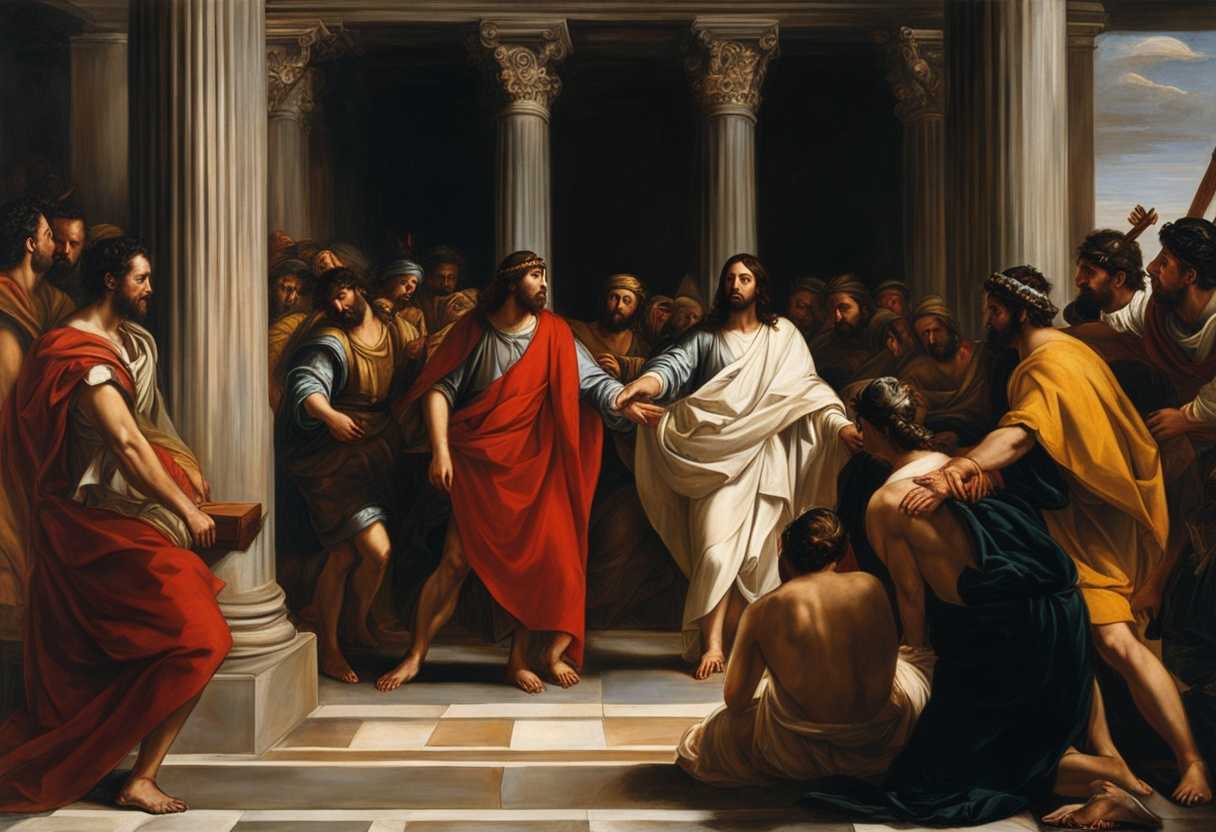
Setting the Scene for Luke 23:6-12
In Luke chapter 23, we find a dramatic scene unfolding in Jerusalem during the time of Jesus’ trial before Pontius Pilate. The Roman governor is faced with a difficult decision as the chief priests and scribes bring Jesus before him, accusing Him of perverting the nation, forbidding the payment of taxes to Caesar, and claiming to be the Christ, a king.
Pilate, a powerful and conflicted figure, finds himself caught between the demands of the Jewish leaders and his own sense of justice. Meanwhile, Jesus stands before him, calm and composed, embodying a sense of divine authority that unnerves Pilate. The atmosphere is tense, with the crowd outside the governor’s palace growing restless and agitated.
As Pilate questions Jesus and tries to discern the truth of the accusations against Him, the chief priests and scribes continue to press for His condemnation. The scene is charged with political intrigue, religious fervor, and the clash of earthly power with the kingdom of God. In this pivotal moment, the fate of Jesus hangs in the balance, setting the stage for the ultimate sacrifice that will fulfill the divine plan of redemption.
What is Luke 23:6-12 about?
We see a significant moment in Jesus’ journey to the crucifixion in this verse. Herod, known for his cruelty and lack of belief in Jesus’ divinity, treats Jesus with contempt during His trial. Despite being mocked and ridiculed, Jesus remains steadfast in His mission and purpose, showcasing unwavering faith and strength in the face of adversity.
The unlikely friendship that forms between Herod and Pilate emphasizes the political complexities and alliances at play during this pivotal moment in history. It raises questions about power dynamics, personal relationships, and the ways in which people can be swayed to compromise their beliefs for the sake of convenience or social standing. Challenges and temptations that can arise when our faith is tested remind us of the importance of staying true to our beliefs even in the face of opposition as we reflect on this verse. It serves as a powerful lesson in remaining steadfast and unwavering in our convictions, even when those around us may mock or deride us.
Understanding what Luke 23:6-12 really means
In Luke 23:6-12, we witness a pivotal moment in Jesus’ trial where He is passed between Pilate and Herod, reflecting the political and social complexities of the time. Pilate’s inquiry into Jesus’ Galilean origin reveals his attempt to evade responsibility, showcasing the political maneuvering prevalent in the situation. This shifting of blame highlights the lack of true justice and the reluctance to make a decisive judgment. As Jesus is sent to Herod upon Pilate’s discovery of his jurisdiction, we see a stark illustration of the division and collaboration between different authorities, emphasizing the fragmented nature of power structures.
Herod’s eagerness to see Jesus, not out of genuine faith but mere curiosity, underscores the superficial interest in Jesus prevalent among those in positions of authority. The subsequent contempt and mockery displayed by Herod and his soldiers towards Jesus serve as a poignant reminder of the humiliation and suffering the Messiah endured, fulfilling prophecies about His sacrificial mission. The newfound friendship between Herod and Pilate, former adversaries united against Jesus, symbolizes the unity of worldly powers in opposition to the divine purpose, showcasing how Jesus’ presence can bring together even those who were once at odds.
Drawing parallels to relevant biblical passages such as Isaiah 53:3 and Psalm 2:2, we see the alignment of Jesus’ suffering with prophetic scriptures and the collaboration of earthly rulers against the Lord’s Anointed. The internal conflict within Pilate, as depicted in Matthew 27:19, further emphasizes the recognition of Jesus’ innocence amidst the political turmoil. These themes of injustice, suffering, and the misuse of power resonate with contemporary issues, urging us to stand firm for truth and justice in a world marred by similar struggles.
The passage serves as a poignant reminder for us today to move beyond superficial curiosity about faith and to cultivate a deeper, more committed relationship with Jesus. It challenges us to reflect on our own actions and attitudes towards justice, truth, and integrity, prompting us to emulate Jesus’ unwavering commitment to righteousness. Just as Jesus faced trials and tribulations with faith and integrity, we are called to draw strength and inspiration from His example in navigating our own challenges with courage and conviction.
In a modern-day context, envision a whistleblower exposing corruption within a corporation, only to be passed around and eventually discredited by those in power. This scenario mirrors Jesus’ treatment, illustrating the timeless struggle for justice and integrity amidst societal structures that often prioritize self-interest over righteousness. By internalizing the lessons from Jesus’ trial, we are encouraged to confront injustices, uphold truth, and deepen our faith with unwavering resolve, echoing His enduring legacy of love and redemption.
How can we resist the influence of peer pressure?
One way to resist the influence of peer pressure is by staying true to our beliefs and values, even when those around us are encouraging us to compromise them. We too may encounter situations where we are urged to conform to the expectations of others, just as Jesus faced pressure from both the religious leaders and the crowd to act in a certain way that went against his principles. We can resist the sway of peer pressure and remain authentic to ourselves by holding firm to what we know is right and honoring our core beliefs.
Another way to resist peer pressure is by seeking guidance and strength through prayer and reflection. Like how Jesus remained steadfast in his mission and sought solace in prayer despite the mounting pressure around him, we too can turn to prayer for support and guidance when faced with challenging situations. We can find the courage and resolve to withstand the influences of those trying to sway us in the wrong direction by grounding ourselves in faith and connecting with our spirituality. By cultivating a strong sense of self-awareness and understanding our values and beliefs, we can ultimately fortify ourselves against peer pressure. We too can stay true to ourselves by knowing who we are and what we stand for, just as Jesus remained unwavering in his convictions despite the demands of the crowd. We can resist the influence of peer pressure and stand firm in our principles by being true to ourselves and seeking strength through our faith.
Application
In a world where challenges are plenty and distractions are constant, let the example of Jesus’ unwavering determination remind you to stand firm in your beliefs. Like Him facing mockery and mistreatment, hold true to your values even when faced with pressure. Just as Jesus stayed committed to His purpose, stay steadfast in spreading love and grace in your daily interactions. The question now is, how will you choose to stand firm in your faith today?

Reverend Michael Johnson is an experienced Church Minister with a profound expertise in spirituality and guidance. With a serene presence and a compassionate heart, he has faithfully served his congregation for over 20 years, leading them on a spiritual journey towards inner peace and enlightenment. Reverend Johnson’s extensive knowledge of religious philosophies and profound understanding of human nature have made him a trusted confidant and mentor to many, as he seamlessly weaves his profound wisdom into life teachings. Reverend Johnson’s calming demeanor and empathetic nature continue to uplift and heal souls, nurturing a sense of unity and tranquility within his community.