
Luke 23:8 is about King Herod’s fascination with Jesus and his desire to see Him perform a miracle, showcasing the tension between worldly power and divine authority.
8 When Herod saw Jesus, he was very glad, for he had long desired to see him, because he had heard about him, and he was hoping to see some sign done by him.
Setting the Scene for Luke 23:8
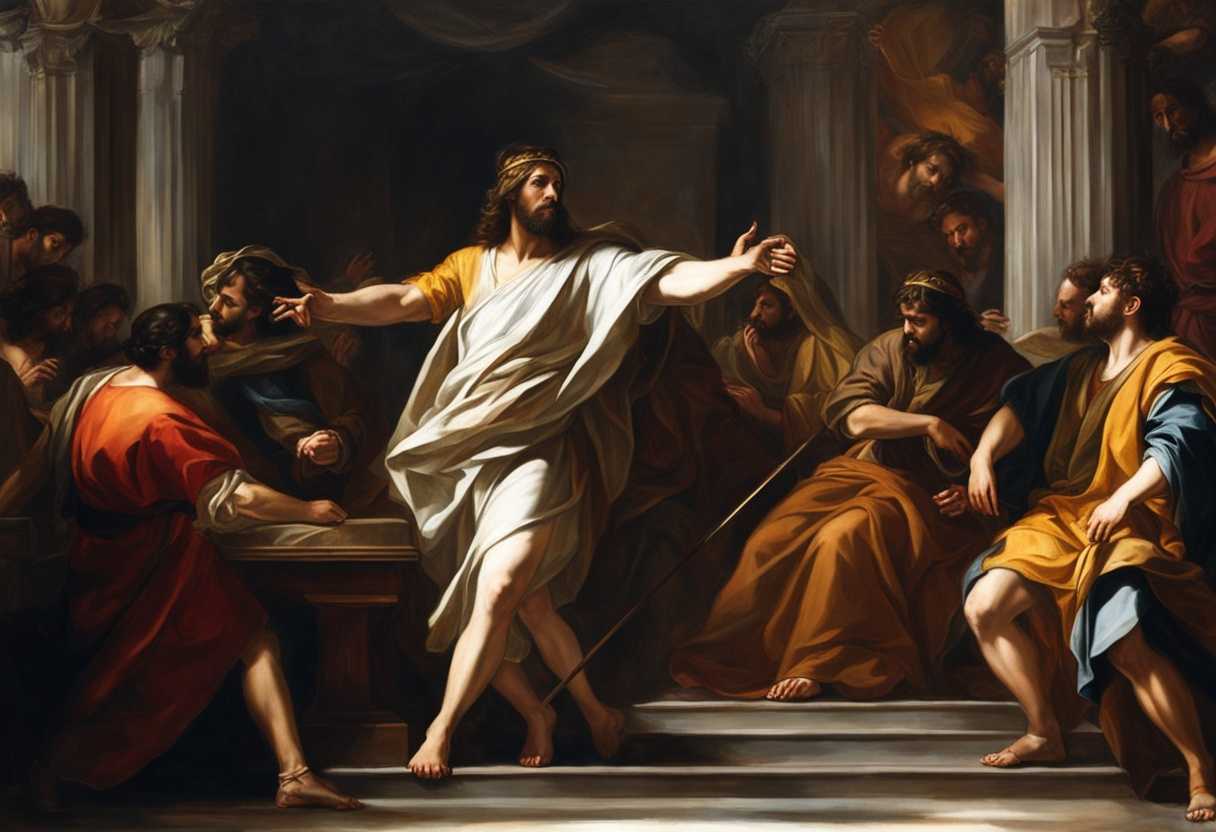
In Luke chapter 23, we find a pivotal scene where Jesus is brought before Herod Antipas, the ruler of Galilee. The setting is a grand and opulent palace, befitting a ruler of Herod’s stature. The room is adorned with luxurious furnishings, intricate tapestries, and servants bustling about attending to their duties. The air is heavy with the scent of incense, adding to the sense of grandeur and formality.
Herod Antipas, known for his extravagant lifestyle and political cunning, is seated on a lavish throne, surrounded by his courtiers and advisors. The atmosphere is tense as Jesus, the accused, is brought before Herod by the chief priests and scribes. The contrast between the humility of Jesus and the ostentation of Herod’s court is stark, underscoring the themes of power and righteousness that permeate the scene.
As the interrogation unfolds, Herod questions Jesus, hoping to witness a miracle or hear a profound teaching. However, Jesus remains silent, refusing to engage in Herod’s political games. The scene is charged with anticipation and intrigue, as onlookers wait to see how this confrontation between earthly power and divine authority will unfold.
What is Luke 23:8 about?
Herod’s superficial interest in Jesus is witnessed in this verse. Herod is not genuinely seeking to understand Jesus or his teachings, but instead, he hopes to be entertained by witnessing a miracle. Despite holding immense power and influence, Herod’s focus is solely on spectacle and personal gratification rather than spiritual enlightenment or a genuine desire to connect with Jesus.
This verse serves as a reminder to us about the importance of sincerity and humility in our approach to matters of faith. It prompts us to reflect on our intentions when seeking spiritual guidance or encountering religious figures – are we seeking superficial entertainment or genuine connection and understanding? By examining Herod’s motives, we encourage ourselves to reevaluate our own attitudes towards faith and ensure that our interactions with religious teachings are driven by a sincere desire for growth and enlightenment rather than mere curiosity for miracles and wonders.
Understanding what Luke 23:8 really means
In the narrative of Jesus’ trial before Herod Antipas, the ruler of Galilee, we encounter a fascinating moment where Herod’s curiosity about Jesus takes center stage. Herod, having heard about Jesus and intrigued by the rumors surrounding Him, eagerly seizes the opportunity to see this renowned figure in person, perhaps hoping for a spectacle or a miraculous display to entertain him.
As the verse states, “Herod saw Jesus, he was greatly pleased.” However, the pleasure Herod derives from seeing Jesus is not rooted in genuine faith or reverence. Instead, it stems from a shallow curiosity and a desire for entertainment. This distinction is crucial in understanding Herod’s motives and sets the stage for a deeper reflection on the nature of our own curiosity about Jesus and Christianity.
The phrase “He had been wanting to see him for a long time” hints at Herod’s prolonged interest in Jesus. This interest, however, is more about satisfying his curiosity and witnessing something extraordinary rather than seeking spiritual truth or understanding. It serves as a cautionary tale about the dangers of approaching matters of faith with a superficial mindset, devoid of genuine seeking and sincerity.
Herod’s knowledge of Jesus, “from what he had heard about him,” underscores the second-hand nature of his understanding. Relying on hearsay and rumors, Herod’s perception of Jesus is clouded by external influences rather than personal experience or a genuine quest for knowledge. This raises important questions for us today about the sources of our beliefs and the authenticity of our faith.
In a world where curiosity about Jesus and Christianity abounds, often fueled by media, cultural portrayals, or societal expectations, we are challenged to examine our own motives. Are we genuinely seeking Jesus out of a desire for truth and a deeper relationship with Him, or are we merely curious, seeking personal gain or entertainment in our exploration of faith?
Consider the parallel of a person who attends church sporadically, drawn by curiosity or tradition rather than a heartfelt faith. This individual may enjoy the rituals, the sense of community, or the music without fully engaging with the teachings of Jesus or committing to a genuine relationship with Him. Reflecting on this scenario prompts us to evaluate the depth of our own commitment and the sincerity of our pursuit of spiritual truth.
As we ponder Herod’s encounter with Jesus, let us be inspired to seek Him with authenticity and a sincere heart. May this verse serve as a reminder to move beyond mere curiosity or superficial interest, striving instead for a profound understanding of Christ and a meaningful relationship with Him. Let us embark on a journey of faith that transcends entertainment and spectacle, leading us to a transformative encounter with the living God.
What does it mean to seek the kingdom of God?
Seeking the kingdom of God refers to prioritizing God’s will and His rule in our lives above all else. It entails centering our lives on God’s teachings, His righteousness, and His ways. This means pursuing a deep relationship with God, aligning our actions with His values, and actively participating in spreading His message of love, grace, and salvation to others.
When we seek the kingdom of God, we acknowledge His sovereignty and authority over us. This involves surrendering our own desires and ambitions to God’s plan for us and trusting in His provision and guidance. We demonstrate our faith and commitment to living in accordance with His divine principles and purposes by seeking the kingdom of God first and foremost, ultimately leading to a life that is filled with blessings, fulfillment, and eternal significance.
Application
Embrace the wisdom found in Luke 23:8 and ponder Pilate’s reaction to King Herod. Let it be a mirror to the complexities of the world we face today. As you walk your path, remember your unwavering faith is a compass guiding you through. How will you stay true to your beliefs in a world that challenges them?

Reverend Michael Johnson is an experienced Church Minister with a profound expertise in spirituality and guidance. With a serene presence and a compassionate heart, he has faithfully served his congregation for over 20 years, leading them on a spiritual journey towards inner peace and enlightenment. Reverend Johnson’s extensive knowledge of religious philosophies and profound understanding of human nature have made him a trusted confidant and mentor to many, as he seamlessly weaves his profound wisdom into life teachings. Reverend Johnson’s calming demeanor and empathetic nature continue to uplift and heal souls, nurturing a sense of unity and tranquility within his community.