
Mark 14:43-50 is about Jesus’ betrayal by Judas Iscariot, fulfilling the Scriptures, and demonstrating Jesus’ submission to God’s will even in the face of his imminent arrest and crucifixion.
43 And immediately, while he was still speaking, Judas came, one of the twelve, and with him a crowd with swords and clubs, from the chief priests and the scribes and the elders.
44 Now the betrayer had given them a sign, saying, “The one I will kiss is the man. Seize him and lead him away under guard.”
45 And when he came, he went up to him at once and said, “Rabbi!” And he kissed him.
46 And they laid hands on him and seized him.
47 But one of those who stood by drew his sword and struck the servant of the high priest and cut off his ear.
48 And Jesus said to them, “Have you come out as against a robber, with swords and clubs to capture me?
49 Day after day I was with you in the temple teaching, and you did not seize me. But let the Scriptures be fulfilled.
50 And they all left him and fled.
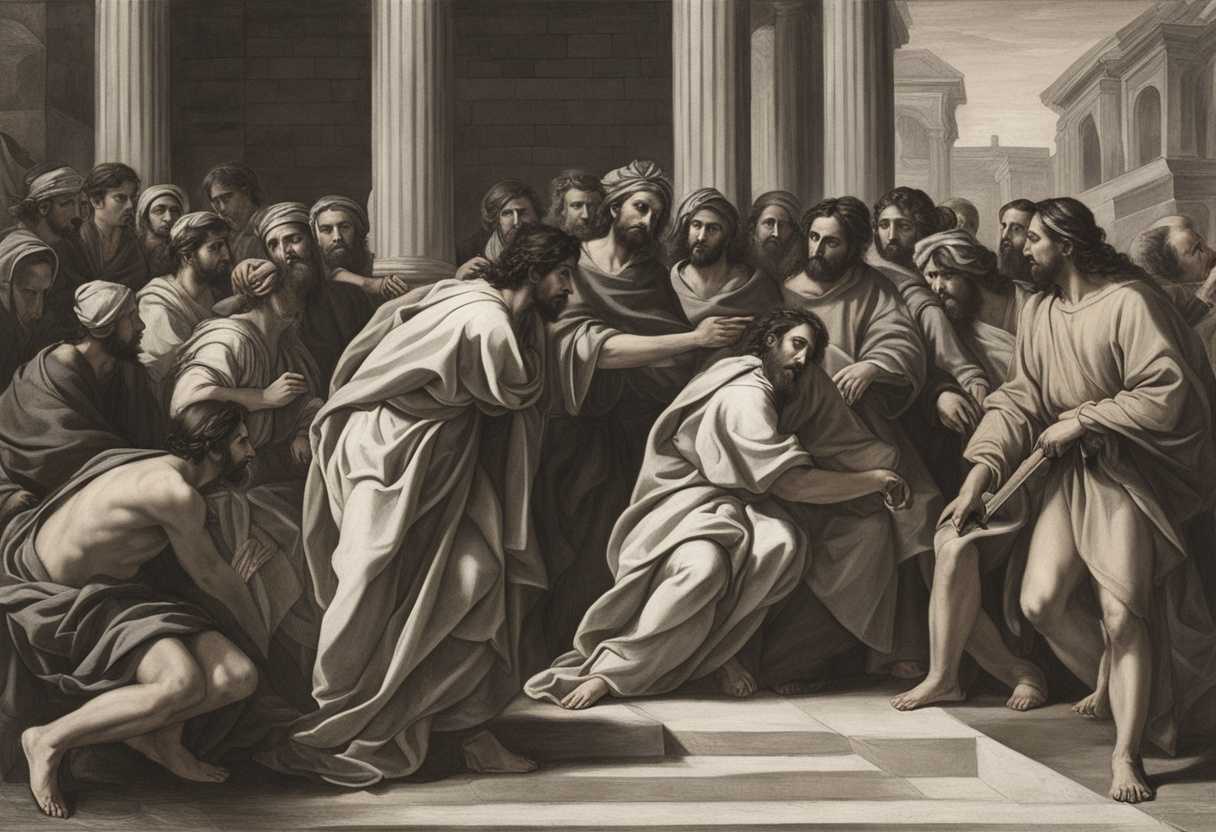
Setting the Scene for Mark 14:43-50
The scene in Mark chapter 14:43-50 takes place in the Garden of Gethsemane, a peaceful olive grove located at the foot of the Mount of Olives, just outside Jerusalem. Jesus, along with his disciples Peter, James, and John, had come to the garden to pray after sharing the Last Supper. The night was dark, with a cool breeze rustling through the trees, creating a somber and reflective atmosphere.
As Jesus was praying, Judas Iscariot, one of his disciples, arrived with a crowd armed with swords and clubs, sent by the religious leaders to arrest Jesus. Judas approached Jesus and betrayed him with a kiss, signaling to the soldiers who Jesus was. The disciples, caught off guard and filled with fear, reacted by drawing their swords, but Jesus urged them to stop and willingly surrendered himself to be taken into custody.
The tension and emotion in the garden were palpable as Jesus faced the betrayal of one of his own and the impending events that would lead to his crucifixion. The flickering torches carried by the soldiers cast eerie shadows among the ancient olive trees, underscoring the gravity of the moment as Jesus submitted to the fulfillment of his divine purpose.
What is Mark 14:43-50 about?
This verse speaks to a pivotal moment in the life of Jesus, where one of his closest companions, Judas Iscariot, betrays him by leading a group of soldiers to arrest him in the Garden of Gethsemane. This act of betrayal carries deep emotional weight, as Jesus had shared intimate moments and important teachings with Judas, only to have him turn against him in a moment of weakness and greed.
Have you ever experienced betrayal or hurt from someone you trusted deeply? How did it make you feel? Imagine the pain and disappointment Jesus must have felt in that moment, knowing that he was being handed over by someone he considered a friend. Despite this betrayal, Jesus showed grace and strength by willingly surrendering himself to fulfill his divine purpose and sacrifice for the salvation of humanity. This verse reminds us of the complexities of human relationships and the importance of forgiveness, even in the face of betrayal, as we reflect on it. It also serves as a reminder of the ultimate sacrifice Jesus made out of love for us, even when faced with betrayal and injustice. Let this verse inspire us to examine our own actions and relationships, and strive to embody the qualities of grace, forgiveness, and love that Jesus exemplified in the face of adversity.
Understanding what Mark 14:43-50 really means
In the poignant narrative of Mark 14:43-50, we witness the heart-wrenching moment of Jesus’ arrest in the Garden of Gethsemane. The scene unfolds with Judas Iscariot, one of Jesus’ trusted twelve disciples, betraying Him with a kiss. This act of betrayal, marked by a gesture of affection turned treacherous, underscores the depth of the betrayal Jesus faced. The arresting party, armed with swords and clubs, sent by the religious authorities, paints a picture of hostility and perceived threat towards Jesus.
The phrase “Judas, one of the Twelve” resonates with profound significance, highlighting the weight of betrayal coming from within Jesus’ inner circle. It serves as a stark reminder of how even those closest to us can falter. The image of a crowd armed with weapons conveys the intensity of the situation, emphasizing the perceived danger Jesus posed to the religious establishment. The betrayal with a kiss adds a layer of emotional complexity, as a symbol of love and loyalty is twisted into an instrument of deceit.
As we delve into related biblical passages, we find echoes of betrayal and abandonment reverberating through the scriptures. Psalm 41:9’s prophetic words foreshadow Judas’ betrayal, underscoring the timeless nature of human frailty. In John 13:21-30, Jesus’ foreknowledge of His betrayal during the Last Supper sheds light on the divine orchestration of events leading to His arrest. Matthew 26:56’s account of the disciples deserting Jesus further emphasizes the theme of abandonment in the face of adversity.
The relevance of this passage to contemporary audiences is striking. Betrayal and trust are universal themes that resonate deeply with individuals who have experienced similar betrayals in their lives. The disciples’ fear and subsequent desertion of Jesus serve as a poignant reminder of human frailty, urging us to seek courage and faith in times of trial. Despite the darkness of betrayal and abandonment, this event is a testament to God’s redemptive plan, offering hope that even in our darkest moments, God can bring about good.
Consider a scenario where a trusted friend suddenly turns against you, akin to Jesus’ experience with Judas. This narrative may evoke personal stories of betrayal and the subsequent journey towards forgiveness and healing. For instance, someone may recount a tale of a business partner’s betrayal leading to unforeseen challenges, yet ultimately paving the way for new opportunities and a deeper reliance on faith.
In conclusion, Mark 14:43-50 serves as a poignant reminder of the complexities of human relationships, the frailty of trust, and the enduring power of faith in the face of betrayal. It prompts us to reflect on our own experiences of betrayal and abandonment, urging us to find solace in the greater narrative of redemption and God’s unwavering plan for salvation.
How can we remain loyal to Jesus in adversity?
Remaining loyal to Jesus in adversity involves staying committed to following His teachings and example, even when faced with challenges and temptations. We can remain loyal in times of difficulty by remembering the faithfulness and love that Jesus showed throughout His own trials. We can stay grounded in our loyalty to Him by trusting in His guidance and seeking strength through prayer and reflection on His word.
It is also important to surround ourselves with a community of fellow believers who can support and encourage us in our faith journey. We can strengthen our resolve and find comfort in knowing we are not alone in facing adversities by staying connected to others who share our commitment to Jesus. Additionally, staying focused on the ultimate goal of living a life that honors and glorifies Him can help us navigate through challenges with a steadfast and unwavering loyalty. We can remain faithful in times of trial and adversity by fixing our eyes on Jesus and allowing His love to guide us.
Application
Dear reader, just like Jesus faced betrayal and challenges, we too encounter trials in our daily lives. Let this passage be a wake-up call for us to remain strong in our beliefs, even when faced with difficulties. Will you stand tall and hold onto your faith, just as Jesus did in the darkest of moments?

Reverend Michael Johnson is an experienced Church Minister with a profound expertise in spirituality and guidance. With a serene presence and a compassionate heart, he has faithfully served his congregation for over 20 years, leading them on a spiritual journey towards inner peace and enlightenment. Reverend Johnson’s extensive knowledge of religious philosophies and profound understanding of human nature have made him a trusted confidant and mentor to many, as he seamlessly weaves his profound wisdom into life teachings. Reverend Johnson’s calming demeanor and empathetic nature continue to uplift and heal souls, nurturing a sense of unity and tranquility within his community.