
Mark 6:1-29 is about Jesus returning to his hometown, being rejected by the people who knew him, and ultimately sending out his disciples to continue his ministry, facing challenges and even hostility along the way.
1 He went away from there and came to his hometown, and his disciples followed him.
2 And on the Sabbath he began to teach in the synagogue, and many who heard him were astonished, saying, “Where did this man get these things? What is the wisdom given to him? How are such mighty works done by his hands?
3 Is not this the carpenter, the son of Mary and brother of James and Joses and Judas and Simon? And are not his sisters here with us?” And they took offense at him.
4 And Jesus said to them, “A prophet is not without honor, except in his hometown and among his relatives and in his own household.”
5 And he could do no mighty work there, except that he laid his hands on a few sick people and healed them.
6 And he marveled because of their unbelief. And he went about among the villages teaching.
7 And he called the twelve and began to send them out two by two, and gave them authority over the unclean spirits.
8 He charged them to take nothing for their journey except a staff—no bread, no bag, no money in their belts—
9 but to wear sandals and not put on two tunics.
10 And he said to them, “Wherever you enter a house, stay there until you depart from there.
11 And if any place will not receive you and they will not listen to you, when you leave, shake off the dust that is on your feet as a testimony against them.”
12 So they went out and proclaimed that people should repent.
13 And they cast out many demons and anointed with oil many who were sick and healed them.
14 King Herod heard of it, for Jesus’ name had become known. Some said, “John the Baptist has been raised from the dead. That is why these miraculous powers are at work in him.”
15 But others said, “He is Elijah.” And others said, “He is a prophet, like one of the prophets of old.”
16 But when Herod heard of it, he said, “John, whom I beheaded, has been raised.”
17 For it was Herod who had sent and seized John and bound him in prison for the sake of Herodias, his brother Philip’s wife, because he had married her.
18 For John had been saying to Herod, “It is not lawful for you to have your brother’s wife.”
19 And Herodias had a grudge against him and wanted to put him to death. But she could not,
20 for Herod feared John, knowing that he was a righteous and holy man, and he kept him safe. When he heard him, he was greatly perplexed, and yet he heard him gladly.
21 But an opportunity came when Herod on his birthday gave a banquet for his nobles and military commanders and the leading men of Galilee.
22 For when Herodias’s daughter came in and danced, she pleased Herod and his guests. And the king said to the girl, “Ask me for whatever you wish, and I will give it to you.”
23 And he vowed to her, “Whatever you ask me, I will give you, up to half of my kingdom.”
24 And she went out and said to her mother, “For what should I ask?” And she said, “The head of John the Baptist.”
25 And she came in immediately with haste to the king and asked, saying, “I want you to give me at once the head of John the Baptist on a platter.”
26 And the king was exceedingly sorry, but because of his oaths and his guests he did not want to break his word to her.
27 And immediately the king sent an executioner with orders to bring John’s head. He went and beheaded him in the prison
28 brought his head on a platter and gave it to the girl, and the girl gave it to her mother.
29 When his disciples heard of it, they came and took his body and laid it in a tomb.
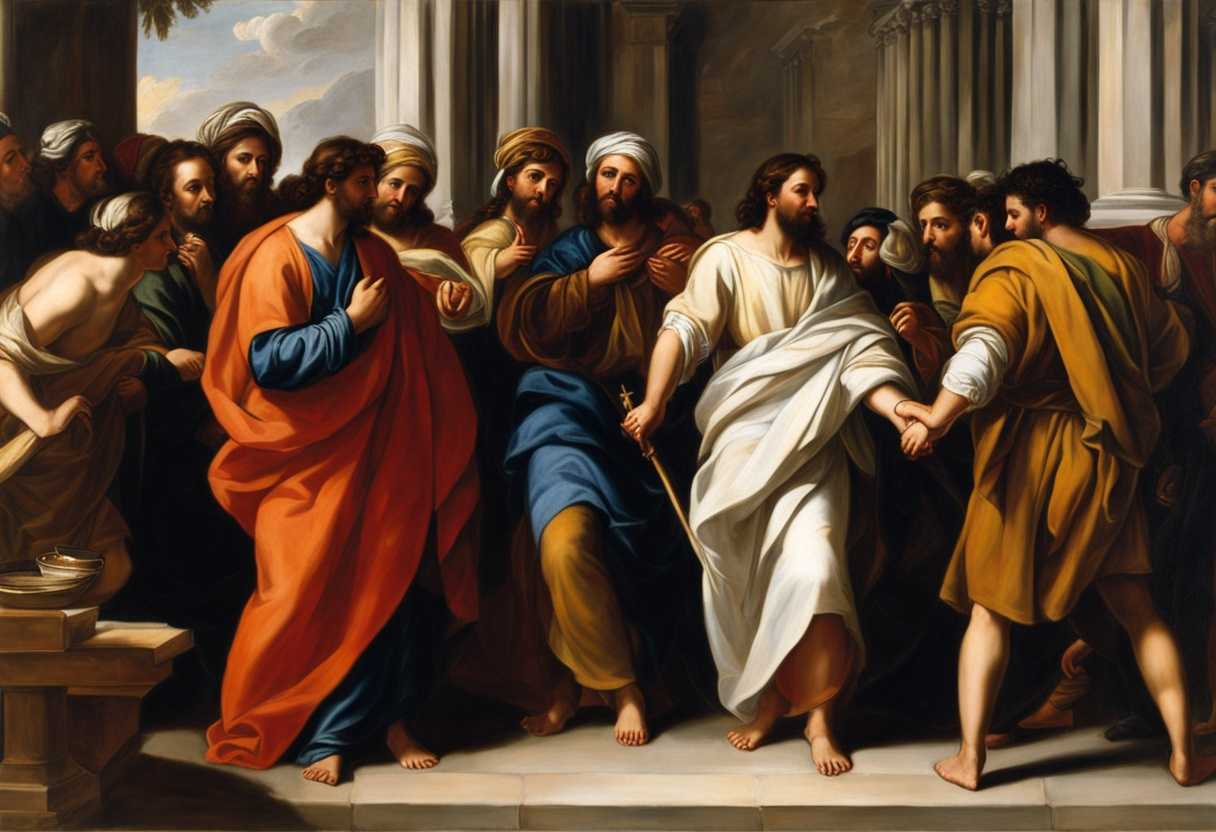
Setting the Scene for Mark 6:1-29
In Mark chapter 6, the scene opens in the town of Nazareth, where Jesus returns to teach in the synagogue. The crowd gathered there includes familiar faces from Jesus’ hometown – friends, family, and neighbors who have known him since childhood. They are astonished by his wisdom and the miracles he performs, but their familiarity with him as the son of a carpenter clouds their ability to fully accept his divine authority.
As Jesus continues to teach, the skepticism and disbelief of the people in Nazareth grow. They question how someone they know so well could possess such wisdom and power. Jesus, aware of their lack of faith, remarks that “Prophets are not without honor, except in their hometown, and among their own kin, and in their own house.” The lack of faith in Nazareth prevents Jesus from performing many miracles there.
The scene then shifts to the story of John the Baptist’s imprisonment and subsequent execution by King Herod. Herod’s birthday celebration leads to a series of events that culminate in John’s beheading. The contrast between the disbelief in Nazareth and the tragic consequences of Herod’s actions serves as a powerful reminder of the importance of faith and the consequences of rejecting God’s messengers.
What is Mark 6:1-29 about?
When reading this passage, it’s important to reflect on the rejection faced by Jesus in his hometown of Nazareth. Have you ever felt like your closest ones didn’t understand or appreciate your true worth? Jesus faced rejection from those who should have known him best in a similar way. This rejection serves as a reminder that sometimes the greatest challenges come from familiar places. It prompts us to consider how we respond to rejection, and whether we let it define us or propel us towards greater purpose.
The death of John the Baptist also holds significant meaning in this passage. John was a powerful and influential figure, yet his life ended tragically at the hands of those who opposed him. This event serves as a stark reminder of the sacrifices made by those who stand up for their beliefs and values. It challenges us to consider the cost of our own convictions and the courage required to uphold them, even in the face of danger. Reflecting on this passage can lead us to examine our own commitment to our beliefs and the willingness to face adversity for the sake of truth and justice.
Understanding what Mark 6:1-29 really means
In Mark 6:1-29, we delve into pivotal moments in Jesus’ ministry, unveiling profound truths about faith, rejection, mission, and the sacrifices demanded by discipleship. The passage opens with Jesus facing rejection in Nazareth, where familiarity breeds contempt, echoing the struggles of prophets like Jeremiah and Ezekiel who were spurned by their own people. “A prophet is not without honor except in his own town” (Mark 6:4) serves as a poignant reminder that even those closest to us may fail to recognize our divine calling.
Jesus’ astonishment at the lack of faith in Nazareth (“He was amazed at their lack of faith” – Mark 6:6) underscores the indispensable role of faith in experiencing God’s power. This sentiment resonates with Hebrews 11:6, emphasizing that faith is the gateway to pleasing God. When Jesus instructs His disciples to “Take nothing for the journey except a staff” (Mark 6:8), He underscores the importance of relying on God’s provision and the hospitality of others, fostering trust and dependence on the Almighty, akin to the Israelites’ faith during the Exodus.
The passage also sheds light on the far-reaching impact of Jesus’ ministry, as seen in King Herod’s apprehension upon hearing of Jesus’ fame (“King Herod heard about this, for Jesus’ name had become well known” – Mark 6:14). This mirrors Acts 4:13, where the Sanhedrin is astonished by the boldness of Peter and John, showcasing the transformative power of Jesus’ name. Today, many face rejection for their faith, akin to the young woman enduring ridicule for her Christian beliefs in a secular setting, finding solace in Jesus’ own experience of rejection.
Moreover, the timeless call to mission and reliance on God’s provision challenges believers in a self-sufficient world to trust in divine guidance. The narrative of a missionary couple abandoning comfort to serve in a remote area, solely reliant on God’s provision, inspires a deeper trust in God among their peers. The sobering account of John the Baptist’s martyrdom serves as a poignant reminder of the sacrifices demanded by discipleship, urging believers to reflect on the depth of their commitment.
In conclusion, Mark 6:1-29 serves as a profound exploration of faith, rejection, mission, and the cost of discipleship. It beckons believers to stand firm in their faith, lean on God’s provision, and brace themselves for the challenges inherent in following Christ. Just as Jesus faced rejection and challenges, this passage reminds us that our faith journey may entail similar trials, yet through unwavering commitment and trust in God, we can navigate the complexities of discipleship with grace and resilience.
What obstacles prevent us from fully accessing God’s power?
One obstacle that can prevent us from fully accessing God’s power is doubt. When we doubt God’s ability to work in our lives or the lives of others, we limit our faith and hinder the flow of His power. Doubt can come from various sources such as past disappointments, societal influences, or personal insecurities. But when we hold onto doubt, we create a barrier that blocks the full manifestation of God’s power.
Another obstacle is pride. When we rely too much on our own strength, wisdom, or resources, we can easily miss out on experiencing the supernatural power of God. Pride can blind us to our need for God and prevent us from humbly seeking His help and guidance. It is only when we surrender our pride and acknowledge our dependence on God that we can fully access His power in our lives.
Lastly, fear can also hinder us from fully accessing God’s power. When we allow fear to dominate our hearts and minds, we can become paralyzed and unable to step out in faith. Fear of failure, rejection, or the unknown can hold us back from stepping into the abundant life that God has planned for us. However, when we trust in God’s promises and step out in faith despite our fears, we open the door for His power to work mightily in and through us.
Application
Open your heart like a blank canvas at work, ready to be painted with fresh ideas. Don’t let past perceptions of your family close your mind to the teachings of Christ; let them guide you to new possibilities. Will you choose to tune in to His teachings and let them shape your journey?

Reverend Michael Johnson is an experienced Church Minister with a profound expertise in spirituality and guidance. With a serene presence and a compassionate heart, he has faithfully served his congregation for over 20 years, leading them on a spiritual journey towards inner peace and enlightenment. Reverend Johnson’s extensive knowledge of religious philosophies and profound understanding of human nature have made him a trusted confidant and mentor to many, as he seamlessly weaves his profound wisdom into life teachings. Reverend Johnson’s calming demeanor and empathetic nature continue to uplift and heal souls, nurturing a sense of unity and tranquility within his community.