
Mark 6:14-29 is about the consequences of staying true to one’s beliefs and morals, even in the face of opposition and persecution, as seen through the martyrdom of John the Baptist for speaking out against King Herod’s unlawful actions.
14 King Herod heard of it, for Jesus’ name had become known. Some said, “John the Baptist has been raised from the dead. That is why these miraculous powers are at work in him.”
15 But others said, “He is Elijah.” And others said, “He is a prophet, like one of the prophets of old.”
16 But when Herod heard of it, he said, “John, whom I beheaded, has been raised.”
17 For it was Herod who had sent and seized John and bound him in prison for the sake of Herodias, his brother Philip’s wife, because he had married her.
18 For John had been saying to Herod, “It is not lawful for you to have your brother’s wife.”
19 And Herodias had a grudge against him and wanted to put him to death. But she could not,
20 for Herod feared John, knowing that he was a righteous and holy man, and he kept him safe. When he heard him, he was greatly perplexed, and yet he heard him gladly.
21 But an opportunity came when Herod on his birthday gave a banquet for his nobles and military commanders and the leading men of Galilee.
22 For when Herodias’s daughter came in and danced, she pleased Herod and his guests. And the king said to the girl, “Ask me for whatever you wish, and I will give it to you.”
23 And he vowed to her, “Whatever you ask me, I will give you, up to half of my kingdom.”
24 And she went out and said to her mother, “For what should I ask?” And she said, “The head of John the Baptist.”
25 And she came in immediately with haste to the king and asked, saying, “I want you to give me at once the head of John the Baptist on a platter.”
26 And the king was exceedingly sorry, but because of his oaths and his guests he did not want to break his word to her.
27 And immediately the king sent an executioner with orders to bring John’s head. He went and beheaded him in the prison
28 brought his head on a platter and gave it to the girl, and the girl gave it to her mother.
29 When his disciples heard of it, they came and took his body and laid it in a tomb.
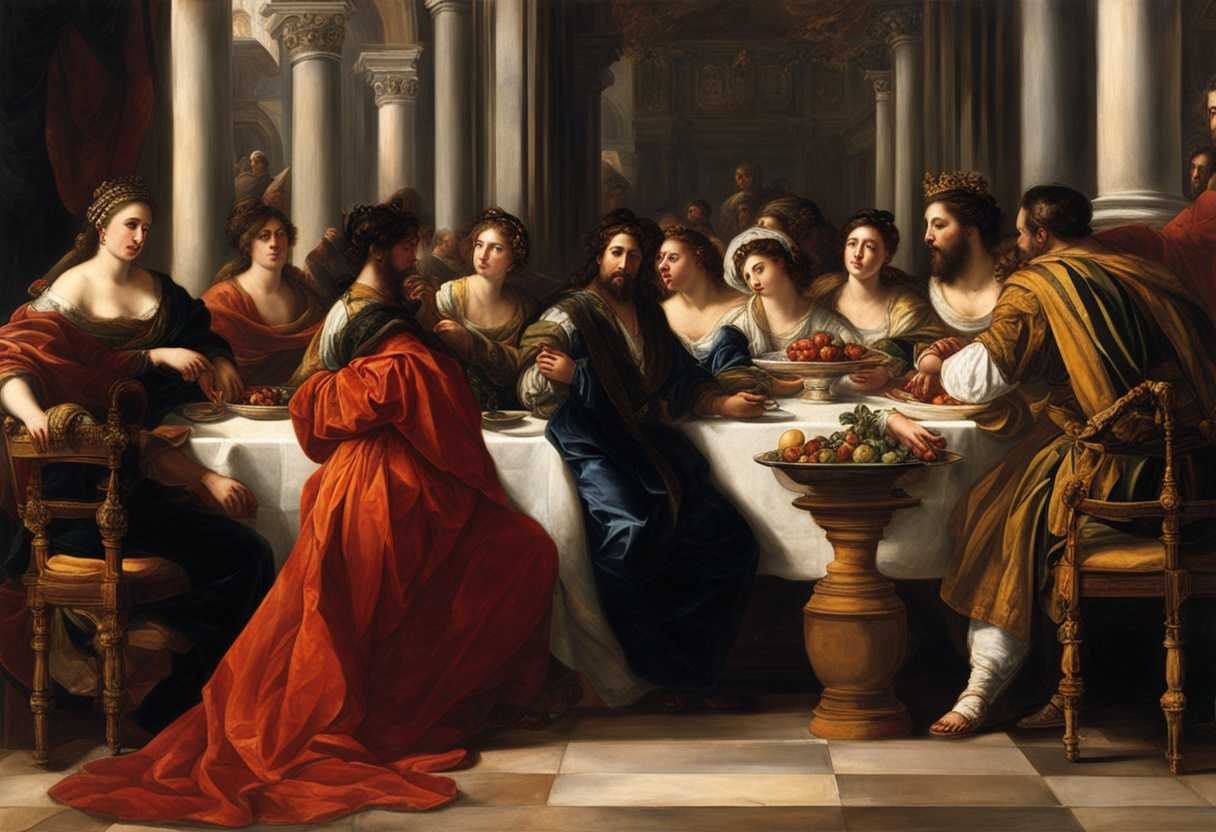
Setting the Scene for Mark 6:14-29
The scene in Mark chapter 6:14-29 takes place in the palace of King Herod Antipas. King Herod had thrown a lavish banquet in honor of his birthday, inviting his nobles, military commanders, and the leading men of Galilee. The opulent palace was filled with guests enjoying the festivities, feasting on sumptuous food and drinking wine.
Among the guests was Herodias, the wife of Herod’s brother Philip, whom Herod had unlawfully married. Herodias’ daughter, Salome, danced for the guests, captivating Herod with her performance. In a moment of drunken revelry and foolishness, Herod made a rash promise to Salome, offering her anything she desired, up to half his kingdom.
Prompted by her mother, Salome asked for the head of John the Baptist, a prophet who had been imprisoned by Herod at the behest of Herodias. Despite his reluctance, Herod felt bound by his oath and ordered the execution of John the Baptist. The scene is one of intrigue, betrayal, and tragic consequences, illustrating the consequences of giving in to worldly desires and the importance of standing firm in one’s faith.
What is Mark 6:14-29 about?
Ah, the tragic tale of John the Baptist, a prophet who fearlessly spoke the truth even to those in power. This passage serves as a sobering reminder of the consequences that can arise when individuals are unwilling to accept criticism or challenge to their authority. Despite John’s unwavering commitment to his beliefs and his dedication to sharing the message of repentance, he ultimately met a brutal end at the hands of a king who was unable to handle the uncomfortable truths being presented to him. We reflect on this passage and are prompted to consider the importance of speaking truth to power, even in the face of potential backlash. It compels us to examine our own willingness to stand up for what is right and just, regardless of the consequences. How do we react when faced with adversity or opposition to our beliefs? Are we willing to follow in the footsteps of John the Baptist, remaining steadfast in our convictions even in the face of great danger? This passage challenges us to reflect on our own moral courage and to consider the cost of remaining silent in the face of injustice.
Understanding what Mark 6:14-29 really means
The passage in Mark 6:14-29 recounts the tragic tale of John the Baptist’s beheading by King Herod. John had criticized Herod’s marriage to Herodias, his brother’s wife, leading to his imprisonment. Herodias, nursing a grudge against John, orchestrated his demise. At a banquet, Herodias’s daughter’s dance pleased Herod, who promised her any wish. Influenced by her mother, she requested John’s head on a platter, a gruesome demand that Herod reluctantly fulfilled.
One key phrase, “John, whom I beheaded, has been raised from the dead,” reveals Herod’s guilt and fear. He believed Jesus was John resurrected, showcasing his troubled conscience. Another phrase, “Herodias had a grudge against John and wanted to kill him,” underscores the destructive nature of holding grudges and the lengths to which people will go to seek vengeance. Additionally, “The king was greatly distressed, but because of his oaths and his dinner guests, he did not want to refuse her,” highlights the internal conflict Herod faced between his conscience and his desire to maintain his reputation.
Related biblical passages like Matthew 14:1-12 and Luke 9:7-9 provide additional insights into Herod’s fear and the influence of Herodias. Proverbs 29:25 warns against the snare of fearing man over trusting in the Lord, emphasizing the danger of prioritizing human approval over divine principles. Today, the story of John the Baptist’s beheading serves as a poignant reminder of the repercussions of moral compromise and the perils of holding onto grudges.
In contemporary society, individuals often encounter dilemmas where they must choose between upholding their values or yielding to societal pressures. This passage encourages prioritizing integrity and moral courage, urging individuals to stand firm in their convictions even amidst adversity. For instance, envision an employee witnessing unethical behavior at work. Despite potential repercussions like job loss or social isolation, inspired by John the Baptist’s story, the employee decides to report the misconduct, valuing integrity over personal gain or approval.
In conclusion, the narrative of John the Baptist’s tragic end imparts timeless lessons on moral integrity, the dangers of harboring grudges, and the consequences of compromising values for the sake of reputation or fear. It prompts introspection among readers, challenging them to contemplate how they can uphold their convictions in challenging circumstances.
How can we stay true to our spiritual values?
Staying true to our spiritual values involves following the example set by John the Baptist in the verse. John stood up for his beliefs and principles even when faced with difficult circumstances and opposition. Similarly, we can stay true to our spiritual values by having the courage to speak out against injustice, uphold moral integrity, and stay committed to our faith even in the face of challenges.
Furthermore, staying true to our spiritual values requires us to prioritize our relationship with God above all else. We can stay true to our spiritual values by maintaining a deep connection with our faith through prayer, reflection, and seeking guidance from Scripture, just as John remained steadfast in his devotion to God. We can navigate life’s complexities with integrity and authenticity by keeping our focus on God and aligning our actions with our spiritual beliefs. Having a strong foundation in our faith is essential in a world where external pressures and temptations may lead us astray from our spiritual values. We can stay true to our spiritual values in all aspects of our lives and continue to grow in our relationship with God by grounding ourselves in the teachings and principles that guide us.
Application
Think about how every email you send or decision you make shapes your family’s future. Like John the Baptist, speak your truth boldly, even when it’s tough. Stand firm in your beliefs, just as you’d stand up for your loved ones. Your integrity can inspire others and bring positive change. Will you be the one to lead with courage, even when the road gets rough?

Reverend Michael Johnson is an experienced Church Minister with a profound expertise in spirituality and guidance. With a serene presence and a compassionate heart, he has faithfully served his congregation for over 20 years, leading them on a spiritual journey towards inner peace and enlightenment. Reverend Johnson’s extensive knowledge of religious philosophies and profound understanding of human nature have made him a trusted confidant and mentor to many, as he seamlessly weaves his profound wisdom into life teachings. Reverend Johnson’s calming demeanor and empathetic nature continue to uplift and heal souls, nurturing a sense of unity and tranquility within his community.