
Mark 9:33-35 is about Jesus teaching his disciples the lesson that true greatness comes from serving others selflessly and with humility.
33 And they came to Capernaum. And when he was in the house he asked them, “What were you discussing on the way?”
34 But they kept silent, for on the way they had argued with one another about who was the greatest.
35 And he sat down and called the twelve. And he said to them, “If anyone would be first, he must be last of all and servant of all.”
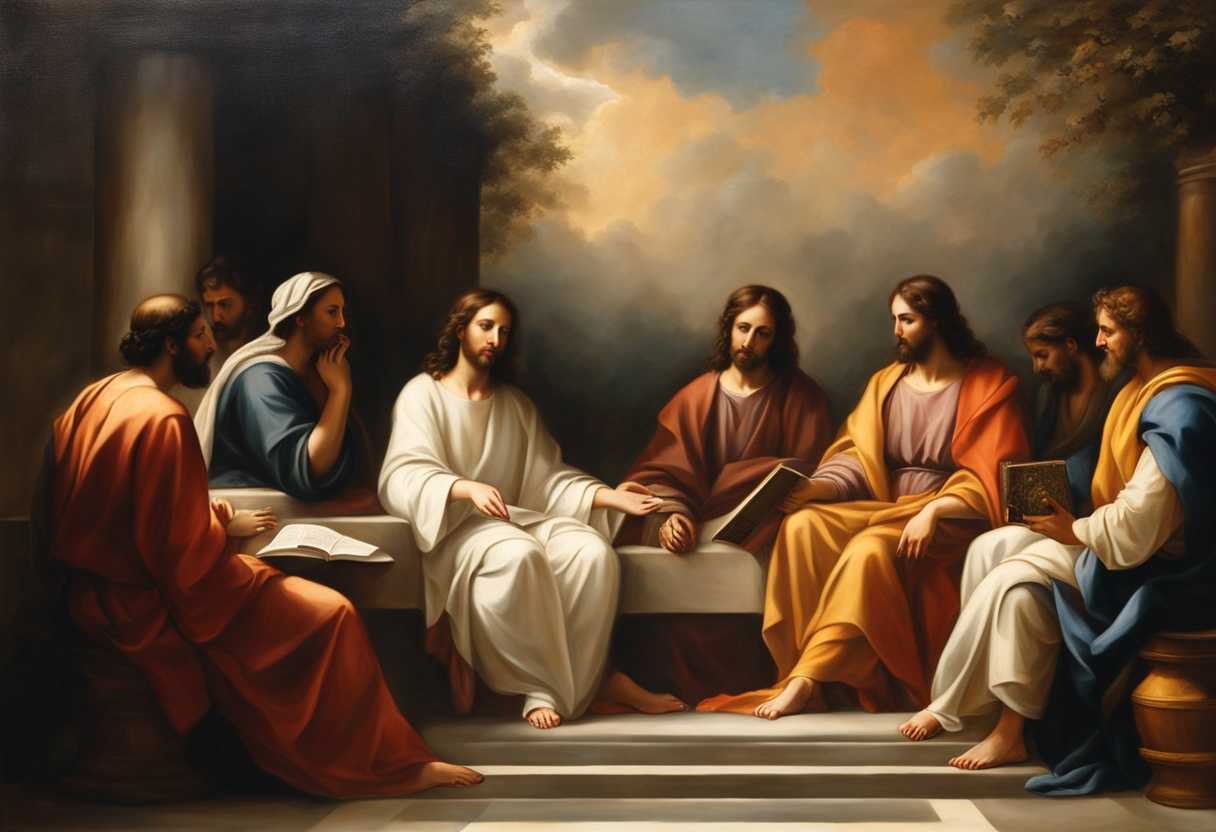
Setting the Scene for Mark 9:33-35
In Mark chapter 9, we find Jesus and his disciples traveling through Galilee. As they journey, Jesus takes the opportunity to teach his disciples about humility and servanthood. The scene unfolds with the disciples walking along the dusty roads, the sun beating down on them as they follow closely behind their beloved teacher.
Among the disciples, there is an air of anticipation and curiosity as they wonder what Jesus will teach them next. As they walk, a discussion arises among them about who among them is the greatest. Sensing their thoughts, Jesus gathers them together and sits down, creating a moment of intimacy and importance. With a gentle smile, he begins to explain that true greatness comes from being a servant to all, using a child as an example of humility and innocence.
The disciples listen intently, their hearts stirred by Jesus’ words. In this simple yet profound moment, Jesus imparts a lesson that challenges their preconceived notions of power and status. The dusty road, the heat of the sun, and the presence of their teacher all combine to create a sacred space where the disciples are invited to reflect on what it truly means to follow Jesus.
What is Mark 9:33-35 about?
This verse embodies a powerful message about leadership and service. It challenges our conventional understanding of greatness and encourages us to prioritize humility and servanthood. Jesus is highlighting that true greatness is not found in status or power, but in one’s ability to serve and uplift others. By embodying the values of compassion and empathy through selflessly serving others, we create a more harmonious and equitable society.
Have you ever reflected on what it means to be a true leader? This verse prompts us to reconsider our definition of greatness and encourages us to lead by example through acts of service and humility. It’s a reminder that our impact on others is not measured by our achievements or accolades, but by our ability to serve and support those around us. We, as educators, must instill these values of humility and servanthood in our students, teaching them that true leadership is not about being at the top but about lifting others up. Let’s aspire to be the greatest by serving all, just as Jesus teaches.
Understanding what Mark 9:33-35 really means
Jesus and His disciples find themselves in Capernaum, a setting where the disciples’ human tendencies come to light as they engage in a heated debate about who among them is the greatest. This moment serves as a backdrop for Jesus to impart a crucial lesson on humility and servanthood, redirecting their focus from worldly notions of greatness to a more profound understanding of leadership.
In Mark 9:33-35, Jesus astutely asks the disciples, “What were you arguing about on the road?” This question not only reveals Jesus’ awareness of their dispute but also serves as an invitation for introspection and honesty. It prompts the disciples to confront the root of their argument and opens the door for a transformative teaching moment.
Jesus then delivers a powerful statement, “Anyone who wants to be first must be the very last, and the servant of all.” This declaration challenges conventional wisdom by redefining greatness in terms of humility and service. In a society where power and status often dictate one’s worth, Jesus’ words turn societal norms upside down, emphasizing the importance of selfless service over self-aggrandizement.
This teaching echoes throughout the Bible, resonating with passages like Matthew 20:26-28, where Jesus exemplifies servanthood by stating His purpose to serve rather than to be served. Similarly, in Philippians 2:3-4, Paul urges believers to prioritize others above themselves, echoing the essence of Jesus’ teaching on humility and selflessness.
The relevance of this message transcends time, challenging contemporary society’s obsession with power, status, and self-promotion. In a world that often glorifies individual achievements, Jesus’ lesson calls us to reassess our definitions of success and leadership. It beckons us to embody humility, prioritize service, and consider the well-being of others above our own ambitions.
To illustrate this principle, imagine a successful CEO who, despite his lofty position, humbly engages in acts of service like mentoring young employees, tidying up after meetings, and attentively listening to his staff’s concerns. His actions exemplify the essence of servant leadership, earning him genuine respect and loyalty from those around him. This anecdote mirrors Jesus’ teaching, demonstrating that true greatness lies not in titles or accolades but in humble service to others.
As we reflect on this passage, let us examine our lives for areas where we may be seeking recognition or status. Let us ponder how we can cultivate a servant’s heart in our daily interactions, whether at work, home, or within our communities. By following Jesus’ example of humility and love, may we strive to serve others selflessly, embodying the essence of true greatness in a world that often values power over service.
How can we humble ourselves to be great leaders?
To humble ourselves as great leaders, we should be willing to serve others selflessly and with compassion. We should seek to understand the needs and concerns of those we lead, putting their well-being above our own desires and ambitions. We can create a positive and supportive environment where everyone can thrive and reach their full potential by approaching leadership with a mindset of service and humility.
Great leaders are those who set aside their pride and ego, acknowledging that their role is not about power or recognition but about making a positive impact on the lives of others. They lead by example, showing kindness, empathy, and respect to everyone they encounter. They earn the trust and loyalty of their team by remaining humble and grounded, inspiring them to work together towards a common goal and fostering a culture of collaboration and success.
Application
Think about how Jesus in Mark 9:33-35 was like a great leader in a big corporation who served everyone, not just the top executives. Are you ready to bring that same attitude into your own life? Whether it’s your work or your family, can you put others first and serve them? Be the change in your world. What if your small acts of service could transform the entire environment around you?

Reverend Michael Johnson is an experienced Church Minister with a profound expertise in spirituality and guidance. With a serene presence and a compassionate heart, he has faithfully served his congregation for over 20 years, leading them on a spiritual journey towards inner peace and enlightenment. Reverend Johnson’s extensive knowledge of religious philosophies and profound understanding of human nature have made him a trusted confidant and mentor to many, as he seamlessly weaves his profound wisdom into life teachings. Reverend Johnson’s calming demeanor and empathetic nature continue to uplift and heal souls, nurturing a sense of unity and tranquility within his community.