
23 But he turned and said to Peter, “Get behind me, Satan! You are a hindrance to me. For you are not setting your mind on the things of God, but on the things of man.”
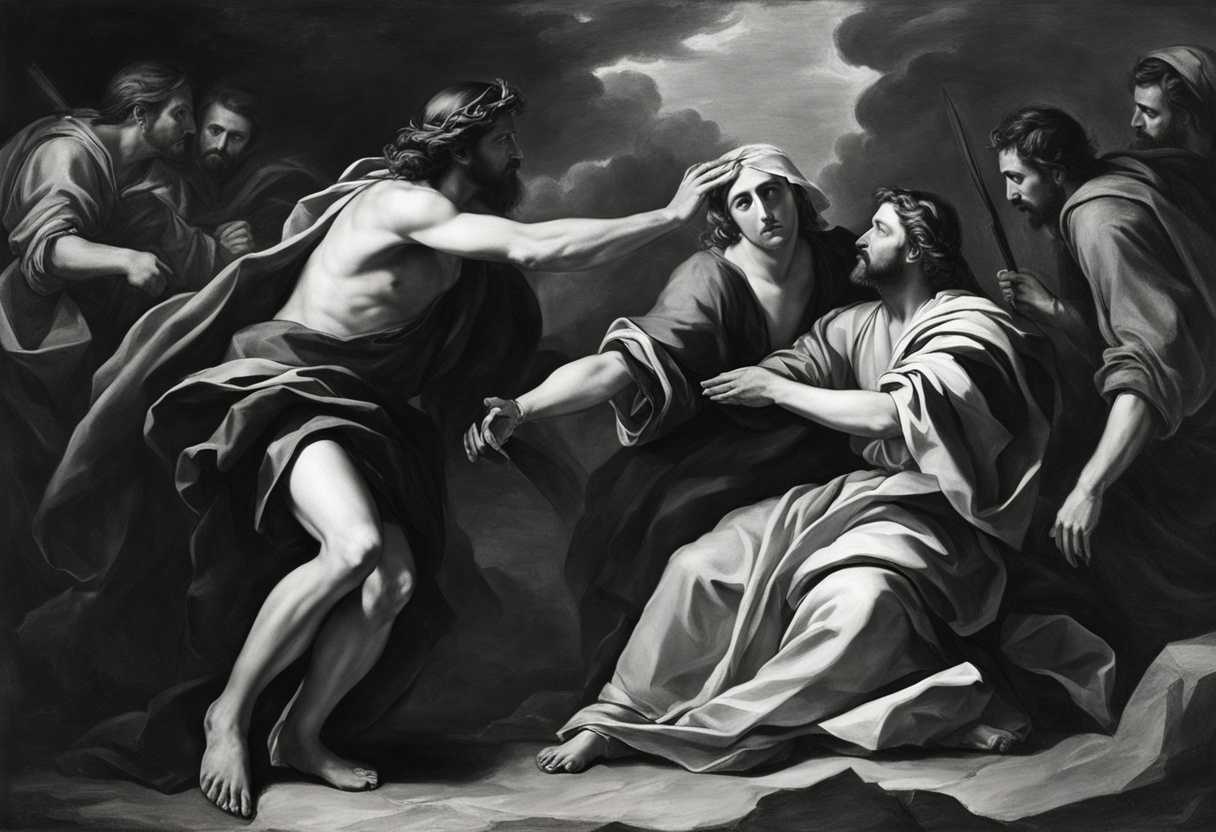
Setting the Scene for Matthew 16:23
In Matthew chapter 16, we find Jesus with his disciples in the region of Caesarea Philippi. The scene is set against the backdrop of a rocky landscape, with the sound of the nearby Jordan River flowing gently in the background. The disciples are gathered around Jesus, listening intently as he imparts his teachings to them.
Among the disciples present are Peter, Andrew, James, and John, who have been following Jesus throughout his ministry. They have witnessed his miracles, heard his parables, and seen the compassion and wisdom with which he interacts with people. In this particular moment, Jesus is foretelling his death and resurrection, a concept that is difficult for the disciples to comprehend.
As the conversation unfolds, Peter speaks up, expressing his disbelief at the idea of Jesus suffering and dying. Jesus then rebukes Peter, saying, “Get behind me, Satan! You are a stumbling block to me; you do not have in mind the concerns of God, but merely human concerns.” This exchange serves as a pivotal moment in the disciples’ understanding of Jesus’ mission and the cost of discipleship.
What is Matthew 16:23 about?
Jesus is addressing Peter in this verse, who is trying to dissuade Him from the path He knows He must take, which is to be crucified for the salvation of humankind. Jesus is not saying that Peter is literally the devil when he calls him “Satan,” but rather highlighting how Peter’s words are echoing the temptations that Satan himself had presented to Jesus in the wilderness. Jesus recognizes that Peter’s well-intentioned concern is actually a stumbling block, an obstacle in the way of His divine mission.
This moment serves as a powerful reminder that following God’s will often requires us to go against our own instincts and desires. It challenges us to trust in God’s plan even when it may seem difficult or painful. Just like Peter, we may sometimes find ourselves inadvertently standing in the way of God’s greater purpose due to our limited understanding or personal fears. Jesus’s response to Peter prompts us to reflect on our own attitudes and actions, asking ourselves if we are truly aligned with God’s will or if we are inadvertently becoming stumbling blocks to the work of God in our lives and in the world.
Understanding what Matthew 16:23 really means
Structure for Commentary
- Introduction to the Verse
- Contextual Background
- Interpretation of Key Phrases
- Cross-References with Other Biblical Passages
- Relevance to Modern Life
- Anecdote for Better Understanding
- Jesus rebukes Peter sharply in this passage for his lack of understanding and alignment with divine intentions. This verse is pivotal in showcasing the tension between human perspective and God’s plan. It is both a moment of correction and a teaching opportunity.
Contextual Background
To fully grasp this verse, it is essential to understand the preceding events. Peter has just confessed that Jesus is the Messiah, a revelation that Jesus praised. However, when Jesus began to speak of his impending suffering and death, Peter rebuked him, unable to comprehend why the Messiah would suffer. Jesus’ response to Peter is a stern reminder of the necessity of divine perspective over human thinking.
Interpretation of Key Phrases
The phrase “Get behind me, Satan!” is striking. Jesus isn’t calling Peter Satan in a literal sense but is highlighting that Peter’s words are a temptation to avoid the path of suffering that Jesus must take. The words “You are a stumbling block to me” underscore that Peter’s misunderstanding is an obstacle to Jesus’ mission. Lastly, “You do not have in mind the concerns of God, but merely human concerns” points to the crux of the issue: Peter’s perspective is limited to human fears and desires, not the greater divine plan.
Cross-References with Other Biblical Passages
This moment can be cross-referenced with Jesus’ temptation in the wilderness (Matthew 4:1-11). Jesus faces temptations to deviate from God’s plan in both instances. Additionally, Isaiah 55:8-9 reminds us, “For my thoughts are not your thoughts, neither are your ways my ways.” This emphasizes the necessity of aligning our understanding with God’s will. We often prioritize human concerns over divine intentions in our daily lives. Career ambitions, personal desires, and societal pressures can lead us astray from our spiritual path. This verse serves as a reminder to constantly seek alignment with God’s will, even when it contradicts our own plans. Sarah, a young woman, felt a strong calling to missionary work. Her family and friends, though well-meaning, advised her against it, citing financial stability and safety concerns. Sarah struggled, much like Peter, between human advice and divine calling. She ultimately chose to follow God’s will, and her work brought profound positive change to many lives.
Conclusion and Reflection
This verse challenges us to examine whose concerns are guiding our decisions. Are we, like Peter, focused on human concerns? Or are we striving to align with the divine plan? Reflect on moments in your life where you’ve faced similar tensions. How can you better align your thoughts and actions with God’s will? Understanding this verse reminds us of the importance of divine perspective, encouraging us to trust in God’s plan, even when it challenges our human understanding.
How can we recognize God’s will in our lives?
We can recognize God’s will in our lives by staying focused on His priorities and purposes. When we align our thoughts and actions with what God desires, we can be confident that we are following His will. Just as Jesus rebuked Peter for his earthly concerns, we should be mindful of any distractions or obstacles that may lead us away from God’s plan for us.
Additionally, seeking guidance through prayer and studying God’s Word can help us discern His will more clearly. We can better understand His direction for our lives by staying connected to God through regular communication and learning from His teachings. Trusting in His wisdom and seeking His guidance in all decisions can lead us closer to living out His will for us. Being open to God’s leading and surrendering our own desires to His sovereign plan is key in recognizing His will in our lives. We can trust that His purpose will be fulfilled in our lives by submitting ourselves to Him and allowing Him to work in and through us.
Application
Just like balancing work and family, keeping your thoughts aligned with God’s will is essential. In Matthew 16:23, Jesus urges us to resist worldly temptations that pull us off track. Can you intentionally center your actions around Jesus’ teachings and seek His guidance in every part of your day? Are you ready to guard your mind and stay true to the path God has set for you? How will you make this commitment today?

Reverend Michael Johnson is an experienced Church Minister with a profound expertise in spirituality and guidance. With a serene presence and a compassionate heart, he has faithfully served his congregation for over 20 years, leading them on a spiritual journey towards inner peace and enlightenment. Reverend Johnson’s extensive knowledge of religious philosophies and profound understanding of human nature have made him a trusted confidant and mentor to many, as he seamlessly weaves his profound wisdom into life teachings. Reverend Johnson’s calming demeanor and empathetic nature continue to uplift and heal souls, nurturing a sense of unity and tranquility within his community.