
Matthew 21:18-22 is about Jesus using the withering of the fig tree as a symbolic lesson to demonstrate the power of faith and the importance of believing without doubting when approaching God in prayer.
18 In the morning, as he was returning to the city, he became hungry.
19 And seeing a fig tree by the wayside, he went to it and found nothing on it but only leaves. And he said to it, “May no fruit ever come from you again!” And the fig tree withered at once.
20 When the disciples saw it, they marveled, saying, “How did the fig tree wither at once?”
21 And Jesus answered them, “Truly, I say to you, if you have faith and do not doubt, you will not only do what has been done to the fig tree, but even if you say to this mountain, ‘Be taken up and thrown into the sea,’ it will happen.
22 And whatever you ask in prayer, you will receive, if you have faith.
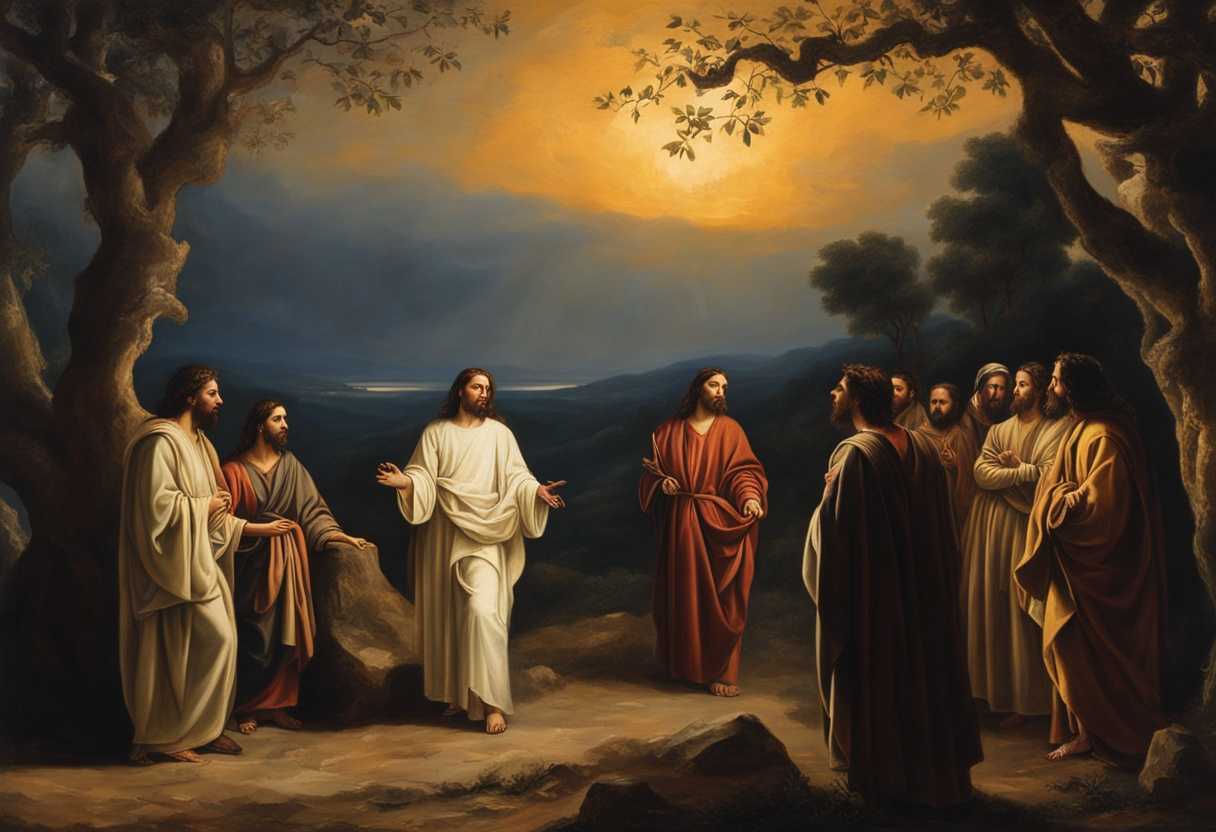
Setting the Scene for Matthew 21:18-22
In Matthew chapter 21, we find Jesus and his disciples traveling to Jerusalem for the Passover festival. As they approach the city, they come across a fig tree by the roadside. Jesus, feeling hungry, goes to the tree looking for fruit, but finding none, he curses the tree, and it withers immediately. This event takes place in the early morning, with the sun just beginning to rise over the horizon, casting a warm glow on the landscape.
The disciples, including Peter, James, John, and Andrew, are with Jesus as he performs this miracle. They witness the power of his words as the fig tree withers before their eyes. The scene is set against the backdrop of the bustling city of Jerusalem, with pilgrims and merchants making their way to the temple for the Passover celebrations. The disciples are amazed by Jesus’ authority and the lesson he imparts about the importance of faith and the power of prayer. This moment serves as a powerful reminder of Jesus’ divinity and his ability to bring about miraculous transformations in the world around him.
What is Matthew 21:18-22 about?
Jesus curses a fig tree in this verse for not bearing fruit, demonstrating the importance of genuine faith and the power of prayer. This incident serves as a powerful visual lesson for his disciples and us, emphasizing the significance of faith that produces tangible results. Through this action, Jesus conveys the idea that faith without fruitfulness is empty and lacking in substance. Our faith should also manifest in our actions and produce positive outcomes, just as we expect a fig tree to bear fruit. Jesus highlights the necessity of a living faith that is actively engaged and fruitful by cursing the fig tree. This narrative challenges us to examine the authenticity of our own faith and its impact on our lives and the lives of others. It reminds us that genuine faith is not just a passive belief but a dynamic force that propels us to act, bear fruit, and make a difference in the world around us. Through the power of prayer, we can nurture and cultivate our faith, enabling it to grow and produce fruits of love, compassion, and service to others. Let us consider how prayer and action can deepen our faith as we reflect on this verse. Let us ponder on the significance of bearing fruit in our lives. How can we ensure that our faith is not barren like the fig tree, but fruitful and impactful in fulfilling God’s will on earth? Let us strive to cultivate a dynamic and fruitful faith that glorifies God and brings about positive transformations in our lives and the world around us.
Understanding what Matthew 21:18-22 really means
In Matthew 21:18-22, we encounter a powerful account of Jesus cursing a fig tree for its lack of fruit, which serves as a symbolic representation of spiritual barrenness. This passage not only showcases Jesus’ humanity, as He experiences physical hunger, but also conveys a profound message about faith and prayer. The curse on the fig tree signifies judgment on unfruitfulness and serves as a warning against spiritual barrenness, urging us to reflect on our own spiritual productivity.
Jesus’ statement about having faith without doubt and the ability to move mountains with a mere command underscores the immense power of unwavering faith. This challenges us to examine the depth of our own faith and the extent to which we truly believe in the miraculous. The parallel in Mark 11:12-14, 20-24 further emphasizes the significance of faith in achieving the seemingly impossible, reinforcing the message of Matthew 21:21.
The relevance of this passage extends to our lives today, urging us to put our faith into action amidst life’s challenges and uncertainties. Just as the fig tree was expected to bear fruit, we are called to live out our faith in tangible ways, demonstrating spiritual fruitfulness through our actions. This passage serves as a reminder of the importance of prayer and belief, reassuring us that with faith, even the most daunting obstacles can be overcome.
Consider the analogy of a farmer tending to a vineyard, where one unproductive vine is eventually removed to make way for fruitful growth. Similarly, in our spiritual lives, we are called to be fruitful and productive, fulfilling the purpose God has for us. Reflect on the story of a woman facing a dire medical diagnosis, whose unwavering faith and fervent prayers led to a miraculous recovery. Her testimony echoes the message of Matthew 21:18-22, illustrating the transformative power of faith and prayer in the face of adversity.
As we ponder this passage, let us introspect on the state of our own faith and the fruit it bears in our lives. Let us strive to cultivate unwavering faith, free from doubt, and to trust in the potency of prayer. In our spiritual journeys, may we seek to be fruitful, trusting that with God, all things are possible.
Does our faith result in tangible outcomes?
Yes, our faith can result in tangible outcomes. Jesus curses a fig tree in the mentioned verses, and the disciples witness the immediate withering of the tree. Through this miracle, Jesus teaches the disciples about the power of faith and the importance of believing in God’s ability to answer prayers. This story illustrates that when we have genuine faith in God and His power, we can see tangible results in our lives.
Additionally, the passage highlights the significance of not only believing in prayer but also speaking it. Jesus emphasizes the power of speaking our prayers out loud with unwavering faith. This demonstrates that our words are not just empty phrases but have the potential to manifest real outcomes when coupled with genuine faith. Our faith should lead us to confidently pray and speak out our requests to God, trusting that He will answer according to His will. The story of the fig tree serves as a reminder of the importance of aligning our desires with God’s will. Jesus’ actions were not arbitrary but served a greater purpose in teaching His disciples about faith and the power of prayer. When we earnestly seek God’s will in our prayers and have faith in His ability to act, we open ourselves up to experiencing tangible outcomes that bring glory to Him.
Application
Think of faith as the fuel that keeps your life’s engine running smoothly. Just like you trust your car to get you to work, trust God to guide you through everyday challenges. When your family faces tough times, lean on prayer as your strongest tool. Are you ready to deepen your faith and commit to praying more fervently in every aspect of your life?

Reverend Michael Johnson is an experienced Church Minister with a profound expertise in spirituality and guidance. With a serene presence and a compassionate heart, he has faithfully served his congregation for over 20 years, leading them on a spiritual journey towards inner peace and enlightenment. Reverend Johnson’s extensive knowledge of religious philosophies and profound understanding of human nature have made him a trusted confidant and mentor to many, as he seamlessly weaves his profound wisdom into life teachings. Reverend Johnson’s calming demeanor and empathetic nature continue to uplift and heal souls, nurturing a sense of unity and tranquility within his community.