
Matthew 26:14-27:66 is about the betrayal, trial, crucifixion, and resurrection of Jesus Christ, highlighting themes of sacrifice, redemption, and faithfulness.
14 Then one of the twelve, whose name was Judas Iscariot, went to the chief priests
15 and said, “What will you give me if I deliver him over to you?” And they paid him thirty pieces of silver.
16 And from that moment he sought an opportunity to betray him.
17 Now on the first day of Unleavened Bread the disciples came to Jesus, saying, “Where will you have us prepare for you to eat the Passover?”
18 He said, “Go into the city to a certain man and say to him, ‘The Teacher says, My time is at hand. I will keep the Passover at your house with my disciples.’”
19 So the disciples did as Jesus had directed them, and they prepared the Passover.
20 When it was evening, he reclined at table with the twelve.
21 And as they were eating, he said, “Truly, I say to you, one of you will betray me.”
22 And they were very sorrowful and began to say to him one after another, “Is it I, Lord?”
23 He answered, “He who has dipped his hand in the dish with me will betray me.
24 The Son of Man goes as it is written of him, but woe to that man by whom the Son of Man is betrayed! It would have been better for that man if he had not been born.
25 Judas, who would betray him, answered, “Is it I, Rabbi?” He said to him, “You have said so.”
26 Now as they were eating, Jesus took bread, and after blessing it broke it and gave it to the disciples, and said, “Take, eat; this is my body.”
27 And he took a cup, and when he had given thanks he gave it to them, saying, “Drink of it, all of you,
28 for this is my blood of the covenant, which is poured out for many for the forgiveness of sins.
29 I tell you I will not drink again of this fruit of the vine until that day when I drink it new with you in my Father’s kingdom.”
30 And when they had sung a hymn, they went out to the Mount of Olives.
31 Then Jesus said to them, “You will all fall away because of me this night. For it is written, ‘I will strike the shepherd, and the sheep of the flock will be scattered.’
32 But after I am raised up, I will go before you to Galilee.
33 Peter answered him, “Though they all fall away because of you, I will never fall away.”
34 Jesus said to him, “Truly, I tell you, this very night, before the rooster crows, you will deny me three times.”
35 Peter said to him, “Even if I must die with you, I will not deny you.” And all the disciples said the same.
36 Then Jesus went with them to a place called Gethsemane, and he said to his disciples, “Sit here, while I go over there and pray.”
37 And taking with him Peter and the two sons of Zebedee, he began to be sorrowful and troubled.
38 Then he said to them, “My soul is very sorrowful, even to death; remain here, and watch with me.”
39 And going a little farther he fell on his face and prayed, saying, “My Father, if it be possible, let this cup pass from me; nevertheless, not as I will, but as you will.”
40 And he came to the disciples and found them sleeping. And he said to Peter, “So, could you not watch with me one hour?
41 Watch and pray that you may not enter into temptation. The spirit indeed is willing, but the flesh is weak.
42 Again, for the second time, he went away and prayed, “My Father, if this cannot pass unless I drink it, your will be done.”
43 And again he came and found them sleeping, for their eyes were heavy.
44 So, leaving them again, he went away and prayed for the third time, saying the same words again.
45 Then he came to the disciples and said to them, “Sleep and take your rest later on. See, the hour is at hand, and the Son of Man is betrayed into the hands of sinners.
46 Rise, let us be going; see, my betrayer is at hand.
47 While he was still speaking, Judas came, one of the twelve, and with him a great crowd with swords and clubs, from the chief priests and the elders of the people.
48 Now the betrayer had given them a sign, saying, “The one I will kiss is the man; seize him.”
49 And he came up to Jesus at once and said, “Greetings, Rabbi!” And he kissed him.
50 Jesus said to him, “Friend, do what you came to do.” Then they came up and laid hands on Jesus and seized him.
51 And behold, one of those who were with Jesus stretched out his hand and drew his sword and struck the servant of the high priest and cut off his ear.
52 Then Jesus said to him, “Put your sword back into its place. For all who take the sword will perish by the sword.
53 Do you think that I cannot appeal to my Father, and he will at once send me more than twelve legions of angels?
54 But how then should the Scriptures be fulfilled, that it must be so?”
55 At that hour Jesus said to the crowds, “Have you come out as against a robber, with swords and clubs to capture me? Day after day I sat in the temple teaching, and you did not seize me.
56 But all this has taken place that the Scriptures of the prophets might be fulfilled.” Then all the disciples left him and fled.
57 Then those who had seized Jesus led him to Caiaphas the high priest, where the scribes and the elders had gathered.
58 But Peter was following him at a distance, as far as the courtyard of the high priest, and going inside he sat with the guards to see the end.
59 Now the chief priests and the whole council were seeking false testimony against Jesus that they might put him to death,
60 but they found none, though many false witnesses came forward. At last two came
61 and said, “This man said, ‘I am able to destroy the temple of God, and to rebuild it in three days.’”
62 And the high priest stood up and said, “Have you no answer to make? What is it that these men testify against you?”
63 But Jesus remained silent. And the high priest said to him, “I adjure you by the living God, tell us if you are the Christ, the Son of God.”
64 Jesus said to him, “You have said so. But I tell you, from now on you will see the Son of Man seated at the right hand of Power and coming on the clouds of heaven.”
65 Then the high priest tore his robes and said, “He has uttered blasphemy. What further witnesses do we need? You have now heard his blasphemy.
66 What is your judgment?” They answered, “He deserves death.”
67 Then they spit in his face and struck him. And some slapped him,
68 saying, “Prophesy to us, you Christ! Who is it that struck you?”
69 Now Peter was sitting outside in the courtyard. And a servant girl came up to him and said, “You also were with Jesus the Galilean.”
70 But he denied it before them all, saying, “I do not know what you mean.”
71 And when he went out to the entrance, another servant girl saw him, and she said to the bystanders, “This man was with Jesus of Nazareth.”
72 And again he denied it with an oath: “I do not know the man.”
73 After a little while the bystanders came up and said to Peter, “Certainly you too are one of them, for your accent betrays you.”
74 Then he began to invoke a curse on himself and to swear, “I do not know the man.” And immediately the rooster crowed.
75 And Peter remembered the saying of Jesus, “Before the rooster crows, you will deny me three times.” And he went out and wept bitterly.
1 When morning came, all the chief priests and the elders of the people took counsel against Jesus to put him to death.
2 And they bound him and led him away and delivered him over to Pilate the governor.
3 Then when Judas, his betrayer, saw that Jesus was condemned, he changed his mind and brought back the thirty pieces of silver to the chief priests and the elders,
4 saying, “I have sinned by betraying innocent blood.” They said, “What is that to us? See to it yourself.”
5 And throwing down the pieces of silver into the temple, he departed, and he went and hanged himself.
6 But the chief priests, taking the pieces of silver, said, “It is not lawful to put them into the treasury, since it is blood money.”
7 So they took counsel and bought with them the potter’s field as a burial place for strangers.
8 Therefore that field has been called the Field of Blood to this day.
5 Then he threw down the pieces of silver in the temple and departed, and went and hanged himself.
10 and they gave them for the potter’s field, as the Lord directed me.”
11 Now Jesus stood before the governor, and the governor asked him, “Are you the King of the Jews?” Jesus said, “You have said so.”
12 But when he was accused by the chief priests and elders, he gave no answer.
27 Then Pilate said to him, “Do you not hear how many things they testify against you?”
14 But he gave him no answer, not even to a single charge, so that the governor was greatly amazed.
15 Now at the feast the governor was accustomed to release for the crowd any one prisoner whom they wanted.
16 And they had then a notorious prisoner called Barabbas.
17 So when they had gathered, Pilate said to them, “Whom do you want me to release for you: Barabbas, or Jesus who is called Christ?”
18 For he knew that it was out of envy that they had delivered him up.
19 Besides, while he was sitting on the judgment seat, his wife sent word to him, “Have nothing to do with that righteous man, for I have suffered much because of him today in a dream.”
20 Now the chief priests and the elders persuaded the crowd to ask for Barabbas and destroy Jesus.
21 The governor again said to them, “Which of the two do you want me to release for you?” And they said, “Barabbas.”
22 Pilate said to them, “Then what shall I do with Jesus who is called Christ?” They all said, “Let him be crucified!”
23 And he said, “Why? What evil has he done?” But they shouted all the more, “Let him be crucified!”
24 So when Pilate saw that he was gaining nothing, but rather that a riot was beginning, he took water and washed his hands before the crowd, saying, “I am innocent of this man’s blood; see to it yourselves.”
25 And all the people answered, “His blood be on us and on our children!”
26 Then he released for them Barabbas, and having scourged Jesus, delivered him to be crucified.
27 Then the soldiers of the governor took Jesus into the governor’s headquarters, and they gathered the whole battalion before him.
28 And they stripped him and put a scarlet robe on him,
29 and twisting together a crown of thorns, they put it on his head and put a reed in his right hand. And kneeling before him, they mocked him, saying, “Hail, King of the Jews!”
30 And they spit on him and took the reed and struck him on the head.
31 And when they had mocked him, they stripped him of the robe and put his own clothes on him and led him away to crucify him.
32 As they went out, they found a man of Cyrene, Simon by name. They compelled this man to carry his cross.
33 And when they came to a place called Golgotha (which means Place of a Skull),
34 they offered him wine to drink, mixed with gall, but when he tasted it, he would not drink it.
35 And when they had crucified him, they divided his garments among them by casting lots.
36 Then sitting down, they kept watch over him there.
37 And over his head they put the charge against him, which read, “This is Jesus, the King of the Jews.”
38 Then two robbers were crucified with him, one on the right and one on the left.
39 And those who passed by derided him, wagging their heads
40 and saying, “You who would destroy the temple and rebuild it in three days, save yourself! If you are the Son of God, come down from the cross.”
41 So also the chief priests, with the scribes and elders, mocked him, saying,
42 “He saved others; he cannot save himself. He is the King of Israel; let him come down now from the cross, and we will believe in him.”
43 He trusts in God; let God deliver him now, if he desires him. For he said, ‘I am the Son of God.’”
44 And the robbers who were crucified with him also reviled him in the same way.
46 And about the ninth hour Jesus cried out with a loud voice, saying, “Eli, Eli, lema sabachthani?” that is, “My God, my God, why have you forsaken me?”
46 And about the ninth hour Jesus cried out with a loud voice, saying, “Eli, Eli, lema sabachthani?” that is, “My God, my God, why have you forsaken me?”
47 And some of the bystanders, hearing it, said, “This man is calling Elijah.”
48 And one of them at once ran and took a sponge, filled it with sour wine, and put it on a reed and gave it to him to drink.
49 And the rest said, “Let us see whether Elijah will come to save him.”
50 And Jesus cried out again with a loud voice and yielded up his spirit.
51 And behold, the curtain of the temple was torn in two, from top to bottom. And the earth shook, and the rocks were split.
52 The tombs also were opened. And many bodies of the saints who had fallen asleep were raised,
53 They came out of the tombs after his resurrection and went into the holy city and appeared to many.
54 When the centurion and those who were with him, keeping watch over Jesus, saw the earthquake and what took place, they were filled with awe and said, “Truly this was the Son of God!”
55 There were also many women there, looking on from a distance, who had followed Jesus from Galilee, ministering to him,
56 among whom were Mary Magdalene and Mary the mother of James and Joseph, and the mother of the sons of Zebedee.
57 When it was evening, there came a rich man from Arimathea, named Joseph, who also was a disciple of Jesus.
58 He went to Pilate and asked for the body of Jesus. Then Pilate ordered it to be given to him.
59 And Joseph took the body and wrapped it in a clean linen shroud
60 and laid it in his own new tomb, which he had cut in the rock. And he rolled a great stone to the entrance of the tomb and went away.
61 Mary Magdalene and the other Mary were there, sitting opposite the tomb.
62 The next day, that is, after the day of Preparation, the chief priests and the Pharisees gathered before Pilate
63 and said, “Sir, we remember how that impostor said, while he was still alive, ‘After three days I will rise.’
64 Therefore order the tomb to be made secure until the third day, lest his disciples go and steal him away and tell the people, ‘He has risen from the dead,’ and the last fraud will be worse than the first.”
“Take a guard,” Pilate answered. “Go, make the tomb as secure as you can.”
66 So they went and made the tomb secure by sealing the stone and setting a guard.
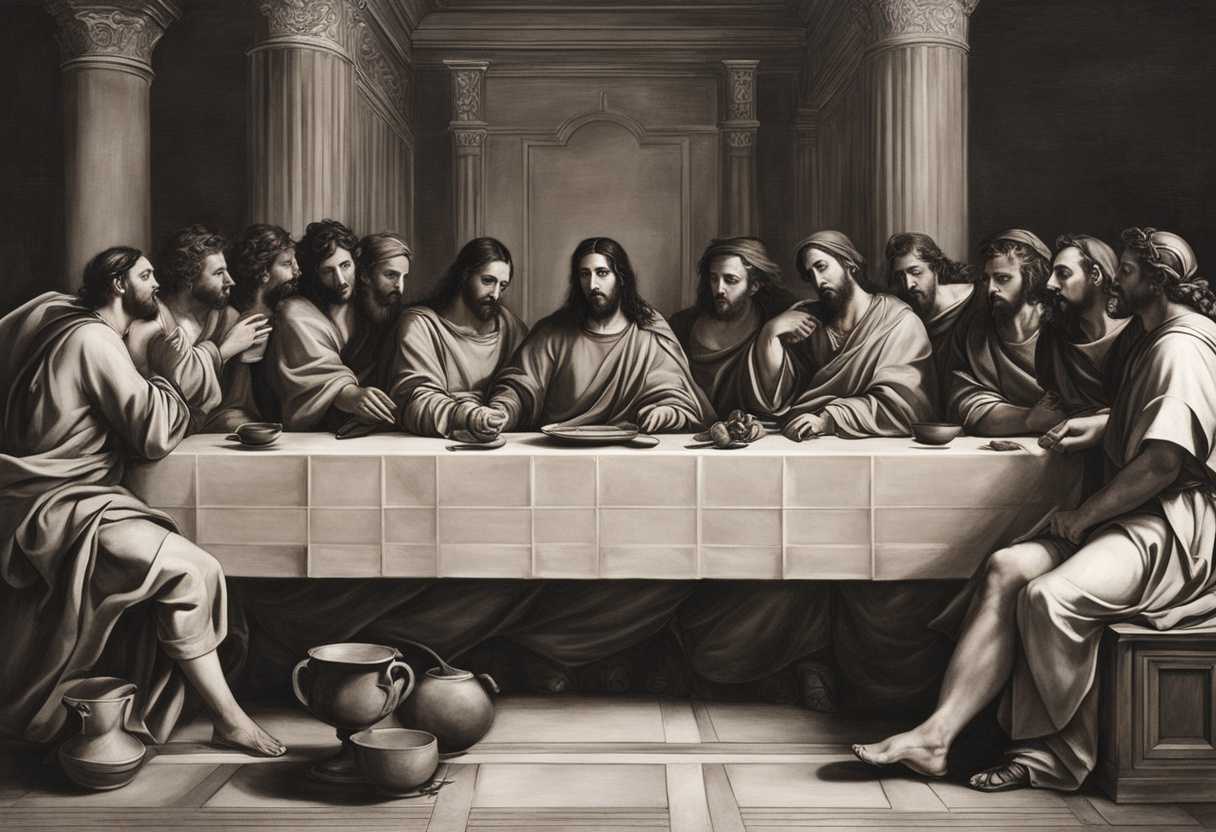
Setting the Scene for Matthew 26:14-27:66
The scene described in Matthew 26:14-27:66 takes place in Jerusalem during the final days of Jesus Christ. The main characters in this scene include Jesus, his disciples, Judas Iscariot, Pontius Pilate, and a crowd of people. The events leading up to this scene involve Judas betraying Jesus for thirty pieces of silver, Jesus being arrested in the Garden of Gethsemane, and brought before the high priest Caiaphas for a trial.
The surroundings are tense and chaotic as Jesus is brought before Pontius Pilate, the Roman governor, for questioning. The crowd is stirred up by the religious leaders who want Jesus crucified. Pilate, caught in a difficult position, tries to appease the crowd by offering to release either Jesus or Barabbas, a notorious criminal. The crowd chooses to release Barabbas and demands Jesus be crucified. The scene culminates in Jesus being mocked, beaten, and ultimately crucified on a cross at Golgotha.
The atmosphere is heavy with emotion as Jesus is crucified, with his disciples and followers watching in disbelief and sorrow. The scene serves as a pivotal moment in the Christian faith, as it represents the sacrifice Jesus made for humanity’s sins. The events that unfold in this scene lead to Jesus’ death and resurrection, which are central to the Christian belief in salvation and redemption.
What is Matthew 26:14-27:66 about?
This verse presents a profound and impactful moment in the Christian faith: the crucifixion and burial of Jesus Christ. These events are the culmination of the ultimate sacrifice made by Jesus for the salvation of humanity. The betrayal by one of his own disciples, the unjust trial, the excruciating crucifixion, and the solemn burial all depict the depths of suffering and sacrifice that Jesus endured out of love for all people.
Reflecting on this verse, we are invited to contemplate the immense love and sacrifice demonstrated by Jesus in his final moments on Earth. It prompts us to consider the significance of his death and burial in the Christian belief system, as well as the profound impact it has had on believers throughout history. Through these events, we are reminded of the importance of humility, forgiveness, and compassion in our own lives, as we strive to embody the teachings and example of Jesus Christ. We are challenged to consider the weight of our own actions and the choices we make in our daily lives as we ponder the betrayal, trial, crucifixion, and burial of Jesus Christ. How do we respond to betrayal and injustice? How do we show love and forgiveness to those who wrong us? How can we emulate the selfless sacrifice of Jesus in our interactions with others? These are questions that this verse inspires us to grapple with as we seek to deepen our understanding of faith and live out its principles in a meaningful way.
Understanding what Matthew 26:14-27:66 really means
The passage from Matthew 26:14-27:66 delves into the heart-wrenching account of Jesus’ betrayal, crucifixion, and resurrection. It is a pivotal moment in Christian faith, laying the foundation for the belief in Jesus’ sacrificial death and triumphant resurrection. Judas’ betrayal of Jesus for thirty pieces of silver serves as a stark reminder of the themes of treachery and the fulfillment of prophecy, echoing the words of Zechariah 11:12-13. The Last Supper, where Jesus institutes the Eucharist, symbolizing His body and blood given for the salvation of humanity, resonates with the profound words, “This is my body… this is my blood,” as detailed in 1 Corinthians 11:23-26.
In the garden of Gethsemane, Jesus’ prayer, “Not my will, but yours be done,” showcases His unwavering submission to God’s plan, even amidst immense suffering, mirroring the sentiment in Luke 22:42. As Jesus hangs on the cross, His poignant cry, “My God, my God, why have you forsaken me?” reflects His deep anguish and fulfills the prophetic words of Psalm 22. These key themes and phrases intertwine to paint a vivid picture of Jesus’ unwavering commitment to fulfilling God’s redemptive plan for humanity.
The passage finds resonance in related scriptures such as Isaiah 53, which prophesies the suffering and sacrifice of the Servant, prefiguring Jesus’ ultimate sacrifice. Parallel accounts in John 13-19 offer additional insights into the events, enriching our understanding of the narrative. Hebrews 9:11-14 further elucidates the significance of Jesus’ sacrifice as the ultimate atonement for sin, underscoring the depth of God’s love and mercy.
Today, the themes of betrayal, forgiveness, sacrifice, and redemption continue to hold profound relevance. Jesus’ response to betrayal and His forgiveness of those who crucified Him exemplify the transformative power of grace and forgiveness in the face of deep hurt. The concept of sacrificial love, embodied by Jesus’ ultimate sacrifice, offers hope and redemption to all, inspiring believers to emulate His example in their relationships and communities. In moments of personal struggle, Jesus’ submission to God’s will in Gethsemane serves as a beacon of trust and surrender to divine providence.
Consider a scenario where an individual grapples with feelings of betrayal and anger from a close friend. Reflecting on Jesus’ experience with Judas and His unfathomable forgiveness can serve as a source of healing and empowerment, igniting a journey towards extending forgiveness even in the most challenging circumstances. The passage from Matthew 26:14-27:66 encapsulates the essence of Christian faith, urging believers to introspect on the profound themes of betrayal, sacrifice, and redemption, and to embody these virtues in their daily lives.
How can we find strength to face suffering?
We can find strength to face suffering by looking to the example of Jesus in the verse. Jesus endured immense suffering and remained steadfast in his faith and purpose. His unwavering commitment to his mission, even in the face of betrayal, denial, and physical pain, serves as a powerful reminder that we are not alone in our suffering. We too can draw upon our faith and inner resolve to face our own trials and tribulations, just as Jesus found the strength to endure. Jesus surrenders to the will of God despite knowing the suffering that awaited him in the verse. This act of submission and trust in a higher power can also provide us with the strength and courage needed to navigate through our own challenges. We can find comfort and resilience in the midst of adversity by acknowledging our limitations and placing our trust in something greater than ourselves.
Additionally, the verse underscores the importance of perseverance and resilience in the face of suffering. Jesus’s ability to endure through his suffering ultimately led to his resurrection and victory over death. This highlights the transformative power of perseverance in the face of hardship, showing us that by staying true to our beliefs and values, we can emerge stronger and more resilient on the other side of suffering.
Application
Picture your life as a journey, navigating the hustle of work and family. Think about how Jesus’ sacrifice on the cross is your compass, guiding you toward gratitude and service. His ultimate act of love is your fuel, powering you to be a beacon of hope and kindness. Will you seize this moment to follow His path and impact lives around you today?

Reverend Michael Johnson is an experienced Church Minister with a profound expertise in spirituality and guidance. With a serene presence and a compassionate heart, he has faithfully served his congregation for over 20 years, leading them on a spiritual journey towards inner peace and enlightenment. Reverend Johnson’s extensive knowledge of religious philosophies and profound understanding of human nature have made him a trusted confidant and mentor to many, as he seamlessly weaves his profound wisdom into life teachings. Reverend Johnson’s calming demeanor and empathetic nature continue to uplift and heal souls, nurturing a sense of unity and tranquility within his community.