
Matthew 26:17-29 is about Jesus instructing his disciples to prepare for the Passover meal, during which he foreshadows his impending betrayal, sacrifice, and establishment of the new covenant through the bread and wine, symbolizing his body and blood.
17 Now on the first day of Unleavened Bread the disciples came to Jesus, saying, “Where will you have us prepare for you to eat the Passover?”
18 He said, “Go into the city to a certain man and say to him, ‘The Teacher says, My time is at hand. I will keep the Passover at your house with my disciples.’”
19 So the disciples did as Jesus had directed them, and they prepared the Passover.
20 When it was evening, he reclined at table with the twelve.
21 And as they were eating, he said, “Truly, I say to you, one of you will betray me.”
22 And they were very sorrowful and began to say to him one after another, “Is it I, Lord?”
23 He answered, “He who has dipped his hand in the dish with me will betray me.
24 The Son of Man goes as it is written of him, but woe to that man by whom the Son of Man is betrayed! It would have been better for that man if he had not been born.
25 Judas, who would betray him, answered, “Is it I, Rabbi?” He said to him, “You have said so.”
26 Now as they were eating, Jesus took bread, and after blessing it broke it and gave it to the disciples, and said, “Take, eat; this is my body.”
27 And he took a cup, and when he had given thanks he gave it to them, saying, “Drink of it, all of you,
28 for this is my blood of the covenant, which is poured out for many for the forgiveness of sins.
29 I tell you I will not drink again of this fruit of the vine until that day when I drink it new with you in my Father’s kingdom.”
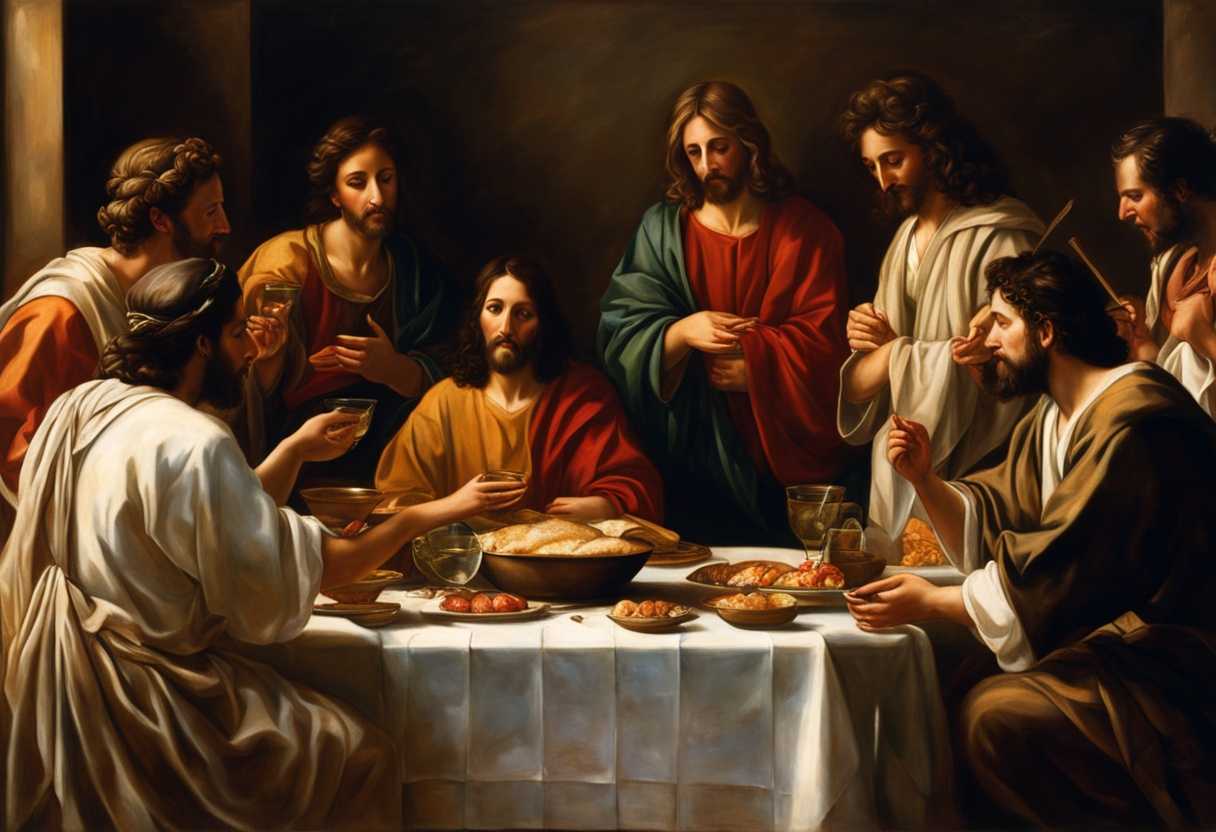
Setting the Scene for Matthew 26:17-29
The scene described in Matthew 26:17-29 takes place in Jerusalem during the time of the Passover feast. Jesus instructs his disciples, Peter and John, to go into the city and prepare a room for them to eat the Passover meal together. The disciples follow Jesus’ directions and find a large upper room furnished and ready for their use.
As evening falls, Jesus and his twelve disciples gather in the upper room to share the Passover meal. The room is dimly lit by oil lamps, casting a warm glow over the group. The disciples recline at the table, their sandals kicked off, as was the custom of the time. The air is filled with the aroma of roasted lamb, unleavened bread, bitter herbs, and wine, all traditional elements of the Passover feast.
As they eat, Jesus takes the unleavened bread, blesses it, and breaks it, symbolizing his body that will be broken for them. He then takes the cup of wine, blesses it, and shares it with his disciples, telling them that it represents his blood which will be shed for the forgiveness of sins. The atmosphere in the room is solemn yet filled with love and camaraderie as Jesus prepares his disciples for the events that are about to unfold.
What is Matthew 26:17-29 about?
Jesus is establishing the practice of the Lord’s Supper, also known as Communion or the Eucharist in this verse. He takes bread and wine, giving them new significance by declaring them to be symbols of his body and blood. Jesus foreshadows his upcoming sacrifice on the cross by sharing the bread and wine with his disciples, where his body will be broken and his blood shed for the forgiveness of sins.
The Lord’s Supper serves as a powerful reminder for Christians of Jesus’ sacrifice and the salvation that it brings. It is a sacred and solemn act of remembering Jesus’ love and the ultimate price he paid for our redemption. Through partaking in the Lord’s Supper, believers have the opportunity to commune with God, express their faith, and strengthen their spiritual bond with Jesus and fellow believers. We reflect on this verse and the significance of the Lord’s Supper, reminding us of the depth of Jesus’ love and the immense grace he extends to us through his sacrifice. It prompts us to examine our hearts, repent of our sins, and recommit ourselves to following Jesus wholeheartedly. The Lord’s Supper is a tangible representation of the central message of Christianity – that through Jesus’ death and resurrection, we have access to forgiveness, reconciliation with God, and eternal life.
Understanding what Matthew 26:17-29 really means
The passage in Matthew 26:17-29 captures a pivotal moment in Jesus’ ministry – the Last Supper. As Jesus gathers with His disciples to share a final meal before His crucifixion, the atmosphere is charged with significance. The setting during the Feast of Unleavened Bread adds layers of meaning, tying in the historical context of the Israelites’ exodus from Egypt with Jesus’ impending sacrifice for humanity’s redemption.
In this poignant scene, Jesus utters phrases that resonate with profound symbolism. When He declares, “My time is at hand,” He acknowledges the divine plan unfolding before Him, demonstrating His unwavering obedience to God’s will. As He offers bread as His body and wine as His blood, He establishes a powerful visual representation of the sacrifice He is about to make for the salvation of all.
Drawing parallels with Old Testament passages such as Exodus 12:1-14, the Last Supper becomes a fulfillment of the Passover tradition, with Jesus embodying the ultimate Passover Lamb whose sacrifice brings liberation from sin and death. The continuity of this event is emphasized in Paul’s recounting in 1 Corinthians 11:23-26, highlighting the enduring importance of remembering Jesus’ sacrifice through Communion.
The Last Supper’s relevance extends beyond its historical context, resonating deeply with believers today. Through the practice of Communion, Christians are invited to partake in a ritual that not only commemorates Jesus’ sacrifice but also fosters a sense of unity and remembrance within the faith community. Themes of sacrifice, redemption, and the establishment of a new covenant are central to Christian theology, shaping believers’ understanding of their relationship with God.
To grasp the emotional depth of this moment, one can envision a heartfelt family gathering where a loved one imparts a message of love and unity before embarking on a journey. The Last Supper similarly encapsulates a profound expression of love as Jesus shares His final moments with His disciples, cementing a bond that transcends time and space.
As we reflect on the Last Supper, we are called to contemplate the significance of Jesus’ sacrifice in our lives. The practice of Communion serves as a tangible reminder of our connection to Christ and the larger Christian community, deepening our faith and sense of belonging. The establishment of a new covenant through Jesus’ blood invites us to consider the transformative power of God’s love and grace in our personal relationship with Him.
In understanding the rich symbolism and theological implications of the Last Supper, we are invited to delve into the depths of Jesus’ love and sacrifice, allowing these truths to shape and inspire our faith journey. May we carry the essence of this sacred moment in our hearts, reflecting on its profound implications for our lives and our walk with Christ.
How can we cultivate a spirit of humility?
Cultivating a spirit of humility involves acknowledging our own limitations and weaknesses in comparison to the greatness of God. This verse highlights the importance of humility through the example of Jesus humbly serving his disciples by washing their feet. We can learn to put others before ourselves and serve with a heart of humility by following Jesus’ example of humility.
Humility also involves recognizing that we are not always right and being open to correction and growth. Jesus displays humility by submitting to the will of the Father even in the face of great suffering and sacrifice in the context of this verse. We can learn to surrender our own will and desires to God’s greater purpose by following his example.
Furthermore, cultivating humility involves a genuine sense of gratitude and thankfulness for the blessings we receive. Jesus acknowledges the Father and gives thanks before breaking bread with his disciples in this verse. Developing a humble and grateful heart can nurture a deeper relationship with God and others, leading to a life of service and obedience.
Application
Think of the Lord’s Supper as a family dinner where we honor the ultimate sacrifice. Come to the table with thankfulness and humility, appreciating the profound gift given to us. Let’s mirror that love and forgiveness in our daily grind, showing the same grace we’ve been given. Will you stand with me, pledging to reflect Jesus’s sacrifice in everything we do and say?

Reverend Michael Johnson is an experienced Church Minister with a profound expertise in spirituality and guidance. With a serene presence and a compassionate heart, he has faithfully served his congregation for over 20 years, leading them on a spiritual journey towards inner peace and enlightenment. Reverend Johnson’s extensive knowledge of religious philosophies and profound understanding of human nature have made him a trusted confidant and mentor to many, as he seamlessly weaves his profound wisdom into life teachings. Reverend Johnson’s calming demeanor and empathetic nature continue to uplift and heal souls, nurturing a sense of unity and tranquility within his community.