
Numbers 32:1-33 is about the request of the tribes of Reuben and Gad to settle in the land east of the Jordan River instead of entering the Promised Land, emphasizing themes of responsibility, commitment to communal goals, and the importance of fulfilling one’s promises to support fellow Israelites in their journey to inherit God’s covenant.
1 Now the people of Reuben and the people of Gad had a very great number of livestock. And they saw the land of Jazer and the land of Gilead, and behold, the place was a place for livestock.
2 the sons of Gad and the sons of Reuben came and said to Moses, “Ataroth, Dibon, Jazer, Nimrah, Heshbon, Elealeh, Sebam, Nebo, and Beon,
3 “Ataroth, Dibon, Jazer, Nimrah, Heshbon, Elealeh, Sebam, Nebo, and Beon,”
4 the land that the Lord struck down before the congregation of Israel, is a land for livestock, and your servants have livestock.”
5 And they said, “If we have found favor in your sight, let this land be given to your servants for a possession. Do not take us across the Jordan.”
6 But Moses said to the people of Gad and to the people of Reuben, “Shall your brothers go to the war while you sit here?
7 Why will you discourage the heart of the people of Israel from going over into the land that the Lord has given them?
8 Your fathers did this, when I sent them from Kadesh-barnea to see the land.
9 For when they went up to the Valley of Eshcol and saw the land, they discouraged the heart of the people of Israel from going into the land that the Lord had given them.
10 And the Lord’s anger was kindled on that day, and he swore, saying,
11 ‘Surely none of the men who came up out of Egypt, from twenty years old and upward, shall see the land that I swore to give to Abraham, to Isaac, and to Jacob, because they have not wholly followed me,
12 except Caleb the son of Jephunneh the Kenizzite and Joshua the son of Nun, for they have wholly followed the Lord.’
13 And the Lord’s anger was kindled against Israel, and he made them wander in the wilderness forty years, until all the generation that had done evil in the sight of the Lord was gone.
14 And behold, you have risen in your fathers’ place, a brood of sinful men, to increase still more the fierce anger of the Lord against Israel.
15 For if you turn away from following him, he will again abandon them in the wilderness, and you will destroy all this people.”
16 Then they came near to him and said, “We will build sheepfolds here for our livestock, and cities for our little ones,
17 But we will take up arms, ready to go before the people of Israel, until we have brought them to their place. And our little ones shall live in the fortified cities because of the inhabitants of the land.
18 We will not return to our homes until each of the people of Israel has gained his inheritance.
19 For we will not inherit with them on the other side of the Jordan and beyond, because our inheritance has come to us on this side of the Jordan to the east.”
20 So Moses said to them, “If you will do this, if you will take up arms to go before the Lord for the war,
21 And every armed man of you will pass over the Jordan before the Lord, until he has driven out his enemies from before him,
22 And the land is subdued before the Lord; then after that you shall return and be free of obligation to the Lord and to Israel, and this land shall be your possession before the Lord.
23 But if you will not do so, behold, you have sinned against the Lord, and be sure your sin will find you out.
24 Build cities for your little ones and folds for your sheep, and do what you have promised.”
25 And the people of Gad and the people of Reuben said to Moses, “Your servants will do as my lord commands.
26 Our little ones, our wives, our livestock, and all our cattle shall remain there in the cities of Gilead,
27 But your servants will pass over, every man who is armed for war, before the Lord to battle, as my lord orders.”
28 So Moses gave command concerning them to Eleazar the priest and to Joshua the son of Nun and to the heads of the fathers’ houses of the tribes of the people of Israel.
29 And Moses said to them, “If the people of Gad and the people of Reuben, every man who is armed to battle, will pass with you over the Jordan and the land shall be subdued before you, then you shall give them the land of Gilead for a possession.
30 But if they do not pass over with you armed, they shall have possessions among you in the land of Canaan.”
31 And the people of Gad and the people of Reuben answered, “What the Lord has said to your servants, we will do.
32 We will pass over armed before the Lord into the land of Canaan, and the possession of our inheritance shall remain with us on this side of the Jordan.”
33 So Moses gave to the Gadites, the Reubenites, and the half-tribe of Manasseh the son of Joseph the kingdom of Sihon king of the Amorites and the kingdom of Og king of Bashan, the land and its cities with their territories, the cities of the land throughout the country.
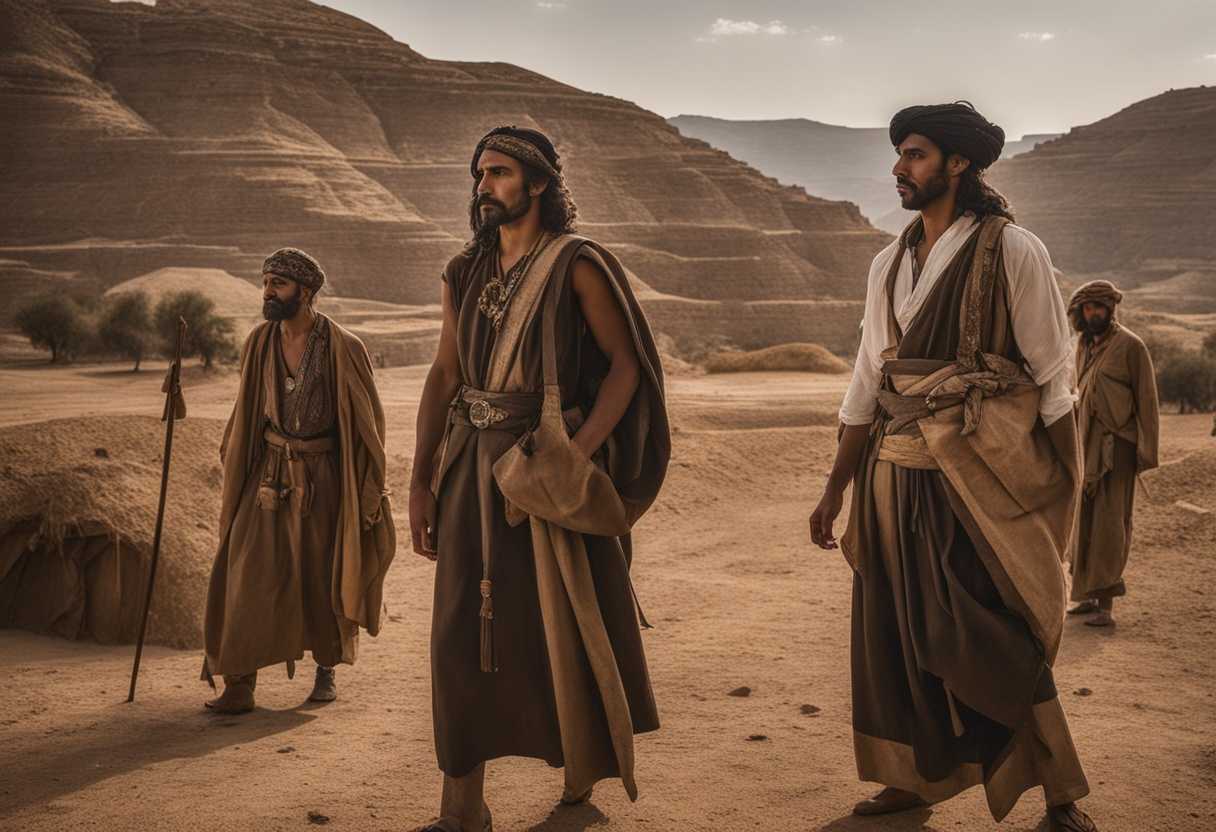
Setting the Scene for Numbers 32:1-33
The scene unfolds in the vast plains of Moab, a region characterized by rolling hills and expansive grasslands, just east of the Jordan River. The air is thick with anticipation as the Israelites, weary from their long journey through the wilderness, gather to discuss their future. Among them are the tribes of Reuben and Gad, who stand apart from the rest, their faces reflecting a mix of determination and concern. They have just returned from surveying the land of Jazer and Gilead, where they found lush pastures ideal for their livestock. The sun hangs low in the sky, casting a golden hue over the landscape, and the sound of sheep bleating fills the air, a reminder of the wealth they could amass if they settle here.
Moses, the revered leader of the Israelites, stands before the assembly, his weathered face etched with the burdens of leadership. He has led this people through trials and tribulations, and now, as they stand on the brink of entering the Promised Land, he feels the weight of their decisions. The tribes of Reuben and Gad express their desire to remain in this fertile land rather than cross the Jordan with the rest of the Israelites. Their request is met with mixed reactions; some are supportive, seeing the practicality of their choice, while others are concerned about the implications of abandoning their fellow tribes in the conquest of Canaan. The tension in the air is palpable as Moses listens intently, weighing their words against the backdrop of God’s promises.
As the discussion unfolds, the surrounding landscape serves as a poignant reminder of the journey they have undertaken. The mountains of Gilead rise majestically in the distance, a symbol of the challenges that lie ahead. The Israelites are reminded of their covenant with God, who has promised them a land flowing with milk and honey. The murmurs of the crowd echo the uncertainty of their future, as they grapple with the implications of the Reubenites’ and Gadites’ choice. Will they stand united as one people, or will this decision sow discord among them? The scene is charged with emotion, as the fate of the tribes hangs in the balance, and the legacy of their journey is about to be shaped by the choices they make in this pivotal moment.
What is Numbers 32:1-33 about?
Reuben and Gad, the tribes, make a significant request to Moses in this biblical verse as they stand on the precipice of entering the Promised Land. They ask for land to be allocated to them east of the Jordan River, which was considered less desirable compared to the fertile lands west of the Jordan. Why do you think they chose this land? Was it merely for the sake of convenience, or was there a deeper reason tied to their identity and aspirations? Their request reveals much about their priorities and motivations, prompting us to reflect on our own choices.
Additionally, the tribes of Reuben and Gad vow to support the Israelites in battle despite their choice to settle away from the main body of the nation. This commitment speaks volumes about their loyalty and sense of responsibility. Are their actions an embodiment of self-interest or a genuine desire to contribute to a greater cause? They understood the importance of unity and collaboration in challenging times. Their promise to fight alongside their brethren illustrates a broader idea—sometimes, we must make sacrifices to ensure the success and well-being of those we hold dear. We consider how our individual decisions affect our community in our own lives. Are we prepared to support others, even when we are charting our own course? This interaction between the tribes and Moses ultimately serves as a powerful reminder of the complexities of leadership, loyalty, and community values. It encourages us to ponder the balance between individual desires and collective responsibilities, whether in historical contexts, personal relationships, or contemporary societal issues. We might reflect on the commitments we make and the ways in which we choose to support one another as we navigate our own paths. How can we ensure that our personal choices are harmonized with the greater good?
Understanding what Numbers 32:1-33 really means
In Numbers 32, we encounter a pivotal moment for the Israelites as they stand on the brink of entering the Promised Land. The tribes of Reuben and Gad express a desire to settle in the land east of the Jordan River, a choice that raises significant questions about commitment, faith, and leadership responsibilities. Their request is not merely a geographical preference; it reflects deeper tensions between personal desires and communal obligations. What does it mean to prioritize individual comfort over collective faithfulness to God’s promises?
The decision of the Reubenites and Gadites symbolizes a struggle that many of us face today. It highlights the tension between seeking immediate security and remaining faithful to a larger calling. Their choice prompts us to reflect on our own lives: Are we settling for what feels comfortable, or are we willing to step into the unknown, trusting in God’s greater plan? This passage serves as a reminder that our choices can have far-reaching implications, not just for ourselves but for our communities and the mission of the Church.
To further understand this dynamic, we can look at related biblical passages. In Joshua 1:16-18, the emphasis on unity among the tribes as they prepare to enter the Promised Land underscores the importance of collective commitment. Similarly, Hebrews 11:8-10 recounts Abraham’s faith in leaving his homeland for a promised inheritance, contrasting the call to follow God with the allure of immediate comfort. These scriptures invite us to consider how faith often requires us to leave behind what is familiar for the sake of a greater purpose.
In our modern context, many of us grapple with decisions that pit personal comfort against communal responsibility. The desire for security can lead us to settle for less than what God has promised. This passage challenges us to evaluate how our choices impact not only our lives but also the lives of those around us. Are we willing to embrace the discomfort that comes with pursuing God’s mission, or do we cling to our own desires?
I recall a time when our church faced a decision about expanding our outreach program. Some members were hesitant, preferring the comfort of the status quo. However, after much prayer and discussion, we recognized that stepping out in faith could lead to greater blessings for our community. This mirrors the choice faced by the Reubenites and Gadites—will we prioritize our comfort or embrace the call to serve?
Several phrases in this passage stand out for their significance. When the Reubenites say, “We will build sheepfolds here for our livestock,” it illustrates their desire for immediate security. This focus on personal needs raises an important question: Are we prioritizing our comfort at the expense of our spiritual journey? Conversely, their commitment to not return home until every Israelite has received their inheritance reflects a willingness to sacrifice personal desires for the sake of others. True leadership, as this passage reminds us, involves putting the needs of the community above our own. Finally, the phrase “Your brothers are going to go to war” emphasizes the importance of unity and shared responsibility, challenging us to consider how our actions affect those around us.
In conclusion, Numbers 32 serves as a powerful reminder of the choices we face in our spiritual journeys. It calls us to reflect on our priorities and encourages us to embrace a faith that is willing to step out of comfort zones for the sake of God’s greater purpose. As we navigate our own paths, may we be inspired to support one another and remain committed to the mission God has set before us. How will you respond to the call to prioritize community over comfort in your own life?
Am I prioritizing my spiritual journey over worldly desires?
The passage focuses on the decision-making process of the Israelites as they approach their promised land. The Reubenites and Gadites express a desire to settle in a land that is appealing to them, prioritizing immediate comfort and benefits over the collective spiritual journey of their people. This illustrates a tension between worldly desires—symbolized by the lush land they wish to inhabit—and the spiritual commitment to fulfill a divine promise.
Your own spiritual journey should be evaluated against similar criteria. Are you allowing immediate comforts or personal pursuits to distract you from a higher calling? If your choices reflect a desire to secure temporary satisfaction at the expense of deeper spiritual growth, it may indicate a misalignment in your priorities. Engaging in self-reflection can reveal if you are leaning more toward worldly desires rather than striving for a higher purpose. Striving for a deeper understanding and connection to one’s beliefs in spiritual progress ultimately requires sacrifice and a willingness to look beyond immediate gratifications. It’s important to assess whether you’re committed to your spiritual journey, encouraging growth and unity, rather than yielding to desires that may seem appealing but fall short of a meaningful legacy or transformation.
Application
Imagine you’re part of a team at work, striving towards a shared goal. Just like in that setting, your choices can shape the entire group, especially when it comes to your family or community. Are you chasing after your own ambitions while neglecting your responsibilities to those you care about? Take a moment to think about what you can give up to lift others up. Your commitment can make a real difference in the lives around you. So, are you ready to step up and support your community for a greater purpose?

Reverend Michael Johnson is an experienced Church Minister with a profound expertise in spirituality and guidance. With a serene presence and a compassionate heart, he has faithfully served his congregation for over 20 years, leading them on a spiritual journey towards inner peace and enlightenment. Reverend Johnson’s extensive knowledge of religious philosophies and profound understanding of human nature have made him a trusted confidant and mentor to many, as he seamlessly weaves his profound wisdom into life teachings. Reverend Johnson’s calming demeanor and empathetic nature continue to uplift and heal souls, nurturing a sense of unity and tranquility within his community.