
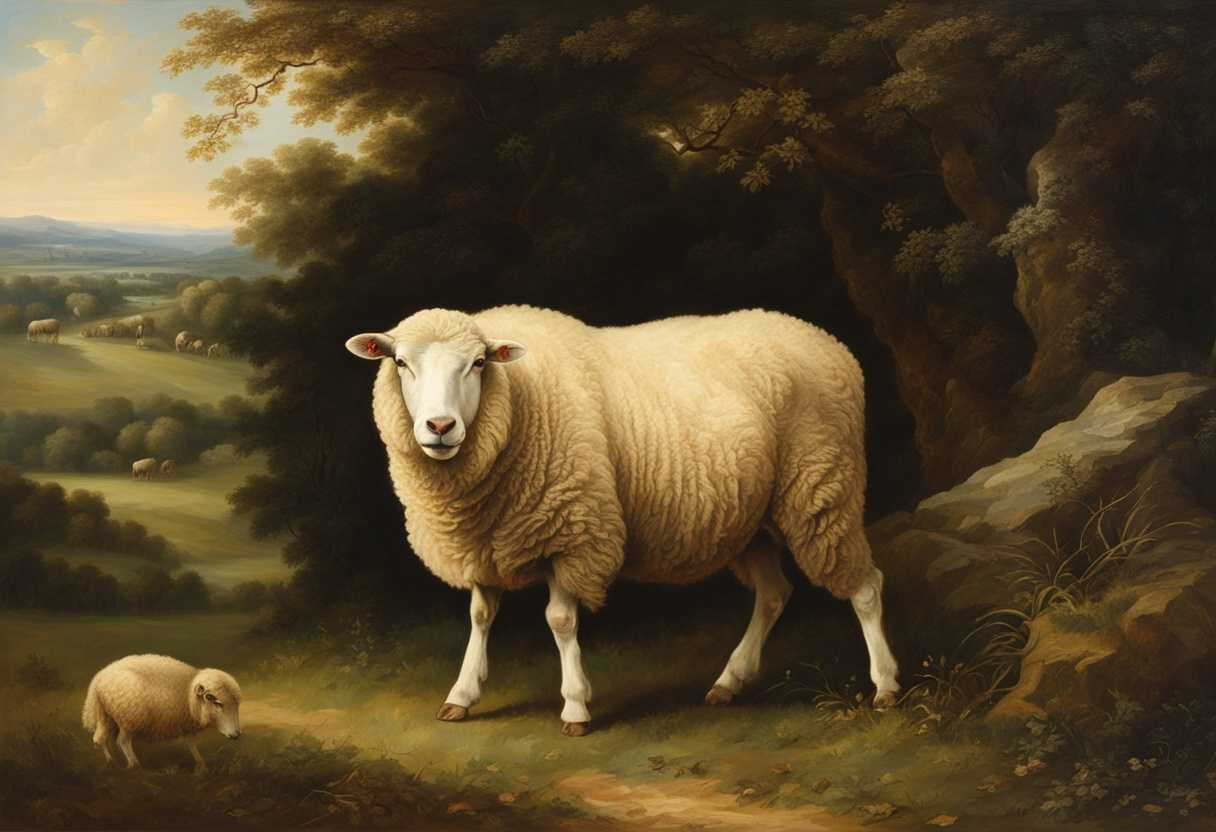
The term “black sheep” is not explicitly mentioned in the Bible, but it is often used to describe an individual who deviates from the norms or expectations of their family or community. In biblical contexts, it can symbolize sinfulness or being an outcast, akin to the parables of the lost sheep (Luke 15:4-7), illustrating God’s concern for those who stray from the righteous path.
Scripture
3 Now Israel loved Joseph more than any other of his sons, because he was the son of his old age. And he made him a robe of many colors.
4 But when his brothers saw that their father loved him more than all his brothers, they hated him and could not speak peacefully to him.
5 Now Joseph had a dream, and when he told it to his brothers they hated him even more.
6 He said to them, “Hear this dream that I have dreamed:
7 And behold, we were binding sheaves in the field, and behold, my sheaf arose and stood upright.
8 His brothers said to him, “Are you indeed to reign over us? Or are you indeed to rule over us?” So they hated him even more for his dreams and for his words.
9 Then he dreamed another dream and told it to his brothers and said, “Behold, I have dreamed another dream. Behold, the sun, the moon, and eleven stars were bowing down to me.”
10 But when he told it to his father and to his brothers, his father rebuked him and said to him, “What is this dream that you have dreamed? Shall I and your mother and your brothers indeed come to bow ourselves to the ground before you?”
11 His brothers were jealous of him, but his father kept the saying in mind.
Biblical Significance of “Black Sheep”
The concept of the “black sheep,” while not directly referenced in Biblical text, can be interpreted through various scriptural narratives that highlight themes of deviation from communal or familial norms, sinfulness, and acceptance. In Luke 15:4-7, Jesus tells the parable of the lost sheep, which speaks to God’s unwavering love and pursuit of individuals who stray from His fold. This parable emphasizes that every soul is precious to God, including those who may be labeled as misfits or “black sheep” within their families or societies. The shepherd’s determination to find the one lost sheep serves as a powerful reminder of grace that transcends societal judgment and the innate worth of every person.
Furthermore, the story of Cain and Abel in Genesis (Genesis 4:1-16) illustrates the theme of being an outsider within one’s own family. Cain, with his resentment toward Abel, becomes a figurative “black sheep,” representing the consequences of jealousy and moral failure. God’s warning to Cain about sin’s desire to master him reflects a deeper understanding of the human condition and the potential for redemption. In this light, “black sheep” can symbolize not only those who err but also the possibility of transformation and divine acceptance, inviting individuals back into the fold regardless of their pasts. Through these narratives, the notion of being a “black sheep” can resonate with the idea of God’s relentless pursuit of sinners, offering hope and demonstrating that every wayward heart can find its way back home.
Another way to explore the concept of the “black sheep” in the Bible is through the story of the Prodigal Son, found in Luke 15:11-32. This parable presents the experience of a young man who chooses to abandon his family, squandering his inheritance on reckless living. Upon realizing his folly, he decides to return home, uncertain of how he will be received. His father, a figure of unconditional love and grace, welcomes him back with open arms, illustrating the profound message that even those who stray farthest can find redemption. This narrative echoes the sentiments surrounding “black sheep,” as it underscores the idea that one’s past mistakes do not define their worth in the eyes of God or in the eyes of those who genuinely love them. Instead, it celebrates reconciliation and the joy that accompanies the return of one who was lost.
Additionally, the character of Matthew, the tax collector, exemplifies the idea of the “black sheep” as he was considered an outcast by society due to his profession, often viewed as corrupt and sinful. Yet, Jesus calls Matthew to be one of His disciples, showcasing that divine purpose and acceptance can extend to those deemed unworthy by societal standards. In this context, the notion of a “black sheep” emphasizes the transformative power of grace—Jesus’ choice to engage with those on the fringes signifies a radical inclusion that transcends social norms. Through these reflections, we see that the Bible consistently acknowledges the complexities of human behavior while simultaneously affirming the hope of redemption and belonging for individuals who may feel alienated or marginalized.
The Concept of the Outcast
In biblical narratives, the term “black sheep” can symbolize those who are marginalized or considered outcasts within their communities. This reflects the broader theme of God’s love and acceptance for all individuals, regardless of their societal status or perceived shortcomings. The Bible often highlights the importance of reaching out to those who are deemed unworthy or different, emphasizing that they too have a place in God’s kingdom.
Redemption and Transformation
Another significant meaning of “black sheep” in the Bible relates to the potential for redemption and transformation. Many biblical figures who initially strayed from the path of righteousness ultimately experienced profound change and became instruments of God’s purpose. This illustrates the idea that no one is beyond the reach of divine grace, and that even those who may be seen as “black sheep” can find forgiveness and a new identity in faith.
The Value of Individuality
The notion of the “black sheep” also speaks to the value of individuality and the unique roles that different people play within the larger community of believers. Just as a black sheep stands out among a flock of white sheep, individuals who may not conform to societal norms or expectations can bring diverse perspectives and gifts to the body of Christ. This diversity is celebrated in the Bible, as it reflects the multifaceted nature of God’s creation and the importance of every person’s contribution to the community of faith.
How to Embrace Redemption and Foster True Community
Embracing redemption is a transformative journey that begins with acknowledging our imperfections and seeking God’s grace, which is freely offered to us through Christ. As we accept this gift, we not only experience personal healing but also become vessels of that grace in our communities. To foster true community, we must cultivate an environment of openness and vulnerability, where we can share our struggles and triumphs without fear of judgment. This means actively listening to one another, offering support, and celebrating each other’s victories, no matter how small. Remember, true community is built on love, forgiveness, and the shared understanding that we are all works in progress, continually shaped by God’s redemptive power. So, let’s step out in faith, reach out to those around us, and create spaces where everyone feels valued and accepted, reflecting the heart of Christ in our relationships.
Bible References to “Black Sheep” Meaning:
Genesis 37:18-28: 18 They saw him from afar, and before he came near to them, they conspired against him to kill him.
19 They said to one another, “Here comes this dreamer.
20 Come now, let us kill him and throw him into one of the pits. Then we will say that a fierce animal has devoured him, and we will see what will become of his dreams.”
21 But when Reuben heard it, he rescued him out of their hands, saying, “Let us not take his life.”
22 And Reuben said to them, “Shed no blood; throw him into this pit here in the wilderness, but do not lay a hand on him”—that he might rescue him out of their hand to restore him to his father.
23 So when Joseph came to his brothers, they stripped him of his robe, the robe of many colors that he wore.
24 Then they took him and threw him into a pit. The pit was empty; there was no water in it.
25 Then they sat down to eat. And looking up they saw a caravan of Ishmaelites coming from Gilead, with their camels bearing gum, balm, and myrrh, on their way to carry it down to Egypt.
26 Then Judah said to his brothers, “What profit is it if we kill our brother and conceal his blood?
27 Come, let us sell him to the Ishmaelites, and let not our hand be upon him, for he is our brother, our own flesh. And his brothers listened to him.
28 Then Midianite traders passed by. And they drew Joseph up and lifted him out of the pit, and sold him to the Ishmaelites for twenty shekels of silver. They took Joseph to Egypt.
Genesis 4:3-12: 3 In the course of time Cain brought to the Lord an offering of the fruit of the ground.
4 and Abel also brought of the firstborn of his flock and of their fat portions. And the Lord had regard for Abel and his offering,
5 but for Cain and his offering he had no regard. So Cain was very angry, and his face fell.
6 The Lord said to Cain, “Why are you angry, and why has your face fallen?
7 If you do well, will you not be accepted? And if you do not do well, sin is crouching at the door. Its desire is contrary to you, but you must rule over it.”
8 Cain spoke to Abel his brother. And when they were in the field, Cain rose up against his brother Abel and killed him.
9 Then the Lord said to Cain, “Where is Abel your brother?” He said, “I do not know; am I my brother’s keeper?”
10 And the Lord said, “What have you done? The voice of your brother’s blood is crying to me from the ground.
11 And now you are cursed from the ground, which has opened its mouth to receive your brother’s blood from your hand.
12 When you work the ground, it shall no longer yield to you its strength. You shall be a fugitive and a wanderer on the earth.
1 Samuel 16:1-13: 16 The Lord said to Samuel, “How long will you grieve over Saul, since I have rejected him from being king over Israel? Fill your horn with oil, and go. I will send you to Jesse the Bethlehemite, for I have provided for myself a king among his sons.”
2 And Samuel said, “How can I go? If Saul hears it, he will kill me.” And the Lord said, “Take a heifer with you and say, ‘I have come to sacrifice to the Lord.’
3 Invite Jesse to the sacrifice, and I will show you what you shall do. And you shall anoint for me him whom I declare to you.”
4 Samuel did what the Lord commanded and came to Bethlehem.
5 And he said, “Peaceably; I have come to sacrifice to the Lord. Consecrate yourselves, and come with me to the sacrifice.” And he consecrated Jesse and his sons and invited them to the sacrifice.
6 When they came, he looked on Eliab and thought, “Surely the Lord’s anointed is before him.”
7 But the Lord said to Samuel, “Do not look on his appearance or on the height of his stature, because I have rejected him. For the Lord sees not as man sees: man looks on the outward appearance, but the Lord looks on the heart.”
8 Then Jesse called Abinadab and made him pass before Samuel. And he said, “Neither has the Lord chosen this one.”
9 Then Jesse made Shammah pass by. And he said, “Neither has the Lord chosen this one.”
10 Thus Jesse made seven of his sons pass before Samuel. And Samuel said to Jesse, “The Lord has not chosen these.”
11 Then Samuel said to Jesse, “Are all your sons here?” And he said, “There remains yet the youngest, but behold, he is keeping the sheep.” And Samuel said to Jesse, “Send and get him, for we will not sit down till he comes here.”
12 And he sent and brought him in. Now he was ruddy and had beautiful eyes and was handsome. And the Lord said, “Arise, anoint him, for this is he.”
13 Then Samuel took the horn of oil and anointed him in the midst of his brothers. And the Spirit of the Lord rushed upon David from that day forward. And Samuel rose up and went to Ramah.
1 Samuel 17:28-30: 28 Now Eliab his eldest brother heard when he spoke to the men. And Eliab’s anger was kindled against David, and he said, “Why have you come down? And with whom have you left those few sheep in the wilderness? I know your presumption and the evil of your heart, for you have come down to see the battle.”
29 And David said, “What have I done now? Was it not but a word?”
30 Then he turned away from him toward another, and spoke in the same way, and the people answered him again as before.
1 Samuel 18:6-9: 6 As they were coming home, when David returned from striking down the Philistine, the women came out of all the cities of Israel, singing and dancing, to meet King Saul, with tambourines, with songs of joy, and with musical instruments.
7 And the women sang to one another as they celebrated, “Saul has struck down his thousands, and David his ten thousands.”
8 And Saul was very angry, and this saying displeased him. He said, “They have ascribed to David ten thousands, and to me they have ascribed thousands, and what more can he have but the kingdom?”
9 And Saul eyed David from that day on.
1 Samuel 19:1-10: 1 And Saul spoke to Jonathan his son and to all his servants, that they should kill David.
2 And Jonathan told David, “Saul my father seeks to kill you. Therefore be on your guard in the morning. Stay in a secret place and hide yourself.
3 And I will go out and stand beside my father in the field where you are, and I will speak to my father about you. And if I learn anything I will tell you.”
4 And Jonathan spoke well of David to Saul his father and said to him, “Let not the king sin against his servant David, because he has not sinned against you, and because his deeds have brought good to you.
5 For he took his life in his hand and he struck down the Philistine, and the Lord worked a great salvation for all Israel. You saw it, and rejoiced. Why then will you sin against innocent blood by killing David without cause?”
6 And Saul listened to the voice of Jonathan. Saul swore, “As the Lord lives, he shall not be put to death.”
7 And Jonathan called David, and Jonathan reported to him all these things. And Jonathan brought David to Saul, and he was in his presence as before.
8 And there was war again. And David went out and fought with the Philistines and struck them with a great blow, so that they fled before him.
9 Then a harmful spirit from the Lord came upon Saul, as he sat in his house with his spear in his hand. And David was playing the lyre.
10 And Saul sought to pin David to the wall with the spear, but he eluded Saul, so that he struck the spear into the wall. And David fled and escaped that night.
1 Samuel 20:30-34: 30 Then Saul’s anger was kindled against Jonathan, and he said to him, “You son of a perverse, rebellious woman, do I not know that you have chosen the son of Jesse to your own shame, and to the shame of your mother’s nakedness?
31 For as long as the son of Jesse lives on the earth, neither you nor your kingdom shall be established. Therefore send and bring him to me, for he shall surely die.”
32 And Jonathan answered Saul his father, “Why should he be put to death? What has he done?”
33 But Saul hurled his spear at him to strike him. So Jonathan knew that his father was determined to put David to death.
34 Jonathan rose from the table in fierce anger and ate no food the second day of the month, for he was grieved for David, because his father had disgraced him.
1 Samuel 22:6-23: 6 Now Saul heard that David was discovered, and the men who were with him. Saul was sitting at Gibeah under the tamarisk tree on the height with his spear in his hand, and all his servants were standing about him.
7 And Saul said to his servants who stood about him, “Hear now, people of Benjamin; will the son of Jesse give every one of you fields and vineyards, will he make you all commanders of thousands and commanders of hundreds,
8 that all of you have conspired against me? No one discloses to me when my son makes a covenant with the son of Jesse. And none of you is sorry for me or discloses to me that my son has stirred up my servant against me, to lie in wait, as at this day.”
9 Then answered Doeg the Edomite, who stood by the servants of Saul, “I saw the son of Jesse coming to Nob, to Ahimelech the son of Ahitub,
10 And he inquired of the Lord for him and gave him provisions. He also gave him the sword of Goliath the Philistine.”
11 Then the king sent to summon Ahimelech the priest, the son of Ahitub, and all his father’s house, the priests who were at Nob, and all of them came to the king.
12 And Saul said, “Hear now, son of Ahitub.” And he answered, “Here I am, my lord.”
13 And Saul said to him, “Why have you conspired against me, you and the son of Jesse, in that you have given him bread and a sword and have inquired of God for him, so that he has risen against me, to lie in wait, as at this day?”
14 Then Ahimelech answered the king, “And who among all your servants is so faithful as David, who is the king’s son-in-law, and captain over your bodyguard, and honored in your house?
15 Did I then begin to inquire of God for him? No! Far be it from me. Let not the king impute anything to his servant or to all the house of my father, for your servant has known nothing of all this, much or little.”
16 And the king said, “You shall surely die, Ahimelech, you and all your father’s house.”
17 And the king said to the guard who stood about him, “Turn and kill the priests of the Lord, because their hand also is with David, and they knew that he fled and did not disclose it to me.” But the servants of the king would not put out their hand to strike the priests of the Lord.
18 Then the king said to Doeg, “You turn and strike the priests.” And Doeg the Edomite turned and struck down the priests, and he killed on that day eighty-five persons who wore the linen ephod.
19 And Nob, the city of the priests, he put to the sword; both man and woman, child and infant, ox, donkey, and sheep, he put to the sword.
20 But one of the sons of Ahimelech the son of Ahitub, named Abiathar, escaped and fled after David.
21 And Abiathar told David that Saul had killed the priests of the Lord.
22 And David said to Abiathar, “I knew on that day, when Doeg the Edomite was there, that he would surely tell Saul. I have occasioned the death of all the persons of your father’s house.
23 Stay with me; do not be afraid, for he who seeks my life seeks your life. With me you shall be safe.”
1 Samuel 24:1-22: 1 When Saul returned from following the Philistines, he was told, “Behold, David is in the wilderness of Engedi.”
2 Then Saul took three thousand chosen men out of all Israel and went to seek David and his men in front of the Wildgoats’ Rocks.
3 And he came to the sheepfolds by the way, where there was a cave, and Saul went in to relieve himself. Now David and his men were sitting in the innermost parts of the cave.
4 And the men of David said to him, “Here is the day of which the Lord said to you, ‘Behold, I will give your enemy into your hand, and you shall do to him as it shall seem good to you.’” Then David arose and stealthily cut off a corner of Saul’s robe.
5 And afterward David’s heart struck him, because he had cut off a corner of Saul’s robe.
6 He said to his men, “The Lord forbid that I should do this thing to my lord, the Lord’s anointed, to put out my hand against him, seeing he is the Lord’s anointed.”
7 So David persuaded his men with these words and did not permit them to attack Saul. And Saul rose up and left the cave and went on his way.
8 Afterward David also arose and went out of the cave, and called after Saul, “My lord the king!” And when Saul looked behind him, David bowed with his face to the earth and paid homage.
9 And David said to Saul, “Why do you listen to the words of men who say, ‘Behold, David seeks your harm’?
10 Behold, this day your eyes have seen how the Lord gave you today into my hand in the cave. And some told me to kill you, but I spared you. I said, ‘I will not put out my hand against my lord, for he is the Lord’s anointed.’
11 See, my father, see the corner of your robe in my hand. For by the fact that I cut off the corner of your robe and did not kill you, you may know and see that there is no wrong or treason in my hands. I have not sinned against you, though you hunt my life to take it.
12 May the Lord judge between me and you, may the Lord avenge me against you, but my hand shall not be against you.
13 As the proverb of the ancients says, ‘Out of the wicked comes wickedness.’ But my hand shall not be against you.
14 After whom has the king of Israel come out? After whom do you pursue? After a dead dog! After a flea!
15 May the Lord therefore be judge and give sentence between me and you, and see to it and plead my cause and deliver me from your hand.”
16 As soon as David had finished speaking these words to Saul, Saul said, “Is this your voice, my son David?” And Saul lifted up his voice and wept.
17 He said to David, “You are more righteous than I, for you have repaid me good, whereas I have repaid you evil.
18 And you have declared this day how you have dealt well with me, in that you did not kill me when the Lord put me into your hands.
19 For if a man finds his enemy, will he let him go away safe? So may the Lord reward you with good for what you have done to me this day.
20 And now, behold, I know that you shall surely be king, and that the kingdom of Israel shall be established in your hand.
21 Swear to me therefore by the Lord that you will not cut off my offspring after me, and that you will not destroy my name out of my father’s house.
22 And David swore this to Saul. Then Saul went home, but David and his men went up to the stronghold.
1 Samuel 26:1-25: 1 Then the Ziphites came to Saul at Gibeah, saying, “Is not David hiding himself on the hill of Hachilah, which is on the east of Jeshimon?”
2 So Saul arose and went down to the wilderness of Ziph with three thousand chosen men of Israel to seek David in the wilderness of Ziph.
3 And Saul encamped on the hill of Hachilah, which is beside the road on the east of Jeshimon. But David remained in the wilderness.
4 David sent out spies and learned that Saul had come in very deed.
5 Then David rose and came to the place where Saul had encamped. And David saw the place where Saul lay, with Abner the son of Ner, the commander of his army. Saul was lying within the encampment, while the army was encamped around him.
6 Then David said to Ahimelech the Hittite, and to Joab’s brother Abishai the son of Zeruiah, “Who will go down with me into the camp to Saul?” And Abishai said, “I will go down with you.”
7 So David and Abishai went to the army by night. And there lay Saul sleeping within the encampment, with his spear stuck in the ground at his head, and Abner and the army lay around him.
8 Then said Abishai to David, “God has given your enemy into your hand this day. Now please let me pin him to the earth with one stroke of the spear, and I will not strike him twice.”
9 But David said to Abishai, “Do not destroy him, for who can put out his hand against the Lord’s anointed and be guiltless?”
10 And David said, “As the Lord lives, the Lord will strike him, or his day will come to die, or he will go down into battle and perish.
11 The Lord forbid that I should put out my hand against the Lord’s anointed.
12 So David took the spear and the jar of water from Saul’s head, and they went away. No man saw it or knew it, nor did any awake, for they were all asleep, because a deep sleep from the Lord had fallen upon them.
13 Then David went over to the other side and stood far off on the top of the hill, with a great space between them.
14 And David called out to the army and to Abner the son of Ner, saying, “Will you not answer, Abner?” Then Abner answered, “Who are you who calls to the king?”
15 And David said to Abner, “Are you not a man? Who is like you in Israel? Why then have you not kept watch over your lord the king? For one of the people came in to destroy your lord the king.
16 This thing that you have done is not good. As the Lord lives, you deserve to die, because you have not kept watch over your lord, the Lord’s anointed. And now see where the king’s spear is and the jar of water that was at his head.”
17 The Lord rewards every man for his righteousness and his faithfulness, for the Lord gave you into my hand today, and I would not put out my hand against the Lord’s anointed.
18 And he said, “Why does my lord pursue after his servant? For what have I done? What evil is on my hands?
19 Now therefore let my lord the king hear the words of his servant. If it is the Lord who has stirred you up against me, may he accept an offering, but if it is men, may they be cursed before the Lord, for they have driven me out this day that I should have no share in the heritage of the Lord, saying, ‘Go, serve other gods.’
20 Now therefore, let not my blood fall to the earth away from the presence of the Lord, for the king of Israel has come out to seek a single flea like one who hunts a partridge in the mountains.
21 Then Saul said, “I have sinned. Return, my son David, for I will no more do you harm, because my life was precious in your eyes this day. Behold, I have acted foolishly, and have made a great mistake.”
22 And David answered and said, “Here is the spear, O king! Let one of the young men come over and take it.
23 The Lord rewards every man for his righteousness and his faithfulness, for the Lord gave you into my hand today, and I would not put out my hand against the Lord’s anointed.
24 Behold, as your life was precious this day in my sight, so may my life be precious in the sight of the Lord, and may he deliver me out of all tribulation.
25 Then Saul said to David, “Blessed be you, my son David! You will do many things and will succeed in them.” So David went his way, and Saul returned to his place.
2 Samuel 15:1-12: 1 After this Absalom got himself a chariot and horses, and fifty men to run before him.
2 And Absalom used to rise early and stand beside the way of the gate. And when any man had a dispute to come before the king for judgment, Absalom would call to him and say, “From what city are you?” And when he said, “Your servant is of such and such a tribe in Israel,”
3 And Absalom would say to him, “See, your claims are good and right, but there is no man designated by the king to hear you.”
4 Then Absalom would say, “Oh that I were judge in the land! Then every man with a dispute or cause might come to me, and I would give him justice.”
5 And when anyone came near to pay homage to him, he would put out his hand and take hold of him and kiss him.
6 And on this manner did Absalom to all Israel who came to the king for judgment. So Absalom stole the hearts of the men of Israel.
7 And at the end of four years Absalom said to the king, “Please let me go and pay my vow, which I have vowed to the Lord, in Hebron.
8 For your servant vowed a vow while I lived at Geshur in Aram, saying, ‘If the Lord will indeed bring me back to Jerusalem, then I will offer worship to the Lord.’”
9 And the king said to him, “Go in peace.” So he arose and went to Hebron.
10 But Absalom sent secret messengers throughout all the tribes of Israel, saying, “As soon as you hear the sound of the trumpet, then say, ‘Absalom is king in Hebron.’”
11 With Absalom went two hundred men from Jerusalem who were invited guests, and they went in their innocence and knew nothing.
12 And while Absalom was offering the sacrifices, he sent for Ahithophel the Gilonite, David’s counselor, from his city Giloh. And the conspiracy grew strong, and the people with Absalom kept increasing.
2 Samuel 15:13-37: 13 And a messenger came to David, saying, “The hearts of the men of Israel have gone after Absalom.”
14 Then David said to all his servants who were with him at Jerusalem, “Arise, and let us flee, or else there will be no escape for us from Absalom. Go quickly, lest he overtake us quickly and bring down ruin on us and strike the city with the edge of the sword.”
15 And the king’s servants said to the king, “Behold, your servants are ready to do whatever my lord the king decides.”
16 And the king went out, and all his household after him. And the king left ten concubines to keep the house.
17 And the king went out, and all the people after him, and they halted at the last house.
18 And all his servants passed by him, and all the Cherethites, and all the Pelethites, and all the six hundred Gittites who had followed him from Gath, passed on before the king.
19 Then the king said to Ittai the Gittite, “Why do you also go with us? Go back and stay with the king, for you are a foreigner and also an exile from your home.
20 You came only yesterday, and shall I today make you wander about with us, since I go I know not where? Go back and take your brothers with you, and may the Lord show steadfast love and faithfulness to you.”
21 But Ittai answered the king, “As the Lord lives, and as my lord the king lives, wherever my lord the king shall be, whether for death or for life, there also will your servant be.”
22 And David said to Ittai, “Go then, pass on.” So Ittai the Gittite passed on with all his men and all the little ones who were with him.
23 And all the land wept aloud as all the people passed by, and the king crossed the brook Kidron, and all the people passed on toward the wilderness.
24 And Abiathar came up, and behold, Zadok came also with all the Levites, bearing the ark of the covenant of God. And they set down the ark of God until the people had all passed out of the city.
25 Then the king said to Zadok, “Carry the ark of God back into the city. If I find favor in the eyes of the Lord, he will bring me back and let me see both it and his dwelling place.
26 But if he says, ‘I have no pleasure in you,’ behold, here I am, let him do to me what seems good to him.”
27 The king also said to Zadok the priest, “Are you not a seer? Go back to the city in peace, with your two sons, Ahimaaz your son, and Jonathan the son of Abiathar.
28 See, I will wait at the fords of the wilderness until word comes from you to inform me.”
29 So Zadok and Abiathar carried the ark of God back to Jerusalem, and they remained there.
30 But David went up the ascent of the Mount of Olives, weeping as he went, barefoot and with his head covered. And all the people who were with him covered their heads, and they went up, weeping as they went.
31 And it was told David, “Ahithophel is among the conspirators with Absalom.” And David said, “O Lord, please turn the counsel of Ahithophel into foolishness.”
32 While David was coming to the summit, where God was worshiped, behold, Hushai the Archite came to meet him with his coat torn and dirt on his head.
33 And David said to him, “If you go on with me, you will be a burden to me.
34 But if you return to the city and say to Absalom, ‘I will be your servant, O king; as I have been your father’s servant in time past, so now I will be your servant,’ then you will defeat for me the counsel of Ahithophel.
35 Are not Zadok and Abiathar the priests with you there? So whatever you hear from the king’s house, tell it to Zadok and Abiathar the priests.
36 Behold, their two sons are with them there, Ahimaaz, Zadok’s son, and Jonathan, Abiathar’s son, and by them you shall send to me everything you hear.”
37 So Hushai, David’s friend, came into the city, just as Absalom was entering Jerusalem.
2 Samuel 16:5-14: 5 When King David came to Bahurim, there came out a man of the family of the house of Saul, whose name was Shimei, the son of Gera, and as he came he cursed continually.
6 And he threw stones at David and at all the servants of King David, and all the people and all the mighty men were on his right hand and on his left.
7 And Shimei said as he cursed, “Get out, get out, you man of blood, you worthless man!
8 The Lord has avenged on you all the blood of the house of Saul, in whose place you have reigned, and the Lord has given the kingdom into the hand of your son Absalom. See, your evil is on you, for you are a man of blood.”
9 Then Abishai the son of Zeruiah said to the king, “Why should this dead dog curse my lord the king? Let me go over and take off his head.”
10 But the king said, “What have I to do with you, you sons of Zeruiah? If he is cursing because the Lord has said to him, ‘Curse David,’ who then shall say, ‘Why have you done so?’
11 And David said to Abishai and to all his servants, “Behold, my own son seeks my life; how much more now may this Benjaminite! Leave him alone, and let him curse, for the Lord has told him to.
12 It may be that the Lord will look on the wrong done to me, and that the Lord will repay me with good for his cursing today.”
13 So David and his men went on the road, while Shimei went along on the hillside opposite him and cursed as he went and threw stones at him and flung dust.
14 And the king, and all the people who were with him, arrived weary at the Jordan. And there he refreshed himself.
2 Samuel 18:1-18: 1 Then David mustered the men who were with him and set over them commanders of thousands and commanders of hundreds.
2 And David sent out the army, one third under the command of Joab, one third under the command of Abishai the son of Zeruiah, Joab’s brother, and one third under the command of Ittai the Gittite. And the king said to the men, “I myself will also go out with you.”
3 But the men said, “You shall not go out. For if we flee, they will not care about us. If half of us die, they will not care about us. But you are worth ten thousand of us. Therefore it is better that you send us help from the city.”
4 And the king said to them, “Whatever seems best to you I will do.” So the king stood at the side of the gate, while all the army marched out by hundreds and by thousands.
5 And the king ordered Joab and Abishai and Ittai, “Deal gently for my sake with the young man Absalom.” And all the people heard when the king gave orders to all the commanders about Absalom.
6 So the army went out into the field against Israel, and the battle was fought in the forest of Ephraim.
7 And the men of Israel were defeated there by the servants of David, and the loss there was great on that day, twenty thousand men.
8 The men of Israel were defeated there by the servants of David, and the loss there was great on that day, twenty thousand men.
9 And Absalom happened to meet the servants of David. Absalom was riding on his mule, and the mule went under the thick branches of a great oak, and his head caught fast in the oak, and he was suspended between heaven and earth, while the mule that was under him went on.
10 And a certain man saw it and told Joab, “Behold, I saw Absalom hanging in an oak.”
11 And Joab said to the man who told him, “What, you saw him! Why then did you not strike him there to the ground? I would have been glad to give you ten pieces of silver and a belt.”
12 But the man said to Joab, “Even if I felt in my hand the weight of a thousand pieces of silver, I would not reach out my hand against the king’s son, for in our hearing the king commanded you and Abishai and Ittai, ‘For my sake protect the young man Absalom.’
13 And Joab the son of Zeruiah and the servants of David went out and met them at the pool of Gibeon. And they sat down, the one on the one side of the pool, and the other on the other side of the pool.
14 Joab said, “I will not waste time like this with you.” And he took three javelins in his hand and thrust them into the heart of Absalom while he was still alive in the oak.
15 And ten young men, Joab’s armor-bearers, surrounded Absalom and struck him and killed him.
16 Joab blew the trumpet, and the troops came back from pursuing Israel, for Joab restrained them.
17 And they took Absalom and threw him into a great pit in the forest and raised over him a very great heap of stones. And all Israel fled every one to his tent.
18 Now Absalom in his lifetime had taken and set up for himself the pillar that is in the King’s Valley, for he said, “I have no son to keep my name in remembrance.” He called the pillar after his own name, and it is called Absalom’s monument to this day.
2 Samuel 18:19-33: 19 Then Ahimaaz the son of Zadok said, “Let me run and carry news to the king that the Lord has delivered him from the hand of his enemies.”
20 Then Joab said to him, “You will not carry news today. You may carry news another day, but today you shall carry no news, because the king’s son is dead.”
21 Then Joab said to the Cushite, “Go, tell the king what you have seen.” And the Cushite bowed before Joab and ran.
22 Then Ahimaaz the son of Zadok said, “Let me run and carry news to the king that the Lord has delivered him from the hand of his enemies.”
23 But whatever happens, he said, I will run.
24 Now David was sitting between the two gates, and the watchman went up to the roof of the gate by the wall, and lifted up his eyes and looked, and behold, a man running alone.
25 And the watchman cried out and told the king. And the king said, “If he is alone, there is news in his mouth.” And he drew nearer and nearer.
26 And the watchman saw another man running. And the watchman called to the gate and said, “See, another man running alone!” The king said, “He also brings news.”
27 The watchman said, “I think the running of the first is like the running of Ahimaaz the son of Zadok.”
28 Then Ahimaaz cried out to the king, “All is well.” And he bowed before the king with his face to the earth and said, “Blessed be the Lord your God, who has delivered up the men who raised their hand against my lord the king.”
29 The king said, “Is it well with the young man Absalom?” Ahimaaz answered, “When Joab sent the king’s servant, your servant, I saw a great commotion, but I do not know what it was.”
30 The king said, “Turn aside and stand here.” So he turned aside and stood still.
31 And behold, the Cushite came, and the Cushite said, “Good news for my lord the king! For the Lord has delivered you this day from the hand of all who rose up against you.”
32 The king said to the Cushite, “Is it well with the young man Absalom?” And the Cushite answered, “May the enemies of my lord the king and all who rise up against you for evil be like that young man.”
33 And the king was deeply moved and went up to the chamber over the gate and wept. And as he went, he said, “O my son Absalom, my son, my son Absalom! Would I had died instead of you, O Absalom, my son, my son!”
Luke 15:11-32: 11 And he said, “There was a man who had two sons.
12 And the younger of them said to his father, ‘Father, give me the share of property that is coming to me.’ And he divided his property between them.
13 Not many days later, the younger son gathered all he had and took a journey into a far country, and there he squandered his property in reckless living.
14 And when he had spent everything, a severe famine arose in that country, and he began to be in need.
And he went and hired himself out to one of the citizens of that country, who sent him into his fields to feed pigs.
16 And he was longing to be fed with the pods that the pigs ate, and no one gave him anything.
17 “But when he came to himself, he said, ‘How many of my father’s hired servants have more than enough bread, but I perish here with hunger!
18 I will arise and go to my father, and I will say to him, “Father, I have sinned against heaven and before you.
19 I am no longer worthy to be called your son.
20 And he arose and came to his father. But while he was still a long way off, his father saw him and felt compassion, and ran and embraced him and kissed him.
21 And the son said to him, ‘Father, I have sinned against heaven and before you. I am no longer worthy to be called your son.’
22 But the father said to his servants, ‘Bring quickly the best robe, and put it on him, and put a ring on his hand, and shoes on his feet.
23 And bring the fattened calf and kill it, and let us eat and celebrate.
24 For this my son was dead, and is alive again; he was lost, and is found.’ And they began to celebrate.
25 “Now his older son was in the field, and as he came and drew near to the house, he heard music and dancing.”
26 And he called one of the servants and asked what these things meant.
27 And he said to him, ‘Your brother has come, and your father has killed the fattened calf, because he has received him back safe and sound.’
28 But he was angry and refused to go in. His father came out and entreated him.
29 but he answered his father, ‘Look, these many years I have served you, and I never disobeyed your command, yet you never gave me a young goat, that I might celebrate with my friends.
30 But when this son of yours came, who has devoured your property with prostitutes, you killed the fattened calf for him!’
31 And he said to him, ‘Son, you are always with me, and all that is mine is yours.
32 It was fitting to celebrate and be glad, for this your brother was dead, and is alive; he was lost, and is found.’”
John 1:10-11: 10 He was in the world, and the world was made through him, yet the world did not know him.
11 He came to his own, and his own people did not receive him.
John 7:1-9: 1 After this Jesus went about in Galilee. He would not go about in Judea, because the Jews were seeking to kill him.
2 Now the Jews’ Feast of Booths was at hand.
3 So his brothers said to him, “Leave here and go to Judea, that your disciples also may see the works you are doing.
4 For no one works in secret if he seeks to be known openly. If you do these things, show yourself to the world.
5 For not even his brothers believed in him.
6 Jesus said to them, “My time has not yet come, but your time is always here.”
7 The world cannot hate you, but it hates me because I testify about it that its works are evil.
8 You go up to the feast. I am not going up to this feast, for my time has not yet fully come.
9 After saying this, he remained in Galilee.
John 15:18-25: 18 “If the world hates you, know that it has hated me before it hated you.”
19 If you were of the world, the world would love you as its own; but because you are not of the world, but I chose you out of the world, therefore the world hates you.
20 Remember the word that I said to you: ‘A servant is not greater than his master.’ If they persecuted me, they will also persecute you. If they kept my word, they will also keep yours.
21 But all these things they will do to you on account of my name, because they do not know him who sent me.
22 If I had not come and spoken to them, they would not have been guilty of sin, but now they have no excuse for their sin.
23 Whoever hates me hates my Father also.
24 If I had not done among them the works that no one else did, they would not be guilty of sin, but now they have seen and hated both me and my Father.
25 But the word that is written in their Law must be fulfilled: ‘They hated me without a cause.’
Acts 7:9-10: 9 “And the patriarchs, jealous of Joseph, sold him into Egypt; but God was with him”
10 and rescued him out of all his afflictions and gave him favor and wisdom before Pharaoh, king of Egypt, who made him ruler over Egypt and over all his household.
Acts 9:1-19: 1 But Saul, still breathing threats and murder against the disciples of the Lord, went to the high priest
2 and asked him for letters to the synagogues at Damascus, so that if he found any belonging to the Way, men or women, he might bring them bound to Jerusalem.
3 Now as he went on his way, he approached Damascus, and suddenly a light from heaven shone around him.
4 And falling to the ground, he heard a voice saying to him, “Saul, Saul, why are you persecuting me?”
5 And he said, “Who are you, Lord?” And he said, “I am Jesus, whom you are persecuting.
6 But rise and enter the city, and you will be told what you are to do.”
7 The men who were traveling with him stood speechless, hearing the voice but seeing no one.
8 Saul rose from the ground, and although his eyes were opened, he saw nothing. So they led him by the hand and brought him into Damascus.
9 And for three days he was without sight, and neither ate nor drank.
10 Now there was a disciple at Damascus named Ananias. The Lord said to him in a vision, “Ananias.” And he said, “Here I am, Lord.”
11 And the Lord said to him, “Rise and go to the street called Straight, and at the house of Judas look for a man of Tarsus named Saul, for behold, he is praying,
12 and he has seen in a vision a man named Ananias come in and lay his hands on him so that he might regain his sight.”
13 But Ananias answered, “Lord, I have heard from many about this man, how much evil he has done to your saints in Jerusalem.
14 And here he has authority from the chief priests to bind all who call on your name.”
15 But the Lord said to him, “Go, for he is a chosen instrument of mine to carry my name before the Gentiles and kings and the children of Israel.
16 For I will show him how much he must suffer for the sake of my name.
17 So Ananias departed and entered the house. And laying his hands on him he said, “Brother Saul, the Lord Jesus who appeared to you on the road by which you came has sent me so that you may regain your sight and be filled with the Holy Spirit.”
18 And immediately something like scales fell from his eyes, and he regained his sight. Then he rose and was baptized.
19 and taking food, he was strengthened.
Acts 13:44-52: 44 The next Sabbath almost the whole city gathered to hear the word of the Lord.
45 But when the Jews saw the crowds, they were filled with jealousy and began to contradict what was spoken by Paul, reviling him.
46 And Paul and Barnabas spoke out boldly, saying, “It was necessary that the word of God be spoken first to you. Since you thrust it aside and judge yourselves unworthy of eternal life, behold, we are turning to the Gentiles.”
47 For so the Lord has commanded us, saying, “I have made you a light for the Gentiles, that you may bring salvation to the ends of the earth.”
48 And when the Gentiles heard this, they began rejoicing and glorifying the word of the Lord, and as many as were appointed to eternal life believed.
49 And the word of the Lord was spreading throughout the whole region.
But the Jews incited the devout women of high standing and the leading men of the city, stirred up persecution against Paul and Barnabas, and drove them out of their district.
13 And they shook off the dust from their feet against them and went to Iconium.
52 And the disciples were filled with joy and with the Holy Spirit.
Acts 22:1-21: 1 “Brothers and fathers, hear the defense that I now make before you.”
2 And when they heard that he was addressing them in the Hebrew language, they became even more quiet. And he said:
3 “I am a Jew, born in Tarsus in Cilicia, but brought up in this city, educated at the feet of Gamaliel according to the strict manner of the law of our fathers, being zealous for God as all of you are this day.
4 I persecuted this Way to the death, binding and delivering to prison both men and women,
5 As the high priest and the whole council of elders can bear me witness. From them I received letters to the brothers, and I journeyed toward Damascus to take those also who were there and bring them in bonds to Jerusalem to be punished.
6 “As I was on my way and drew near to Damascus, about noon a great light from heaven suddenly shone around me.
7 And I fell to the ground and heard a voice saying to me, ‘Saul, Saul, why are you persecuting me?’
8 And I answered, ‘Who are you, Lord?’ And he said to me, ‘I am Jesus of Nazareth, whom you are persecuting.’
9 Now those who were with me saw the light but did not understand the voice of the one who was speaking to me.
10 And I said, ‘What shall I do, Lord?’ And the Lord said to me, ‘Rise, and go into Damascus, and there you will be told all that is appointed for you to do.’
11 And since I could not see because of the brightness of that light, I was led by the hand by those who were with me, and came into Damascus.
And one Ananias, a devout man according to the law, well spoken of by all the Jews who lived there,
And when the blood of Stephen your witness was being shed, I myself was standing by and approving and watching over the garments of those who killed him.
And he said, ‘The God of our fathers appointed you to know his will, to see the Righteous One and to hear a voice from his mouth;
15 For you will be a witness for him to everyone of what you have seen and heard.
And now why do you wait? Rise and be baptized and wash away your sins, calling on his name.
When I had returned to Jerusalem and was praying in the temple, I fell into a trance.
And saw him saying to me, ‘Make haste and get out of Jerusalem quickly, because they will not accept your testimony about me.’
19 And I said, ‘Lord, they themselves know that in one synagogue after another I imprisoned and beat those who believed in you.
20 And when the blood of Stephen your witness was being shed, I myself was standing by and approving and watching over the garments of those who killed him.’
And he said to me, ‘Go, for I will send you far away to the Gentiles.’”
Acts 26:9-18: 9 “I myself was convinced that I ought to do many things in opposing the name of Jesus of Nazareth.
10 And I did so in Jerusalem. I not only locked up many of the saints in prison after receiving authority from the chief priests, but when they were put to death I cast my vote against them.
11 And I punished them often in all the synagogues and tried to make them blaspheme, and in raging fury against them I persecuted them even to foreign cities.
12 “In this connection I journeyed to Damascus with the authority and commission of the chief priests.”
13 At midday, O king, I saw on the way a light from heaven, brighter than the sun, that shone around me and those who journeyed with me.
And when we had all fallen to the ground, I heard a voice saying to me in the Hebrew language, ‘Saul, Saul, why are you persecuting me? It is hard for you to kick against the goads.’
15 And I said, ‘Who are you, Lord?’ And the Lord said, ‘I am Jesus whom you are persecuting.
16 But rise and stand upon your feet, for I have appeared to you for this purpose, to appoint you as a servant and witness to the things in which you have seen me and to those in which I will appear to you,
17 delivering you from your people and from the Gentiles—to whom I am sending you to open their eyes, so that they may turn from darkness to light and from the power of Satan to God, that they may receive forgiveness of sins and a place among those who are sanctified by faith in me.’
18 to open their eyes, so that they may turn from darkness to light and from the power of Satan to God, that they may receive forgiveness of sins and a place among those who are sanctified by faith in me.’

Rev. François Dupont is a dedicated church minister with a wealth of experience in serving spiritual communities. With a calm and serene demeanor, he has been devoted to sharing the message of love, compassion, and tolerance for over two decades. Through his thoughtful sermons, compassionate counseling, and unwavering support, Rev. Dupont has touched the lives of countless individuals, allowing them to find solace and strength during difficult times. His serene presence and deep understanding of the human condition make him a trusted guide for those seeking spiritual nourishment and guidance.