
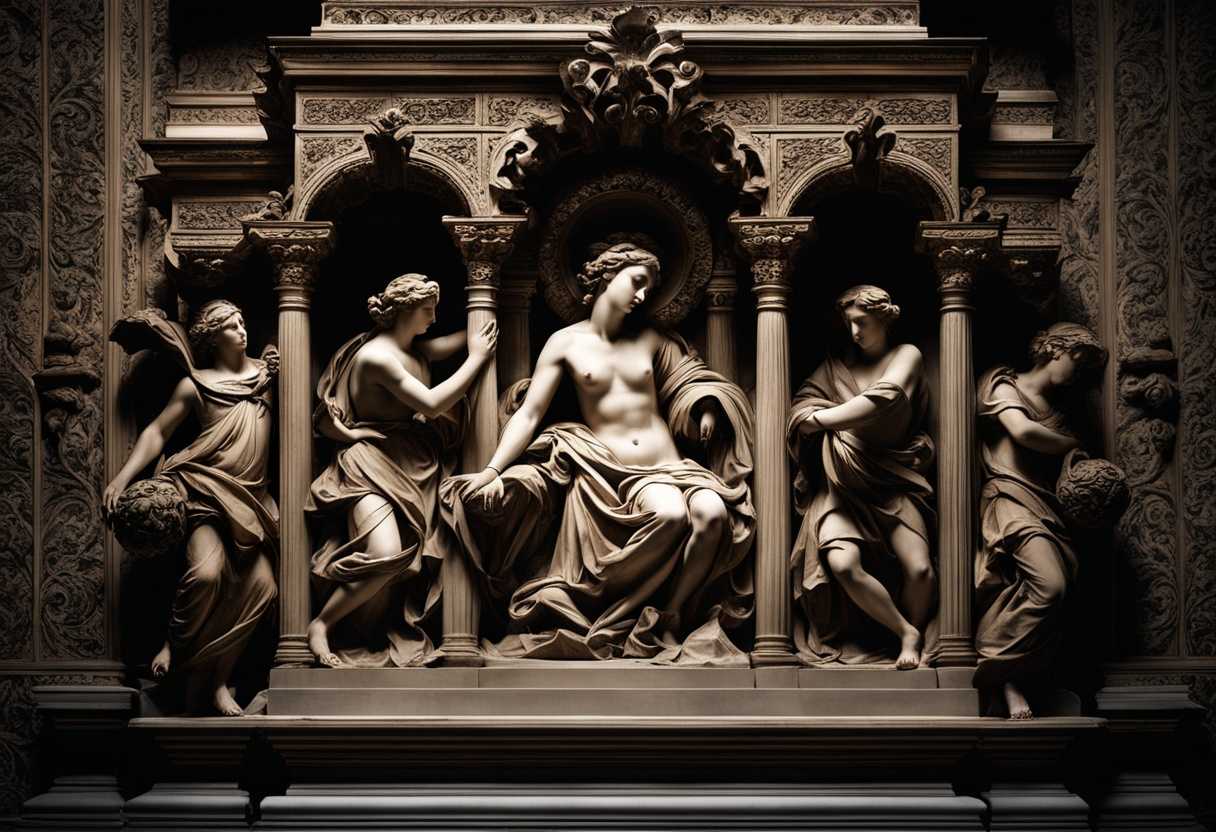
A “graven image” in the Bible refers to a carved or sculpted representation of a deity or idol, which is often condemned as a violation of the commandment to worship only the true God (Exodus 20:4-5). It symbolizes misplaced faith and can lead people away from true worship.
Scripture
4 “You shall not make for yourself a carved image, or any likeness of anything that is in heaven above, or that is in the earth beneath, or that is in the water under the earth.
5 You shall not bow down to them or serve them, for I the Lord your God am a jealous God, visiting the iniquity of the fathers on the children to the third and the fourth generation of those who hate me,
6 but showing steadfast love to thousands of those who love me and keep my commandments.
Meaning of Graven Image in the Bible
The concept of “graven images” reflects a broader theological stance in the Bible regarding the nature of worship and idolatry. Specifically, Exodus 20:4-5 warns against making carved images for the purpose of worship, stating, “You shall not make for yourself a carved image, or any likeness of anything that is in heaven above, or that is in the earth beneath, or that is in the water under the earth. You shall not bow down to them or serve them.” This prohibition points to a fundamental belief that God is transcendent and cannot be adequately represented by physical forms. The worship of graven images symbolizes a profound misunderstanding of the divine, as it reduces the infinite God to finite representations. As highlighted in Isaiah 44:9-20, those who create and worship these idols are depicted as foolish, as they place their faith in something that is ultimately powerless—merely made of wood or stone.
Additionally, the recurring theme throughout the Scriptures emphasizes the danger of idolatry, where dependence on graven images can lead to spiritual corruption and distance from God. In Jeremiah 10:14, it is further stated, “Every man is stupid and without knowledge; every goldsmith is put to shame by his idols, for his images are false, and there is no breath in them.” This imagery underscores the stark contrast between the living God and the lifeless idols. Idolatry, therefore, represents not only a violation of covenantal faithfulness but also a failure to acknowledge and embrace the true nature of God, leading believers to seek fulfillment and guidance in inferior and lifeless substitutes. In a contemporary context, the teaching against graven images invites reflection on what modern “idols” may distract individuals today—such as materialism, fame, or power—challenging them to prioritize a genuine, personal relationship with God.
The concept of graven images in the Bible serves as a critical reminder of the identity and sovereignty of God versus the limitations of human constructs. In the book of Leviticus, for example, the Israelites are given detailed laws that distinguish between sacred and profane, emphasizing purity in worship. These guidelines serve to instill an understanding that God cannot be contained within man-made objects or rituals, reinforcing the uniqueness of divine worship. This illumination of God’s holiness elevates the necessity for worshipers to approach Him with reverence and genuine devotion, rather than relying on tangential symbols that might dilute their relationship with the Creator.
Moreover, in the New Testament, the theme of idolatry resurfaces in various contexts. The Apostle Paul, in his letters, often highlights the futility of idols, addressing both Gentile converts and Jewish audiences. For instance, in 1 Corinthians 10, he warns believers not to partake in idol worship while simultaneously participating in the communion of Christ, reinforcing the idea that any form of idolatry compromises spiritual integrity. The New Testament encourages Christians to examine their lives carefully, discerning whether they place their trust in ephemeral things rather than fully committing to the relationship with Christ. Similar to the ancient Israelites, modern believers are called to identify and dismantle the “graven images” of their own lives—distractions that may come in the form of wealth, success, or even religious practices that overshadow a true relationship with God. Thus, the caution against graven images resonates across both the Old and New Testaments, emphasizing ongoing relevance for both ancient and contemporary believers.
Idolatry and False Worship
Graven images in the Bible often symbolize the act of idolatry, where individuals or communities turn away from the worship of the one true God to create and venerate physical representations of deities. This practice reflects a fundamental misunderstanding of the divine nature, as it reduces the infinite and transcendent God to a finite object. The emphasis on graven images serves as a warning against the temptation to prioritize material representations over spiritual truths, highlighting the importance of faith and devotion that transcends physical forms.
The Nature of God and Human Limitations
The concept of graven images also underscores the limitations of human understanding and the inadequacy of human attempts to depict the divine. By creating images, people often impose their own interpretations and limitations on God, which can lead to a distorted view of His nature. This theme invites reflection on the mystery of God and the belief that He cannot be fully captured or represented by human-made objects. It encourages believers to seek a deeper, more personal relationship with God that goes beyond mere physical representations.
The Call to Authentic Worship
Graven images serve as a reminder of the call to authentic worship that is rooted in spirit and truth rather than in external rituals or objects. The biblical narrative emphasizes that true worship involves a heart aligned with God’s will and a life that reflects His character. The rejection of graven images points to the necessity of engaging in a genuine relationship with God, where worship is expressed through actions, love, and obedience rather than through the mere veneration of physical idols. This call to authenticity challenges believers to examine their own practices and motivations in their spiritual lives.
How to Strengthen Faith and Avoid Idolatry
Strengthening your faith and avoiding idolatry is a journey that requires intentionality and reflection. Start by immersing yourself in Scripture; the Bible is filled with stories and teachings that remind us of God’s sovereignty and love. Make it a habit to pray daily, inviting God into every aspect of your life, and ask Him to reveal any areas where you may be placing other things—like work, relationships, or even personal ambitions—above Him. Surround yourself with a community of believers who can encourage and challenge you in your walk with Christ. Remember, idolatry often creeps in subtly, so be vigilant about what captures your heart and attention. Regularly assess your priorities and make adjustments as needed, ensuring that your relationship with God remains at the center of your life. By nurturing your faith through prayer, study, and fellowship, you’ll find that your love for God deepens, making it easier to resist the allure of idols that seek to distract you from His purpose.
Bible References to Graven Images:
Deuteronomy 4:15-19: 15 “Therefore watch yourselves very carefully. Since you saw no form on the day that the Lord spoke to you at Horeb out of the midst of the fire,”
16 Beware lest you act corruptly by making a carved image for yourselves, in the form of any figure, the likeness of male or female,
17 the likeness of any animal that is on the earth, the likeness of any winged bird that flies in the air,
18 the likeness of anything that creeps on the ground, the likeness of any fish that is in the water under the earth.
19 And beware lest you raise your eyes to heaven, and when you see the sun and the moon and the stars, all the host of heaven, you be drawn away and bow down to them and serve them, things that the Lord your God has allotted to all the peoples under the whole heaven.
Leviticus 26:1-2: 1 “You shall not make idols for yourselves or erect an image or pillar, and you shall not set up a figured stone in your land to bow down to it, for I am the Lord your God.”
2 You shall keep my Sabbaths and reverence my sanctuary: I am the Lord.
Isaiah 44:9-20: 9 All who fashion idols are nothing, and the things they delight in do not profit. Their witnesses neither see nor know, that they may be put to shame.
10 Who fashions a god or casts an idol that is profitable for nothing?
11 Behold, all his companions shall be put to shame, and the craftsmen are only human. Let them all assemble, let them stand forth. They shall be terrified; they shall be put to shame together.
12 The ironsmith takes a cutting tool and works it over the coals. He fashions it with hammers and works it with his strong arm. He becomes hungry, and his strength fails; he drinks no water and is faint.
13 The carpenter stretches a line; he marks it out with a pencil. He shapes it with planes and marks it with a compass. He shapes it into the figure of a man, with the beauty of a man, to dwell in a house.
14 He cuts down cedars, or he chooses a cypress tree or an oak and lets it grow strong among the trees of the forest. He plants a cedar and the rain nourishes it.
15 Then it becomes fuel for a man. He takes a part of it and warms himself; he kindles a fire and bakes bread. Also he makes a god and worships it; he makes it an idol and falls down before it.
16 Half of it he burns in the fire. Over the half he eats meat; he roasts it and is satisfied. Also he warms himself and says, “Aha, I am warm, I have seen the fire!”
17 And the rest of it he makes into a god, his idol, and falls down to it and worships it. He prays to it and says, “Deliver me, for you are my god!”
18 They know not, nor do they discern, for he has shut their eyes, so that they cannot see, and their hearts, so that they cannot understand.
19 No one considers, nor is there knowledge or discernment to say, “Half of it I burned in the fire; I also baked bread on its coals; I roasted meat and have eaten. And shall I make the rest of it an abomination? Shall I fall down before a block of wood?”
20 He feeds on ashes; a deluded heart has led him astray, and he cannot deliver himself or say, “Is there not a lie in my right hand?”
Jeremiah 10:1-5: 10 Hear the word that the Lord speaks to you, O house of Israel.
2 Thus says the Lord: “Learn not the way of the nations, nor be dismayed at the signs of the heavens because the nations are dismayed at them,
3 for the customs of the peoples are vanity.
4 They decorate it with silver and gold; they fasten it with hammer and nails so that it cannot move.
5 Their idols are like scarecrows in a cucumber field, and they cannot speak; they have to be carried, for they cannot walk. Do not be afraid of them, for they cannot do evil, neither is it in them to do good.”
Psalm 115:4-8: 4 Their idols are silver and gold, the work of human hands.
5 They have mouths, but do not speak; eyes, but do not see;
6 They have ears, but do not hear; noses, but do not smell.
7 They have hands, but do not feel; they have feet, but do not walk; they have mouths, but do not speak.
8 Those who make them become like them; so do all who trust in them.
Habakkuk 2:18-20: 18 “What profit is an idol
when its maker has shaped it,
a metal image, a teacher of lies?
For its maker trusts in his own creation
when he makes speechless idols!
19 Woe to him who says to a wooden thing, Awake; to a silent stone, Arise! Can this teach? Behold, it is overlaid with gold and silver, and there is no breath at all in it.
20 But the Lord is in his holy temple;
let all the earth keep silence before him.”
1 Corinthians 10:14-22: 14 Therefore, my beloved, flee from idolatry.
15 I speak as to sensible people; judge for yourselves what I say.
16 The cup of blessing that we bless, is it not a participation in the blood of Christ? The bread that we break, is it not a participation in the body of Christ?
17 Because there is one bread, we who are many are one body, for we all partake of the one bread.
18 Consider the people of Israel: are not those who eat the sacrifices participants in the altar?
19 What do I imply then? That food offered to idols is anything, or that an idol is anything?
20 No, I imply that what pagans sacrifice they offer to demons and not to God. I do not want you to be participants with demons.
21 You cannot drink the cup of the Lord and the cup of demons. You cannot partake of the table of the Lord and the table of demons.
22 Shall we provoke the Lord to jealousy? Are we stronger than he?
Acts 17:29-31: 29 Being then God’s offspring, we ought not to think that the divine being is like gold or silver or stone, an image formed by the art and imagination of man.
30 The times of ignorance God overlooked, but now he commands all people everywhere to repent,
31 because he has fixed a day on which he will judge the world in righteousness by a man whom he has appointed; and of this he has given assurance to all by raising him from the dead.”
Deuteronomy 27:15: 15 “‘Cursed be the man who makes a carved or cast metal image, an abomination to the Lord, a thing made by the hands of a craftsman, and sets it up in secret.’ And all the people shall answer and say, ‘Amen.’
Isaiah 40:18-20: 18 To whom then will you liken God,
or what likeness compare with him?
19 The idol! a workman casts it, and a goldsmith overlays it with gold and casts for it silver chains.
20 He who is too impoverished for an offering chooses wood that will not rot; he seeks out a skillful craftsman to set up an idol that will not move.
Isaiah 42:8-9: 8 I am the Lord; that is my name; my glory I give to no other, nor my praise to carved idols.
9 Behold, the former things have come to pass,
and new things I now declare;
before they spring forth
I tell you of them.”
Isaiah 46:5-7: 5 “To whom will you liken me and make me equal,
and compare me, that we may be alike?
6 Those who lavish gold from the purse, and weigh out silver in the scales, hire a goldsmith, and he makes it into a god; then they fall down and worship!
7 They lift it to their shoulders, they carry it, they set it in its place, and it stands there; it cannot move from its place. If one cries to it, it does not answer or save him from his trouble.
1 John 5:21: 21 Little children, keep yourselves from idols.

Rev. François Dupont is a dedicated church minister with a wealth of experience in serving spiritual communities. With a calm and serene demeanor, he has been devoted to sharing the message of love, compassion, and tolerance for over two decades. Through his thoughtful sermons, compassionate counseling, and unwavering support, Rev. Dupont has touched the lives of countless individuals, allowing them to find solace and strength during difficult times. His serene presence and deep understanding of the human condition make him a trusted guide for those seeking spiritual nourishment and guidance.