
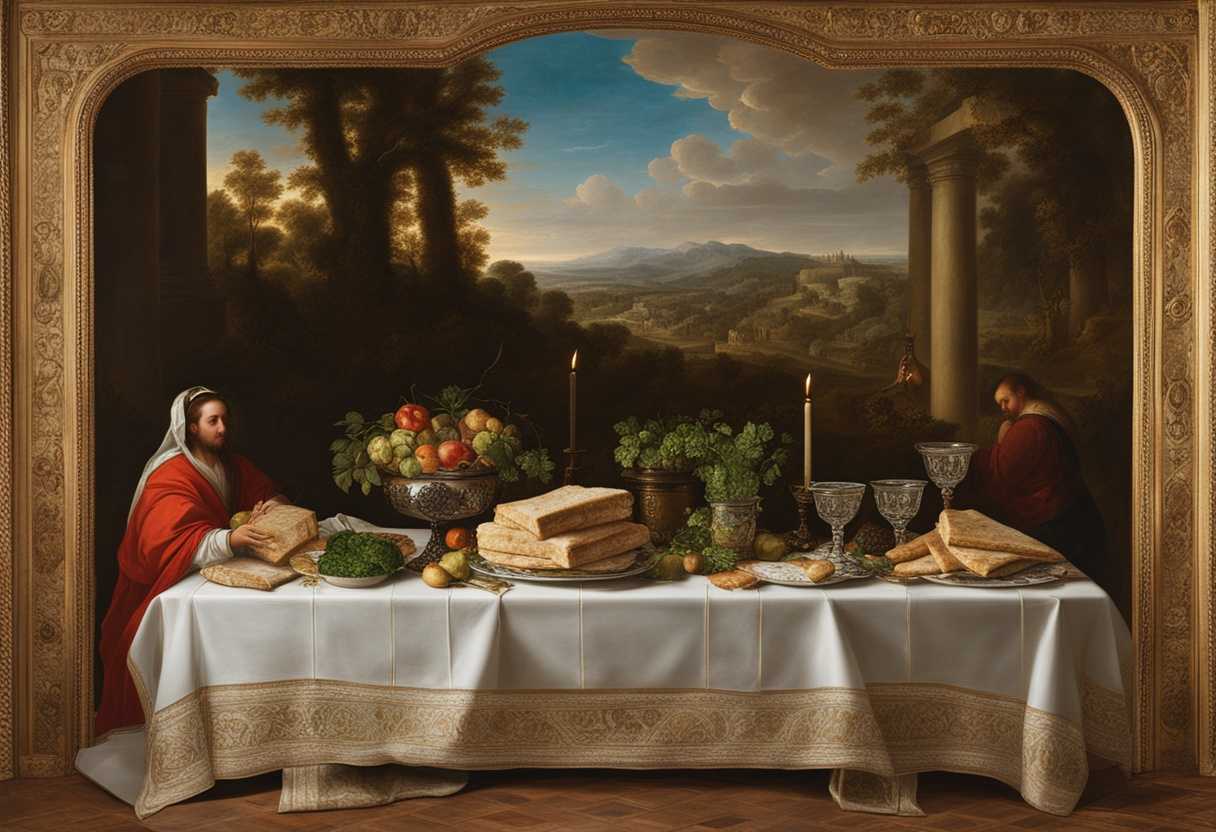
In the Bible, Passover commemorates the Israelites’ exodus from Egypt, represented through specific menu items. Key elements include unleavened bread (matzah) symbolizing haste in leaving Egypt, bitter herbs (maror) representing the bitterness of slavery, and lamb (the Passover sacrifice) symbolizing redemption and God’s protection during the final plague.
Scripture
1 The Lord said to Moses and Aaron in the land of Egypt,
2 “This month shall be for you the beginning of months. It shall be the first month of the year for you.
3 Tell all the congregation of Israel that on the tenth day of this month every man shall take a lamb according to their fathers’ houses, a lamb for a household.
4 And if the household is too small for a lamb, then he and his nearest neighbor shall take according to the number of persons; according to what each can eat you shall make your count for the lamb.
5 Your lamb shall be without blemish, a male a year old.
6 and you shall keep it until the fourteenth day of this month, when the whole assembly of the congregation of Israel shall kill their lambs at twilight.
7 Then they shall take some of the blood and put it on the two doorposts and the lintel of the houses in which they eat it.
8 They shall eat the flesh that night, roasted on the fire; with unleavened bread and bitter herbs they shall eat it.
9 Do not eat any of it raw or boiled in water, but roasted, its head with its legs and its inner parts.
10 And you shall let none of it remain until the morning; anything that remains until the morning you shall burn.
11 In this manner you shall eat it: with your belt fastened, your sandals on your feet, and your staff in your hand. And you shall eat it in haste. It is the Lord’s Passover.
12 For I will pass through the land of Egypt that night, and I will strike all the firstborn in the land of Egypt, both man and beast; and on all the gods of Egypt I will execute judgments: I am the Lord.
13 The blood shall be a sign for you, on the houses where you are. And when I see the blood, I will pass over you, and no plague will befall you to destroy you when I strike the land of Egypt.
14 “This day shall be for you a memorial day, and you shall keep it as a feast to the Lord; throughout your generations, as a statute forever, you shall keep it as a feast.”
15 Seven days you shall eat unleavened bread. On the first day you shall remove leaven out of your houses, for if anyone eats what is leavened, from the first day until the seventh day, that person shall be cut off from Israel.
16 On the first day you shall hold a holy assembly, and on the seventh day a holy assembly. No work shall be done on those days. But what everyone needs to eat, that alone may be prepared by you.
17 And you shall observe the Feast of Unleavened Bread, for on this very day I brought your hosts out of the land of Egypt. Therefore you shall observe this day, throughout your generations, as a statute forever.
18 In the first month, from the fourteenth day of the month at evening, you shall eat unleavened bread until the twenty-first day of the month at evening.
19 For seven days no leaven is to be found in your houses. If anyone eats what is leavened, that person will be cut off from the congregation of Israel, whether he is a sojourner or a native of the land.
20 You shall eat nothing leavened; in all your dwelling places you shall eat unleavened bread.”
21 Then Moses called all the elders of Israel and said to them, “Go and select lambs for yourselves according to your clans, and kill the Passover lamb.
22 Take a bunch of hyssop and dip it in the blood that is in the basin, and touch the lintel and the two doorposts with the blood that is in the basin. None of you shall go out of the door of his house until the morning.
23 For the Lord will pass through to strike the Egyptians, and when he sees the blood on the lintel and on the two doorposts, the Lord will pass over the door and will not allow the destroyer to enter your houses to strike you.
24 You shall observe this rite as a statute for you and for your sons forever.
25 And when you come to the land that the Lord will give you, as he has promised, you shall keep this service.
26 And when your children say to you, ‘What do you mean by this service?’
27 Then you shall say, ‘It is the sacrifice of the Lord’s Passover, for he passed over the houses of the people of Israel in Egypt, when he struck the Egyptians but spared our houses.’” And the people bowed their heads and worshiped.
28 Then the people of Israel went and did so; as the Lord had commanded Moses and Aaron, so they did.
Passover Menu Items and Their Symbolism in the Bible
The Passover menu is rich with symbolism that captures both the historical and spiritual significance of the Israelites’ deliverance from slavery in Egypt. Unleavened bread, or matzah, serves as a powerful reminder of the haste with which the Israelites fled, as highlighted in Exodus 12:39, where it states, “And they baked the dough which they had brought out of Egypt into cakes of unleavened bread; for it was not leavened, because they were thrust out of Egypt, and could not tarry.” The absence of leaven not only signifies the speed of their exodus but also symbolizes the purity and the breaking away from the corrupting influences of sin and bondage.
Bitter herbs, or maror, evoke the anguish and suffering endured during their enslavement, as indicated in Exodus 1:14, where the Egyptians made the lives of the Israelites “bitter with hard bondage.” This tangible aspect of the Passover meal encourages reflection on the hardships faced, allowing participants to connect with the historical context of sorrow and oppression. Meanwhile, the lamb, sacrificed and consumed during the meal, embodies redemption and divine protection, as specified in Exodus 12:13: “The blood shall be to you for a token upon the houses where you are: and when I see the blood, I will pass over you, and the plague shall not be upon you to destroy you.” This act of marking the doorposts with lamb’s blood not only initiated their liberation but prefigured Christ’s ultimate sacrifice for humanity, underscoring a theme of salvation and covenant that resonates throughout scripture, moving from the Old Testament shadow to the New Testament fulfillment. Through these elements, the Passover menu serves as a vivid narrative that intertwines history, identity, and faith, inviting each generation to remember, reflect, and reaffirm their commitment to God’s promises.
In addition to matzah, maror, and the lamb, the Passover Seder includes a variety of symbolic foods that deepen the experience of remembrance. Charoset, a sweet mixture of apples, nuts, wine, and cinnamon, recalls the mortar the Israelites used while enslaved, representing their labor and the striving for freedom. The sweetness of charoset offers a counterbalance, evoking the hope and sweetness that came with liberation and the promise of a better future. This juxtaposition of bitterness and sweetness speaks to the complexities of the human experience, acknowledging suffering while celebrating the resilience and joy that follows deliverance.
Another key element in the Passover Seder is the presence of parsley or another green vegetable, known as karpas, dipped in salt water. The green symbolizes springtime and new life, reinforcing themes of renewal and rebirth in the context of redemption. When dipped in salt water—a reminder of the tears shed during enslavement—karpas serves as a poignant reminder of the duality of joy and sorrow in the historical narrative. It invites participants to reflect on the shared experiences of struggle and hope, reaffirming their connection to the generations that preceded them while recognizing the ongoing journey toward liberation from all forms of oppression. These elements come together in the Seder plate, forming a rich tableau of tradition and faith that bridges past and present, weaving the story of the Exodus into the communal identity of the Jewish people.
The Significance of Matzah
Matzah, or unleavened bread, is a central element of the Passover Seder. Its symbolism extends beyond mere dietary restrictions; it represents the haste with which the Israelites fled Egypt, as there was no time for the bread to rise. This unleavened bread also serves as a reminder of humility and simplicity, encouraging reflection on the transient nature of life and the importance of spiritual nourishment over material excess. In a broader sense, matzah embodies the theme of liberation, as it signifies the breaking away from the constraints of slavery and the journey towards freedom.
The Bitter Herbs and Their Lessons
Bitter herbs, typically represented by horseradish, are consumed during the Passover Seder to symbolize the bitterness of slavery experienced by the Israelites in Egypt. This poignant reminder serves to evoke empathy and awareness of suffering, both historical and contemporary. The act of eating bitter herbs encourages participants to confront the harsh realities of oppression and injustice, fostering a sense of solidarity with those who endure hardship. Furthermore, the bitterness can also symbolize the transformative power of faith and resilience, as it highlights the contrast between suffering and the sweetness of redemption that follows.
The Role of Charoset in Redemption
Charoset, a sweet mixture of fruits, nuts, and wine, represents the mortar used by the Israelites in their forced labor while in Egypt. However, its sweetness also symbolizes hope and the promise of redemption. This duality reflects the complexity of the human experience, where moments of hardship can coexist with the potential for joy and liberation. Charoset serves as a reminder that even in the darkest times, there is the possibility of sweetness and renewal, encouraging individuals to seek out and celebrate the positive aspects of life amidst adversity.
How to Cultivate a Deeper Christian Faith and Unity
Cultivating a deeper Christian faith and unity begins with a genuine commitment to prayer and scripture study, as these are the lifelines that connect us to God and His will for our lives. Set aside time each day to immerse yourself in the Word, allowing it to transform your heart and mind. Engage in community with fellow believers, as unity flourishes in shared experiences and mutual encouragement. Attend church services, join a small group, or volunteer in your community to build relationships that reflect Christ’s love. Remember, it’s not just about personal growth; it’s about fostering a spirit of togetherness, where we support one another in our journeys. Embrace the diversity within the body of Christ, recognizing that our differences can strengthen our unity when we focus on our shared faith in Jesus. As you deepen your relationship with God and with others, you’ll find that your faith becomes a vibrant source of hope and love, drawing you closer to the heart of Christ and to one another.
Bible References to Passover Symbolism:
Exodus 12:43-50: 43 And the Lord said to Moses and Aaron, “This is the statute of the Passover: no foreigner shall eat of it,
44 but every slave that is bought for money may eat of it after you have circumcised him.
45 It shall be eaten in one house; you shall not take any of the flesh outside the house, and you shall not break any of its bones.
46 It shall be eaten in one house; you shall not take any of the flesh outside the house, and you shall not break any of its bones.
47 All the congregation of Israel shall keep it.
48 If a stranger shall sojourn with you and would keep the Passover to the Lord, let all his males be circumcised. Then he may come near and keep it; he shall be as a native of the land. But no uncircumcised person shall eat of it.
49 There shall be one law for the native and for the stranger who sojourns among you.”
50 All the people of Israel did just as the Lord commanded Moses and Aaron.
Leviticus 23:4-8: 4 “These are the appointed feasts of the Lord, the holy convocations, which you shall proclaim at the time appointed for them.
5 In the first month, on the fourteenth day of the month at twilight, is the Lord’s Passover.
6 And on the fifteenth day of the same month is the Feast of Unleavened Bread to the Lord; for seven days you shall eat unleavened bread.
7 On the first day you shall have a holy convocation; you shall not do any ordinary work.
8 But you shall present a food offering to the Lord for seven days. On the seventh day is a holy convocation; you shall not do any ordinary work.”
Numbers 9:1-14: 1 And the Lord spoke to Moses in the wilderness of Sinai, in the first month of the second year after they had come out of the land of Egypt, saying:
2 “Let the people of Israel keep the Passover at its appointed time.
3 On the fourteenth day of this month, at twilight, you shall keep it at its appointed time; according to all its statutes and all its rules you shall keep it.
4 So Moses told the people of Israel that they should keep the Passover.
5 And they kept the Passover in the first month, on the fourteenth day of the month, at twilight, in the wilderness of Sinai; according to all that the Lord commanded Moses, so the people of Israel did.
6 And there were certain men who were unclean through touching a dead body, so that they could not keep the Passover on that day, and they came before Moses and Aaron on that day.
7 And those men said to him, “We are unclean through touching a dead body. Why are we kept from bringing the Lord’s offering at its appointed time among the people of Israel?”
8 And Moses said to them, “Wait, that I may hear what the Lord will command concerning you.”
9 And the Lord spoke to Moses, saying,
10 “Speak to the people of Israel, saying, If any one of you or of your descendants is unclean through touching a dead body, or is on a long journey, he shall still keep the Passover to the Lord.”
11 In the second month on the fourteenth day at twilight, they shall keep it.
12 They shall leave none of it until the morning, nor break any of its bones; according to all the statute for the Passover they shall keep it.
13 But the man who is clean and is not on a journey, and yet fails to keep the Passover, that person shall be cut off from his people because he did not bring the Lord’s offering at its appointed time; that man shall bear his sin.
14 And if a stranger sojourns among you and would keep the Passover to the Lord, according to the statute of the Passover and according to its rule, so shall he do. You shall have one statute, both for the sojourner and for the native.”
Deuteronomy 16:1-8: 1 “Observe the month of Abib and keep the Passover to the Lord your God, for in the month of Abib the Lord your God brought you out of Egypt by night.
2 You shall offer the Passover sacrifice to the Lord your God, from the flock or the herd, at the place that the Lord will choose, to make his name dwell there.
3 You shall eat no leavened bread with it. Seven days you shall eat it with unleavened bread, the bread of affliction—for you came out of the land of Egypt in haste—that all the days of your life you may remember the day when you came out of the land of Egypt.
4 And no leaven shall be seen with you in all your territory for seven days, and none of the flesh that you sacrifice on the evening of the first day shall remain all night until morning.
5 You may not offer the Passover sacrifice within any of your towns that the Lord your God is giving you,
6 but at the place that the Lord your God will choose, to make his name dwell in it, there you shall offer the Passover sacrifice, in the evening at sunset, at the time you came out of Egypt.
7 You shall cook it and eat it at the place that the Lord your God will choose. And in the morning you shall turn and go to your tents.
8 Six days you shall eat unleavened bread, and on the seventh day there shall be a solemn assembly to the Lord your God. You shall do no work on it.
Matthew 26:17-30: 17 Now on the first day of Unleavened Bread the disciples came to Jesus, saying, “Where will you have us prepare for you to eat the Passover?”
18 He said, “Go into the city to a certain man and say to him, ‘The Teacher says, My time is at hand. I will keep the Passover at your house with my disciples.’”
19 So the disciples did as Jesus had directed them, and they prepared the Passover.
20 When it was evening, he reclined at table with the twelve.
21 And as they were eating, he said, “Truly, I say to you, one of you will betray me.”
22 And they were very sorrowful and began to say to him one after another, “Is it I, Lord?”
23 He answered, “He who has dipped his hand in the dish with me will betray me.
24 The Son of Man goes as it is written of him, but woe to that man by whom the Son of Man is betrayed! It would have been better for that man if he had not been born.
25 Judas, who would betray him, answered, “Is it I, Rabbi?” He said to him, “You have said so.”
26 Now as they were eating, Jesus took bread, and after blessing it broke it and gave it to the disciples, and said, “Take, eat; this is my body.”
27 And he took a cup, and when he had given thanks he gave it to them, saying, “Drink of it, all of you,
28 for this is my blood of the covenant, which is poured out for many for the forgiveness of sins.
29 I tell you I will not drink again of this fruit of the vine until that day when I drink it new with you in my Father’s kingdom.”
30 And when they had sung a hymn, they went out to the Mount of Olives.
Mark 14:12-26: 12 And on the first day of Unleavened Bread, when they sacrificed the Passover lamb, his disciples said to him, “Where will you have us go and prepare for you to eat the Passover?”
13 And he sent two of his disciples and said to them, “Go into the city, and a man carrying a jar of water will meet you. Follow him,
14 And wherever he enters, say to the master of the house, ‘The Teacher says, Where is my guest room, where I may eat the Passover with my disciples?’
15 And he will show you a large upper room furnished and ready; there prepare for us.”
16 And the disciples set out and went to the city and found it just as he had told them, and they prepared the Passover.
17 And when it was evening, he came with the twelve.
18 And as they were reclining at table and eating, Jesus said, “Truly, I say to you, one of you will betray me, one who is eating with me.”
19 They began to be sorrowful and to say to him one after another, “Is it I?”
20 He said to them, “It is one of the twelve, one who is dipping bread into the dish with me.
21 For the Son of Man goes as it is written of him, but woe to that man by whom the Son of Man is betrayed! It would have been better for that man if he had not been born.
22 And as they were eating, he took bread, and after blessing it broke it and gave it to them, and said, “Take; this is my body.”
23 And he took a cup, and when he had given thanks he gave it to them, and they all drank of it.
24 And he said to them, “This is my blood of the covenant, which is poured out for many.
25 Truly, I say to you, I will not drink again of the fruit of the vine until that day when I drink it new in the kingdom of God.”
26 And when they had sung a hymn, they went out to the Mount of Olives.
Luke 22:7-20: 7 Then came the day of Unleavened Bread, on which the Passover lamb had to be sacrificed.
8 Jesus sent Peter and John, saying, “Go and prepare the Passover for us, that we may eat it.”
9 And they said to him, “Where will you have us prepare it?”
10 And he said to them, “Behold, when you have entered the city, a man carrying a jar of water will meet you. Follow him into the house that he enters.
11 and tell the master of the house, ‘The Teacher says to you, Where is the guest room, where I may eat the Passover with my disciples?’
12 And he will show you a large upper room furnished; prepare it there.”
13 And they went and found it just as he had told them, and they prepared the Passover.
14 And when the hour came, he reclined at table, and the apostles with him.
15 And he said to them, “I have earnestly desired to eat this Passover with you before I suffer.
16 for I tell you I will not eat it until it is fulfilled in the kingdom of God.”
17 And he took a cup, and when he had given thanks he said, “Take this, and divide it among yourselves.
18 for I tell you that from now on I will not drink of the fruit of the vine until the kingdom of God comes.”
19 And he took bread, and when he had given thanks, he broke it and gave it to them, saying, “This is my body, which is given for you. Do this in remembrance of me.”
20 And likewise the cup after they had eaten, saying, “This cup that is poured out for you is the new covenant in my blood.
John 13:1-30: 1 Now before the Feast of the Passover, when Jesus knew that his hour had come to depart out of this world to the Father, having loved his own who were in the world, he loved them to the end.
2 During supper, when the devil had already put it into the heart of Judas Iscariot, Simon’s son, to betray him,
3 Jesus, knowing that the Father had given all things into his hands, and that he had come from God and was going back to God,
4 rose from supper. He laid aside his outer garments, and taking a towel, tied it around his waist.
5 Then he poured water into a basin and began to wash the disciples’ feet and to wipe them with the towel that was wrapped around him.
6 He came to Simon Peter, who said to him, “Lord, do you wash my feet?”
7 Jesus answered him, “What I am doing you do not understand now, but afterward you will understand.”
8 Peter said to him, “You shall never wash my feet.” Jesus answered him, “If I do not wash you, you have no share with me.”
9 Simon Peter said to him, “Lord, not my feet only but also my hands and my head!”
10 Jesus said to him, “The one who has bathed does not need to wash, except for his feet, but is completely clean. And you are clean, but not every one of you.”
11 For he knew who was to betray him; that was why he said, “Not all of you are clean.”
12 When he had washed their feet and put on his outer garments and resumed his place, he said to them, “Do you understand what I have done to you?
13 You call me Teacher and Lord, and you are right, for so I am.
14 If I then, your Lord and Teacher, have washed your feet, you also ought to wash one another’s feet.
15 For I have given you an example, that you also should do just as I have done to you.
16 Truly, truly, I say to you, a servant is not greater than his master, nor is a messenger greater than the one who sent him.
17 If you know these things, blessed are you if you do them.
18 I am not speaking of all of you; I know whom I have chosen. But the Scripture will be fulfilled, ‘He who ate my bread has lifted his heel against me.’
19 I am telling you this now, before it takes place, that when it does take place you may believe that I am he.
20 Truly, truly, I say to you, whoever receives the one I send receives me, and whoever receives me receives the one who sent me.
21 After saying these things, Jesus was troubled in his spirit, and testified, “Truly, truly, I say to you, one of you will betray me.”
22 The disciples looked at one another, uncertain of whom he spoke.
23 One of his disciples, whom Jesus loved, was reclining at table at Jesus’ side,
24 So Simon Peter motioned to him to ask Jesus of whom he was speaking.
25 So that disciple, leaning back against Jesus, said to him, “Lord, who is it?”
26 Jesus answered, “It is he to whom I will give this morsel of bread when I have dipped it.” So when he had dipped the morsel, he gave it to Judas, the son of Simon Iscariot.
27 Then after he had taken the morsel, Satan entered into him. Jesus said to him, “What you are going to do, do quickly.”
28 Now no one at the table knew why he said this to him.
29 Some thought that, because Judas had the moneybag, Jesus was telling him, “Buy what we need for the feast,” or that he should give something to the poor.
30 So, after receiving the morsel of bread, he immediately went out. And it was night.
1 Corinthians 5:6-8: 6 Your boasting is not good. Do you not know that a little leaven leavens the whole lump?
7 Cleanse out the old leaven that you may be a new lump, as you really are unleavened. For Christ, our Passover lamb, has been sacrificed.
8 Let us therefore celebrate the festival, not with the old leaven, the leaven of malice and evil, but with the unleavened bread of sincerity and truth.
1 Corinthians 11:23-26: 23 For I received from the Lord what I also delivered to you, that the Lord Jesus on the night when he was betrayed took bread,
24 and when he had given thanks, he broke it, and said, “This is my body, which is for you. Do this in remembrance of me.”
25 In the same way also he took the cup, after supper, saying, “This cup is the new covenant in my blood. Do this, as often as you drink it, in remembrance of me.”
26 For as often as you eat this bread and drink the cup, you proclaim the Lord’s death until he comes.

Reverend Michael Johnson is an experienced Church Minister with a profound expertise in spirituality and guidance. With a serene presence and a compassionate heart, he has faithfully served his congregation for over 20 years, leading them on a spiritual journey towards inner peace and enlightenment. Reverend Johnson’s extensive knowledge of religious philosophies and profound understanding of human nature have made him a trusted confidant and mentor to many, as he seamlessly weaves his profound wisdom into life teachings. Reverend Johnson’s calming demeanor and empathetic nature continue to uplift and heal souls, nurturing a sense of unity and tranquility within his community.