
The term “Son of Nebat” refers to Jeroboam, a significant figure in the Bible who became the first king of the northern kingdom of Israel after the kingdom split. He is often associated with leading Israel into idolatry and is remembered for his role in establishing false worship practices that deviated from the worship of Yahweh.
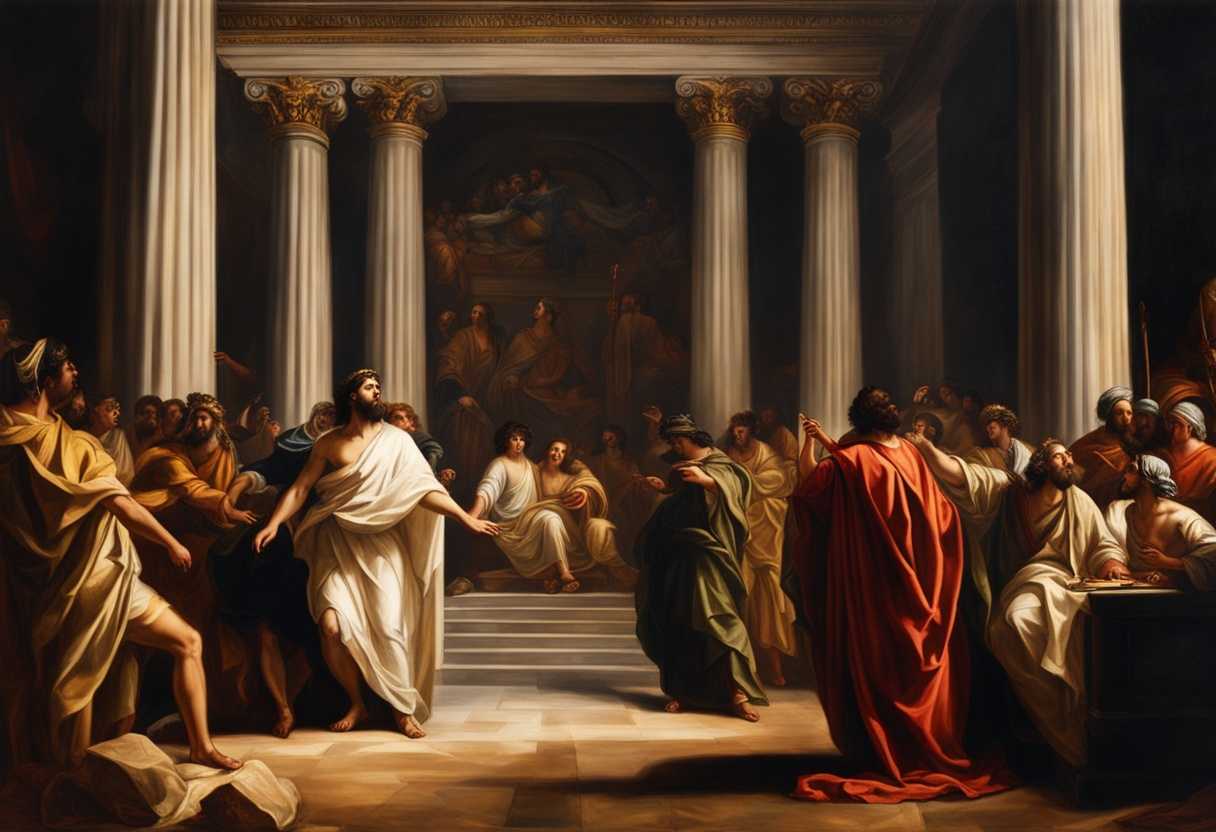
Scripture
26 Then Jeroboam the son of Nebat, an Ephraimite of Zeredah, a servant of Solomon, whose mother’s name was Zeruah, a widow, also lifted up his hand against the king.
27 And this was the reason why he lifted up his hand against the king. Solomon built the Millo, and closed up the breach of the city of David his father.
28 The man Jeroboam was very able, and when Solomon saw that the young man was industrious he gave him charge over all the forced labor of the house of Joseph.
29 And at that time, when Jeroboam went out of Jerusalem, the prophet Ahijah the Shilonite found him on the road. Now Ahijah had dressed himself in a new garment, and the two of them were alone in the open country.
30 and Ahijah laid hold of the new garment that was on him, and tore it into twelve pieces.
31 And he said to Jeroboam, “Take for yourself ten pieces, for thus says the Lord, the God of Israel, ‘Behold, I am about to tear the kingdom from the hand of Solomon and will give you ten tribes.
32 (but he shall have one tribe, for the sake of my servant David and for the sake of Jerusalem, the city that I have chosen out of all the tribes of Israel),
33 because they have forsaken me and worshiped Ashtoreth the goddess of the Sidonians, Chemosh the god of Moab, and Milcom the god of the Ammonites, and they have not walked in my ways, doing what is right in my sight and keeping my statutes and my rules, as David his father did.
34 However, I will not take the whole kingdom out of his hand, but I will make him ruler all the days of his life, for the sake of David my servant whom I chose, who kept my commandments and my statutes.
35 but I will take the kingdom out of his son’s hand and will give it to you, ten tribes.
36 Yet to his son I will give one tribe, that David my servant may always have a lamp before me in Jerusalem, the city where I have chosen to put my name.
37 However, I will take you, and you shall reign over all that your soul desires, and you shall be king over Israel.
38 And if you will listen to all that I command you, and will walk in my ways, and do what is right in my eyes by keeping my statutes and my commandments, as David my servant did, I will be with you and will build you a sure house, as I built for David, and I will give Israel to you.
39 And I will afflict the offspring of David because of this, but not forever.’”
40 Solomon sought therefore to kill Jeroboam. But Jeroboam arose and fled into Egypt, to Shishak king of Egypt, and was in Egypt until the death of Solomon.
Meaning of Son of Nebat in Scripture
The phrase “Son of Nebat” holds significant connotations in biblical literature, primarily identifying Jeroboam, the first king of the northern kingdom of Israel. Referenced in key texts like 1 Kings 11:26-40 and 1 Kings 12:1-20, Jeroboam’s ascent to power follows the division of Solomon’s kingdom, marking a pivotal moment in Israel’s history. His kingship is emblematic of a broader spiritual decline, as he established golden calves in Bethel and Dan to solidify his rule and prevent his subjects from returning to Jerusalem for worship (1 Kings 12:28-30). This action represents a profound shift as Jeroboam prioritized political stability over fidelity to Yahweh, leading the nation into idolatry—a recurring theme in biblical narratives showcasing the tension between divine authority and human governance.
The significance of Jeroboam as the “Son of Nebat” transcends his individual actions and reflects a larger theological narrative concerning apostasy and leadership in Israel. The biblical text often recounts the wickedness associated with his reign, illustrating how bad leadership can lead to widespread spiritual failure (1 Kings 14:16). Jeroboam is frequently invoked as a cautionary figure; subsequent kings in Israel are measured against his legacy of sinfulness (e.g., 2 Kings 13:2). Thus, the term encapsulates not just an individual but also a lineage of disobedience and a warning about the consequences of abandoning covenant faithfulness, underscoring an enduring theme in Scripture: the critical importance of aligning earthly rule with divine mandates.
In later biblical accounts, Jeroboam’s influence as the “Son of Nebat” continues to resonate, especially in the context of prophetic warnings and reminders of Israel’s historical failures. Prophets such as Ahijah and others reference his actions as they deliver messages from God, using his name to symbolize the root of Israel’s troubles. This pattern highlights the generational impact of his disobedience, as the spiritual and moral failures of one leader often reverberate through subsequent leadership, shaping the fate of the nation. The act of likening later kings to Jeroboam functions as both a diagnostic tool and a moral assessment, reinforcing the text’s call for faithfulness to Yahweh amid political instability.
Moreover, the legacy of Jeroboam as the “Son of Nebat” serves as a pivotal motif when understanding the broader narrative arc of Israel’s history post-Solomon. As the narrative unfolds, recurring themes emerge: the temptation of idolatry, the conflict between true worship and political expedience, and the frequent prophetic calls to repentance that echo the consequences laid out during Jeroboam’s reign. These elements reflect an ongoing struggle within the Israelite community to balance their national identity with their covenant obligations. By consistently referring to Jeroboam, the biblical writers remind the audience of the inherent dangers that arise when loyalty to God is sacrificed for human ambition, thus ensuring that the lessons of the past remain ever relevant in spiritual discourse.
Symbol of Division and Rebellion
The term “Son of Nebat” is often associated with Jeroboam, who became the first king of the northern kingdom of Israel after the division of the united monarchy. This division symbolizes a significant turning point in biblical history, representing the fracture of the Israelite nation and the ensuing conflict between the northern and southern kingdoms. Jeroboam’s actions, including the establishment of alternative worship sites, reflect a broader theme of rebellion against divinely appointed leadership and the consequences of turning away from God’s commandments.
Representation of Idolatry and Apostasy
Jeroboam, as the “Son of Nebat,” is also emblematic of idolatry and apostasy in Israel’s history. His decision to create golden calves for worship in Bethel and Dan signifies a departure from the worship of Yahweh and the introduction of practices that were contrary to the covenant established with Israel. This act of leading the people into idolatry serves as a cautionary tale about the dangers of straying from true worship and the impact of leadership on the spiritual direction of a nation.
Legacy of Leadership and Its Consequences
The legacy of Jeroboam, the “Son of Nebat,” extends beyond his immediate reign, as it sets a precedent for future kings of Israel. His rule is often referenced in the context of evaluating the faithfulness of subsequent leaders, with many being compared to him in terms of their fidelity to God. This highlights the broader biblical theme of leadership accountability and the long-lasting effects of a leader’s choices on the spiritual and moral trajectory of a community or nation.
How to Overcome Idolatry and Strengthen Your Faith in God
Overcoming idolatry and strengthening your faith in God is a deeply personal journey that requires both introspection and action. Start by identifying what might be taking precedence in your life over your relationship with God—this could be anything from material possessions to relationships or even your own ambitions. Once you’ve recognized these distractions, take intentional steps to realign your priorities. Engage in regular prayer and immerse yourself in Scripture, allowing God’s word to guide your thoughts and actions. Surround yourself with a community of believers who can encourage and challenge you in your faith. Remember, it’s not about perfection but about progress; each small step you take towards God is a victory. Trust that as you seek Him earnestly, He will help you dismantle the idols in your life and fill you with a deeper, more fulfilling faith.
Bible References to Son of Nebat:
1 Kings 12:25-33: 25 Then Jeroboam built Shechem in the hill country of Ephraim and lived there. And he went out from there and built Penuel.
26 And Jeroboam said in his heart, “Now the kingdom will turn back to the house of David.
27 If this people go up to offer sacrifices in the temple of the Lord at Jerusalem, then the heart of this people will turn again to their lord, to Rehoboam king of Judah, and they will kill me and return to Rehoboam king of Judah.”
28 So the king took counsel and made two calves of gold. And he said to the people, “You have gone up to Jerusalem long enough. Behold your gods, O Israel, who brought you up out of the land of Egypt.”
29 And he set one in Bethel, and the other he put in Dan.
30 Then this thing became a sin, for the people went as far as Dan to be before one.
31 He also made temples on high places and appointed priests from among all the people, who were not of the Levites.
32 And Jeroboam appointed a feast on the fifteenth day of the eighth month like the feast that was in Judah, and he offered sacrifices on the altar. So he did in Bethel, sacrificing to the calves that he made. And he placed in Bethel the priests of the high places that he had made.
33 He went up to the altar that he had made in Bethel on the fifteenth day in the eighth month, in the month that he had devised from his own heart. And he instituted a feast for the people of Israel and went up to the altar to make offerings.
1 Kings 13:1-10: And behold, a man of God came out of Judah by the word of the Lord to Bethel.
And the man cried against the altar by the word of the Lord and said, “O altar, altar, thus says the Lord: ‘Behold, a son shall be born to the house of David, Josiah by name, and he shall sacrifice on you the priests of the high places who make offerings on you, and human bones shall be burned on you.’”
3 And he gave a sign the same day, saying, “This is the sign that the Lord has spoken: ‘Behold, the altar shall be torn down, and the ashes that are on it shall be poured out.’”
4 And when the king heard the saying of the man of God, which he cried against the altar at Bethel, Jeroboam stretched out his hand from the altar, saying, “Seize him.” And his hand, which he stretched out against him, dried up, so that he could not draw it back to himself.
5 And the altar also was split apart, and the ashes poured out from the altar, according to the sign that the man of God had given by the word of the Lord.
6 And the king said to the man of God, “Entreat now the favor of the Lord your God, and pray for me, that my hand may be restored to me.” And the man of God entreated the Lord, and the king’s hand was restored to him and became as it was before.
7 And the king said to the man of God, “Come home with me, and refresh yourself, and I will give you a reward.”
8 But the man of God said to the king, “If you give me half your house, I will not go in with you. And I will not eat bread or drink water in this place,
9 For so it was commanded me by the word of the Lord, saying, ‘You shall neither eat bread nor drink water nor return by the way that you came.’
10 And he went another way and did not return by the way that he came to Bethel.
1 Kings 14:1-20: 1 At that time Abijah the son of Jeroboam fell sick.
2 And Jeroboam said to his wife, “Arise, and disguise yourself, that it not be known that you are the wife of Jeroboam, and go to Shiloh. Behold, Ahijah the prophet is there, who said of me that I should be king over this people.
3 And take with you ten loaves, some cakes, and a jar of honey, and go to him. He will tell you what shall happen to the child.”
4 And Jeroboam’s wife did so. She arose and went to Shiloh and came to the house of Ahijah. Now Ahijah could not see, for his eyes were dim because of his age.
5 Now the Lord had said to Ahijah, “Behold, the wife of Jeroboam is coming to inquire of you concerning her son, for he is sick. Thus and thus shall you say to her.”
6 And when Ahijah heard the sound of her feet as she came in at the door, he said, “Come in, wife of Jeroboam. Why do you pretend to be another? For I am charged with unbearable news for you.
7 Go, tell Jeroboam, ‘Thus says the Lord, the God of Israel: “Because I exalted you from among the people and made you leader over my people Israel,
8 and tore the kingdom away from the house of David and gave it to you, and yet you have not been like my servant David, who kept my commandments and followed me with all his heart, doing only that which was right in my eyes,
9 but you have done evil above all who were before you and have gone and made for yourself other gods and metal images, provoking me to anger, and have cast me behind your back,
10 therefore behold, I will bring harm upon the house of Jeroboam and will cut off from Jeroboam every male, both bond and free in Israel, and will burn up the house of Jeroboam, as a man burns up dung until it is all gone.
11 Anyone belonging to Jeroboam who dies in the city the dogs shall eat, and anyone who dies in the open country the birds of the heavens shall eat, for the Lord has spoken it.
12 Arise therefore, go to your house. When your feet enter the city, the child shall die.
13 And all Israel shall mourn for him and bury him, for he only of Jeroboam shall come to the grave, because in him there is found something pleasing to the Lord, the God of Israel, in the house of Jeroboam.
14 Moreover, the Lord will raise up for himself a king over Israel who shall cut off the house of Jeroboam today.
15 And the Lord will strike Israel as a reed is shaken in the water, and root up Israel out of this good land that he gave to their fathers and scatter them beyond the Euphrates, because they have made their Asherim, provoking the Lord to anger.
16 And he will give Israel up because of the sins of Jeroboam, which he sinned and made Israel to sin.
17 Then Jeroboam’s wife arose and departed and came to Tirzah. When she came to the threshold of the house, the child died.
18 And they buried him, and all Israel mourned for him, according to the word of the Lord, which he spoke by his servant Ahijah the prophet.
19 Now the rest of the acts of Jeroboam, how he warred and how he reigned, behold, they are written in the Book of the Chronicles of the Kings of Israel.
20 And the time that Jeroboam reigned was twenty-two years. And he slept with his fathers, and Nadab his son reigned in his place.
1 Kings 15:25-30: 25 Now Nadab the son of Jeroboam began to reign over Israel in the second year of Asa king of Judah, and he reigned over Israel two years.
26 He did what was evil in the sight of the Lord and walked in the way of his father, and in his sin which he made Israel to sin.
27 Baasha the son of Ahijah, of the house of Issachar, conspired against him. And Baasha struck him down at Gibbethon, which belonged to the Philistines, for Nadab and all Israel were laying siege to Gibbethon.
28 Baasha killed him in the third year of Asa king of Judah and reigned in his place.
29 And as soon as he was king, he killed all the house of Jeroboam. He left to the house of Jeroboam not one that breathed, until he had destroyed it, according to the word of the Lord that he spoke by his servant Ahijah the Shilonite.
30 because of the sins of Jeroboam that he sinned and that he made Israel to sin, and because of the anger to which he provoked the Lord, the God of Israel.
1 Kings 16:1-7: 16 And the word of the Lord came to Jehu the son of Hanani against Baasha, saying:
2 “Since I exalted you out of the dust and made you leader over my people Israel, and you have walked in the way of Jeroboam and have made my people Israel to sin, provoking me to anger with their sins,
3 Surely I will sweep away Baasha and his house, and I will make your house like the house of Jeroboam the son of Nebat.
4 Anyone belonging to Baasha who dies in the city the dogs shall eat, and anyone of his who dies in the field the birds of the heavens shall eat.”
5 Now the rest of the acts of Baasha and what he did, and his might, are they not written in the Book of the Chronicles of the Kings of Israel?
6 And Baasha slept with his fathers and was buried at Tirzah, and Elah his son reigned in his place.
7 Moreover, the word of the Lord came by the prophet Jehu the son of Hanani against Baasha and his house, both because of all the evil that he did in the sight of the Lord, provoking him to anger with the work of his hands, in being like the house of Jeroboam, and also because he destroyed it.
2 Kings 3:1-3: 3 Now Jehoram the son of Ahab became king over Israel in Samaria in the eighteenth year of Jehoshaphat king of Judah, and reigned twelve years.
2 He did what was evil in the sight of the Lord, though not like his father and mother, for he put away the pillar of Baal that his father had made.
3 Nevertheless, he clung to the sins of Jeroboam the son of Nebat, which he made Israel to sin; he did not depart from them.
2 Kings 10:29-31: 29 But Jehu did not turn aside from the sins of Jeroboam the son of Nebat, which he made Israel to sin—that is, the golden calves that were in Bethel and in Dan.
30 And the Lord said to Jehu, “Because you have done well in carrying out what is right in my eyes, and have done to the house of Ahab according to all that was in my heart, your sons of the fourth generation shall sit on the throne of Israel.”
31 But Jehu was not careful to walk in the law of the Lord, the God of Israel, with all his heart. He did not turn from the sins of Jeroboam, which he made Israel to sin.
2 Kings 13:1-6: 1 In the twenty-third year of Joash the son of Ahaziah, king of Judah, Jehoahaz the son of Jehu began to reign over Israel in Samaria, and he reigned seventeen years.
2 And he did what was evil in the sight of the Lord and followed the sins of Jeroboam the son of Nebat, which he made Israel to sin; he did not depart from them.
3 And the anger of the Lord was kindled against Israel, and he gave them continually into the hand of Hazael king of Syria and into the hand of Ben-hadad the son of Hazael.
4 Then Jehoahaz sought the favor of the Lord, and the Lord listened to him, for he saw the oppression of Israel, how the king of Syria oppressed them.
5 So the Lord gave Israel a savior, and they escaped from the hand of the Syrians. Then the people of Israel lived in their homes as formerly.
6 Nevertheless, they did not depart from the sins of the house of Jeroboam, which he made Israel to sin, but walked in them; and the Asherah also remained in Samaria.
2 Kings 14:23-27: 23 In the fifteenth year of Amaziah the son of Joash, king of Judah, Jeroboam the son of Joash, king of Israel, began to reign in Samaria, and he reigned forty-one years.
24 He did what was evil in the sight of the Lord. He did not depart from all the sins of Jeroboam the son of Nebat, which he made Israel to sin.
25 He restored the border of Israel from Lebo-hamath as far as the Sea of the Arabah, according to the word of the Lord, the God of Israel, which he spoke by his servant Jonah the son of Amittai, the prophet, who was from Gath-hepher.
26 For the Lord saw that the affliction of Israel was very bitter, for there was none left, bond or free, and there was none to help Israel.
27 And the Lord did not say that he would blot out the name of Israel from under heaven, so he saved them by the hand of Jeroboam the son of Joash.
2 Kings 15:8-12: 8 In the thirty-eighth year of Azariah king of Judah, Zechariah the son of Jeroboam reigned over Israel in Samaria six months.
9 And he did what was evil in the sight of the Lord, as his fathers had done. He did not depart from the sins of Jeroboam the son of Nebat, which he made Israel to sin.
10 Shallum the son of Jabesh conspired against him and struck him down at Ibleam and put him to death and reigned in his place.
11 Pul the king of Assyria came against the land, and Menahem gave Pul a thousand talents of silver, that he might help him to confirm his hold on the royal power.
12 Shallum the son of Jabesh conspired against him and struck him down at Ibleam and put him to death and reigned in his place.
2 Kings 17:20-23: 20 And the Lord rejected all the descendants of Israel and afflicted them and gave them into the hand of plunderers, until he had cast them out of his sight.
21 When he had torn Israel from the house of David, they made Jeroboam the son of Nebat king. And Jeroboam drove Israel from following the Lord and made them commit great sin.
22 For the people of Israel walked in all the sins that Jeroboam did. They did not depart from them,
23 until the Lord removed Israel out of his sight, as he had spoken by all his servants the prophets. So Israel was exiled from their own land to Assyria until this day.
2 Chronicles 9:29-31: 29 Now the rest of the acts of Solomon, from first to last, are they not written in the history of Nathan the prophet, and in the prophecy of Ahijah the Shilonite, and in the visions of Iddo the seer concerning Jeroboam the son of Nebat?
30 Solomon reigned in Jerusalem over all Israel forty years.
31 And Solomon slept with his fathers and was buried in the city of David his father, and Rehoboam his son reigned in his place.
2 Chronicles 10:1-19: 2 Rehoboam went to Shechem, for all Israel had come to Shechem to make him king.
2 Chronicles 10:2
And as soon as Jeroboam the son of Nebat heard of it (for he was in Egypt, where he had fled from King Solomon), then Jeroboam returned from Egypt.
3 So they sent and summoned him. And Jeroboam and all Israel came and said to Rehoboam,
4 Your father made our yoke heavy. Now therefore lighten the hard service of your father and his heavy yoke on us, and we will serve you.”
5 He said to them, “Come to me again in three days.” So the people went away.
6 Then King Rehoboam took counsel with the old men, who had stood before Solomon his father while he was yet alive, saying, “How do you advise me to answer this people?”
7 And they said to him, “If you will be good to this people and please them and speak good words to them, then they will be your servants forever.”
8 But he abandoned the counsel that the old men gave him and took counsel with the young men who had grown up with him and stood before him.
9 He said to them, “What do you advise that we answer this people who have said to me, ‘Lighten the yoke that your father put on us’?”
10 And the young men who had grown up with him said to him, “Thus shall you speak to the people who said to you, ‘Your father made our yoke heavy, but you lighten it for us’—thus shall you say to them, ‘My little finger is thicker than my father’s thighs.
11 My father disciplined you with whips, but I will discipline you with scorpions.
12 So Jeroboam and all the people came to Rehoboam the third day, as the king said, “Come to me again the third day.”
13 And the king answered them harshly; and King Rehoboam forsake the counsel of the old men,
14 he spoke to them according to the counsel of the young men, saying, “My father made your yoke heavy, but I will add to it. My father disciplined you with whips, but I will discipline you with scorpions.”
15 So the king did not listen to the people, for it was a turn of affairs brought about by God that the Lord might fulfill his word, which he spoke by Ahijah the Shilonite to Jeroboam the son of Nebat.
16 And when all Israel saw that the king did not listen to them, the people answered the king, “What portion do we have in David? We have no inheritance in the son of Jesse. Each of you to your tents, O Israel! Look now to your own house, David.” So all Israel went to their tents.
17 But Rehoboam reigned over the people of Israel who lived in the cities of Judah.
18 Then King Rehoboam sent Hadoram, who was taskmaster over the forced labor, and the people of Israel stoned him to death with stones. And King Rehoboam quickly mounted his chariot to flee to Jerusalem.
19 So Israel has been in rebellion against the house of David to this day.
2 Chronicles 11:1-17: 1 When Rehoboam came to Jerusalem, he assembled the house of Judah and Benjamin, 180,000 chosen warriors, to fight against Israel, to restore the kingdom to Rehoboam.
2 But the word of the Lord came to Shemaiah the man of God:
3 Thus says the Lord, “You shall not go up or fight against your relatives. Return every man to his home, for this thing is from me.” So they listened to the word of the Lord and returned and did not go against Jeroboam.
4 ‘Thus says the Lord, You shall not go up or fight against your relatives. Return every man to his home, for this thing is from me.’ So they listened to the word of the Lord and returned and did not go against Jeroboam.
5 Rehoboam lived in Jerusalem, and he built cities for defense in Judah.
6 He built Bethlehem, Etam, Tekoa,
7 Bethel and its villages, and Jahaz and its villages, and Meon and its villages,
8 Gibeon, and Jeiel the son of Hotham the Gibeonite, were the overseers of the workmen and the Levites who were skilled in all the work of the service of the house of God.
9 And Adoraim, Lachish, Azekah,
10 Zorah, Aijalon, and Hebron, which are fortified cities in Judah and in Benjamin.
11 He also strengthened the fortresses and put commanders in them, and stores of food, oil, and wine.
12 And in every city he put shields and spears, and made them very strong. So he held Judah and Benjamin.
13 And the priests and the Levites who were in all Israel presented themselves to him from all places where they lived.
14 for the Levites left their common lands and their holdings and came to Judah and Jerusalem, because Jeroboam and his sons cast them out from serving as priests of the Lord,
15 And he appointed his own priests for the high places and for the goat idols and for the calves that he had made.
16 Those who had set their hearts to seek the Lord God of Israel came after them from all the tribes of Israel to Jerusalem to sacrifice to the Lord, the God of their fathers.
17 So they strengthened the kingdom of Judah, and for three years they made Rehoboam the son of Solomon secure, for they walked for three years in the way of David and Solomon.
2 Chronicles 12:1-16: 1 When the rule of Rehoboam was established and he was strong, he abandoned the law of the Lord, and all Israel with him.
2 When Rehoboam humbled himself, the wrath of the Lord turned from him, so as not to make a complete destruction. Moreover, conditions were good in Judah.
3 With 1,200 chariots and 60,000 horsemen. And the people were without number who came with him from Egypt—the Libyans, Sukkiim, and Ethiopians.
4 And he took the fortified cities of Judah and came as far as Jerusalem.
5 Then Shemaiah the prophet came to Rehoboam and to the princes of Judah, who had gathered at Jerusalem because of Shishak, and said to them, “Thus says the Lord, ‘You abandoned me, so I have abandoned you to the hand of Shishak.’”
6 Then the princes of Israel and the king humbled themselves and said, “The Lord is righteous.”
7 When the Lord saw that they humbled themselves, the word of the Lord came to Shemaiah: “They have humbled themselves. I will not destroy them, but I will grant them some deliverance, and my wrath shall not be poured out on Jerusalem by the hand of Shishak.
8 Nevertheless, they shall be servants to him, that they may know my service and the service of the kingdoms of the countries.
9 So Shishak king of Egypt came up against Jerusalem and took away the treasures of the house of the Lord and the treasures of the king’s house. He took away everything. He also took away the shields of gold that Solomon had made.
10 Instead of which King Rehoboam made shields of bronze and committed them to the hands of the officers of the guard, who kept the door of the king’s house.
11 When the king entered the house of the Lord, the guard came and carried them to the guardroom.
12 And when he humbled himself the wrath of the Lord turned from him, so as not to make a complete destruction.
13 Thus King Rehoboam grew strong in Jerusalem and reigned. Rehoboam was forty-one years old when he began to reign, and he reigned seventeen years in Jerusalem, the city that the Lord had chosen out of all the tribes of Israel to put his name there. His mother’s name was Naamah the Ammonite.
14 And he did evil, for he did not set his heart to seek the Lord.
15 Now the acts of Rehoboam, from first to last, are they not written in the chronicles of Shemaiah the prophet and of Iddo the seer? There were continual wars between Rehoboam and Jeroboam.
16 And Rehoboam slept with his fathers and was buried in the city of David, and Abijah his son reigned in his place.
2 Chronicles 13:1-22: 13 In the eighteenth year of King Jeroboam, Abijah began to reign over Judah.
13 He reigned three years in Jerusalem. His mother’s name was Micaiah the daughter of Uriel of Gibeah. And there was war between Abijah and Jeroboam.
3 Abijah went out to battle, having an army of valiant men of war, 400,000 chosen men. Jeroboam drew up his line of battle against him with 800,000 chosen mighty warriors.
4 Abijah stood up on Mount Zemaraim, that is in the hill country of Ephraim, and said, “Hear me, O Jeroboam and all Israel!
5 Ought you not to know that the Lord God of Israel gave the kingship over Israel forever to David and his sons by a covenant of salt?
6 Yet Jeroboam the son of Nebat, a servant of Solomon the son of David, rose up and rebelled against his lord,
7 And certain worthless scoundrels gathered about him and defied Rehoboam the son of Solomon, when Rehoboam was young and irresolute and could not withstand them.
8 “And now you think to withstand the kingdom of the Lord in the hand of the sons of David, because you are a great multitude and have with you the golden calves that Jeroboam made for you as gods.”
9 Have you not driven out the priests of the Lord, the sons of Aaron, and the Levites, and made priests for yourselves like the peoples of other lands? Whoever comes for ordination with a young bull or seven rams becomes a priest of what are not gods.
10 But as for us, the Lord is our God, and we have not forsaken him. We have priests ministering to the Lord who are sons of Aaron, and Levites for their service.
11 They offer to the Lord every morning and every evening burnt offerings and incense of sweet spices, set out the showbread on the table of pure gold, and care for the golden lampstand that its lamps may burn every evening. For we keep the charge of the Lord our God, but you have forsaken him.
12 Behold, God is with us at our head, and his priests with their battle trumpets to sound the call to battle against you. O sons of Israel, do not fight against the Lord, the God of your fathers, for you cannot succeed.”
13 But Jeroboam had sent an ambush around to come upon them from behind, so his troops were in front of Judah, and the ambush was behind them.
14 And when Judah looked, behold, the battle was in front of and behind them. And they cried to the Lord, and the priests blew the trumpets.
15 So the men of Judah shouted, and as the men of Judah shouted, God defeated Jeroboam and all Israel before Abijah and Judah.
16 The men of Judah raised the battle shout. And when the men of Judah shouted, God defeated Jeroboam and all Israel before Abijah and Judah.
17 Abijah and his people struck them with great force, so there fell slain of Israel five hundred thousand chosen men.
18 Thus the men of Israel were subdued at that time, and the men of Judah prevailed, because they relied on the Lord, the God of their fathers.
19 And Abijah pursued Jeroboam and took cities from him, Bethel with its villages and Jeshanah with its villages.
20 So Jeroboam did not recover his power in the days of Abijah. And the Lord struck him down, and he died.
21 But Abijah grew mighty. And he took fourteen wives and had twenty-two sons and sixteen daughters.
22 The rest of the acts of Abijah, his ways and his sayings, are written in the story of the prophet Iddo.

Reverend Ogunlade is a seasoned Church Minister with over three decades of experience in guiding and nurturing congregations. With profound wisdom and a serene approach, Reverend Ogunlade has carried out various pastoral duties, including delivering uplifting sermons, conducting religious ceremonies, and offering sage counsel to individuals seeking spiritual guidance. Their commitment to fostering harmony and righteousness within their community is exemplified through their compassionate nature, making them a beloved and trusted figure among the congregation.