
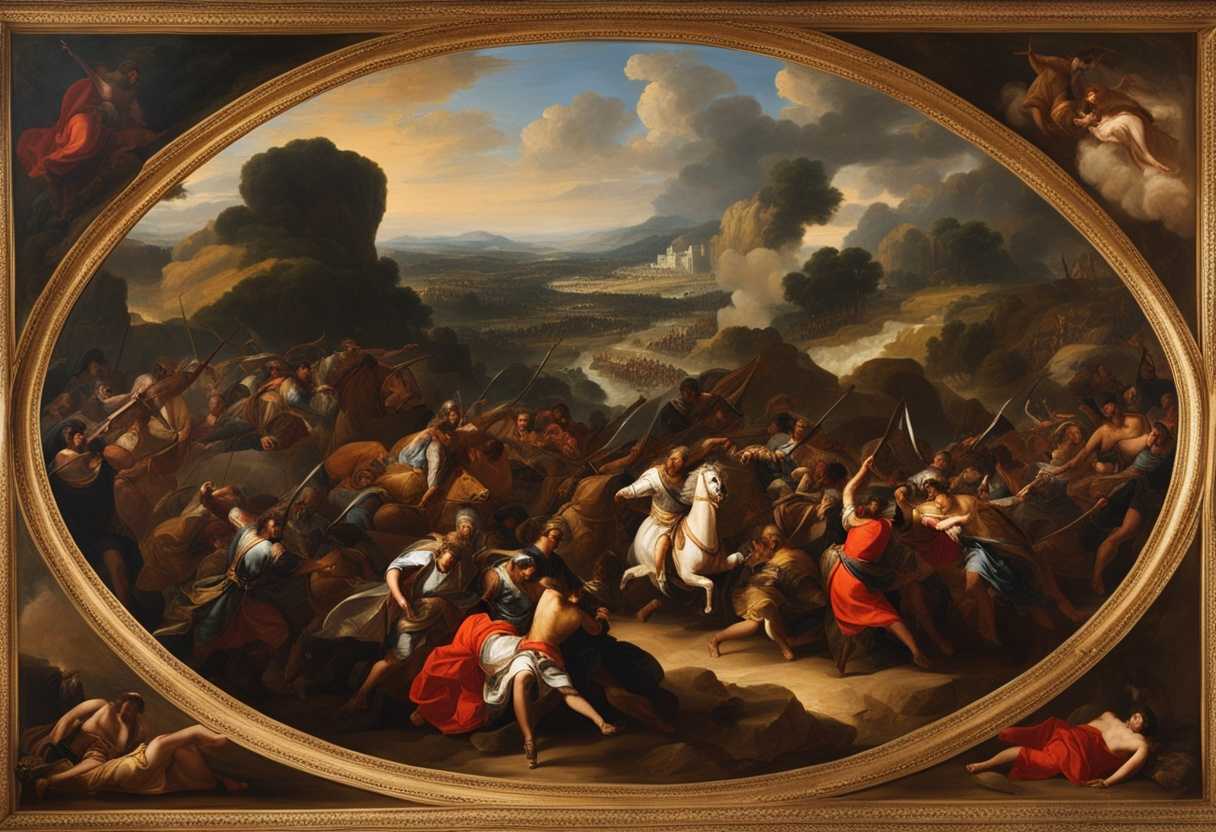
Sihon is a king of the Amorites mentioned in the Book of Numbers (21:21-30) and Deuteronomy (2:24-37), known for opposing the Israelites and being defeated by them. His defeat is significant as it marks the Israelites’ conquest of the Transjordan region, paving the way for their eventual entry into the Promised Land.
Scripture
24 ‘Rise up, set out on your journey and go over the Valley of the Arnon. Behold, I have given into your hand Sihon the Amorite, king of Heshbon, and his land. Begin to take possession, and contend with him in battle.
25 This day I will begin to put the dread and fear of you on the peoples who are under the whole heaven, who shall hear the report of you and shall tremble and be in anguish because of you.’
26 So I sent messengers from the wilderness of Kedemoth to Sihon the king of Heshbon, with words of peace, saying,
27 Let me pass through your land. I will go only by the road; I will turn aside neither to the right nor to the left.
28 You shall sell me food for money, that I may eat, and give me water for money, that I may drink. Only let me pass through on foot,
29 as the sons of Esau who live in Seir and the Moabites who live in Ar did for me, until I go over the Jordan into the land that the Lord our God is giving to us.’
30 But Sihon the king of Heshbon would not let us pass by him, for the Lord your God hardened his spirit and made his heart obstinate, that he might give him into your hand, as he is this day.
31 And the Lord said to me, ‘Behold, I have begun to give Sihon and his land over to you. Begin to take possession, that you may occupy his land.’
32 Then Sihon came out against us, he and all his people, to battle at Jahaz.
33 And the Lord our God gave him over to us, and we defeated him and his sons and all his people.
34 And we captured all his cities at that time and devoted to destruction every city, men, women, and children. We left no survivors.
35 Only the livestock we took as spoil for ourselves, with the plunder of the cities that we captured.
36 From Aroer, which is on the edge of the Valley of the Arnon, and from the city that is in the valley, as far as Gilead, there was not a city too high for us. The Lord our God gave all into our hands.
37 Only to the land of the sons of Ammon you did not draw near, that is, to all the banks of the river Jabbok and the cities of the hill country, whatever the Lord our God had forbidden us.
Meaning of Sihon in the Bible
The figure of Sihon, the king of the Amorites, carries profound significance within the biblical narrative, particularly as it relates to themes of divine promise and judgment. His opposition to the Israelites, as depicted in Numbers 21:21-30, illustrates the conflict between the chosen people of God and those who stand in opposition to His will. Sihon’s rejection of Israel’s attempt to pass through his territory serves as a foreshadowing of the broader spiritual warfare that Israel would face as they moved towards their destiny in the Promised Land. In Deuteronomy 2:24-37, the Israelites’ victory over Sihon is not merely a military triumph; it is also portrayed as a fulfillment of God’s promise to give them the land, demonstrating God’s sovereignty and faithfulness in delivering His people.
The defeat of Sihon also symbolizes the eradication of wickedness and idolatry, representing not just a geopolitical conquest but a deeper spiritual victory. His land, which is described as part of the territory stretching from the Arnon River to Mount Hermon, becomes a tangible inheritance for the Israelites, showing God’s provision for His people and the establishment of His kingdom on earth (Deuteronomy 3:1-11). Furthermore, Sihon’s story prompts reflection on the consequences of resisting God’s will; ultimately, it serves as a reminder that those who oppose God’s purposes may find themselves subject to judgment, while those who remain obedient and faithful will witness God’s power in their favor. Thus, Sihon embodies the broader biblical themes of opposition, divine justice, and the faithfulness of God in fulfilling His promises to His people.
Beyond the immediate narratives of conquest, Sihon’s role in the biblical text serves as an illustrative case of the tensions between divine mandate and human agency. His refusal to allow the Israelites passage and subsequent aggression can be interpreted as emblematic of the broader human condition—where resistance to God and His people often leads to dire consequences. This theme resonates throughout scripture, reinforcing the notion that those who challenge the sovereignty of God inevitably find themselves on the losing side of history. Sihon’s story parallels the fate of other nations and leaders throughout the Bible who opposed God’s plans, serving as a cautionary tale on the repercussions of pride and disobedience.
Moreover, the defeat of Sihon emphasizes God’s role as both protector and warrior for His chosen people. As the Israelites move forward into their inheritance, his defeat not only signifies a physical territorial acquisition but also marks a critical moment in the overarching narrative of Israel’s journey into the Promised Land. The conquest of Sihon thus becomes an essential component of Israel’s identity, reinforcing their narrative of liberation and covenantal promises. In the literary and theological context of the Old Testament, Sihon embodies impure nations, serving as a catalyst for discussions around holiness, covenant fidelity, and the moral imperative to confront evil. This underscores that, for the Israelites, every victory over opposition is not simply a matter of military prowess but a testament to the unwavering support of a God who orchestrates their history and destiny.
The Symbol of Opposition to God’s People
Sihon, the king of the Amorites, represents the opposition that the Israelites faced as they journeyed to the Promised Land. His resistance to allowing the Israelites passage through his territory symbolizes the broader theme of conflict between God’s chosen people and those who stand against divine purpose. This opposition serves as a reminder of the spiritual battles believers may encounter in their own lives when pursuing God’s will.
The Consequences of Rebellion
Sihon’s fate illustrates the consequences of rebellion against God. His refusal to heed the requests of the Israelites and his subsequent defeat highlight the idea that those who oppose God’s plans ultimately face judgment. This narrative serves as a cautionary tale about the importance of aligning oneself with God’s intentions and the dangers of pride and defiance.
The Fulfillment of God’s Promises
The defeat of Sihon and the conquest of his land signify the fulfillment of God’s promises to the Israelites. This event underscores the theme of divine providence and the assurance that God will provide for His people as they remain faithful. The victory over Sihon not only demonstrates God’s power but also reinforces the belief that He is actively involved in guiding and protecting His people on their journey.
How to Embrace Grace and Cultivate Kindness in Faith
Embracing grace and cultivating kindness in our faith journey is truly transformative, both for ourselves and those around us. It starts with recognizing that grace is a gift we receive, not something we earn; it’s the unmerited love of God that invites us to extend that same love to others. As we reflect on our own imperfections and the grace we’ve been shown, we can begin to let go of judgment and embrace compassion. Practically, this means looking for opportunities to serve others, whether through a kind word, a helping hand, or simply being present in someone’s time of need. Remember, kindness is often a quiet act of love that can ripple outwards, reflecting the heart of Christ in our everyday interactions. So, let’s commit to being vessels of grace, allowing it to flow through us, and watch how it transforms our relationships and deepens our faith.
Bible References to Sihon in Scripture:
Deuteronomy 3:1-11: 1 “Then we turned and went up the way to Bashan. And Og the king of Bashan came out against us, he and all his people, to battle at Edrei.”
2 But the Lord said to me, ‘Do not fear him, for I have given him and all his people and his land into your hand. And you shall do to him as you did to Sihon king of the Amorites, who lived at Heshbon.’
3 So the Lord our God gave into our hand Og also, the king of Bashan, and all his people, and we struck him down until he had no survivor left.
4 And we took all his cities at that time—there was not a city that we did not take from them—sixty cities, the whole region of Argob, the kingdom of Og in Bashan.
5 All these were cities fortified with high walls, gates, and bars, besides very many unwalled villages.
6 And we devoted them to destruction, as we did to Sihon the king of Heshbon, devoting to destruction every city, men, women, and children.
7 But all the livestock and the spoil of the cities we took as our plunder.
8 So we took the land at that time out of the hand of the two kings of the Amorites who were beyond the Jordan, from the Valley of the Arnon to Mount Hermon.
9 (The Sidonians call Hermon Sirion, while the Amorites call it Senir.)
10 all the cities of the tableland and all Gilead and all Bashan, as far as Salecah and Edrei, cities of the kingdom of Og in Bashan.
11 (For only Og the king of Bashan was left of the remnant of the Rephaim. Behold, his bed was a bed of iron. Is it not in Rabbah of the Ammonites? Nine cubits was its length, and four cubits its breadth, according to the common cubit.)
Numbers 21:21-31: 35 So they defeated him and his sons and all his people, until he had no survivor left. And they took possession of his land.
22 “Let me pass through your land. We will not turn aside into field or vineyard; we will not drink the water of a well. We will go by the King’s Highway until we have passed through your territory.”
32 And Moses sent to spy out Jazer, and they captured its villages and dispossessed the Amorites who were there.
24 And Israel defeated him with the edge of the sword and took possession of his land from the Arnon to the Jabbok, as far as to the Ammonites, for the border of the Ammonites was strong.
25 And Israel took all these cities, and Israel settled in all the cities of the Amorites, in Heshbon, and in all its villages.
26 For Heshbon was the city of Sihon the king of the Amorites, who had fought against the former king of Moab and taken all his land out of his hand, as far as the Arnon.
27 Therefore the ballad singers say,
“Come to Heshbon, let it be built;
let the city of Sihon be established.
28 For fire came out from Heshbon, flame from the city of Sihon. It devoured Ar of Moab, and swallowed the heights of the Arnon.
29 Woe to you, O Moab! You are undone, O people of Chemosh! He has made his sons fugitives, and his daughters captives, to an Amorite king, Sihon.
30 And we overthrew them; Heshbon, as far as Dibon, perished; and we laid waste as far as Nophah; fire spread as far as Medeba.
31 Thus Israel lived in the land of the Amorites.
Judges 11:19-22: 19 And Israel sent messengers to Sihon king of the Amorites, the king of Heshbon, and Israel said to him, “Please let us pass through your land to our country,”
20 But Sihon did not trust Israel to pass through his territory, so Sihon gathered all his people together and encamped at Jahaz and fought with Israel.
21 And the Lord, the God of Israel, gave Sihon and all his people into the hand of Israel, and they defeated them. So Israel took possession of all the land of the Amorites, who inhabited that country.
22 And they took possession of all the territory of the Amorites from the Arnon to the Jabbok and from the wilderness to the Jordan.
Joshua 12:1-6: 1 Now these are the kings of the land whom the people of Israel defeated and took possession of their land beyond the Jordan toward the sunrise, from the Valley of the Arnon to Mount Hermon, with all the Arabah eastward:
2 Sihon king of the Amorites who lived in Heshbon and ruled from Aroer, which is on the edge of the Valley of the Arnon, and from the middle of the valley as far as the river Jabbok, the boundary of the Ammonites, that is, half of Gilead,
3 and the Arabah to the Sea of Chinneroth eastward, and in the direction of Beth-jeshimoth, to the Sea of the Arabah, the Salt Sea, southward to the foot of the slopes of Pisgah;
4 and Og king of Bashan, one of the remnant of the Rephaim, who lived at Ashtaroth and at Edrei,
5 the king of Eglon, one; the king of Gezer, one;
6 Moses, the servant of the Lord, and the people of Israel defeated them. And Moses the servant of the Lord gave their land for a possession to the Reubenites, the Gadites, and the half-tribe of Manasseh.
Joshua 13:8-10: 8 With the other half of the tribe of Manasseh the Reubenites and the Gadites received their inheritance, which Moses gave them, beyond the Jordan eastward, as Moses the servant of the Lord gave them:
9 from Aroer, which is on the edge of the Valley of the Arnon, and the city that is in the middle of the valley, and all the tableland of Medeba;
10 and all the cities of Sihon king of the Amorites, who reigned in Heshbon, as far as the boundary of the Ammonites,
Nehemiah 9:22-24: 22 “You gave them kingdoms and peoples and allotted to them every corner. So they took possession of the land of Sihon king of Heshbon and the land of Og king of Bashan.”
23 You multiplied their children as the stars of heaven, and you brought them into the land that you had told their fathers to enter and possess.
24 So the descendants went in and possessed the land, and you subdued before them the inhabitants of the land, the Canaanites, and gave them into their hand, with their kings and the peoples of the land, that they might do with them as they would.
Psalm 135:10-12: 10 Who struck down great nations and killed mighty kings,
11 Sihon, king of the Amorites, and Og, king of Bashan, and all the kingdoms of Canaan;
12 And gave their land as a heritage, a heritage to his people Israel.
Psalm 136:17-22: 17 to him who struck down great kings, for his steadfast love endures forever;
18 and killed mighty kings, for his steadfast love endures forever;
19 Sihon, king of the Amorites, for his steadfast love endures forever;
20 And gave their land as a heritage, for his steadfast love endures forever.
21 and gave their land as a heritage, for his steadfast love endures forever.
22 A heritage to his servant Israel, for his steadfast love endures forever.

Reverend Michael Johnson is an experienced Church Minister with a profound expertise in spirituality and guidance. With a serene presence and a compassionate heart, he has faithfully served his congregation for over 20 years, leading them on a spiritual journey towards inner peace and enlightenment. Reverend Johnson’s extensive knowledge of religious philosophies and profound understanding of human nature have made him a trusted confidant and mentor to many, as he seamlessly weaves his profound wisdom into life teachings. Reverend Johnson’s calming demeanor and empathetic nature continue to uplift and heal souls, nurturing a sense of unity and tranquility within his community.