
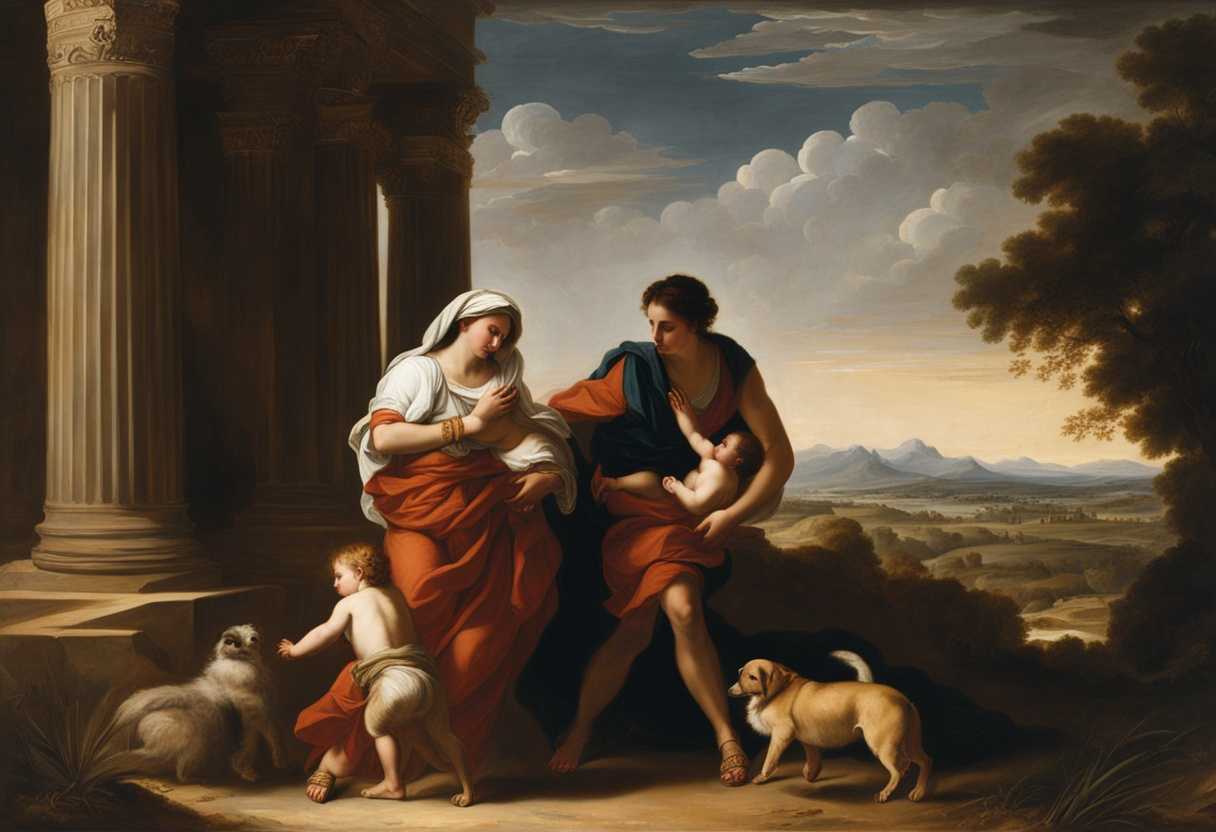
In the Bible, the name Hagar means “flight” or “to flee.” Hagar was an Egyptian servant of Sarah who bore Abraham’s son Ishmael after Sarah was unable to conceive.
Scripture
1 Now Sarai, Abram’s wife, had borne him no children.
2 And Sarai said to Abram, “Behold now, the Lord has prevented me from bearing children. Go in to my servant; it may be that I shall obtain children by her.” And Abram listened to the voice of Sarai.
3 And Sarai, Abram’s wife, took Hagar the Egyptian, her servant, after Abram had lived ten years in the land of Canaan, and gave her to Abram her husband to be his wife.
4 And he went in to Hagar, and she conceived. And when she saw that she had conceived, she looked with contempt on her mistress.
5 And Sarai said to Abram, “May the wrong done to me be on you! I gave my servant to your embrace, and when she saw that she had conceived, she looked on me with contempt. May the Lord judge between you and me!”
6 But Abram said to Sarai, “Behold, your servant is in your power; do to her as you please.” Then Sarai dealt harshly with her, and she fled from her.
7 The angel of the Lord found her by a spring of water in the wilderness, the spring on the way to Shur.
8 And he said, “Hagar, servant of Sarai, where have you come from and where are you going?” She said, “I am fleeing from my mistress Sarai.”
9 The angel of the Lord said to her, “Return to your mistress and submit to her.”
10 The angel of the Lord also said to her, “I will surely multiply your offspring so that they cannot be numbered for multitude.”
11 And the angel of the Lord said to her, “Behold, you are pregnant and shall bear a son. You shall call his name Ishmael, because the Lord has listened to your affliction.
12 He shall be a wild donkey of a man, his hand against everyone and everyone’s hand against him, and he shall dwell over against all his kinsmen.”
13 So she called the name of the Lord who spoke to her, “You are a God of seeing,” for she said, “Truly here I have seen him who looks after me.”
14 Therefore the well was called Beer-lahai-roi; it lies between Kadesh and Bered.
15 And Hagar bore Abram a son, and Abram called the name of his son, whom Hagar bore, Ishmael.
16 Abram was eighty-six years old when Hagar bore Ishmael to Abram.
Meaning of Hagar in the Bible
In the biblical narrative, the name Hagar, which means “flight” or “to flee,” resonates deeply with her story and the broader themes of desperation and divine intervention. Hagar’s journey begins in Genesis 16, where she is introduced as Sarah’s maidservant, tasked with bearing a child on behalf of Sarah, who was struggling with infertility. This act of surrogacy was culturally acceptable at the time, but it brings forth tension and strife within the household. When Hagar becomes pregnant, she is mistreated by Sarah, which prompts her to flee into the wilderness. It is here, in her flight, that she encounters the Angel of the Lord, who not only reassures her but also gives her a promise concerning her son Ishmael (Genesis 16:7-12). This moment of divine confrontation signifies that even in her despair and isolation, God sees and cares for her, highlighting the theme that accounts for the marginalized and oppressed.
Hagar’s experience serves as a poignant illustration of God’s attention to those who are often overlooked or mistreated. Her name carries a dual significance: while it marks her act of fleeing from her troubles, it also signifies her journey toward empowerment and affirmation of identity. In Genesis 21, after she is cast out into the wilderness with Ishmael, it is again God who intervenes by providing for them and promising that Ishmael would also become the father of a great nation (Genesis 21:17-18). Thus, Hagar embodies the broader biblical theme of resilience amidst suffering and reflects God’s compassion towards the outcast. Her story invites readers to reflect on how divine providence can manifest in the lives of those who experience marginalization, emphasizing that every person, regardless of their background, is integral to God’s overarching narrative of redemption and hope.
The complexity of Hagar’s character extends beyond her immediate circumstances and highlights critical themes of identity and social status within the biblical context. As an Egyptian slave, her name, symbolizing flight, evokes not only her physical journeys but also her social and spiritual flight from oppression. Hagar’s plight encapsulates the experience of many marginalized individuals, showcasing their struggles for dignity and recognition in a patriarchal society that often disregards women, especially those of lower status. In her interactions with the divine, Hagar becomes a figure of profound significance, illustrating that God’s care and purpose extend to the most vulnerable members of society.
Moreover, the implications of Hagar’s story can be discerned in later biblical writings, where her narrative is invoked to discuss themes of freedom and bondage. The Apostle Paul, in his letter to the Galatians, uses Hagar as a metaphor for the old covenant and the bondage of the Law, contrasting her with Sarah, who represents the new covenant of grace (Galatians 4:21-31). This connection elevates Hagar’s role from mere survivor of her circumstance to a symbol of broader spiritual truths. Consequently, her story carries forward not just the theme of fleeing from pain, but also the transformative journey towards spiritual empowerment and liberation—echoing the promise that even those who seem most marginalized can play a crucial role in the fulfillment of God’s redemptive plan for humanity. Hagar thus stands as a testament to the unyielding pursuit of identity and freedom, a narrative that resonates deeply within the biblical framework and continues to inspire discussions of justice and inclusion today.
The Significance of Hagar as a Symbol of Struggle
Hagar’s name, which is often interpreted to mean “flight” or “to flee,” reflects her experiences of hardship and struggle. As a servant who faced oppression and was cast out, Hagar embodies the plight of those who are marginalized and mistreated. Her story highlights the themes of survival and resilience in the face of adversity, serving as a reminder of the struggles faced by many throughout history.
Hagar as a Representation of Divine Care
Despite her difficult circumstances, Hagar’s encounters with God reveal a deeper meaning behind her name. The narrative illustrates that even in moments of despair, divine presence and care are accessible. Hagar’s experiences emphasize that God sees and hears the cries of the oppressed, reinforcing the idea that no one is forgotten or abandoned, regardless of their social status or situation.
Hagar’s Role in the Broader Narrative of Faith
Hagar’s name and story contribute to the larger biblical narrative concerning faith, promise, and the complexities of human relationships. Her role as the mother of Ishmael introduces themes of covenant and lineage, illustrating how God’s plans can unfold in unexpected ways. Hagar’s journey invites reflection on the intersections of faith, identity, and the unfolding of divine purpose in the lives of individuals who may not fit traditional narratives.
How to Embrace Growth in Your Christian Journey
Embracing growth in your Christian journey is a beautiful and transformative process that requires both intention and openness. Start by immersing yourself in Scripture, allowing the Word to challenge and inspire you daily; consider keeping a journal to reflect on your thoughts and prayers, which can help you track your spiritual progress. Surround yourself with a community of believers who encourage and uplift you, as fellowship can provide accountability and support during tough times. Don’t shy away from stepping out of your comfort zone—whether it’s volunteering, sharing your faith, or engaging in difficult conversations about your beliefs. Remember, growth often comes through trials, so embrace challenges as opportunities to deepen your faith and reliance on God. Above all, be patient with yourself; spiritual growth is a lifelong journey, and every step, no matter how small, brings you closer to the heart of Christ.
Bible References to Hagar’s Name Meaning:
Genesis 21:8-21: 8 And the child grew and was weaned. And Abraham made a great feast on the day that Isaac was weaned.
9 But Sarah saw the son of Hagar the Egyptian, whom she had borne to Abraham, laughing.
10 So she said to Abraham, “Cast out this slave woman with her son, for the son of this slave woman shall not be heir with my son Isaac.”
11 And the thing was very displeasing to Abraham on account of his son.
12 But God said to Abraham, “Be not displeased because of the boy and because of your slave woman. Whatever Sarah says to you, do as she tells you, for through Isaac shall your offspring be named.”
13 And I will make a nation of the son of the slave woman also, because he is your offspring.
14 So Abraham rose early in the morning and took bread and a skin of water and gave it to Hagar, putting it on her shoulder, along with the child, and sent her away. And she departed and wandered in the wilderness of Beersheba.
15 When the water in the skin was gone, she put the child under one of the bushes.
16 Then she went and sat down opposite him a good way off, about the distance of a bowshot, for she said, “Let me not look on the death of the child.” And as she sat opposite him, she lifted up her voice and wept.
17 And God heard the voice of the boy, and the angel of God called to Hagar from heaven and said to her, “What troubles you, Hagar? Fear not, for God has heard the voice of the boy where he is.
18 Up! Lift up the boy, and hold him fast with your hand, for I will make him into a great nation.”
19 Then God opened her eyes, and she saw a well of water. And she went and filled the skin with water and gave the boy a drink.
20 And God was with the boy, and he grew up. He lived in the wilderness and became an expert with the bow.
21 He lived in the wilderness of Paran, and his mother took a wife for him from the land of Egypt.
Genesis 25:12-18: 12 These are the generations of Ishmael, Abraham’s son, whom Hagar the Egyptian, Sarah’s servant, bore to Abraham.
13 These are the names of the sons of Ishmael, named in the order of their birth: Nebaioth, the firstborn of Ishmael, and Kedar, Adbeel, Mibsam,
14 Mishma, Dumah, Massa,
15 Hadad died, and Samlah of Masrekah reigned in his place.
16 These are the sons of Ishmael and these are their names, by their villages and by their encampments, twelve princes according to their tribes.
17 (These are the years of the life of Ishmael: 137 years. He breathed his last and died, and was gathered to his people.)
18 They settled from Havilah to Shur, which is opposite Egypt in the direction of Assyria. He settled over against all his kinsmen.
Galatians 4:21-31: Tell me, you who desire to be under the law, do you not listen to the law?
22 For it is written that Abraham had two sons, one by a slave woman and one by a free woman.
23 But the son of the slave was born according to the flesh, while the son of the free woman was born through promise.
24 Now this may be interpreted allegorically: these women are two covenants. One is from Mount Sinai, bearing children for slavery; she is Hagar.
25 Now Hagar is Mount Sinai in Arabia; she corresponds to the present Jerusalem, for she is in slavery with her children.
26 But the Jerusalem above is free, and she is our mother.
27 For it is written, “Rejoice, O barren one who does not bear; break forth and cry aloud, you who are not in labor! For the children of the desolate one will be more than those of the one who has a husband.”
Now you, brothers, like Isaac, are children of promise.
29 But just as at that time he who was born according to the flesh persecuted him who was born according to the Spirit, so also it is now.
30 But what does the Scripture say? “Cast out the slave woman and her son, for the son of the slave woman shall not inherit with the son of the free woman.”
31 So, brothers, we are not children of the slave but of the free woman.

Rev. François Dupont is a dedicated church minister with a wealth of experience in serving spiritual communities. With a calm and serene demeanor, he has been devoted to sharing the message of love, compassion, and tolerance for over two decades. Through his thoughtful sermons, compassionate counseling, and unwavering support, Rev. Dupont has touched the lives of countless individuals, allowing them to find solace and strength during difficult times. His serene presence and deep understanding of the human condition make him a trusted guide for those seeking spiritual nourishment and guidance.