
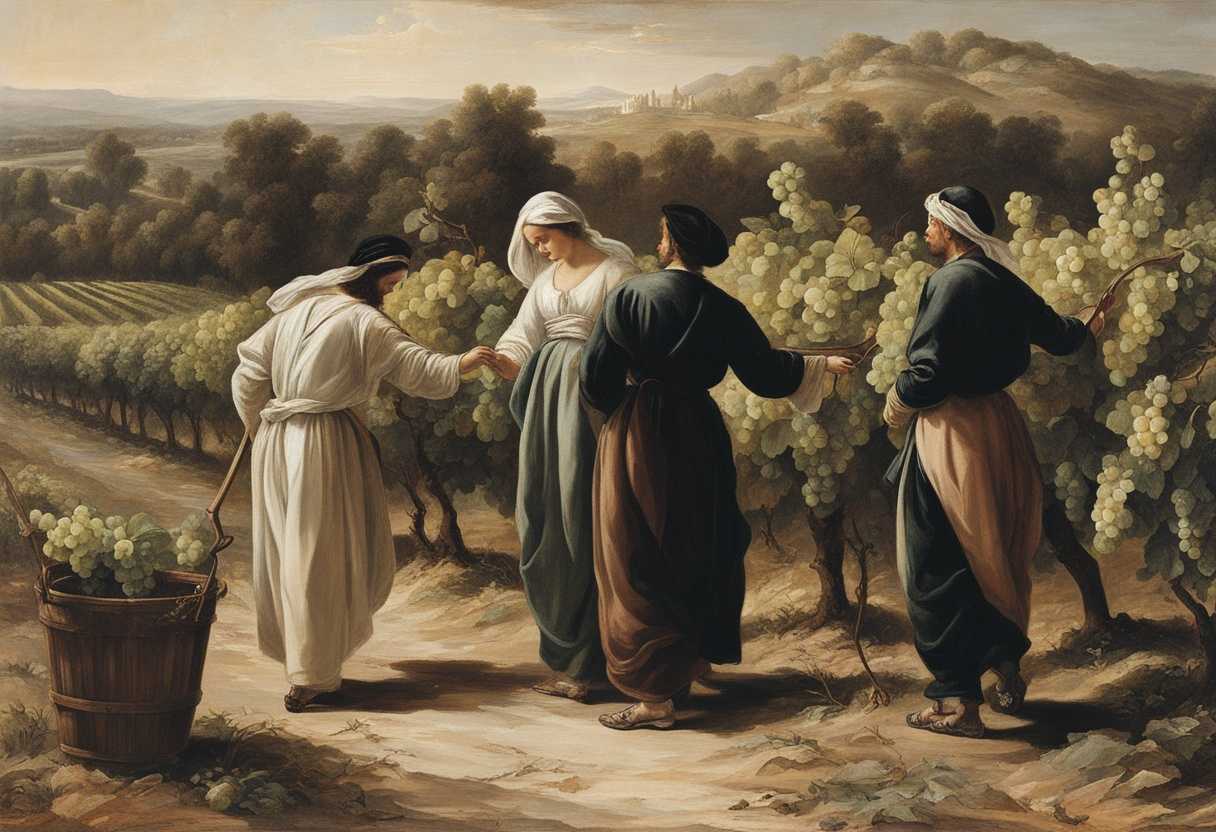
In the KJV Bible, “vinedressers” refers to those who tend to vineyards, caring for the vines and grapes. This term often symbolizes the responsibility of stewardship and cultivation in spiritual contexts, as seen in parables like the one in Matthew 21:33-41.
Scripture
1 The Spirit of the Lord God is upon me,
because the Lord has anointed me
to bring good news to the poor;
he has sent me to bind up the brokenhearted,
to proclaim liberty to the captives,
and the opening of the prison to those who are bound;
2 to proclaim the year of the Lord’s favor, and the day of vengeance of our God; to comfort all who mourn;
3 to grant to those who mourn in Zion—
to give them a beautiful headdress instead of ashes,
the oil of gladness instead of mourning,
the garment of praise instead of a faint spirit;
that they may be called oaks of righteousness,
the planting of the Lord, that he may be glorified.
4 They shall build up the ancient ruins; they shall raise up the former devastations; they shall repair the ruined cities, the devastations of many generations.
5 Strangers shall stand and tend your flocks; foreigners shall be your plowmen and vinedressers.
6 but you shall be called the priests of the Lord;
they shall speak of you as the ministers of our God;
you shall eat the wealth of the nations,
and in their glory you shall boast.
7 Instead of your shame there shall be a double portion; instead of dishonor they shall rejoice in their lot; therefore in their land they shall possess a double portion; they shall have everlasting joy.
8 For I the Lord love justice;
I hate robbery and wrong;
I will faithfully give them their recompense,
and I will make an everlasting covenant with them.
9 Their offspring shall be known among the nations, and their descendants in the midst of the peoples; all who see them shall acknowledge them, that they are an offspring the Lord has blessed.
10 I will greatly rejoice in the Lord; my soul shall exult in my God, for he has clothed me with the garments of salvation; he has covered me with the robe of righteousness, as a bridegroom decks himself like a priest with a beautiful headdress, and as a bride adorns herself with her jewels.
11 For as the earth brings forth its sprouts,
and as a garden causes what is sown in it to sprout up,
so the Lord God will cause righteousness and praise
to sprout up before all the nations.
Meaning of Vinedressers in the KJV Bible
In the KJV Bible, the term “vinedressers” carries rich symbolic meaning, particularly in relation to stewardship, accountability, and spiritual care. The parable found in Matthew 21:33-41 presents a poignant narrative where Jesus speaks of a landowner who plants a vineyard and hires vinedressers to tend to it. This vineyard can be seen as a metaphor for God’s kingdom or His people, and the vinedressers represent the leaders and caretakers entrusted with these responsibilities. The vinedressers’ actions reflect their management of the resources and blessings given to them, and their refusal to honor the landowner evokes themes of rebellion and the rejection of divine authority.
The broader implication of this role emphasizes that stewardship is not just about care for physical resources, but also about nurturing the faith and wellbeing of others. In John 15:1-8, Jesus identifies Himself as the true vine and His followers as the branches, reinforcing the connection between His divine sustenance and the need for care and cultivation in spiritual growth. The responsibility of vinedressers extends beyond basic maintenance; it encompasses the call to produce good fruit (resulting in righteous living and evangelism), to remain connected to Christ, and to bear witness to His truths. Thus, the concept of vinedressers encapsulates a profound responsibility that emphasizes accountability to God for how one nurtures both their personal faith and the faith of others within the community.
The concept of vinedressers is echoed in various passages throughout the KJV Bible, shedding light on the themes of responsibility and the relationship between the caretaker and the landowner. In Isaiah 5:1-7, the imagery of a vineyard is employed to articulate God’s expectations for His people, illustrating that proper cultivation should yield justice and righteousness. This passage highlights the expectation that those entrusted with stewardship must not only tend to the ecosystem but also ensure that their actions align with the moral and ethical standards set by God. The failure of the vinedressers in this context reflects a broader societal breakdown, underscoring the consequences of neglecting God’s commandments and the resulting divine judgment.
Additionally, the theme of vinedressers resonates in the context of spiritual leadership within the church. In passages like 1 Peter 5:2-4, church leaders are called to “feed the flock of God” and to exercise their roles willingly and eagerly. This directive mirrors the responsibilities of the vinedressers, who must nurture the growth of the vineyard while being fully accountable for their actions. Their leadership is characterized by a model of servanthood, where the primary goal is the flourishing of the community in faith rather than personal gain. This emphasizes the broader biblical narrative that highlights the importance of faithful stewardship, encouraging leaders to cultivate an environment where individuals can grow spiritually and produce good fruit that brings glory to God. Ultimately, the role of the vinedressers challenges believers to reflect on how they manage the gifts and responsibilities that God has entrusted to them, maintaining a focus on accountability and divine purpose.
Stewardship and Responsibility
In the biblical context, vinedressers symbolize the concept of stewardship. They are entrusted with the care and cultivation of the vineyard, which represents God’s creation or His people. This role emphasizes the responsibility that individuals have in nurturing and maintaining what has been given to them. It reflects the broader theme of accountability in the Bible, where believers are called to manage their resources, talents, and relationships in a way that honors God.
Judgment and Consequences
Vinedressers also embody the theme of judgment and the consequences of one’s actions. In various parables, the treatment of the vineyard and its owner can lead to significant outcomes, illustrating the idea that those who fail to fulfill their duties or act unjustly will face repercussions. This serves as a reminder of divine justice and the importance of living righteously, as one’s actions will ultimately be evaluated by God.
Community and Collaboration
The role of vinedressers can also be seen as a representation of community and collaboration. In the cultivation of a vineyard, teamwork and cooperation are essential for success. This reflects the biblical principle of working together in unity, as believers are called to support one another in their spiritual journeys. The vinedresser’s work highlights the importance of relationships within the body of Christ, where each member plays a vital role in the growth and health of the community.
How to Embrace Stewardship in Your Christian Walk
Embracing stewardship in your Christian walk is a beautiful way to reflect God’s love and generosity in your daily life. It begins with recognizing that everything we have—our time, talents, and treasures—ultimately belongs to God. Start by assessing how you can use these gifts to serve others and glorify Him. This might mean volunteering your time at a local charity, sharing your skills to help someone in need, or being intentional about your financial giving to support your church and community. Remember, stewardship isn’t just about money; it’s about cultivating a heart of gratitude and a willingness to share what you have. As you practice stewardship, you’ll find that it deepens your faith and connects you more profoundly with the body of Christ, reminding you that we are all called to be caretakers of God’s creation. So, take small steps each day to live out this calling, and watch how it transforms not only your life but also the lives of those around you.
Bible References to Vinedressers in KJV:
Matthew 21:33-41: 33 “Hear another parable. There was a master of a house who planted a vineyard and put a fence around it and dug a winepress in it and built a tower and leased it to tenants, and went into another country.
34 When the season for fruit drew near, he sent his servants to the tenants to get his fruit.
35 And the tenants took his servants and beat one, killed another, and stoned another.
36 Again he sent other servants, more than the first. And they did the same to them.
37 Finally he sent his son to them, saying, ‘They will respect my son.’
38 But when the tenants saw the son, they said to themselves, ‘This is the heir. Come, let us kill him and have his inheritance.’
39 And they took him and threw him out of the vineyard and killed him.
40 Now when the owner of the vineyard comes, what will he do to those tenants?”
41 They said to him, “He will put those wretches to a miserable death and let out the vineyard to other tenants who will give him the fruits in their seasons.”
John 15:1-8: 1 “I am the true vine, and my Father is the vinedresser.”
2 Every branch in me that does not bear fruit he takes away, and every branch that does bear fruit he prunes, that it may bear more fruit.
3 Already you are clean because of the word that I have spoken to you.
4 Abide in me, and I in you. As the branch cannot bear fruit by itself, unless it abides in the vine, neither can you, unless you abide in me.
5 I am the vine; you are the branches. Whoever abides in me and I in him, he it is that bears much fruit, for apart from me you can do nothing.
6 If anyone does not abide in me he is thrown away like a branch and withers; and the branches are gathered, thrown into the fire, and burned.
7 If you abide in me, and my words abide in you, ask whatever you wish, and it will be done for you.
8 By this my Father is glorified, that you bear much fruit and so prove to be my disciples.
Isaiah 5:1-7: 1 Let me sing for my beloved my love song concerning his vineyard: My beloved had a vineyard on a very fertile hill.
2 He dug it and cleared it of stones, and planted it with choice vines; he built a watchtower in the midst of it, and hewed out a wine vat in it; and he looked for it to yield grapes, but it yielded wild grapes.
3 And now, O inhabitants of Jerusalem and men of Judah, judge between me and my vineyard.
4 What more was there to do for my vineyard, that I have not done in it? When I looked for it to yield grapes, why did it yield wild grapes?
5 And now I will tell you what I will do to my vineyard. I will remove its hedge, and it shall be devoured; I will break down its wall, and it shall be trampled down.
6 I will make it a waste;
it shall not be pruned or hoed,
and briers and thorns shall grow up;
I will also command the clouds
that they rain no rain upon it.
7 For the vineyard of the Lord of hosts is the house of Israel, and the men of Judah are his pleasant planting; and he looked for justice, but behold, bloodshed; for righteousness, but behold, an outcry!
Jeremiah 12:10-13: 10 Many shepherds have destroyed my vineyard; they have trampled down my portion; they have made my pleasant portion a desolate wilderness.
11 They have made it a desolation;
desolate, it mourns to me.
The whole land is made desolate,
but no man lays it to heart.
12 The destroyers have come upon all the bare heights in the desert, for the sword of the Lord devours from one end of the land to the other; no flesh has peace.
13 They have sown wheat and have reaped thorns; they have tired themselves out but profit nothing. They shall be ashamed of their harvests because of the fierce anger of the Lord.”
Psalm 80:8-16: 8 You brought a vine out of Egypt; you drove out the nations and planted it.
9 You cleared the ground for it; it took deep root and filled the land.
10 The mountains were covered with its shade, the mighty cedars with its branches.
11 It swayed its branches to the sea, and its shoots to the River.
12 Why then have you broken down its walls, so that all who pass along the way pluck its fruit?
13 The boar from the forest ravages it, and all that move in the field feed on it.
14 Turn again, O God of hosts! Look down from heaven, and see; have regard for this vine, the stock that your right hand planted.
15 the stock that your right hand planted, and for the son whom you made strong for yourself.
16 They have burned it with fire; they have cut it down; may they perish at the rebuke of your face!
Mark 12:1-9: 1 And he began to speak to them in parables. “A man planted a vineyard and put a fence around it and dug a pit for the winepress and built a tower, and leased it to tenants and went into another country.
2 When the season came, he sent a servant to the tenants to get from them some of the fruit of the vineyard.
3 And they took him and beat him and sent him away empty-handed.
4 And he sent another, and him they killed. And so with many others: some they beat, and some they killed.
5 And he sent another, and him they killed. And so with many others: some they beat, and some they killed.
6 He had still one other, a beloved son. Finally he sent him to them, saying, ‘They will respect my son.’
7 But those tenants said to one another, ‘This is the heir. Come, let us kill him, and the inheritance will be ours.’
8 And they took him and killed him and threw him out of the vineyard.
9 What will the owner of the vineyard do? He will come and destroy the tenants and give the vineyard to others.
Luke 20:9-16: 9 And he began to tell the people this parable: “A man planted a vineyard and let it out to tenants and went into another country for a long while.
10 When the time came, he sent a servant to the tenants, so that they would give him some of the fruit of the vineyard. But the tenants beat him and sent him away empty-handed.
11 He sent yet another, and they wounded him and cast him out.
12 And he sent yet a third. This one also they wounded and cast out.
13 Then the owner of the vineyard said, ‘What shall I do? I will send my beloved son; perhaps they will respect him.’
14 But when the tenants saw him, they said to themselves, ‘This is the heir. Let us kill him, so that the inheritance may be ours.’
15 So they cast him out of the vineyard and killed him. What then will the owner of the vineyard do to them?
16 He will come and destroy those tenants and give the vineyard to others.” When they heard this, they said, “Surely not!”
Ezekiel 19:10-14: 10 Your mother was like a vine in a vineyard planted by the water, fruitful and full of branches by reason of abundant water.
11 Its strong stem became a ruler’s scepter; it towered aloft among the thick boughs; it was seen in its height with the mass of its branches.
12 But she was plucked up in fury; she was cast down to the ground; the east wind dried up her fruit; her strong rods were broken and withered; the fire consumed them.
13 And now she is planted in the wilderness, in a dry and thirsty land.
14 And fire has gone out from the stem of its shoots, has consumed its fruit, so that there remains in it no strong stem, no scepter for ruling. This is a lamentation and has become a lamentation.
Hosea 10:1-2: 12 Sow for yourselves righteousness;
reap steadfast love;
break up your fallow ground,
for it is the time to seek the Lord,
that he may come and rain righteousness upon you.
2 Their heart is false; now they must bear their guilt. The Lord will break down their altars and destroy their pillars.

Rev. François Dupont is a dedicated church minister with a wealth of experience in serving spiritual communities. With a calm and serene demeanor, he has been devoted to sharing the message of love, compassion, and tolerance for over two decades. Through his thoughtful sermons, compassionate counseling, and unwavering support, Rev. Dupont has touched the lives of countless individuals, allowing them to find solace and strength during difficult times. His serene presence and deep understanding of the human condition make him a trusted guide for those seeking spiritual nourishment and guidance.