
The name James is derived from the Hebrew name Jacob, meaning “supplanter” or “one who takes the place of another.” In the New Testament, James is associated with several key figures, including one of the twelve apostles and the author of the Epistle of James, emphasizing leadership and faith within the early Christian community.
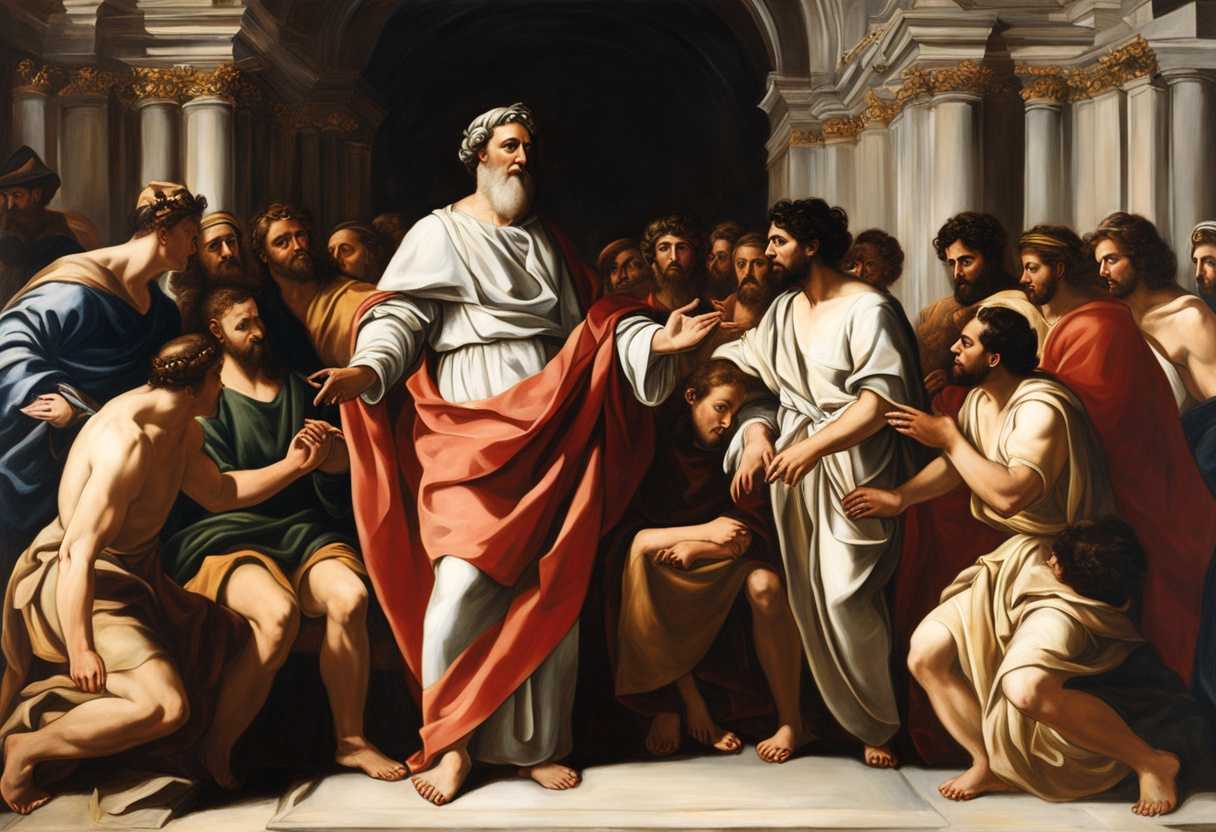
Scripture
18 While walking by the Sea of Galilee, he saw two brothers, Simon (who is called Peter) and Andrew his brother, casting a net into the sea, for they were fishermen.
19 And he said to them, “Follow me, and I will make you fishers of men.”
20 Immediately they left their nets and followed him.
21 And going on from there he saw two other brothers, James the son of Zebedee and John his brother, in the boat with Zebedee their father, mending their nets, and he called them.
22 Immediately they left the boat and their father and followed him.
Meaning of James in the Bible
The name James, originating from the Hebrew name Jacob, carries profound implications that extend beyond its etymological meaning of “supplanter” or “one who takes the place of another.” In the biblical context, the significance of James is multifaceted, particularly seen in the lives of key figures such as James, the son of Zebedee, and James, the brother of Jesus, who plays a central role in the Jerusalem church. These individuals exhibit leadership that underscores the themes of faithfulness and perseverance, especially highlighted in the Epistle of James, where the author exhorts believers to live out their faith through works, stating, “Faith by itself, if it is not accompanied by action, is dead” (James 2:17, NIV). This serves to bridge the connection between faith and practice in the Christian experience.
Additionally, the legacy of James includes the transformative journey of faith that mirrors Jacob’s own life in the Old Testament, where he wrestled with God and emerged with a renewed identity (Genesis 32:28). By naming these pivotal figures James, the biblical text invites readers to reflect on themes of divine purpose, identity, and spiritual leadership. The identity of James as a “supplanter” suggests the idea of God’s sovereign plan to elevate and establish leaders in unexpectedly transformative roles within His community, an act that emphasizes God’s active involvement in human history and the continuity of faith across generations. Thus, the name James embodies a rich tapestry of meaning that captures the essence of discipleship and the enduring call to live a faith that is alive and impactful in the world.
In addition to the notable figures of James within the New Testament, it is essential to consider the broader implications of the name Jacob, which carries through the biblical narrative and shapes the understanding of the name James. Both Jacob and James are emblematic of the complexities of human identity and divine purpose. For instance, Jacob’s struggles, his eventual reconciliation with Esau, and his titular blessing signify a transformation that resonates with the essence of leadership and perseverance present in the lives of those who bear the name James. This connection exemplifies how the trials and triumphs of early followers of Christ echo the archetypal experiences found in the life of Jacob.
Moreover, the historical and cultural contexts surrounding the name James reveal a significant level of influence within the early church and the Jewish community at large. James, the brother of Jesus, represents a pivotal figure bridging the gap between Jewish traditions and the nascent Christian faith. His leadership in Jerusalem established him as a critical voice advocating for the integration of Gentile believers, highlighting the name James as a symbol of unity in diversity. This dual heritage—both Jewish and Christian—reflects the broader narrative of salvation history, wherein individuals like James are called to fulfill God’s mission in transformative ways. This ongoing exploration of the name James thus enriches our understanding of faith, leadership, and the legacy left by those who navigated the complexities of their discipleship journey.
The Significance of the Name James
The name James is derived from the Hebrew name Jacob, which means “supplanter” or “one who follows.” In biblical contexts, this reflects the story of Jacob in the Old Testament, who was known for his cunning and ability to overcome challenges. The name James, therefore, carries connotations of resilience and the ability to navigate life’s obstacles, symbolizing a journey of faith and transformation.
Leadership and Authority
In the New Testament, James is associated with leadership within the early Christian church, particularly as one of the apostles and a prominent figure in Jerusalem. This association highlights the qualities of authority, guidance, and responsibility that the name embodies. James represents the importance of strong leadership in faith communities, emphasizing the role of individuals who guide others in their spiritual journeys.
Faith and Action
The name James is also linked to the concept of faith in action. The epistle of James emphasizes the necessity of demonstrating faith through works, suggesting that true belief is reflected in one’s actions. This broader meaning encourages believers to live out their faith actively, reinforcing the idea that faith is not merely a belief system but a way of life that impacts how one interacts with the world.
How to Embrace Your Identity in Christ
Embracing your identity in Christ is a transformative journey that begins with understanding that you are deeply loved and accepted just as you are. It’s essential to immerse yourself in Scripture, where you’ll find affirmations of your worth—like in Ephesians 2:10, which reminds us that we are God’s handiwork, created for good works. Spend time in prayer, asking God to reveal His truth about who you are in Him, and let that truth shape your thoughts and actions. Surround yourself with a community of believers who encourage you and hold you accountable, as fellowship can strengthen your faith and help you see yourself through God’s eyes. Remember, your identity is not defined by your past mistakes or the world’s standards, but by the grace and love of Christ, who calls you His own. Embrace this identity daily, and let it guide you in living out your purpose with confidence and joy.
Bible References to the Name James:
Mark 1:16-20: 16 Passing alongside the Sea of Galilee, he saw Simon and Andrew the brother of Simon casting a net into the sea, for they were fishermen.
17 And Jesus said to them, “Follow me, and I will make you become fishers of men.”
18 And immediately they left their nets and followed him.
19 And going on a little farther, he saw James the son of Zebedee and John his brother, who were in their boat mending the nets.
20 And immediately he called them, and they left their father Zebedee in the boat with the hired servants and followed him.
Mark 3:13-19: 13 And he went up on the mountain and called to him those whom he desired, and they came to him.
14 And he appointed twelve (whom he also named apostles) so that they might be with him and he might send them out to preach
15 and have authority to cast out demons.
16 He appointed the twelve: Simon (to whom he gave the name Peter);
17 James the son of Zebedee and John the brother of James (to whom he gave the name Boanerges, that is, Sons of Thunder);
18 Andrew, and Philip, and Bartholomew, and Matthew, and Thomas, and James the son of Alphaeus, and Thaddaeus, and Simon the Cananaean,
19 and Judas Iscariot, who betrayed him.
Luke 5:1-11: 1 On one occasion, while the crowd was pressing in on him to hear the word of God, he was standing by the lake of Gennesaret,
2 and he saw two boats by the lake, but the fishermen had gone out of them and were washing their nets.
3 And he got into one of the boats, which was Simon’s, and asked him to put out a little from the land. And he sat down and taught the people from the boat.
4 And when he had finished speaking, he said to Simon, “Put out into the deep and let down your nets for a catch.”
5 And Simon answered, “Master, we toiled all night and took nothing! But at your word I will let down the nets.”
6 And when they had done this, they enclosed a large number of fish, and their nets were breaking.
7 And they signaled to their partners in the other boat to come and help them. And they came and filled both the boats, so that they began to sink.
8 But when Simon Peter saw it, he fell down at Jesus’ knees, saying, “Depart from me, for I am a sinful man, O Lord.”
9 For he and all who were with him were astonished at the catch of fish that they had taken,
10 and so also were James and John, sons of Zebedee, who were partners with Simon. And Jesus said to Simon, “Do not be afraid; from now on you will be catching men.”
11 And when they had brought their boats to land, they left everything and followed him.
Luke 6:12-16: 12 In these days he went out to the mountain to pray, and all night he continued in prayer to God.
13 And when day came, he called his disciples and chose from them twelve, whom he named apostles:
14 Simon, whom he named Peter, and Andrew his brother, and James and John, and Philip, and Bartholomew,
15 Matthew, and Thomas, and James the son of Alphaeus, and Simon who was called the Zealot,
16 and Judas the son of James, and Judas Iscariot, who became a traitor.
Acts 1:12-14: 12 Then they returned to Jerusalem from the mount called Olivet, which is near Jerusalem, a Sabbath day’s journey away.
13 And when they had entered, they went up to the upper room, where they were staying, Peter and John and James and Andrew, Philip and Thomas, Bartholomew and Matthew, James the son of Alphaeus and Simon the Zealot and Judas the son of James.
14 All these with one accord were devoting themselves to prayer, together with the women and Mary the mother of Jesus, and his brothers.
Acts 12:1-2: 1 About that time Herod the king laid violent hands on some who belonged to the church.
2 He killed James the brother of John with the sword.
Galatians 1:18-19: 18 Then after three years I went up to Jerusalem to visit Cephas and remained with him fifteen days.
19 But I saw none of the other apostles except James the Lord’s brother.
Galatians 2:9-10: 9 and when James and Cephas and John, who seemed to be pillars, perceived the grace that was given to me, they gave the right hand of fellowship to Barnabas and me, that we should go to the Gentiles and they to the circumcised.
10 Only, they asked us to remember the poor, the very thing I was eager to do.
James 1:1-4: 1 James, a servant of God and of the Lord Jesus Christ, To the twelve tribes in the Dispersion: Greetings.
2 Count it all joy, my brothers, when you meet trials of various kinds,
3 for you know that the testing of your faith produces steadfastness.
4 And let steadfastness have its full effect, that you may be perfect and complete, lacking in nothing.

Reverend Michael Johnson is an experienced Church Minister with a profound expertise in spirituality and guidance. With a serene presence and a compassionate heart, he has faithfully served his congregation for over 20 years, leading them on a spiritual journey towards inner peace and enlightenment. Reverend Johnson’s extensive knowledge of religious philosophies and profound understanding of human nature have made him a trusted confidant and mentor to many, as he seamlessly weaves his profound wisdom into life teachings. Reverend Johnson’s calming demeanor and empathetic nature continue to uplift and heal souls, nurturing a sense of unity and tranquility within his community.