
In the Bible, the name Rebecca (or Rebekah) signifies beauty and a captivating presence, as she is described as a woman of great physical attractiveness and virtue. Additionally, she represents the themes of faith, family, and divine providence, particularly through her role in the patriarchal narratives as the wife of Isaac and mother of Jacob and Esau.
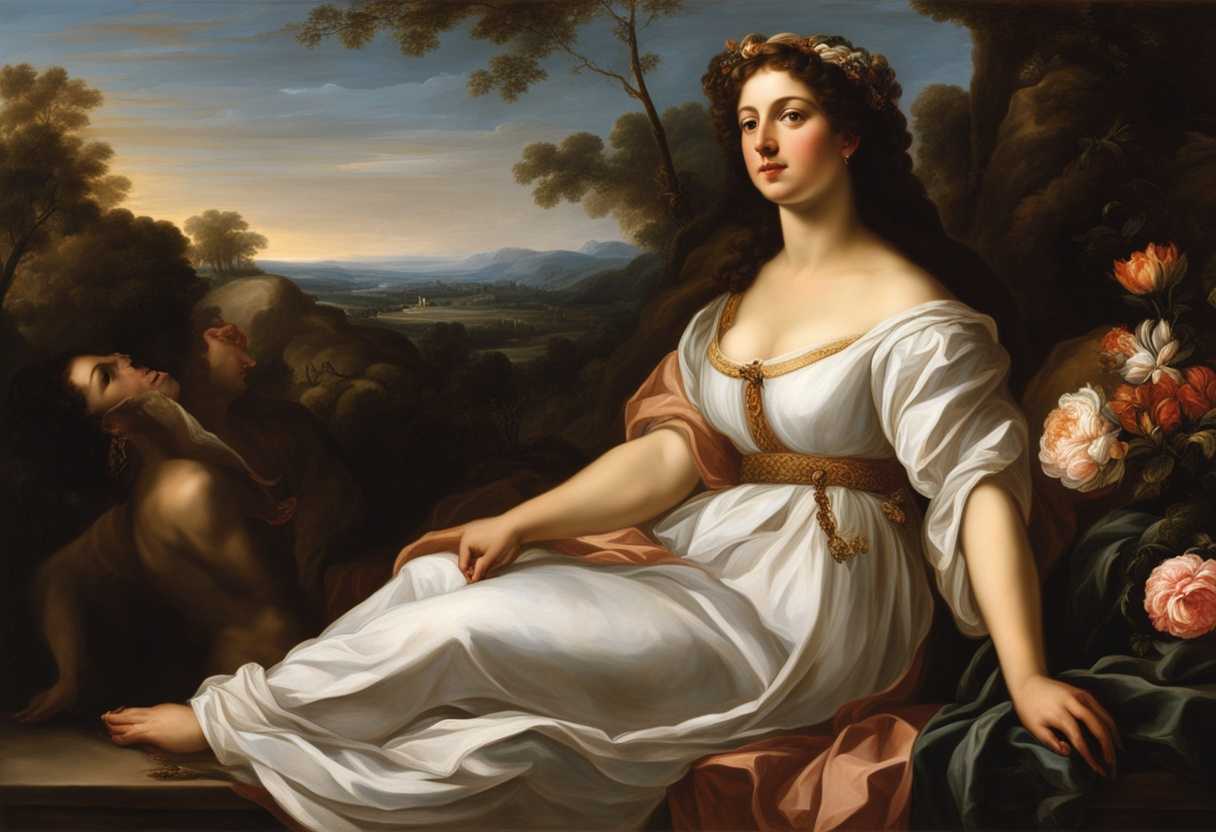
Scripture
15 Before he had finished speaking, behold, Rebekah, who was born to Bethuel the son of Milcah, the wife of Nahor, Abraham’s brother, came out with her water jar on her shoulder.
16 The young woman was very attractive in appearance, a maiden whom no man had known.
17 The servant ran to meet her and said, “Please give me a little water to drink from your jar.”
18 She said, “Drink, my lord.” And she quickly let down her jar upon her hand and gave him a drink.
19 After she had given him a drink, she said, “I will draw water for your camels also, until they have finished drinking.”
20 and quickly emptied her jar into the trough and ran again to the well to draw water, and she drew for all his camels.
21 The man gazed at her in silence to learn whether the Lord had prospered his journey or not.
22 When the camels had finished drinking, the man took a gold ring weighing a half shekel, and two bracelets for her arms weighing ten gold shekels,
23 And said, “Whose daughter are you? Please tell me, is there room in your father’s house for us to spend the night?”
24 She said to him, “I am the daughter of Bethuel the son of Milcah, whom she bore to Nahor.”
25 She added, “We have plenty of both straw and fodder, and room to spend the night.”
26 The man bowed his head and worshiped the Lord.
27 saying, “Blessed be the Lord, the God of my master Abraham, who has not forsaken his steadfast love and his faithfulness toward my master. As for me, the Lord has led me in the way to the house of my master’s kinsmen.”
Spiritual Significance of the Name Rebecca in the Bible
The name Rebecca (or Rebekah) holds significant spiritual meaning in the Bible, symbolizing both physical beauty and profound inner strength. Described in Genesis 24:16 as “very fair to look upon,” Rebecca initially captivates through her outward appearance, yet her character and faith play a more monumental role in the unfolding of God’s covenant with Abraham’s descendants. Her willingness to step into the unknown—leaving her family to marry Isaac, as seen in Genesis 24:58—represents a heart of faith and obedience to God’s plan, a quality that resonates deeply within the biblical narrative. She reflects how divine providence orchestrates the lives of individuals for greater purposes, embodying the essential truth that outer beauty is complemented and often eclipsed by the inner strength of faith.
Moreover, Rebecca’s life illustrates vital themes of family connection and their divine guidance, most evident in her pivotal role in ensuring the continuation of God’s promise to Abraham through her son Jacob. In Genesis 25:23, God reveals to Rebecca that “the older will serve the younger,” a prophetic declaration that she acts upon throughout her life, ultimately leading to the fulfillment of God’s purpose through Jacob. Her actions demonstrate a nuanced understanding of divine destiny, reinforcing the idea that God’s plans often involve human agency and decision-making. This interplay between human choices and divine will encapsulates the broader spiritual significance of Rebecca’s story, offering lessons on faithfulness, family loyalty, and the belief that God directs the paths of those who seek Him, reinforcing themes found throughout Scripture such as Proverbs 3:5-6, which invites believers to trust in the Lord and acknowledge Him in all their ways.
Beyond physical beauty and faith, Rebecca’s name evokes the theme of nurturing and care, essential in both familial and spiritual dimensions. In her role as a matriarch, Rebecca not only bears the future generations but actively guides their destiny. This aspect of her character highlights the powerful influence of maternal figures in the biblical narrative, echoing the concept that women can serve as vital agents in God’s overarching plan. As a mother, her intuitive understanding of divine guidance allows her to cultivate the blessings bestowed upon her family, reflecting how nurturing extends beyond mere physical sustenance to include spiritual guidance and moral fortitude.
Rebecca’s life also serves as a reminder of the complexities that accompany faith. Her choices—while guided by divine revelation—occasionally lead to tension and conflict within her household, underscoring the unvarnished reality of pursuing God’s will. The account of her favoring Jacob over Esau speaks to the reality of human emotions and allegiances, illustrating the delicate balance between divine ordination and personal preference. This internal struggle adds depth to her spiritual narrative, reminding believers that faith can involve navigating challenging dynamics and remaining steadfast in one’s convictions. Thus, the name Rebecca resonates with a multifaceted spiritual significance, embodying the themes of guidance, maternal strength, and the complexities inherent in faithfully pursuing the divine path laid before us.
A Symbol of Faith and Trust
The name Rebecca embodies a deep sense of faith and trust in divine guidance. Her story illustrates the importance of relying on God’s plan, as she was chosen to fulfill a significant role in the lineage of the Israelites. This aspect of her character encourages believers to seek divine direction in their own lives, emphasizing the value of faith in navigating life’s challenges.
The Role of Hospitality and Kindness
Rebecca is often associated with hospitality and kindness, as seen in her willingness to serve and care for others. This quality highlights the spiritual significance of being open-hearted and generous, reflecting the love and compassion that are central to many spiritual teachings. Her actions serve as a reminder of the importance of serving others and creating a welcoming environment, which can lead to deeper connections and community building.
The Power of Choice and Agency
Rebecca’s story also illustrates the theme of choice and agency in spiritual journeys. Her decisions significantly impacted her family and the unfolding of biblical history. This aspect of her narrative encourages individuals to recognize the power of their choices and the responsibility that comes with it. It serves as a reminder that one’s decisions can have far-reaching consequences, urging believers to act with wisdom and discernment in their lives.
How to Cultivate Faithfulness and Devotion in Daily Life
Cultivating faithfulness and devotion in our daily lives is a beautiful journey that requires intentionality and a heart open to God’s guidance. Start by setting aside time each day for prayer and reflection; this sacred space allows you to connect with God and seek His will for your life. Consider keeping a gratitude journal, where you can jot down the blessings you encounter each day, big or small—this practice helps shift your focus from what’s lacking to the abundance God provides. Surround yourself with a community of believers who encourage and challenge you in your faith; fellowship can be a powerful catalyst for growth. Lastly, remember that faithfulness is not about perfection but about persistence; when you stumble, lean into God’s grace and recommit to your journey. Embrace each day as an opportunity to deepen your relationship with Christ, and watch how your devotion transforms not only your life but also the lives of those around you.
Bible References to the Name Rebecca:
Genesis 24:58-67: 58 And they called Rebekah and said to her, “Will you go with this man?” She said, “I will go.”
59 So they sent away Rebekah their sister and her nurse, and Abraham’s servant and his men.
24 They blessed Rebekah and said to her, “Our sister, may you become thousands of ten thousands, and may your offspring possess the gate of those who hate him!”
61 Then Rebekah and her young women arose and rode on the camels and followed the man. Thus the servant took Rebekah and went his way.
62 Now Isaac had returned from Beer-lahai-roi and was dwelling in the Negeb.
63 And Isaac went out to meditate in the field toward evening. And he lifted up his eyes and saw, and behold, there were camels coming.
64 And Rebekah lifted up her eyes, and when she saw Isaac, she dismounted from the camel.
65 and said to the servant, “Who is that man, walking in the field to meet us?” The servant said, “It is my master.” So she took her veil and covered herself.
66 And the servant told Isaac all the things that he had done.
67 Then Isaac brought her into the tent of Sarah his mother and took Rebekah, and she became his wife, and he loved her. So Isaac was comforted after his mother’s death.
Genesis 25:20-26: 20 and Isaac was forty years old when he took Rebekah, the daughter of Bethuel the Aramean of Paddan-aram, the sister of Laban the Aramean, to be his wife.
21 And Isaac prayed to the Lord for his wife, because she was barren. And the Lord granted his prayer, and Rebekah his wife conceived.
22 The children struggled together within her, and she said, “If it is thus, why is this happening to me?” So she went to inquire of the Lord.
23 And the Lord said to her, “Two nations are in your womb, and two peoples from within you shall be divided; the one shall be stronger than the other, the older shall serve the younger.”
24 When her days to give birth were completed, behold, there were twins in her womb.
25 The first came out red, all his body like a hairy cloak, so they called his name Esau.
26 Afterward his brother came out with his hand holding Esau’s heel, so his name was called Jacob.
Genesis 26:6-11: 6 So Isaac settled in Gerar.
7 When the men of the place asked him about his wife, he said, “She is my sister,” for he feared to say, “My wife,” thinking, “lest the men of the place should kill me because of Rebekah,” because she was attractive in appearance.
8 When he had been there a long time, Abimelech king of the Philistines looked out of a window and saw Isaac laughing with Rebekah his wife.
9 So Abimelech called Isaac and said, “Behold, she is your wife. How then could you say, ‘She is my sister’?” Isaac said to him, “Because I thought, ‘Lest I die because of her.’”
10 Then Abimelech said, “What is this you have done to us? One of the people might easily have lain with your wife, and you would have brought guilt upon us.”
11 So Abimelech warned all the people, saying, “Whoever touches this man or his wife shall surely be put to death.”
Genesis 27:5-17: 5 Now Rebekah was listening when Isaac spoke to his son Esau. So when Esau went to the field to hunt for game and bring it,
6 Rebekah said to her son Jacob, “I heard your father speak to your brother Esau, saying,
7 ‘Bring me game and prepare for me delicious food, that I may eat it and bless you before the Lord before I die.’
8 Now therefore, my son, obey my voice as I command you.
9 Go to the flock and bring me two good young goats, so that I may prepare from them delicious food for your father, such as he loves.
10 Then you shall bring it to your father, that he may eat, so that he may bless you before he dies.”
11 But Jacob said to Rebekah his mother, “Behold, my brother Esau is a hairy man, and I am a smooth man.
12 Perhaps my father will feel me, and I shall seem to be mocking him and bring a curse upon myself and not a blessing.”
13 Now therefore, my son, obey my voice. Go to the flock and bring me two good young goats, so that I may prepare from them delicious food for your father, such as he loves.
14 So he went and took them and brought them to his mother, and his mother prepared delicious food, such as his father loved.
15 Then Rebekah took the best garments of Esau her older son, which were with her in the house, and put them on Jacob her younger son.
16 And she put the skins of the young goats on his hands and on the smooth part of his neck.
17 Then she gave the savory food and the bread, which she had prepared, into the hand of her son Jacob.
Genesis 27:42-46: 42 But the words of Esau her older son were told to Rebekah. So she sent and called Jacob her younger son and said to him, “Behold, your brother Esau comforts himself about you by planning to kill you.
43 Now therefore, my son, obey my voice. Arise, flee to Laban my brother in Haran,
44 Stay with him a while, until your brother’s fury turns away,
45 until your brother’s anger turns away from you, and he forgets what you have done to him. Then I will send and bring you from there. Why should I be bereft of you both in one day?”
46 Then Rebekah said to Isaac, “I loathe my life because of the Hittite women. If Jacob marries one of the Hittite women like these, one of the women of the land, what good will my life be to me?”
Genesis 28:1-5: 5 Then Isaac sent Jacob away. And he went to Paddan-aram, to Laban, the son of Bethuel the Aramean, the brother of Rebekah, Jacob’s and Esau’s mother.
2 Arise, go to Paddan-aram to the house of Bethuel your mother’s father, and take as your wife from there one of the daughters of Laban your mother’s brother.
3 God Almighty bless you and make you fruitful and multiply you, that you may become a company of peoples.
4 May he give the blessing of Abraham to you and to your offspring with you, that you may take possession of the land of your sojournings that God gave to Abraham!
5 So Isaac sent Jacob away. And he went to Paddan-aram, to Laban, the son of Bethuel the Aramean, the brother of Rebekah, Jacob’s and Esau’s mother.
Genesis 49:31: 31 There they buried Abraham and Sarah his wife. There they buried Isaac and Rebekah his wife, and there I buried Leah—
Romans 9:10-13: 10 And not only so, but also when Rebekah had conceived children by one man, our forefather Isaac,
11 though they were not yet born and had done nothing either good or bad—in order that God’s purpose of election might continue, not because of works but because of him who calls—
12 she was told, “The older will serve the younger.”
13 As it is written, “Jacob I loved, but Esau I hated.”

Reverend Ogunlade is a seasoned Church Minister with over three decades of experience in guiding and nurturing congregations. With profound wisdom and a serene approach, Reverend Ogunlade has carried out various pastoral duties, including delivering uplifting sermons, conducting religious ceremonies, and offering sage counsel to individuals seeking spiritual guidance. Their commitment to fostering harmony and righteousness within their community is exemplified through their compassionate nature, making them a beloved and trusted figure among the congregation.