
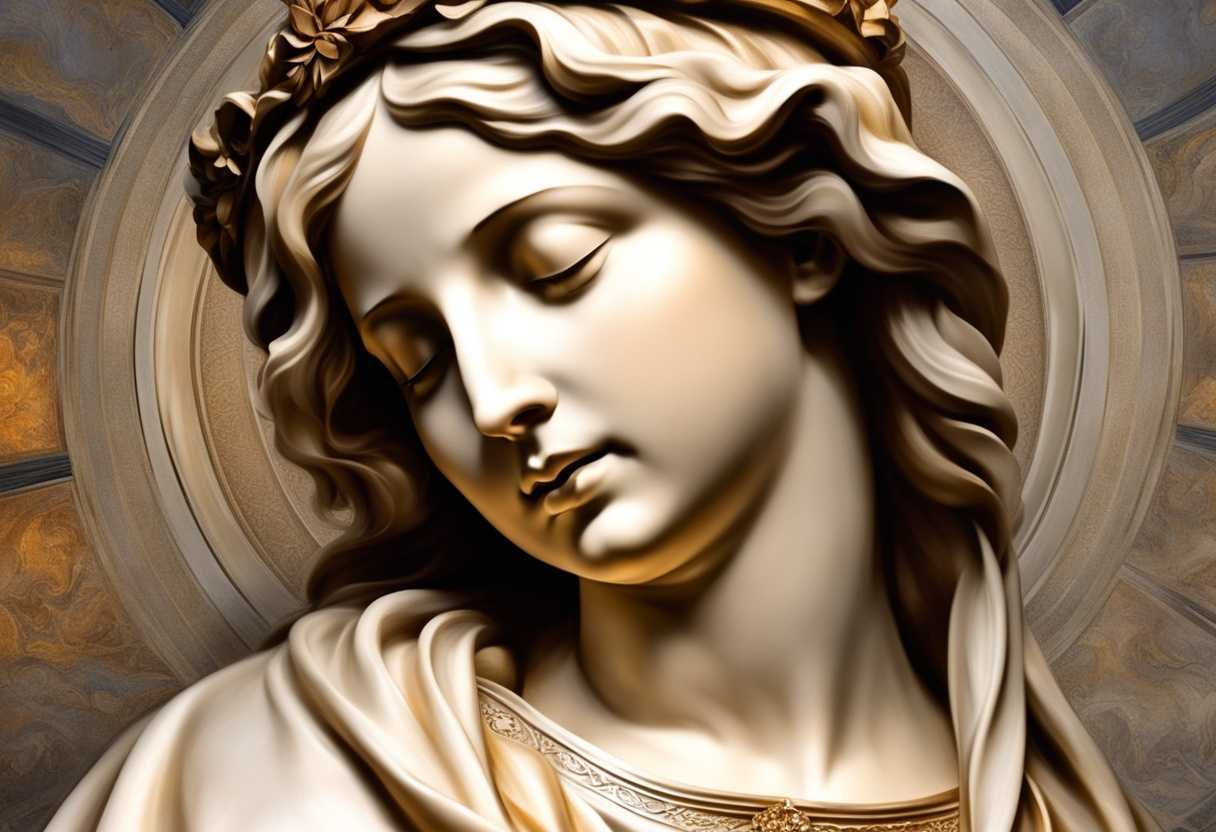
In the Bible, the name Maria, often rendered as Mary, is significant as it is associated with the mother of Jesus Christ, embodying purity, faith, and obedience to God’s will. The name itself is thought to mean “beloved” or “rebellious,” reflecting themes of devotion and transformation in the context of her pivotal role in salvation history.
Scripture
26 In the sixth month the angel Gabriel was sent from God to a city of Galilee named Nazareth,
27 to a virgin betrothed to a man whose name was Joseph, of the house of David. And the virgin’s name was Mary.
28 And he came to her and said, “Greetings, O favored one, the Lord is with you!”
29 But she was greatly troubled at the saying, and tried to discern what sort of greeting this might be.
30 And the angel said to her, “Do not be afraid, Mary, for you have found favor with God.
31 And behold, you will conceive in your womb and bear a son, and you shall call his name Jesus.
32 He will be great and will be called the Son of the Most High. And the Lord God will give to him the throne of his father David,
33 and he will reign over the house of Jacob forever, and of his kingdom there will be no end.”
34 And Mary said to the angel, “How will this be, since I am a virgin?”
35 And the angel answered her, “The Holy Spirit will come upon you, and the power of the Most High will overshadow you; therefore the child to be born will be called holy—the Son of God.
36 And behold, your relative Elizabeth in her old age has also conceived a son, and this is the sixth month with her who was called barren.
37 For nothing will be impossible with God.
38 And Mary said, “Behold, I am the servant of the Lord; let it be to me according to your word.” And the angel departed from her.
Spiritual Significance of the Name Maria in the Bible
The name Maria, or Mary, holds profound spiritual significance in the Bible, particularly as the mother of Jesus Christ. Rooted in humility and strength, Mary is portrayed as a model of faith, exemplifying the virtues of obedience and surrender to God’s plan. The Annunciation, recounted in Luke 1:26-38, highlights her admirable response when the angel Gabriel announced that she would conceive the Savior: “I am the Lord’s servant,” she said, “may your word to me be fulfilled.” This response reflects her deep trust in God’s purpose, reinforcing the notion that true faith often requires the acceptance of a divine calling that transcends personal circumstances.
Furthermore, the name Maria embodies the concept of transformation inherent in Christian belief. Mary’s journey, from an ordinary young woman in Nazareth to the revered figure in salvation history, illustrates the transformative power of grace. In John 2:1-11, at the wedding at Cana, Mary’s intercession prompts Jesus’ first miracle, signifying her role as a mediator between the divine and humanity. This theme of intercession is echoed throughout Christian tradition, positioning Mary as a figure who unconditionally supports and guides believers towards her Son. Thus, the name Maria symbolizes not just personal devotion, but a collective invitation to nurture a deeper relationship with God through faithfulness, hope, and compassion.
The spiritual significance of the name Maria extends beyond her pivotal role as the mother of Jesus to encompass attributes of maternal care, humility, and intercession that resonate throughout Christian tradition. In the New Testament, Mary is often depicted nurturing the nascent Christian community, thus symbolizing the Church’s role as a mother to believers. This metaphorical representation invites believers to see in her the embodiment of love and protection, qualities that are integral to one’s spiritual journey. As a figure revered across denominations, Mary acts as a bridge connecting humanity to the divine, instilling a sense of belonging within the larger narrative of salvation.
Additionally, the name Maria can be associated with the concepts of purity and devotion. The Catholic Church, in particular, celebrates her perpetual virginity, which serves as a powerful testament to her complete dedication and willingness to serve God. This notion of purity is not merely physical but spiritual, emphasizing the importance of inner sanctity and the intention behind one’s actions. Mary’s acceptance of her role can inspire believers to strive for sincere devotion in their own lives, reinforcing that holiness is attainable through faithful response to God’s call. Thus, Maria’s name evokes a profound invitation to embrace one’s own path of transformation while embodying the virtues she so gracefully personifies.
The Role of Intercession and Mediation
The name Maria, often associated with Mary, the mother of Jesus, embodies the concept of intercession. In Christian theology, Mary is seen as a mediator between humanity and God. Her willingness to accept the divine plan signifies the importance of openness to God’s will and the power of intercessory prayer. This role encourages believers to seek her intercession in their spiritual journeys, highlighting the significance of community and support in faith.
Symbol of Purity and Devotion
Maria is often viewed as a symbol of purity and devotion. Her life exemplifies unwavering faith and commitment to God, serving as a model for believers. This purity is not merely physical but also spiritual, representing a heart dedicated to God’s service. The name Maria thus inspires individuals to cultivate their own spiritual purity and devotion, encouraging them to live lives that reflect their faith and commitment to God.
Emblem of Hope and Redemption
The name Maria carries a profound message of hope and redemption. As the mother of Jesus, she plays a pivotal role in the narrative of salvation. Her acceptance of the angel’s message and her subsequent actions contribute to the fulfillment of God’s promise to humanity. This aspect of her identity serves as a reminder to believers that hope is always present, even in challenging circumstances, and that redemption is accessible through faith and trust in God’s plan.
How to Embrace Divine Grace for a Pure Life
Embracing divine grace is a transformative journey that invites us to recognize our imperfections while resting in the boundless love of God. As we strive for a pure life, it’s essential to understand that grace is not merely a concept but a daily reality that empowers us to rise above our shortcomings. Start by cultivating a heart of gratitude; acknowledge the moments when you’ve felt unworthy yet were met with compassion and forgiveness. This awareness can inspire you to extend that same grace to others, fostering a community of love and support. Engage in prayer and scripture, allowing God’s word to wash over you and renew your spirit. Remember, purity isn’t about perfection but about a sincere desire to align your life with God’s will. As you lean into His grace, you’ll find that it not only cleanses your heart but also ignites a passion to live out your faith authentically, reflecting His light in a world that desperately needs it.
Bible References to the Name Maria:
Matthew 1:18-25: 18 Now the birth of Jesus Christ took place in this way. When his mother Mary had been betrothed to Joseph, before they came together she was found to be with child from the Holy Spirit.
19 And her husband Joseph, being a just man and unwilling to put her to shame, resolved to divorce her quietly.
20 But as he considered these things, behold, an angel of the Lord appeared to him in a dream, saying, “Joseph, son of David, do not fear to take Mary as your wife, for that which is conceived in her is from the Holy Spirit.
21 She will bear a son, and you shall call his name Jesus, for he will save his people from their sins.
22 All this took place to fulfill what the Lord had spoken by the prophet:
23 “Behold, the virgin shall conceive and bear a son, and they shall call his name Immanuel” (which means, God with us).
24 When Joseph woke from sleep, he did as the angel of the Lord commanded him: he took his wife,
25 but knew her not until she had given birth to a son. And he called his name Jesus.
John 19:25-27: 25 but standing by the cross of Jesus were his mother and his mother’s sister, Mary the wife of Clopas, and Mary Magdalene.
26 When Jesus saw his mother and the disciple whom he loved standing nearby, he said to his mother, “Woman, behold, your son!”
27 Then he said to the disciple, “Behold, your mother!” And from that hour the disciple took her to his own home.
Luke 2:1-20: 2 In those days a decree went out from Caesar Augustus that all the world should be registered.
2 This was the first registration when Quirinius was governor of Syria.
3 And all went to be registered, each to his own town.
4 And Joseph also went up from Galilee, from the town of Nazareth, to Judea, to the city of David, which is called Bethlehem, because he was of the house and lineage of David,
5 to be registered with Mary, his betrothed, who was with child.
6 And while they were there, the time came for her to give birth.
7 And she gave birth to her firstborn son and wrapped him in swaddling cloths and laid him in a manger, because there was no place for them in the inn.
8 And in the same region there were shepherds out in the field, keeping watch over their flock by night.
9 And an angel of the Lord appeared to them, and the glory of the Lord shone around them, and they were filled with great fear.
10 And the angel said to them, “Fear not, for behold, I bring you good news of great joy that will be for all the people.
11 For unto you is born this day in the city of David a Savior, who is Christ the Lord.
12 And this will be a sign for you: you will find a baby wrapped in swaddling cloths and lying in a manger.
13 And suddenly there was with the angel a multitude of the heavenly host praising God and saying,
14 “Glory to God in the highest, and on earth peace among those with whom he is pleased!”
15 When the angels went away from them into heaven, the shepherds said to one another, “Let us go over to Bethlehem and see this thing that has happened, which the Lord has made known to us.”
16 And they went with haste and found Mary and Joseph, and the baby lying in a manger.
17 And when they saw it, they made known the saying that had been told them concerning this child.
18 And all who heard it wondered at what the shepherds told them.
19 But Mary treasured up all these things, pondering them in her heart.
20 And the shepherds returned, glorifying and praising God for all they had heard and seen, as it had been told them.
Luke 2:41-52: 41 Now his parents went to Jerusalem every year at the Feast of the Passover.
42 And when he was twelve years old, they went up according to custom.
43 And when the feast was ended, as they were returning, the boy Jesus stayed behind in Jerusalem. His parents did not know it,
44 but supposing him to be in the group they went a day’s journey, but then they began to search for him among their relatives and acquaintances.
45 And when they did not find him, they returned to Jerusalem, searching for him.
46 After three days they found him in the temple, sitting among the teachers, listening to them and asking them questions.
47 And all who heard him were amazed at his understanding and his answers.
48 And when his parents saw him, they were astonished. And his mother said to him, “Son, why have you treated us so? Behold, your father and I have been searching for you in great distress.”
49 And he said to them, “Why were you looking for me? Did you not know that I must be in my Father’s house?”
50 And they did not understand the saying that he spoke to them.
51 And he went down with them and came to Nazareth and was submissive to them. And his mother treasured up all these things in her heart.
52 And Jesus increased in wisdom and in stature and in favor with God and man.
Acts 1:12-14: 12 Then they returned to Jerusalem from the mount called Olivet, which is near Jerusalem, a Sabbath day’s journey away.
13 And when they had entered, they went up to the upper room, where they were staying, Peter and John and James and Andrew, Philip and Thomas, Bartholomew and Matthew, James the son of Alphaeus and Simon the Zealot and Judas the son of James.
14 All these with one accord were devoting themselves to prayer, together with the women and Mary the mother of Jesus, and his brothers.
John 2:1-12: 1 On the third day there was a wedding at Cana in Galilee, and the mother of Jesus was there.
2 Jesus also was invited to the wedding with his disciples.
3 When the wine ran out, the mother of Jesus said to him, “They have no wine.”
4 And Jesus said to her, “Woman, what does this have to do with me? My hour has not yet come.”
5 His mother said to the servants, “Do whatever he tells you.”
6 Now there were six stone water jars there for the Jewish rites of purification, each holding twenty or thirty gallons.
7 Jesus said to the servants, “Fill the jars with water.” And they filled them up to the brim.
8 And he said to them, “Now draw some out and take it to the master of the feast.” So they took it.
9 When the master of the feast tasted the water now become wine, and did not know where it came from (though the servants who had drawn the water knew), the master of the feast called the bridegroom.
10 and said to him, “Everyone serves the good wine first, and when people have drunk freely, then the poor wine. But you have kept the good wine until now.”
11 This, the first of his signs, Jesus did at Cana in Galilee, and manifested his glory. And his disciples believed in him.
12 After this he went down to Capernaum, with his mother and his brothers and his disciples, and they stayed there for a few days.
Matthew 2:13-23: 13 Now when they had departed, behold, an angel of the Lord appeared to Joseph in a dream and said, “Rise, take the child and his mother, and flee to Egypt, and remain there until I tell you, for Herod is about to search for the child, to destroy him.”
14 And he rose and took the child and his mother by night and departed to Egypt.
15 and remained there until the death of Herod. This was to fulfill what the Lord had spoken by the prophet, “Out of Egypt I called my son.”
16 Then Herod, when he saw that he had been tricked by the wise men, became furious, and he sent and killed all the male children in Bethlehem and in all that region who were two years old or under, according to the time that he had ascertained from the wise men.
17 Then was fulfilled what was spoken by the prophet Jeremiah:
18 “A voice was heard in Ramah,
weeping and loud lamentation,
Rachel weeping for her children;
she refused to be comforted,
because they are no more.”
19 But when Herod died, behold, an angel of the Lord appeared in a dream to Joseph in Egypt,
20 saying, “Rise, take the child and his mother and go to the land of Israel, for those who sought the child’s life are dead.”
21 And he rose and took the child and his mother and went to the land of Israel.
22 But when he heard that Archelaus was reigning over Judea in place of his father Herod, he was afraid to go there, and being warned in a dream he withdrew to the district of Galilee.
23 And he went and lived in a city called Nazareth, so that what was spoken by the prophets might be fulfilled, that he would be called a Nazarene.
Mark 6:1-6: 1 He went away from there and came to his hometown, and his disciples followed him.
2 And on the Sabbath he began to teach in the synagogue, and many who heard him were astonished, saying, “Where did this man get these things? What is the wisdom given to him? How are such mighty works done by his hands?
3 Is not this the carpenter, the son of Mary and brother of James and Joses and Judas and Simon? And are not his sisters here with us?” And they took offense at him.
4 And Jesus said to them, “A prophet is not without honor, except in his hometown and among his relatives and in his own household.”
5 And he could do no mighty work there, except that he laid his hands on a few sick people and healed them.
6 And he marveled because of their unbelief. And he went about among the villages teaching.
Luke 8:1-3: 1 Soon afterward he went on through cities and villages, proclaiming and bringing the good news of the kingdom of God.
2 and also some women who had been healed of evil spirits and infirmities: Mary, called Magdalene, from whom seven demons had gone out,
3 Joanna, the wife of Chuza, Herod’s household manager, and Susanna, and many others, who provided for them out of their means.

Reverend Michael Johnson is an experienced Church Minister with a profound expertise in spirituality and guidance. With a serene presence and a compassionate heart, he has faithfully served his congregation for over 20 years, leading them on a spiritual journey towards inner peace and enlightenment. Reverend Johnson’s extensive knowledge of religious philosophies and profound understanding of human nature have made him a trusted confidant and mentor to many, as he seamlessly weaves his profound wisdom into life teachings. Reverend Johnson’s calming demeanor and empathetic nature continue to uplift and heal souls, nurturing a sense of unity and tranquility within his community.