
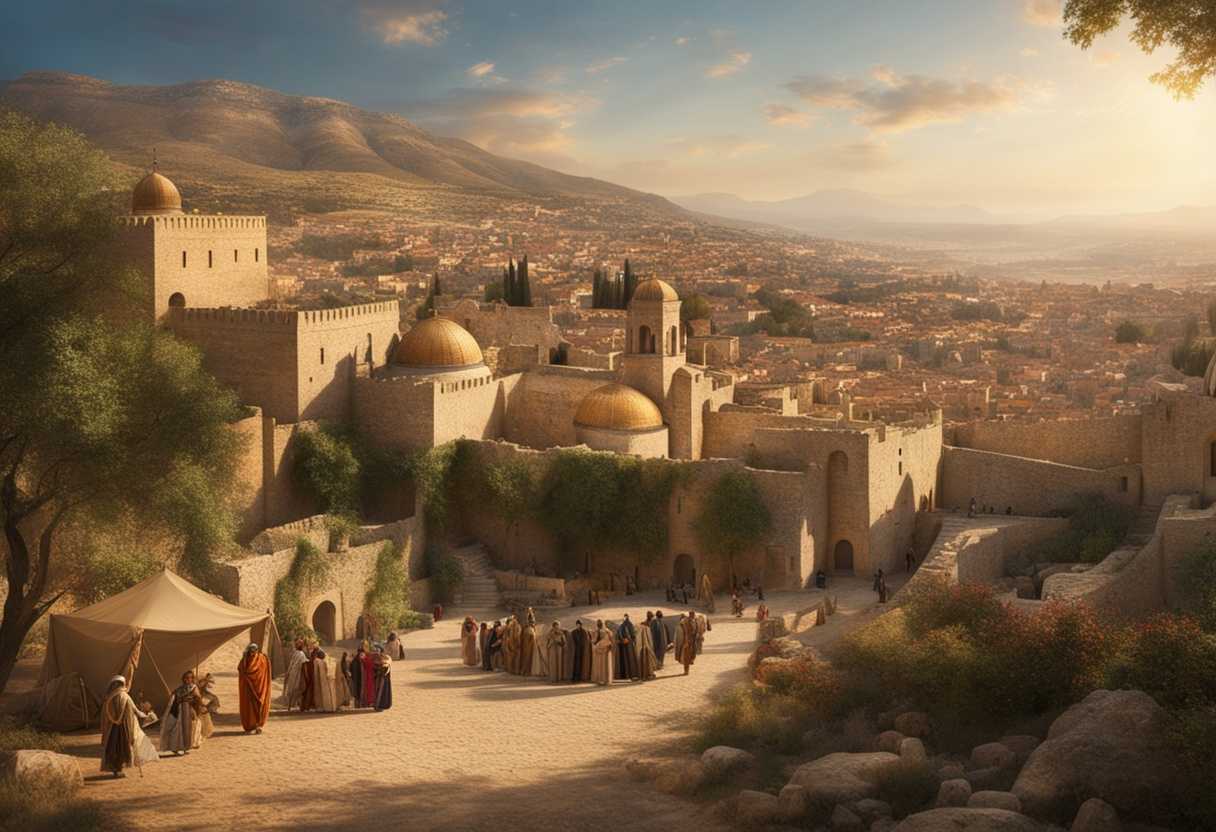
The Hittites and Jebusites were ancient peoples mentioned in the Bible, representing specific Canaanite tribes inhabiting the land of Canaan before the Israelites. The Hittites are often associated with a powerful empire in Anatolia, while the Jebusites are known for occupying Jerusalem, which was later conquered by King David.
Scripture
15 Canaan fathered Sidon his firstborn and Heth,
16 the Jebusites, the Amorites, the Girgashites,
17 the Hivites, the Arkites, the Sinites,
18 the Arvadite, the Zemarite, and the Hamathite. Afterward the clans of the Canaanites spread abroad.
19 And the territory of the Canaanites extended from Sidon in the direction of Gerar as far as Gaza, and in the direction of Sodom, Gomorrah, Admah, and Zeboiim, as far as Lasha.
20 These are the sons of Ham, by their clans, their languages, their lands, and their nations.
Hittites and Jebusites in the Bible
The Hittites and Jebusites, as chronicled in the Bible, serve not only as historical entities but also symbolize the broader themes of conflict, divine promise, and the fulfillment of Israel’s destiny. The Hittites, mentioned in various contexts such as Genesis 23:3-20, where Abraham negotiates for the burial of Sarah, underscore the interactions between the patriarchs and the indigenous populations. Their presence illustrates the diverse cultural milieu of Canaan, reflecting the biblical narrative’s emphasis on God’s covenant with Abraham and his descendants to inherit the Promised Land, despite the challenges posed by existing peoples.
The Jebusites are predominantly associated with Jerusalem, the city that became central to Jewish worship and identity. In 2 Samuel 5:6-10, David’s conquest of Jebus (Jerusalem) symbolizes God’s promise being realized, as the city becomes the political and spiritual capital of Israel. This event marks a significant turning point in biblical history, representing the transition from tribal confederations to a unified monarchy under God’s chosen leader. The Jebusites’ eventual defeat highlights the overarching biblical theme of redemption, showcasing how God uses imperfect vessels to fulfill divine promises, often overcoming formidable obstacles in the process. Through these narratives, the Hittites and Jebusites embody the complex interplay of divine sovereignty, human agency, and the fulfillment of God’s redemptive plan for Israel.
Beyond the specific accounts of Hittites and Jebusites, these groups are emblematic of the broader struggle against idolatries and foreign influences within the ancient Near Eastern context. For the Israelites, the conquest of lands occupied by these peoples was not merely a military endeavor; it was also a spiritual battle against entrenched pagan practices. The Hittites, known for their advanced civilization and legal systems, symbolize the temptations of assimilation into foreign cultures that often diverged from the worship of Yahweh. In various passages, the narrative warns against intermarrying and adopting their customs, suggesting that the Hittites represent not only a physical adversary but also an ideological one, challenging the Israelites’ fidelity to their covenant with God.
Similarly, the Jebusites, as inhabitants of Jerusalem, highlight the tension between God’s promise to His people and the reality of occupation by those who worshipped other gods. The struggle for Jerusalem, a city defined by its future significance as a spiritual hub, mirrors the Israelites’ ongoing quest for a truly holistic relationship with God. The narratives surrounding the Jebusites demonstrate how divine intervention is often necessary to achieve the ultimate goal of a unified and faithful Israel. Their presence in the texts serves to remind the readers of the ever-present likelihood of losing one’s identity amidst prevailing cultures and the critical importance of adhering to divine statutes. Ultimately, the mention of the Hittites and Jebusites reinforces that the story of Israel is one of perseverance, reliance on divine guidance, and the continuous push toward realizing the full measure of God’s promises in the midst of a challenging world.
Symbol of Cultural Conflict
The Hittites and Jebusites represent the cultural and spiritual conflicts faced by the Israelites as they entered the Promised Land. Their presence signifies the challenges of coexisting with different belief systems and practices. The Israelites were often called to remain faithful to their covenant with God, which included avoiding the idolatry and moral practices of these neighboring nations. This conflict serves as a broader metaphor for the struggles between faithfulness to divine commandments and the allure of surrounding cultures.
Representation of God’s Sovereignty
Both the Hittites and Jebusites illustrate God’s sovereignty over all nations and peoples. Their eventual defeat and displacement by the Israelites demonstrate that God’s plans transcend human boundaries and political structures. This theme emphasizes that no matter how powerful or entrenched a people may seem, God’s will ultimately prevails. The narrative of these groups serves to reinforce the belief that God is in control of history and that His purposes will be fulfilled through His chosen people.
Lessons on Redemption and Inclusion
The interactions with the Hittites and Jebusites also highlight themes of redemption and the potential for inclusion within God’s plan. While these groups were often seen as adversaries, there are instances in the biblical narrative where individuals from these nations are portrayed positively or are integrated into the Israelite community. This suggests a broader message about the possibility of redemption for all people, regardless of their origins, and the inclusive nature of God’s grace. It challenges readers to consider the importance of compassion and understanding towards those who may initially seem different or opposed to their beliefs.
How to Embrace Faith and Cultivate Peace in Christ
Embracing faith and cultivating peace in Christ is a journey that requires intentionality and openness to God’s presence in our lives. Start by immersing yourself in Scripture, allowing the words of the Bible to speak to your heart and guide your thoughts. Prayer is essential; it’s not just about asking for things but about building a relationship with God, sharing your fears, joys, and desires. As you pray, seek to listen for His voice, which often brings clarity and comfort. Surround yourself with a community of believers who can encourage you and hold you accountable in your walk of faith. Remember, peace in Christ doesn’t mean the absence of challenges, but rather a deep-seated assurance that He is with you through every storm. Trust in His promises, and let His love transform your worries into a profound sense of peace that surpasses all understanding.
Bible References to Hittites and Jebusites:
Genesis 15:18-21: 18 On that day the Lord made a covenant with Abram, saying, “To your offspring I give this land, from the river of Egypt to the great river, the river Euphrates,
19 the land of the Kenites, the Kenizzites, the Kadmonites,
20 the Hittites, the Perizzites, the Rephaim,
21 And the Amorites, the Canaanites, the Girgashites, and the Jebusites.
Exodus 3:7-10: 7 Then the Lord said, “I have surely seen the affliction of my people who are in Egypt and have heard their cry because of their taskmasters. I know their sufferings,
8 and I have come down to deliver them out of the hand of the Egyptians and to bring them up out of that land to a good and broad land, a land flowing with milk and honey, to the place of the Canaanites, the Hittites, the Amorites, the Perizzites, the Hivites, and the Jebusites.
9 And now, behold, the cry of the people of Israel has come to me, and I have also seen the oppression with which the Egyptians oppress them.
10 Come, I will send you to Pharaoh that you may bring my people, the children of Israel, out of Egypt.”
Exodus 23:23-24: 23 For my angel will go before you and bring you to the Amorites, the Hittites, the Perizzites, the Canaanites, the Hivites, and the Jebusites, and I will blot them out.
24 You shall not bow down to their gods nor serve them, nor do as they do, but you shall utterly overthrow them and break their pillars in pieces.
Deuteronomy 7:1-2: 1 “When the Lord your God brings you into the land that you are entering to take possession of it, and clears away many nations before you, the Hittites, the Girgashites, the Amorites, the Canaanites, the Perizzites, the Hivites, and the Jebusites, seven nations more numerous and mightier than you,”
2 and when the Lord your God gives them over to you, and you defeat them, then you must devote them to complete destruction. You shall make no covenant with them and show no mercy to them.
Joshua 3:9-11: 9 And Joshua said to the people of Israel, “Come here and listen to the words of the Lord your God.”
10 And Joshua said, “Here is how you shall know that the living God is among you and that he will without fail drive out from before you the Canaanites, the Hittites, the Hivites, the Perizzites, the Girgashites, the Amorites, and the Jebusites.
11 Behold, the ark of the covenant of the Lord of all the earth is passing over before you into the Jordan.
Joshua 9:1-2: 1 As soon as all the kings who were beyond the Jordan in the hill country and in the lowland all along the coast of the Great Sea toward Lebanon, the Hittites, the Amorites, the Canaanites, the Perizzites, the Hivites, and the Jebusites, heard of this,
2 they gathered together to fight with Joshua and Israel with one accord.
Joshua 11:1-5: 1 When Jabin, king of Hazor, heard of this, he sent to Jobab king of Madon, and to the king of Shimron, and to the king of Achshaph,
2 and to the kings who were in the northern hill country, and in the Arabah south of Chinneroth, and in the lowland, and in Naphoth-dor on the west,
3 to the Canaanites in the east and the west, the Amorites, the Hittites, the Perizzites, and the Jebusites in the hill country, and the Hivites under Hermon in the land of Mizpah.
4 And they came out with all their troops, a great horde, in number like the sand that is on the seashore, with very many horses and chariots.
5 And all these kings joined their forces and came and encamped together at the waters of Merom to fight against Israel.
Judges 3:1-6: 3 Now these are the nations that the Lord left, to test Israel by them, that is, all in Israel who had not experienced all the wars in Canaan.
2 Only that the generations of the people of Israel might know war, to teach war to those who had not known it before.
3 the five lords of the Philistines, and all the Canaanites, and the Sidonians, and the Hivites who lived on Mount Lebanon, from Mount Baal-hermon as far as Lebo-hamath.
4 They were for the testing of Israel, to know whether Israel would obey the commandments of the Lord, which he commanded their fathers by the hand of Moses.
5 So the people of Israel lived among the Canaanites, the Hittites, the Amorites, the Perizzites, the Hivites, and the Jebusites.
6 and they took their daughters to themselves for wives, and their own daughters they gave to their sons, and they served their gods.
1 Kings 9:20-21: 20 All the people who were left of the Amorites, the Hittites, the Perizzites, the Hivites, and the Jebusites, who were not of the people of Israel—
21 Their descendants who were left after them in the land, whom the people of Israel were unable to devote to destruction—these Solomon drafted to be slaves, and so they are to this day.
1 Chronicles 1:13-16: 13 Canaan fathered Sidon his firstborn and Heth,
14 The sons of Abraham: Isaac and Ishmael.
15 The sons of Pharaoh’s daughter: his daughter Attai, and his daughter Attaliah, and his daughter Attaliah.
16 the sons of Ishmael: Nebaioth, Kedar, Adbeel, Mibsam,
Ezra 9:1-2: 1 After these things had been done, the officials approached me and said, “The people of Israel and the priests and the Levites have not separated themselves from the peoples of the lands with their abominations, from the Canaanites, the Hittites, the Perizzites, the Jebusites, the Ammonites, the Moabites, the Egyptians, and the Amorites.
2 For they have taken some of their daughters to be wives for themselves and for their sons, so that the holy race has mixed itself with the peoples of the lands. And in this faithlessness the hand of the officials and chief men has been foremost.”
Nehemiah 9:7-8: 7 You are the Lord, the God who chose Abram and brought him out of Ur of the Chaldeans and gave him the name Abraham.
8 You found his heart faithful before you, and made with him the covenant to give to his offspring the land of the Canaanite, the Hittite, the Amorite, the Perizzite, the Jebusite, and the Girgashite. And you have kept your promise, for you are righteous.
Nehemiah 9:24-25: 24 So the descendants went in and possessed the land, and you subdued before them the inhabitants of the land, the Canaanites, and gave them into their hand, with their kings and the peoples of the land, that they might do with them as they would.
25 And they captured fortified cities and a rich land, and took possession of houses full of all good things, cisterns already hewn, vineyards, olive orchards and fruit trees in abundance. So they ate and were filled and became fat and delighted themselves in your great goodness.
Psalm 78:54-55: 54 And he brought them to his holy land, to the mountain which his right hand had won.
55 He drove out nations before them; he apportioned them for a possession and settled the tribes of Israel in their tents.
Ezekiel 16:1-3: 1 Again the word of the Lord came to me:
2 “Son of man, make known to Jerusalem her abominations,”
3 and say, Thus says the Lord God to Jerusalem: Your origin and your birth are of the land of the Canaanites; your father was an Amorite and your mother a Hittite.

Reverend Ogunlade is a seasoned Church Minister with over three decades of experience in guiding and nurturing congregations. With profound wisdom and a serene approach, Reverend Ogunlade has carried out various pastoral duties, including delivering uplifting sermons, conducting religious ceremonies, and offering sage counsel to individuals seeking spiritual guidance. Their commitment to fostering harmony and righteousness within their community is exemplified through their compassionate nature, making them a beloved and trusted figure among the congregation.