
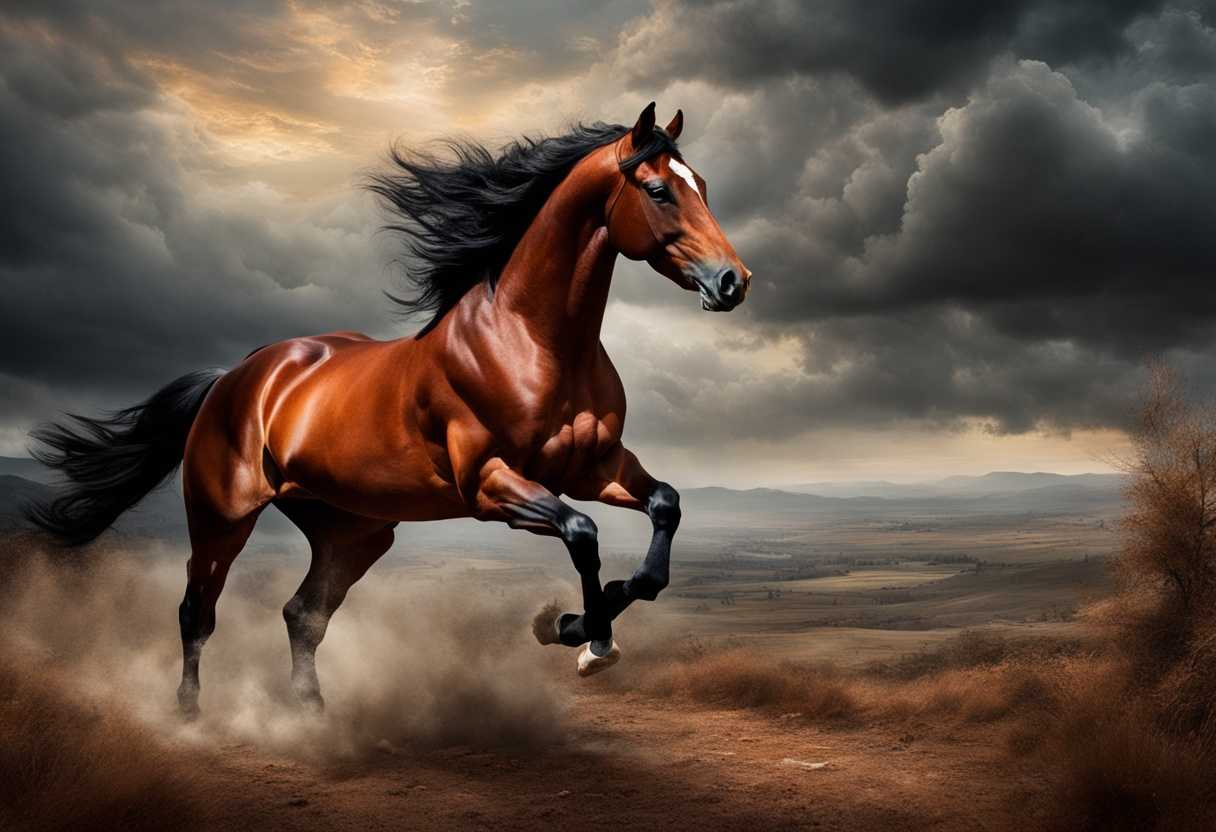
In the Book of Revelation, the red horse symbolizes war and conflict, representing the loss of peace and the strife that arises among nations. It is one of the four horses of the Apocalypse, as described in Revelation 6:4, which signifies the broader themes of judgment and the tumultuous events leading to the end times.
Scripture
3 When he opened the second seal, I heard the second living creature say, “Come!”
4 And out came another horse, bright red. Its rider was permitted to take peace from the earth, so that people should slay one another, and he was given a great sword.
Meaning of the Red Horse in Revelation
The red horse in Revelation 6:4 is an emblematic representation of war and bloodshed, reflecting the catastrophic consequences of humanity’s sin and rebellion against God. It follows the white horse, which symbolizes conquest and tyranny, and suggests a progression into chaos. The rider of the red horse is given a great sword, indicating the power to incite conflict and bloodshed among people, highlighting the breakdown of peace and the ensuing turmoil. This vivid imagery serves as a somber reminder of the destructive nature of human conflict, echoing prophetic themes found in other parts of the Bible, such as in the wars and tribulations described in the Old Testament prophets (e.g., Isaiah 2:4 and Micah 4:3).
Moreover, the red horse is tied to the larger narrative of divine judgment and the ultimate restoration of peace promised in the eschatological hope found in Scripture. As the events of the Apocalypse unfold, they reveal the consequences of collective human choices and the tumultuous fallout of a world that exists apart from God’s righteousness. This theme resonates with Jesus’ teaching in Matthew 24:6-7, where He foretells that wars and rumors of wars will be prevalent before His return. Thus, the red horse serves not only as a warning of impending strife but also positions the faithful to anticipate the eventual establishment of God’s kingdom, where peace will reign supreme (Revelation 21:4). The confrontation with conflict in the red horse narrative propels believers towards a deeper reliance on God’s promises of ultimate reconciliation and peace.
The imagery of the red horse extends beyond the text of Revelation and speaks to a deeper theological understanding of strife threaded throughout the biblical narrative. The chaotic force represented by this horse encapsulates the human experience marred by violence and division. Historically, scripture records numerous instances where warfare and conflict arise as a result of idolatry and moral decay, positioning the red horse as a direct consequence of turning away from divine order. In other prophetic literature, such as the minor prophets, we find a consistent theme that portrays the turmoil of nations engaged in battle and the resulting consequences on both their leaders and the common people, illustrating a historical pattern of conflict tied to disobedience.
Furthermore, the red horse serves as a conceptual bridge to the broader eschatological paradigm of Revelation. The presence of this horse within the seal judgments signifies a tipping point in human history—marking the intensification of suffering before the final restoration. This motif of escalating chaos also finds resonance in the prophetic warnings against nations, such as those delivered by Jeremiah and Ezekiel, where impending warfare serves as both judgment and a precursor to renewal. Thus, the red horse not only symbolizes war but also functions as a catalyst prompting believers to reflect upon their relationship with God, urging them to seek reconciliation and justice in a world fraught with division. Though the imagery may evoke fear, its ultimate purpose is to guide believers toward understanding hope in the midst of turmoil, as they await the final establishment of God’s peace in a renewed creation.
Symbol of War and Conflict
The red horse in Revelation is often interpreted as a symbol of war and conflict. Its appearance signifies the unleashing of violence and bloodshed upon the earth. This imagery reflects the tumultuous nature of human history, where wars and strife have been prevalent. The red color itself is associated with blood, emphasizing the destructive consequences of warfare and the suffering it brings to humanity.
Representation of Human Sinfulness
Another broader meaning of the red horse can be seen as a representation of human sinfulness and the moral decay that leads to conflict. The presence of the red horse serves as a reminder of the consequences of humanity’s choices, where greed, hatred, and ambition can escalate into violence. This interpretation highlights the need for spiritual reflection and the pursuit of peace in a world often marred by discord.
Foreshadowing of Eschatological Events
The red horse also serves as a foreshadowing of eschatological events, indicating a time of great tribulation and upheaval in the end times. Its emergence is part of a larger narrative that points to the ultimate struggle between good and evil. This interpretation encourages believers to remain vigilant and steadfast in their faith, as the presence of the red horse signifies the trials that will precede the eventual establishment of divine justice and peace.
How to Cultivate Peace and Love as a Christian
Cultivating peace and love as a Christian is a beautiful journey that begins in the heart and radiates outward into our daily lives. It starts with prayer and reflection, inviting God’s presence to fill us with His peace that surpasses all understanding (Philippians 4:7). As we immerse ourselves in Scripture, we learn about the unconditional love of Christ, which inspires us to extend that same love to others, even when it’s challenging. Practicing forgiveness is essential; it frees us from bitterness and allows God’s love to flow through us. Additionally, engaging in acts of kindness, whether through volunteering or simply offering a listening ear, can transform our communities and deepen our connections with others. Remember, peace and love are not just feelings but choices we make daily, reflecting the heart of Christ in a world that desperately needs it. So, let’s commit to being vessels of His peace and love, shining brightly in every interaction we have.
Bible References to the Red Horse in Revelation:
Zechariah 1:8-11: 8 I saw in the night, and behold, a man riding on a red horse! He was standing among the myrtle trees in the glen, and behind him were red, sorrel, and white horses.
6 But my words and my statutes, which I commanded my servants the prophets, did they not overtake your fathers? So they repented and said, ‘As the Lord of hosts purposed to deal with us for our ways and deeds, so has he dealt with us.’”
10 And the man who was standing among the myrtle trees answered, ‘These are they whom the Lord has sent to patrol the earth.’
11 And they answered the angel of the Lord who was standing among the myrtle trees, and said, “We have patrolled the earth, and behold, all the earth remains at rest.”
Zechariah 6:1-8: 1 I lifted up my eyes again and saw, and behold, four chariots came out from between two mountains. And the mountains were mountains of bronze.
2 The first chariot had red horses, the second black horses,
3 And in the third chariot white horses.
4 I answered and said to the angel who talked with me, “What are these, my lord?”
5 And the angel answered and said to me, “These are going out to the four winds of heaven, after presenting themselves before the Lord of all the earth.
6 The chariot with the black horses goes toward the north country, the white ones go after them, and the dappled ones go toward the south country.”
7 And the strong horses came out and sought to go and patrol the earth. And he said, “Go, patrol the earth.” So they patrolled the earth.
8 Then he cried to me, “Behold, those who go toward the north country have set my Spirit at rest in the north country.”
Matthew 24:6-7: 6 And you will hear of wars and rumors of wars. See that you are not alarmed, for this must take place, but the end is not yet.
7 For nation will rise against nation, and kingdom against kingdom, and there will be famines and earthquakes in various places.
Ezekiel 38:21-23: 21 I will summon a sword against Gog on all my mountains, declares the Lord God. Every man’s sword will be against his brother.
22 With pestilence and bloodshed I will enter into judgment with him, and I will rain upon him and his hordes and the many peoples who are with him torrential rains and hailstones, fire and sulfur.
23 So I will show my greatness and my holiness and make myself known in the eyes of many nations. Then they will know that I am the Lord.
Jeremiah 25:15-17: 15 Thus the Lord, the God of Israel, said to me: “Take from my hand this cup of the wine of wrath, and make all the nations to whom I send you drink it.
16 They shall drink and stagger and be crazed because of the sword that I am sending among them.
17 So I took the cup from the Lord’s hand, and made all the nations to whom the Lord sent me drink it:
Isaiah 19:2-4: 2 And I will stir up Egyptians against Egyptians,
and they will fight, each against another
and each against his neighbor,
city against city, kingdom against kingdom;
3 And the spirit of the Egyptians within them will be emptied out, and I will confound their counsel; and they will inquire of the idols and the sorcerers, and the mediums and the necromancers.
4 And I will give over the Egyptians into the hand of a hard master, and a fierce king will rule over them, declares the Lord God of hosts.
Daniel 7:21-22: 21 As I looked, this horn made war with the saints and prevailed over them,
22 until the Ancient of Days came, and judgment was given for the saints of the Most High, and the time came when the saints possessed the kingdom.
Joel 3:9-11: 9 Proclaim this among the nations: Consecrate for war; stir up the mighty men. Let all the men of war draw near; let them come up.
Beat your plowshares into swords,
and your pruning hooks into spears;
let the weak say, “I am a warrior.”
11 Hasten and come, all you surrounding nations, and gather yourselves there. Bring down your warriors, O Lord.
Micah 4:3-4: 3 He shall judge between many peoples, and shall decide for strong nations far away; and they shall beat their swords into plowshares, and their spears into pruning hooks; nation shall not lift up sword against nation, neither shall they learn war anymore.
4 But they shall sit every man under his vine and under his fig tree, and no one shall make them afraid, for the mouth of the Lord of hosts has spoken.

Reverend Ogunlade is a seasoned Church Minister with over three decades of experience in guiding and nurturing congregations. With profound wisdom and a serene approach, Reverend Ogunlade has carried out various pastoral duties, including delivering uplifting sermons, conducting religious ceremonies, and offering sage counsel to individuals seeking spiritual guidance. Their commitment to fostering harmony and righteousness within their community is exemplified through their compassionate nature, making them a beloved and trusted figure among the congregation.