
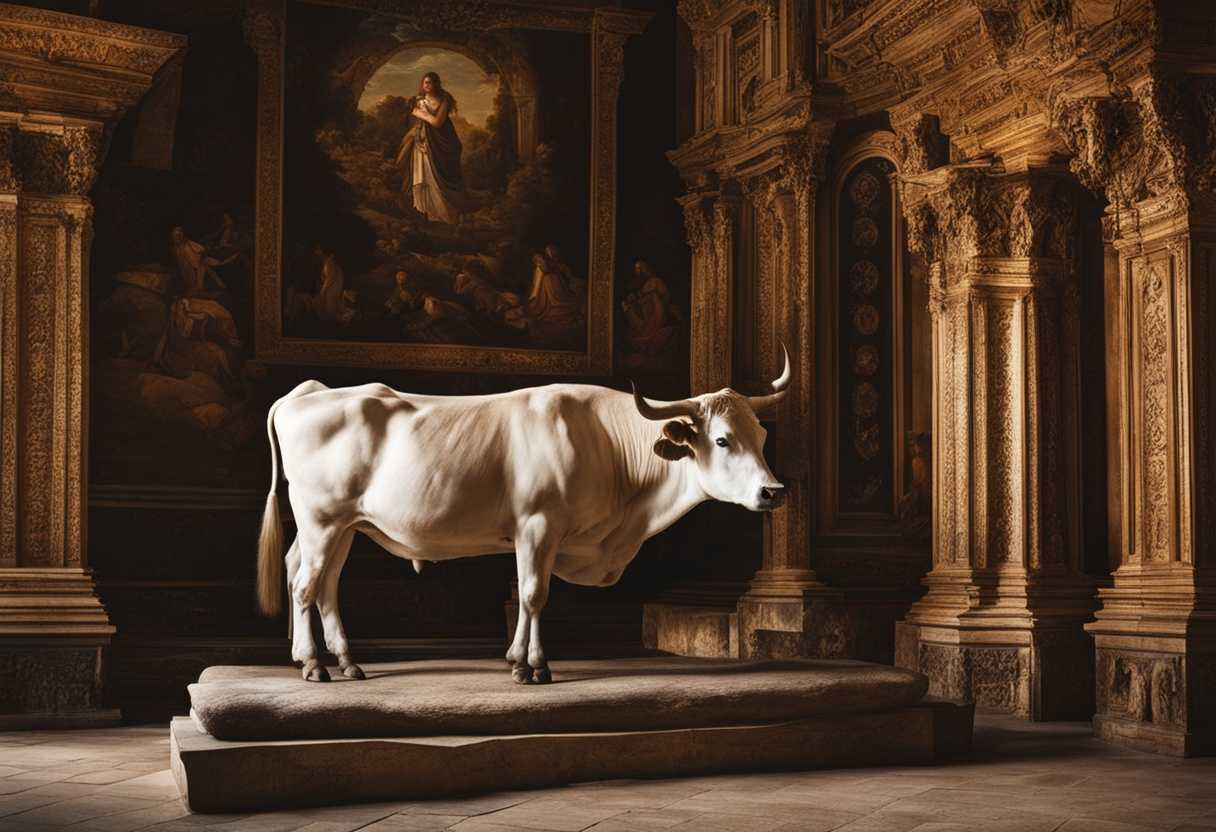
In the Bible, a bullock refers to a young male bovine, often used as a sacrificial animal in religious offerings, signifying purity and strength. It embodies themes of atonement and worship, as seen in sacrifices prescribed in the Old Testament, particularly in Leviticus.
Scripture
3 if it is the anointed priest who sins, thus bringing guilt on the people, then he shall offer for the sin that he has committed a bull from the herd without blemish to the Lord for a sin offering.
4 He shall bring the bull to the entrance of the tent of meeting before the Lord and lay his hand on the head of the bull and kill the bull before the Lord.
5 Then the anointed priest shall take some of the blood of the bull and bring it into the tent of meeting,
6 and the priest shall dip his finger in the blood and sprinkle part of the blood seven times before the Lord in front of the veil of the sanctuary.
7 And the priest shall put some of the blood on the horns of the altar of fragrant incense before the Lord that is in the tent of meeting, and all the rest of the blood of the bull he shall pour out at the base of the altar of burnt offering that is at the entrance of the tent of meeting.
8 And he shall take from it all the fat of the bull of the sin offering; the fat that covers the entrails and all the fat that is on the entrails,
9 And the two kidneys with the fat that is on them at the loins, and the long lobe of the liver that he shall remove with the kidneys.
10 But the bull he shall carry outside the camp and burn it up as he burned the first bull; it is the sin offering for the assembly.
11 But the skin of the bull and all its flesh, with its head, its legs, its entrails, and its dung—
12 that is, all the rest of the bull—he shall carry outside the camp to a clean place, to the ash heap, and shall burn it up on a fire of wood. On the ash heap it shall be burned up.
Biblical Meaning and Significance of Bullock
The bullock, as a young male bovine, appears prominently in the sacrificial system outlined in the Old Testament, representing strength and purity. Its significance is largely derived from its use in atonement rituals, wherein the bullock’s blood was offered to God to symbolize the covering of the sins of the people. For example, Leviticus 16:3 describes how Aaron is to take a bullock for a sin offering for himself and his household, illustrating the animal’s role in securing divine favor and forgiveness. Additionally, the bullock signifies the weight of the atonement burden; the larger the animal, the more significant the sacrifice, pointing to the seriousness of sin and the costs associated with redemption.
Moreover, the bullock is also representative of diligence and labor, as it is often associated with agricultural work. In Deuteronomy 21:4, the law prescribes that a bullock be used to purify a land defiled by violence, further emphasizing its role in restoration and the pursuit of holiness. The imagery of the bullock in sacrificial offerings not only underscores the need for sacrifice due to sin but also foreshadows the ultimate sacrifice of Jesus Christ, the “Lamb of God,” who serves as the perfect and final atonement for humanity’s sins (John 1:29). Thus, the bullock stands at the intersection of sacrifice, holiness, and restoration, echoing deeper themes of repentance and renewal throughout the Scripture.
In addition to its sacrificial significance, the bullock often symbolizes leadership and authority within the biblical narrative. For instance, in the context of the ancient Israelite society, the selection of a bullock for ceremonial purposes often accompanied rituals involving the anointing or commissioning of leaders, signifying both the strength and the weight of responsibility they carried. In this light, the bullock can be viewed as a representation of the divine mandate bestowed upon leaders, encouraging them to shepherd their people with diligence and integrity. The presence of a bullock during pivotal moments served as a reminder of the commitment to God’s laws and the obligation to guide the community in righteousness.
Furthermore, the portrayal of the bullock in prophetic literature often carries implications of judgment and accountability. The images of bullocks weighing heavily on the scale of divine justice reflect the seriousness with which God regards the sins of His people. As presented in the Biblical context, the sacrifice of a bullock is not merely a ritualistic act; it embodies the need for a heartfelt contrition and a turning back to God. Thus, the bullock stands as a multifaceted symbol, representing not only sacrifice and purity but also the call to leadership and the serious nature of accountability before God, echoing throughout the Scriptures as a profound element of the covenant relationship between God and His people.
Symbol of Sacrifice and Atonement
In biblical contexts, the bullock often represents a significant element of sacrifice and atonement. In ancient Israelite culture, the bullock was commonly used in various sacrificial rituals, symbolizing the offering of one’s best to God. This act of sacrifice was not only a means of seeking forgiveness for sins but also a demonstration of devotion and reverence towards the divine. The bullock’s role in these rituals underscores the importance of sacrifice in maintaining a right relationship with God.
Representation of Strength and Leadership
The bullock also serves as a symbol of strength and leadership within biblical narratives. As a powerful animal, it embodies qualities such as resilience, authority, and the ability to bear burdens. In various passages, the bullock can be seen as a metaphor for leaders or figures of authority who are called to guide and protect their people. This symbolism highlights the expectation that leaders should possess strength and integrity, reflecting the characteristics associated with the bullock.
Connection to Agricultural Life and Prosperity
In the agrarian society of ancient Israel, the bullock was integral to agricultural life, often used for plowing fields and as a source of labor. Its presence in the biblical narrative signifies the connection between faith, livelihood, and prosperity. The bullock’s role in farming not only emphasizes the importance of agriculture in sustaining life but also illustrates the blessings that come from God through hard work and stewardship of the land. This connection reinforces the idea that faith and daily life are intertwined, with God’s provision evident in the fruits of labor.
How to Cultivate a Deeper Faith Through Sacrifice
Cultivating a deeper faith through sacrifice is a transformative journey that invites us to step outside our comfort zones and embrace the call of Christ. When we think of sacrifice, it often conjures images of giving up something significant, but it can also mean dedicating our time, energy, and resources to serve others and glorify God. Start small—perhaps by volunteering at a local charity or committing to regular prayer for those in need. As you make these sacrifices, you’ll find that they not only deepen your relationship with God but also open your heart to the struggles of others, fostering empathy and compassion. Remember, Jesus taught us that true greatness comes from serving, and in those moments of giving, we often discover the profound joy and peace that comes from aligning our lives with His purpose. Embrace the challenge, and watch your faith flourish in ways you never imagined!
Bible References to Bullocks: Meaning and Significance:
Leviticus 16:3-6: 3 But in this way Aaron shall come into the Holy Place: with a bull from the herd for a sin offering and a ram for a burnt offering.
4 He shall put on the holy linen coat and shall have the linen undergarment on his body, and he shall tie the linen sash around his waist, and wear the linen turban; these are the holy garments. He shall bathe his body in water and then put them on.
5 And he shall take from the congregation of the people of Israel two male goats for a sin offering, and one ram for a burnt offering.
6 “Aaron shall offer the bull as a sin offering for himself and shall make atonement for himself and for his house.
Numbers 7:87-88: 87 All the livestock for the burnt offering were twelve bulls, the rams twelve, the male lambs a year old twelve, with their grain offering.
88 all the bulls of the sacrifice of peace offerings were twelve rams, the rams twelve, the male lambs a year old twelve, with their grain offering.
Numbers 8:8-12: 8 Then let them take a bull from the herd and its grain offering of fine flour mixed with oil, and you shall take another bull from the herd for a sin offering.
9 And you shall bring the Levites before the tent of meeting and assemble the whole congregation of the people of Israel.
10 And you shall bring the Levites before the Lord, and the people of Israel shall lay their hands on the Levites,
11 And Aaron shall offer the Levites before the Lord as a wave offering from the people of Israel, that they may do the service of the Lord.
12 And the Levites shall lay their hands on the heads of the bulls, and offer the one for a sin offering and the other for a burnt offering to the Lord to make atonement for the Levites.
1 Kings 18:23-26: 23 Let two bulls be given to us, and let them choose one bull for themselves and cut it in pieces and lay it on the wood, but put no fire to it. And I will prepare the other bull and lay it on the wood and put no fire to it.
24 And you call upon the name of your god, and I will call upon the name of the Lord, and the God who answers by fire, he is God.” And all the people answered, “It is well spoken.”
25 Then Elijah said to the prophets of Baal, “Choose for yourselves one bull and prepare it first, for you are many, and call upon the name of your god, but put no fire to it.”
26 And they took the bull that was given them, and they prepared it and called upon the name of Baal from morning until noon, saying, “O Baal, answer us!” But there was no voice, and no one answered. And they limped around the altar that they had made.
2 Chronicles 29:20-24: 20 Then Hezekiah the king rose early and gathered the officials of the city and went up to the house of the Lord.
21 And they brought seven bulls, seven rams, seven lambs, and seven male goats for a sin offering for the kingdom and for the sanctuary and for Judah. And he commanded the priests, the sons of Aaron, to offer them on the altar of the Lord.
22 So they slaughtered the bulls, and the priests received the blood and threw it against the altar.
23 Then the goats for the sin offering were brought to the king and the assembly, and they laid their hands on them,
24 And the priests slaughtered them and made a sin offering with their blood on the altar, to make atonement for all Israel. For the king commanded that the burnt offering and the sin offering should be made for all Israel.
Job 21:10-12: 10 Their bull breeds without fail;
their cow calves and does not miscarry.
11 They send out their little boys like a flock, and their children dance.
12 They sing to the tambourine and the lyre and rejoice to the sound of the pipe.
Psalm 69:30-31: 30 I will praise the name of God with a song; I will magnify him with thanksgiving.
31 This will please the Lord more than an ox or a bull with horns and hoofs.
Isaiah 1:11-13: 11 “What to me is the multitude of your sacrifices? says the Lord; I have had enough of burnt offerings of rams and the fat of well-fed beasts; I do not delight in the blood of bulls, or of lambs, or of goats.”
12 “When you come to appear before me,
who has required of you
this trampling of my courts?
13 Bring no more vain offerings; incense is an abomination to me.
Ezekiel 43:18-21: 18 And he said to me, “Son of man, thus says the Lord God: These are the ordinances for the altar: On the day when it is erected for offering burnt offerings upon it and for throwing blood against it,
19 You shall provide a lamb a year old without blemish for a burnt offering to the Lord daily; morning by morning you shall provide it.
20 You shall take some of its blood and put it on the four horns of the altar and on the four corners of the ledge and upon the rim all around. Thus you shall purify the altar and make atonement for it.
21 you shall also take the bull of the sin offering, and it shall be burned in the appointed place belonging to the temple, outside the sacred area.
Hebrews 9:12-14: 12 he entered once for all into the holy places, not by means of the blood of goats and calves but by means of his own blood, thus securing an eternal redemption.
13 For if the blood of goats and bulls, and the sprinkling of defiled persons with the ashes of a heifer, sanctify for the purification of the flesh,
14 how much more will the blood of Christ, who through the eternal Spirit offered himself without blemish to God, purify our conscience from dead works to serve the living God.

Reverend Ogunlade is a seasoned Church Minister with over three decades of experience in guiding and nurturing congregations. With profound wisdom and a serene approach, Reverend Ogunlade has carried out various pastoral duties, including delivering uplifting sermons, conducting religious ceremonies, and offering sage counsel to individuals seeking spiritual guidance. Their commitment to fostering harmony and righteousness within their community is exemplified through their compassionate nature, making them a beloved and trusted figure among the congregation.