
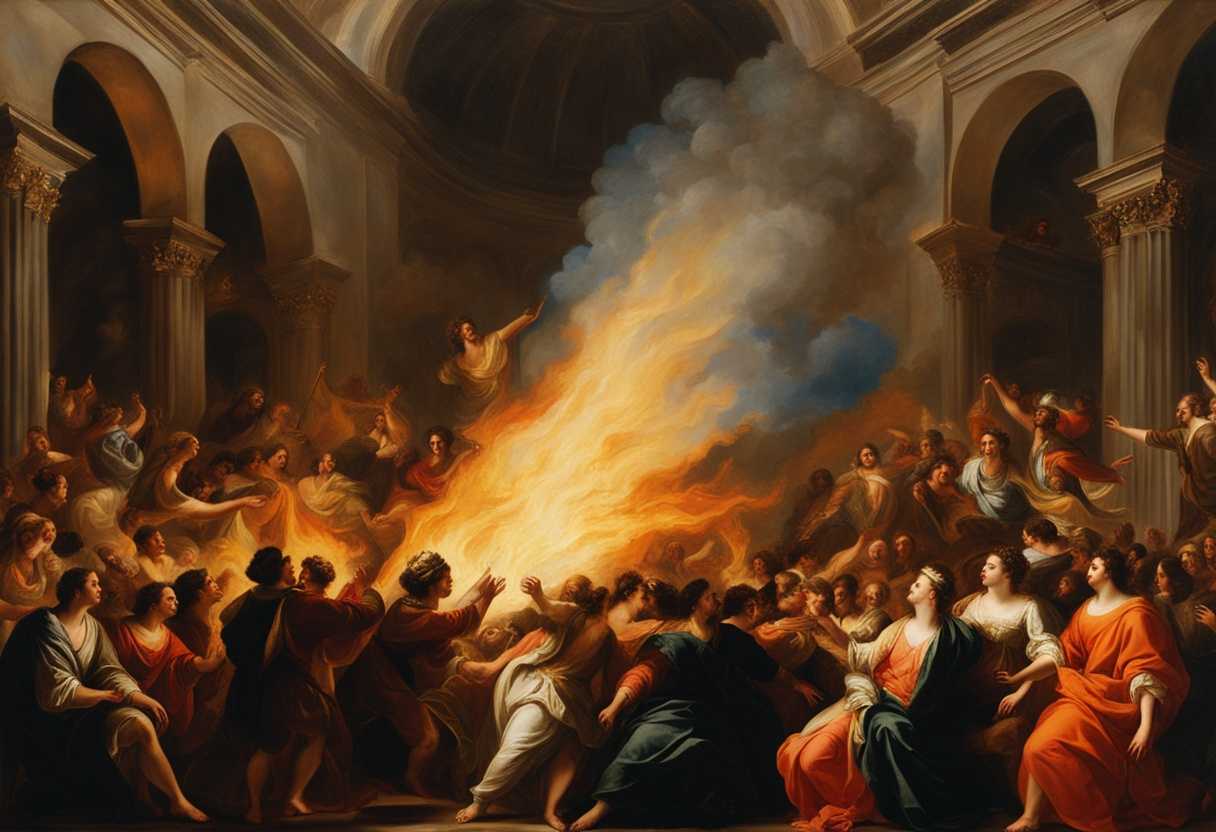
In the Bible, “tongues of fire” refer to the manifestation of the Holy Spirit during Pentecost, as described in Acts 2:3. This supernatural phenomenon symbolizes empowerment and the ability to speak in different languages, signifying the spread of the Gospel to all nations.
Scripture
1 When the day of Pentecost arrived, they were all together in one place.
2 And suddenly there came from heaven a sound like a mighty rushing wind, and it filled the entire house where they were sitting.
3 And divided tongues as of fire appeared to them and rested on each one of them.
4 And they were all filled with the Holy Spirit and began to speak in other tongues as the Spirit gave them utterance.
Meaning of Tongues of Fire in Scripture
The concept of “tongues of fire,” as found in Acts 2:3, holds profound significance in the biblical narrative, particularly in the context of the Pentecost. This moment marks the fulfillment of Jesus’ promise in Acts 1:8, where He states that the disciples would receive power when the Holy Spirit comes upon them, enabling them to be witnesses “to the ends of the earth.” The tongues of fire represent not just the presence of the Holy Spirit but also the divine empowerment bestowed upon the disciples. This empowerment is crucial as it enables them to communicate the message of Christ to diverse peoples, transcending linguistic and cultural barriers, which is echoed in Revelation 7:9, where a great multitude from every nation stands before the throne of God.
Moreover, the imagery of fire carries further connotations, such as purification and judgment. Throughout Scripture, fire symbolizes God’s holiness and His purifying presence (see Isaiah 6:6-7, where the seraphim use burning coals to cleanse Isaiah’s lips). Thus, the tongues of fire can also signify the purification of the apostles, preparing them for their mission. This multifaceted embodiment of the Holy Spirit through tongues of fire emphasizes not only the transformative power of God’s presence but also the urgent call for all believers to engage in the collaborative work of sharing the gospel with a world in need of redemption (Matthew 28:19-20). Essentially, this event acts as a catalytic moment in the early Church’s history, bridging the gap between divine empowerment and human responsibility in the mission of the church.
The motif of fire in the Bible extends beyond its presence at Pentecost, intertwining with other key moments that emphasize God’s authority and transformative influence. In the Old Testament, the burning bush encountered by Moses is a seminal event that encapsulates this theme. The bush, while engulfed in flames, remains unconsumed, signifying God’s ineffable holiness and His call to Moses for a grand purpose. This imagery of fire not only illustrates divine presence but also serves as a precursor to the ways God would later reveal Himself, establishing a pattern of using fire as a means to draw people towards His will. It reflects both the mystery of God’s nature and His desire for personal relational encounters with humanity.
Similarly, the descent of fire upon Mount Sinai during the giving of the Law signifies another critical interaction between God and His people. The mountain enveloped in smoke and flames underscores God’s majesty and the seriousness of His covenant with Israel, reinforcing the idea that fire signifies divine revelation as well as judgment. The driving force of the fire here acts as a continuous reminder of the sacredness that comes with God’s commandments, where obedience leads to life and dishonor leads to consequences. Throughout Scripture, the repeated imagery of fire serves as an evocative sign of the Holy Spirit’s work, calling believers to experience renewal, empowerment, and sanctification in their journey of faith, ultimately reinforcing the notion that they are to be vessels for His purpose in every sphere of life.
Divine Presence and Empowerment
The imagery of tongues of fire in the Bible often signifies the presence of God and His empowering spirit. Fire is a potent symbol of divine holiness and purity, representing God’s ability to refine and transform. In this context, the tongues of fire can be seen as a manifestation of God’s presence among His people, empowering them for service and mission. This empowerment is not just for personal edification but is intended to equip believers to spread the message of God’s love and salvation to others.
Communication and Understanding
Another broader meaning of tongues of fire relates to communication and understanding. The phenomenon of tongues, often associated with speaking in different languages, symbolizes the breaking down of barriers between people. It highlights the idea that the message of God is universal and accessible to all, transcending cultural and linguistic differences. This aspect emphasizes the importance of effective communication in sharing the gospel and fostering unity among diverse groups of believers.
Transformation and Renewal
Tongues of fire also represent transformation and renewal. Fire has the ability to consume and purify, suggesting a process of change that leads to new life. In a spiritual sense, this can be interpreted as the transformative work of the Holy Spirit in the lives of believers, igniting a passion for God and a commitment to His purposes. This renewal is essential for spiritual growth and the ability to live out one’s faith authentically in the world.
How to Strengthen Your Faith Through Divine Empowerment
Strengthening your faith through divine empowerment is a deeply personal journey that invites you to lean into your relationship with God. Start by immersing yourself in prayer and scripture, allowing His words to resonate in your heart and guide your actions. Remember, faith is not just a feeling but a choice to trust in God’s promises, even when life feels uncertain. Surround yourself with a community of believers who can uplift and encourage you, sharing testimonies of God’s faithfulness that can inspire your own. Additionally, seek opportunities to serve others, as acts of kindness can be a powerful reminder of God’s love working through you. Embrace the Holy Spirit’s presence in your life, asking for His guidance and strength in moments of doubt. As you cultivate this divine connection, you’ll find your faith not only strengthened but also transformed, empowering you to face challenges with grace and confidence.
Bible References to Tongues of Fire:
Exodus 3:1-6: 1 Now Moses was keeping the flock of his father-in-law, Jethro, the priest of Midian, and he led his flock to the west side of the wilderness and came to Horeb, the mountain of God.
2 And the angel of the Lord appeared to him in a flame of fire out of the midst of a bush. He looked, and behold, the bush was burning, yet it was not consumed.
3 And Moses said, “I will turn aside to see this great sight, why the bush is not burned.”
4 When the Lord saw that he turned aside to see, God called to him out of the bush, “Moses, Moses!” And he said, “Here I am.”
5 Then he said, “Do not come near; take your sandals off your feet, for the place on which you are standing is holy ground.”
6 And he said, “I am the God of your father, the God of Abraham, the God of Isaac, and the God of Jacob.” And Moses hid his face, for he was afraid to look at God.
Isaiah 6:5-7: 5 And I said: “Woe is me! For I am lost; for I am a man of unclean lips, and I dwell in the midst of a people of unclean lips; for my eyes have seen the King, the Lord of hosts!”
6 Then one of the seraphim flew to me, having in his hand a burning coal that he had taken with tongs from the altar.
7 And he touched my mouth and said: “Behold, this has touched your lips; your guilt is taken away, and your sin atoned for.”
Matthew 3:11-12: 11 “I baptize you with water for repentance, but he who is coming after me is mightier than I, whose sandals I am not worthy to carry. He will baptize you with the Holy Spirit and fire.”
12 His winnowing fork is in his hand, and he will clear his threshing floor and gather his wheat into the barn, but the chaff he will burn with unquenchable fire.
1 Kings 18:36-39: 36 And at the time of the offering of the oblation, Elijah the prophet came near and said, “O Lord, God of Abraham, Isaac, and Israel, let it be known this day that you are God in Israel, and that I am your servant, and that I have done all these things at your word.
37 Answer me, O Lord, answer me, that this people may know that you, O Lord, are God, and that you have turned their hearts back.”
38 Then the fire of the Lord fell and consumed the burnt offering and the wood and the stones and the dust, and licked up the water that was in the trench.
39 And when all the people saw it, they fell on their faces and said, “The Lord, he is God; the Lord, he is God.”
Hebrews 12:28-29: 28 Therefore let us be grateful for receiving a kingdom that cannot be shaken, and thus let us offer to God acceptable worship, with reverence and awe,
29 for our God is a consuming fire.
Revelation 4:5: 5 From the throne came flashes of lightning, and rumblings and peals of thunder, and before the throne were burning seven torches of fire, which are the seven spirits of God,
Luke 3:16-17: 16 John answered them all, saying, “I baptize you with water, but he who is mightier than I is coming, the strap of whose sandals I am not worthy to untie. He will baptize you with the Holy Spirit and fire.
17 His winnowing fork is in his hand, to clear his threshing floor and to gather the wheat into his barn, but the chaff he will burn with unquenchable fire.
Jeremiah 20:9: 9 If I say, “I will not mention him, or speak any more in his name,” there is in my heart as it were a burning fire shut up in my bones, and I am weary with holding it in, and I cannot.
Psalm 104:1-4: 1 Bless the Lord, O my soul! O Lord my God, you are very great! You are clothed with splendor and majesty.
2 Covering yourself with light as with a garment, stretching out the heavens like a tent.
3 He lays the beams of his chambers on the waters; he makes the clouds his chariot; he rides on the wings of the wind;
4 The Lord is the one who makes winds his messengers, flames of fire his ministers.

Reverend Michael Johnson is an experienced Church Minister with a profound expertise in spirituality and guidance. With a serene presence and a compassionate heart, he has faithfully served his congregation for over 20 years, leading them on a spiritual journey towards inner peace and enlightenment. Reverend Johnson’s extensive knowledge of religious philosophies and profound understanding of human nature have made him a trusted confidant and mentor to many, as he seamlessly weaves his profound wisdom into life teachings. Reverend Johnson’s calming demeanor and empathetic nature continue to uplift and heal souls, nurturing a sense of unity and tranquility within his community.