
2 These are the generations of Jacob. Joseph, being seventeen years old, was pasturing the flock with his brothers. He was a boy with the sons of Bilhah and Zilpah, his father’s wives. And Joseph brought a bad report of them to their father.
2 These are the generations of Jacob. Joseph, being seventeen years old, was pasturing the flock with his brothers. He was a boy with the sons of Bilhah and Zilpah, his father’s wives. And Joseph brought a bad report of them to their father.
3 Now Israel loved Joseph more than any other of his sons, because he was the son of his old age. And he made him a robe of many colors.
4 But when his brothers saw that their father loved him more than all his brothers, they hated him and could not speak peacefully to him.
5 Now Joseph had a dream, and when he told it to his brothers they hated him even more.
6 He said to them, “Hear this dream that I have dreamed:
7 For behold, we were binding sheaves in the field, and behold, my sheaf arose and stood upright.
8 His brothers said to him, “Are you indeed to reign over us? Or are you indeed to rule over us?” So they hated him even more for his dreams and for his words.
9 Then he dreamed another dream and told it to his brothers and said, “Behold, I have dreamed another dream. Behold, the sun, the moon, and eleven stars were bowing down to me.”
10 But when he told it to his father and to his brothers, his father rebuked him and said to him, “What is this dream that you have dreamed? Shall I and your mother and your brothers indeed come to bow ourselves to the ground before you?”
11 And his brothers were jealous of him, but his father kept the saying in mind.
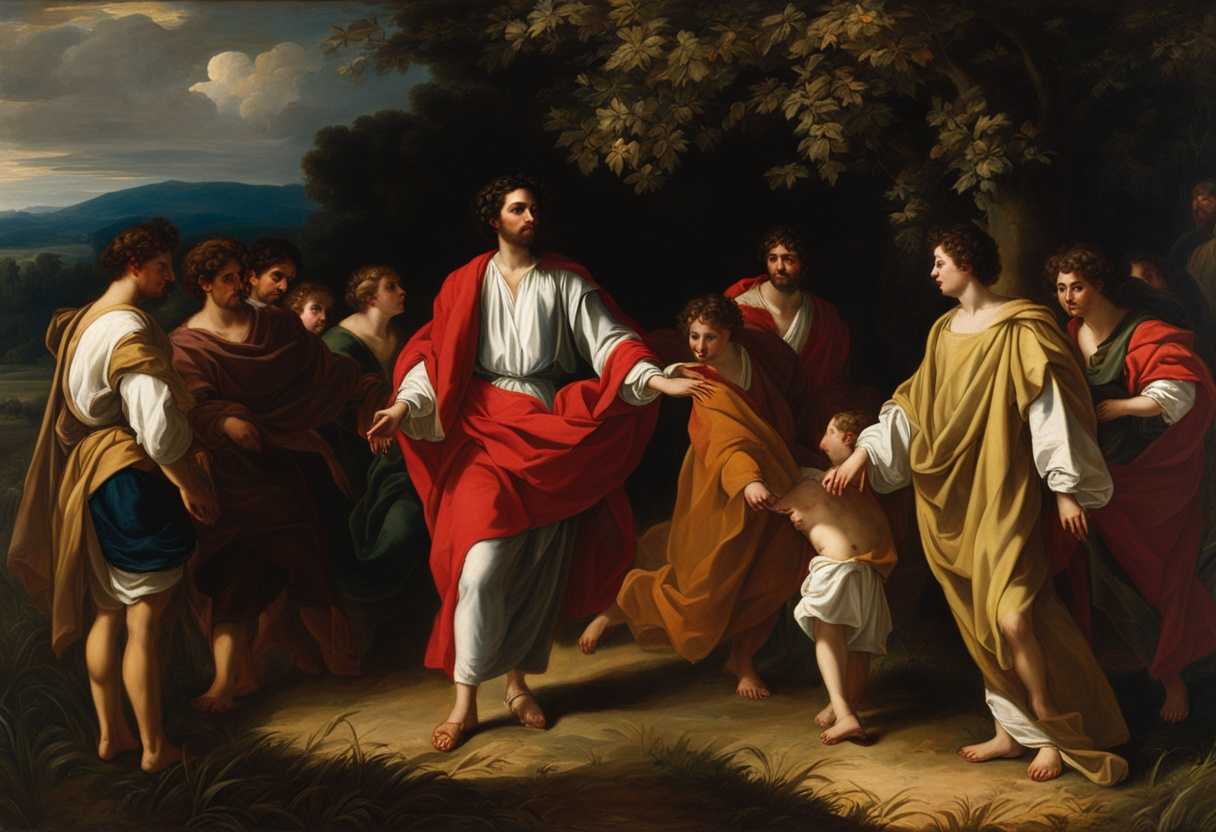
Setting the Scene for Genesis 37:1-11
In Genesis chapter 37, we find Joseph, the son of Jacob, in the land of Canaan. Jacob had twelve sons, and Joseph was his favorite, which caused jealousy among his brothers. One day, Jacob sent Joseph to check on his brothers who were tending to their flocks in Shechem. As Joseph approached them, they saw him from a distance and plotted to kill him out of envy and resentment.
The scene unfolds in a vast, open field with rolling hills and a clear blue sky above. Joseph, dressed in his colorful coat given to him by his father, walks confidently towards his brothers, unaware of the danger that awaits him. His brothers, including Reuben, Simeon, Levi, Judah, and the others, stand together, their faces twisted with anger and jealousy as they watch Joseph approach. The tension in the air is palpable as they discuss their sinister plan to get rid of their younger brother.
As Joseph reaches his brothers, the betrayal begins to unfold, setting the stage for a series of events that will ultimately lead Joseph on a journey of trials and triumphs, as he fulfills his destiny as a great leader in Egypt. This pivotal moment in Joseph’s life marks the beginning of a powerful story of forgiveness, redemption, and the unwavering faithfulness of God.
What is Genesis 37:1-11 about?
Ah, Joseph’s dreams! Such powerful visions that ultimately lead to both strife and greatness. Joseph’s innocent sharing of his dreams with his brothers incites jealousy and sets the stage for the challenges he will face in this verse. It’s fascinating to see how even our most well-intentioned actions can sometimes sow seeds of discord.
Have you ever experienced a time when sharing your ambitions or successes with others led to unexpected reactions? It’s a reminder that our individual paths and destinies can sometimes cause disruptions among those around us. Just like Joseph’s brothers, people’s responses to our dreams can range from support to envy. But it’s crucial to remember that every setback or jealousy-inducing moment can ultimately propel us towards our own leadership journey, just as it did for Joseph. So, let’s take a moment to reflect on how we handle our aspirations and how we navigate the complexities of relationships when our dreams shine brightly.
Understanding what Genesis 37:1-11 really means
Structure for Commentary:
- Introduction and Context
- Analysis of Key Phrases
- Cross-Referencing with Other Scriptures
- Relevance to Contemporary Life
- Application through Anecdote
- Engaging Questions and Conclusion
Commentary:
Introduction and Context:
Genesis 37:1-11 introduces us to Joseph, Jacob’s favored son, and paints the initial strokes of a narrative rich with conflict, envy, and divine providence. This passage serves as the foundation of Joseph’s story, which eventually leads to his rise in Egypt and the salvation of the Israelites during a famine. The family dynamics depicted here are complex and fraught with human emotions that are still deeply relevant today.
Analysis of Key Phrases:
One phrase that stands out is “Israel loved Joseph more than any of his other sons” because it encapsulates the root of familial discord. Favoritism can create deep-seated feelings of resentment, and this partiality sets the stage for the brothers’ envy and subsequent betrayal. Another significant phrase is Joseph’s recounting of his dreams, which imply future dominion. This not only stirs his brothers’ jealousy but also underscores a recurring biblical theme – God’s plans can often seem outrageous or improbable.
Cross-Referencing with Other Scriptures:
The story of sibling rivalry can be paralleled with other biblical narratives, such as Cain and Abel (Genesis 4), and Esau and Jacob (Genesis 25-27). Additionally, Joseph’s dreams echo those of other biblical figures who received divine messages through dreams, like Daniel (Daniel 2) and the Apostle Paul (Acts 16:9-10). Paul reminds us in Romans 8:28 that God works for the good of those who love him in all things, a principle vividly illustrated in Joseph’s life.
Relevance to Contemporary Life:
Today, many can relate to themes of favoritism, jealousy, and the struggle for significance. Feelings of injustice and envy in families, workplaces, or social circles can lead to division and conflict. This scripture invites us to examine our own relationships and motivations critically. Are we fostering an environment of fairness and love, or are we sowing seeds of discord through partiality? Clara, a young woman who excelled in her job and received consistent praise from her boss, is the subject of the story. Her colleague, Tom, felt overlooked and grew resentful, leading to a toxic workplace atmosphere. Only when Clara recognized Tom’s feelings and the underlying dynamics at play did she begin to foster a more inclusive and cooperative environment. Much like Joseph, understanding and acknowledging the root of discord can pave the way for reconciliation and growth.
Engaging Questions and Conclusion:
Reflect on your own life: have you ever felt like Joseph, either favored or resented? How did you respond to those feelings? Are there relationships where you might be playing the role of Joseph’s brothers, harboring envy or resentment? These questions encourage us to dig deeper into personal and community dynamics, fostering a more understanding and compassionate approach to our interactions. Genesis 37:1-11 teaches us about the consequences of favoritism and the importance of understanding God’s overarching plan through a powerful narrative. We can strive to create a more loving and just environment, reflective of divine grace and providence, by examining this scripture alongside our personal experiences.
How can we handle jealousy and favoritism in families?
Jealousy and favoritism in families can be damaging and lead to resentment and division among family members. Handling these issues requires open communication, empathy, and addressing the root causes of these feelings. It is important to acknowledge the emotions of all family members involved and seek to understand the underlying reasons for these feelings. We can work towards resolving conflicts related to jealousy and favoritism by fostering a sense of understanding and inclusivity within the family.
One way to address jealousy and favoritism within a family is by promoting a culture of appreciation and respect for each individual’s unique qualities and contributions. Encouraging open dialogue and creating a safe space for expressing feelings can help family members address any perceived inequalities or unfair treatment. We can foster a sense of unity and belonging within the family by recognizing and valuing each person’s strengths and differences, reducing the likelihood of jealousy and favoritism taking root. Setting boundaries and establishing clear expectations can also help mitigate feelings of jealousy and favoritism. We can create a sense of balance and harmony by promoting fairness and equality in how attention, resources, and opportunities are distributed within the family. Encouraging mutual support and uplifting one another can help cultivate a sense of solidarity among family members, strengthening relationships and reducing the likelihood of jealousy and favoritism becoming a source of conflict.
Application
Think of your job and family life as Joseph’s journey. He faced immense challenges but stayed true to his calling. You too are called to listen even when the path is hard. True success lies in aligning your daily actions and decisions with God’s plan, no matter the obstacles. Reflect on this—how will you respond to God’s call today?

Reverend Michael Johnson is an experienced Church Minister with a profound expertise in spirituality and guidance. With a serene presence and a compassionate heart, he has faithfully served his congregation for over 20 years, leading them on a spiritual journey towards inner peace and enlightenment. Reverend Johnson’s extensive knowledge of religious philosophies and profound understanding of human nature have made him a trusted confidant and mentor to many, as he seamlessly weaves his profound wisdom into life teachings. Reverend Johnson’s calming demeanor and empathetic nature continue to uplift and heal souls, nurturing a sense of unity and tranquility within his community.