
Mark 15:1-47 is about the crucifixion of Jesus Christ, highlighting his suffering, death, and ultimate sacrifice for the redemption of humanity’s sins according to Christian belief.
1 And as soon as it was morning, the chief priests held a consultation with the elders and scribes and the whole council. And they bound Jesus and led him away and delivered him over to Pilate.
2 And Pilate asked him, “Are you the King of the Jews?” And he answered him, “You have said so.”
3 And the chief priests accused him of many things.
4 And Pilate again asked him, “Have you no answer to make? See how many charges they bring against you.”
5 But Jesus made no further answer, so that Pilate was amazed.
6 Now at the feast he used to release for them one prisoner for whom they asked.
7 And among the rebels in prison, who had committed murder in the insurrection, there was a man called Barabbas.
8 And the crowd came up and began to ask Pilate to do as he usually did for them.
9 And Pilate answered them, saying, “Do you want me to release for you the King of the Jews?”
10 For he perceived that it was out of envy that the chief priests had delivered him up.
11 But the chief priests stirred up the crowd to have him release for them Barabbas instead.
12 And Pilate again said to them, “Then what shall I do with the man you call the King of the Jews?”
13 And they cried out again, “Crucify him.”
14 And Pilate said to them, “Why? What evil has he done?” But they shouted all the more, “Crucify him.”
15 So Pilate, wishing to satisfy the crowd, released for them Barabbas, and having scourged Jesus, he delivered him to be crucified.
16 And the soldiers led him away inside the palace (that is, the governor’s headquarters), and they called together the whole battalion.
17 And they clothed him in a purple cloak, and twisting together a crown of thorns, they put it on him.
18 And they began to salute him, “Hail, King of the Jews!”
19 And they struck his head with a reed and spat on him and knelt down in homage to him.
20 And when they had mocked him, they stripped him of the purple cloak and put his own clothes on him. And they led him out to crucify him.
21 And they compelled a passerby, Simon of Cyrene, who was coming in from the country, the father of Alexander and Rufus, to carry his cross.
22 And they brought him to the place called Golgotha (which means Place of a Skull).
23 And they offered him wine mixed with myrrh, but he did not take it.
24 And they crucified him and divided his garments among them, casting lots for them, to decide what each should take.
25 And it was the third hour when they crucified him.
26 And the inscription of the charge against him read, “The King of the Jews.”
27 And with him they crucified two robbers, one on his right and one on his left.
28 And the Scripture was fulfilled that says, “He was numbered with the transgressors.”
29 And those who passed by derided him, wagging their heads and saying, “Aha! You who would destroy the temple and rebuild it in three days,
30 save yourself, and come down from the cross!
31 So also the chief priests with the scribes mocked him to one another, saying, “He saved others; he cannot save himself.
32 Let the Christ, the King of Israel, come down now from the cross that we may see and believe.” Those who were crucified with him also reviled him.
33 And when the sixth hour had come, there was darkness over the whole land until the ninth hour.
34 And at the ninth hour Jesus cried with a loud voice, “Eloi, Eloi, lema sabachthani?” which means, “My God, my God, why have you forsaken me?”
35 And some of the bystanders hearing it said, “Behold, he is calling Elijah.”
36 And someone ran and filled a sponge with sour wine, put it on a reed and gave it to him to drink, saying, “Wait, let us see whether Elijah will come to take him down.”
37 And Jesus uttered a loud cry and breathed his last.
38 And the curtain of the temple was torn in two, from top to bottom.
39 And when the centurion, who stood facing him, saw that in this way he breathed his last, he said, “Truly this man was the Son of God!”
40 There were also women looking on from a distance, among whom were Mary Magdalene, and Mary the mother of James the younger and of Joses, and Salome.
41 When he was in Galilee, they followed him and ministered to him, and there were also many other women who came up with him to Jerusalem.
42 And when evening had come, since it was the day of Preparation, that is, the day before the Sabbath,
43 Joseph of Arimathea, a respected member of the council, who was also himself looking for the kingdom of God, took courage and went to Pilate and asked for the body of Jesus.
44 Pilate was surprised to hear that he should have already died. And summoning the centurion, he asked him whether he was already dead.
45 And when he learned from the centurion that he was dead, he granted the corpse to Joseph.
46 And Joseph bought a linen shroud, and taking him down, wrapped him in the linen shroud and laid him in a tomb that had been cut out of the rock. And he rolled a stone against the entrance of the tomb.
47 Mary Magdalene and Mary the mother of Joses saw where he was laid.
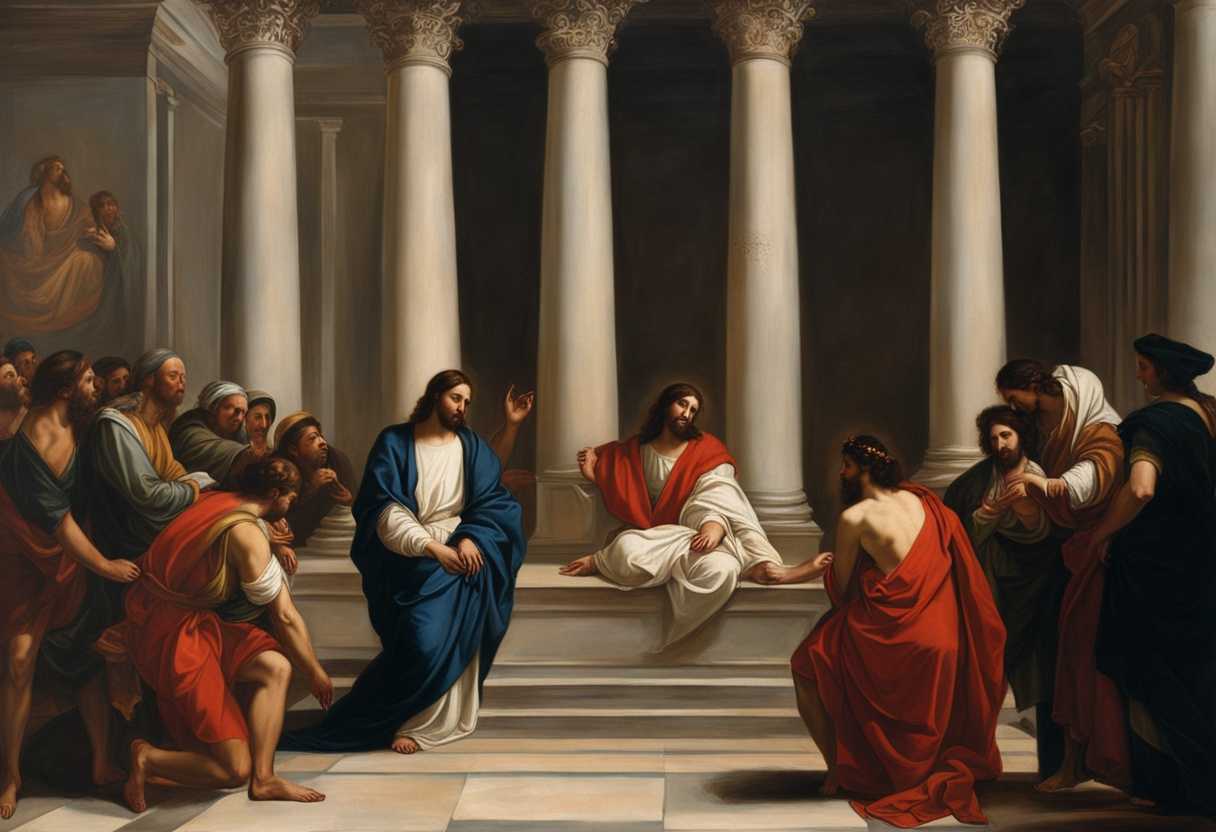
Setting the Scene for Mark 15:1-47
The scene in Mark chapter 15 takes place in Jerusalem during the time of the Passover festival. The main characters in this scene are Jesus, Pontius Pilate, the chief priests, and a crowd of people. Jesus has been brought before Pilate by the chief priests, who are accusing him of claiming to be the King of the Jews and inciting rebellion against the Roman authorities.
Pilate, the Roman governor, is seated on his judgment seat in the Praetorium, a grand palace in Jerusalem. The crowd that has gathered outside the Praetorium is restless and demanding that Pilate take action against Jesus. The chief priests are manipulating the crowd, urging them to call for Jesus’ crucifixion.
The atmosphere is tense and charged with emotion as Pilate questions Jesus and tries to determine what to do with him. The scene ultimately culminates in Pilate giving in to the demands of the crowd and sentencing Jesus to be crucified. The setting is a mix of political intrigue, religious tension, and the clash of power dynamics between the Roman authorities and the Jewish religious leaders.
What is Mark 15:1-47 about?
Ah, the profound significance of this verse! It encapsulates the pivotal moment in Christian theology – the crucifixion of Jesus Christ. Through his crucifixion, Jesus fulfills the prophecies from the Old Testament, showcasing the divine plan unfolding through the ages. This act of ultimate sacrifice serves as a powerful symbol of love and redemption, as Jesus willingly lays down his life for the salvation of humanity, demonstrating the depth of God’s love for his creation.
Imagine the weight of this moment – Jesus, the Son of God, choosing to endure unimaginable suffering and death on the cross, all for the sake of humanity’s salvation. It speaks to the selflessness and unconditional love that Jesus embodies, offering a path to reconciliation and eternal life for all who believe in him. We reflect on this verse, inviting us to contemplate the immense love and grace extended to us through the crucifixion, urging us to respond with gratitude, faith, and a renewed commitment to living in light of this profound sacrifice.
Understanding what Mark 15:1-47 really means
Mark 15:1-47 recounts the trial, crucifixion, death, and burial of Jesus Christ, a pivotal chapter in the Christian faith symbolizing His sacrifice for humanity’s salvation. The urgency of the chief priests and elders early in the morning to condemn Jesus sets the tone for the political and spiritual tension surrounding His identity. Pilate’s question, “Are you the King of the Jews?” highlights this conflict, leading to the crowd’s demand to “Crucify him!” showcasing the rejection of Jesus’ mission. Jesus’ cry from the cross, “My God, my God, why have you forsaken me?” quoting Psalm 22:1, reveals the depth of His suffering and abandonment, resonating with believers through the ages.
The tearing of the temple curtain symbolizes the removal of the barrier between God and humanity, granting direct access through Jesus’ sacrifice. This act echoes Isaiah 53:3-5’s prophecy of the suffering servant and aligns with John 3:16, emphasizing God’s love and the purpose of Jesus’ sacrifice for eternal life. Hebrews 10:19-20 further explains the torn curtain’s significance, pointing to a new way to approach God through Christ. Today, Jesus’ trial and crucifixion serve as a poignant reminder of God’s immense love and sacrifice for humanity’s redemption, prompting believers to reflect on their own sacrifices and relationship with God.
In a world marred by suffering and injustice, Jesus’ endurance and victory offer hope and a model of enduring faith. Consider individuals facing profound injustice or suffering, finding solace in Jesus’ cry of abandonment on the cross, knowing that even in darkness, God is present and working for a greater purpose. Stories of hope and strength found in faith during trials illustrate how Jesus’ sacrifice continues to inspire and uplift people today. Mark 15:1-47 is not merely a historical narrative but a living testament to sacrificial love and redemption, challenging readers to deepen their faith, trust in God’s plan, and discover hope amidst suffering.
What does it mean to truly follow Christ’s example?
To truly follow Christ’s example means to embody qualities such as selflessness, humility, and forgiveness. Christ’s sacrificial love for humanity, as seen in the crucifixion described in Mark 15, serves as a model for believers to emulate in their own lives. Followers are encouraged to demonstrate patience and grace in the face of obstacles or mistreatment, just as Christ endured suffering and persecution without retaliation.
Following Christ’s example also involves prioritizing service to others and extending compassion to those in need. Throughout his ministry, Jesus consistently showed care and concern for the marginalized and the outcasts of society, displaying a commitment to social justice and inclusivity. To follow in his footsteps means to actively seek out opportunities to help those who are struggling and advocate for fairness and kindness in all interactions.
Furthermore, true discipleship involves a willingness to embrace a path of obedience and faithfulness, even in the midst of challenges or doubts. Followers are called to trust in God’s plan and remain firm in their convictions, knowing that ultimately, their actions are guided by a greater purpose beyond themselves.
Application
Let’s embody the selflessness of Jesus in our interactions every day. Let’s offer kindness to those around us, grant forgiveness to those who have hurt us, and share the hope of His resurrection. Will you join in spreading His message of love and grace through your words and deeds?

Reverend Michael Johnson is an experienced Church Minister with a profound expertise in spirituality and guidance. With a serene presence and a compassionate heart, he has faithfully served his congregation for over 20 years, leading them on a spiritual journey towards inner peace and enlightenment. Reverend Johnson’s extensive knowledge of religious philosophies and profound understanding of human nature have made him a trusted confidant and mentor to many, as he seamlessly weaves his profound wisdom into life teachings. Reverend Johnson’s calming demeanor and empathetic nature continue to uplift and heal souls, nurturing a sense of unity and tranquility within his community.