
Job 9:32 is about the longing for a mediator between God and humanity to reconcile their differences and provide the opportunity for understanding and redemption.
32 For he is not a man, as I am, that I might answer him, that we should come to trial together.
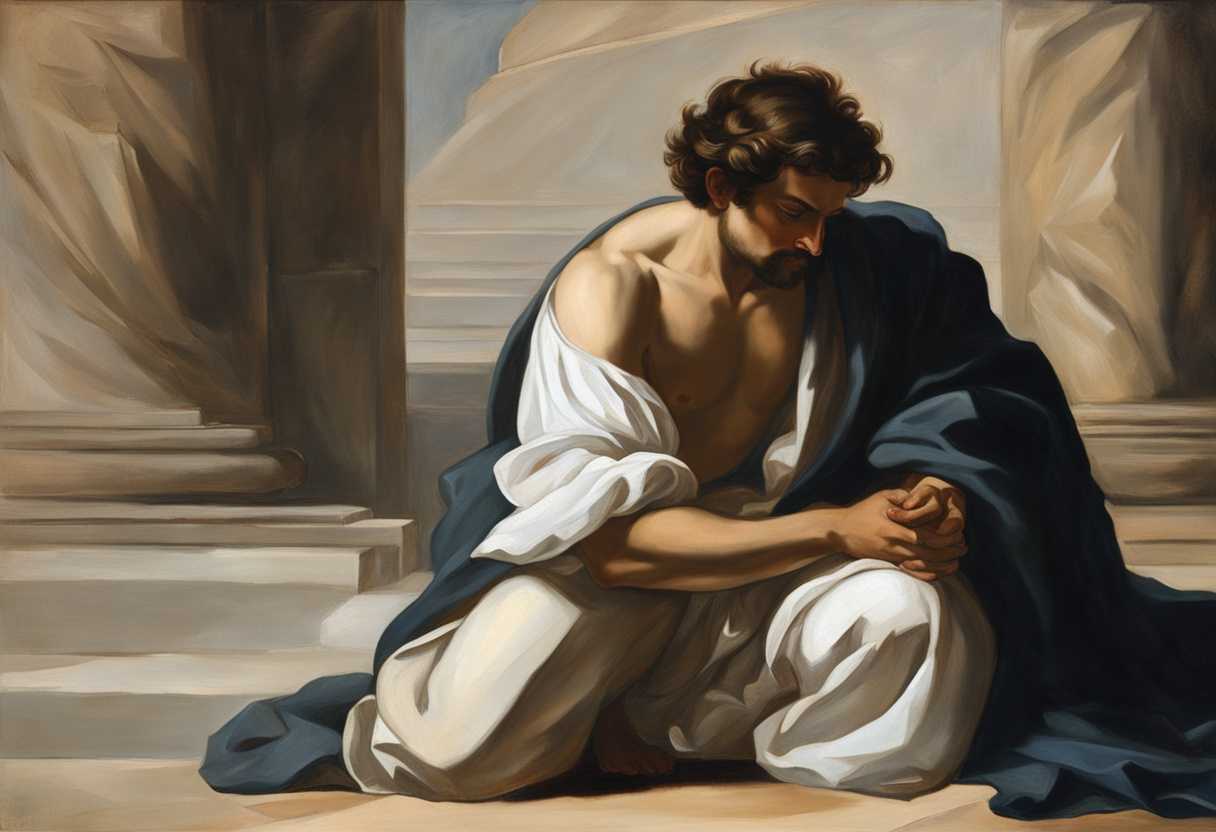
Setting the Scene for Job 9:32
In Job chapter 9, we find Job, a righteous man who is facing immense suffering and loss. Job is sitting in the dust, covered in painful sores, and grappling with the weight of his afflictions. His friends, Eliphaz, Bildad, and Zophar, have come to visit him upon hearing of his troubles. The scene is set in a desolate place, with Job’s friends sitting around him in silence, contemplating the gravity of Job’s situation.
As Job speaks, he expresses his deep anguish and despair, questioning the justice of God and the purpose of his suffering. His friends, initially silent, eventually begin to offer their perspectives on Job’s predicament, each coming from a different angle but ultimately trying to make sense of why such misfortune has befallen their friend. The tension in the air is palpable as Job grapples with his faith and his friends attempt to provide comfort and answers in the midst of his suffering.
The setting is somber and reflective, with the weight of Job’s suffering hanging heavy in the air. Job’s friends, though well-meaning, struggle to understand the depth of his pain and the complexity of his situation. As the dialogue unfolds, we see the raw emotions and deep theological questions that arise in the face of suffering and the search for meaning in the midst of adversity.
What is Job 9:32 about?
Job acknowledges the vast difference between God and humans in Job 9:32. Job recognizes that God is not a mere mortal that can be questioned or challenged like a human being. This verse highlights the profound and incomprehensible nature of God’s wisdom and power in comparison to our limited understanding as human beings. It emphasizes the humility and reverence that we should have towards God, recognizing His sovereignty and authority over all aspects of existence. We reflect on this verse, reminding us of the awe-inspiring greatness of God and the limitations of our own comprehension. It prompts us to consider our place in the divine order and to approach God with humility, respect, and trust in His infinite wisdom. This verse challenges us to surrender our need for control and understanding, recognizing that God’s ways are far beyond our own and that He alone holds the ultimate answers to life’s mysteries. How often do we try to fit God into our own limited understanding instead of approaching Him with reverence and humility? May this verse inspire us to trust in God’s perfect wisdom and authority, even when we do not fully grasp His ways.
Understanding what Job 9:32 really means
Job 9:32 captures Job’s profound sense of inadequacy and humility in the presence of God. In the larger context of Job’s suffering and his friends’ attempts to explain it, this verse stands out as a poignant expression of the vast difference between human frailty and divine perfection. Job’s acknowledgment that God is not a mere mortal like himself underscores the fundamental disparity between the Creator and His creation. This recognition of God’s transcendence challenges us to reflect on our own limitations and the need for humility in our relationship with the Almighty.
The phrase “That I might answer him” reveals Job’s desire for a fair dialogue with God, despite feeling overwhelmed by the magnitude of God’s being. Job’s longing for a mediator or an arbitrator to facilitate a confrontation with God in court reflects his yearning for someone who can bridge the gap between his finite understanding and God’s infinite wisdom. This metaphorical plea for a mediator resonates with our human tendency to seek intermediaries in times of conflict or uncertainty, highlighting the universal need for connection and understanding.
Drawing parallels with other biblical passages such as Isaiah 55:8-9, which emphasizes the distinction between God’s thoughts and human thoughts, and Hebrews 4:15-16, which presents Jesus as the high priest who empathizes with our weaknesses, reinforces the theme of mediation between humanity and God. The verse in 1 Timothy 2:5 further underscores the role of Jesus Christ as the ultimate mediator between God and mankind, fulfilling the longing for someone to stand between us and the divine.
In our contemporary lives, many individuals grapple with feelings of inadequacy and distance from God, mirroring Job’s struggles. The verse serves as a reminder of the human condition’s inherent limitations when faced with the divine. Just as Job sought a mediator, we are encouraged to look to Jesus Christ as the bridge that connects us to God, offering understanding, empathy, and reconciliation. The analogy of a child seeking an older sibling to mediate a difficult situation with a parent illustrates the universal need for intermediaries to facilitate communication and bridge gaps in understanding.
Ultimately, Job 9:32 prompts us to reflect on our relationship with God and the importance of seeking connection and reconciliation, even in moments of overwhelming doubt or despair. It invites us to consider our need for a mediator who can help us navigate the complexities of our faith and bridge the divide between our humanity and God’s divinity. As we grapple with our own limitations and uncertainties, this verse points us towards the hope and assurance found in Jesus Christ, who embodies the ultimate mediator between God and humanity.
How can a mortal be righteous before God?
The Book of Job raises the question about how a mortal can be righteous before God. This verse brings to light the inherent inadequacy of human beings to stand before the pure and holy presence of God. It showcases the gap between humanity’s fallen state and God’s perfect righteousness. Alluding to this verse prompts one to consider the limitations of human righteousness in comparison to the divine standard.
Being righteous before God requires more than just outward actions or deeds; it involves the very core of one’s being. It entails a heart that is fully surrendered to God, acknowledging that true righteousness comes from Him alone. This verse underscores the importance of humility and reliance on God’s grace for any hope of standing blameless before Him. The verse ultimately points to the need for a mediator between God and humanity, someone who can bridge the gap caused by sin and imperfect righteousness. Jesus Christ in Christian theology is seen as the ultimate mediator who makes it possible for mortals to be declared righteous before God. Through faith in Christ, individuals can receive the gift of salvation and be clothed in His righteousness, enabling them to stand before God justified.
Application
Consider this: in the hustle and bustle of our digital lives, have we forgotten about the ultimate mediator – Christ? Let’s pause for a moment and reflect on our own imperfections and the role of a Savior in bridging the gap with God. Embrace the opportunity to seek redemption and place your faith in Him as your mediator. Have you taken that important step towards salvation through Christ?

Reverend Michael Johnson is an experienced Church Minister with a profound expertise in spirituality and guidance. With a serene presence and a compassionate heart, he has faithfully served his congregation for over 20 years, leading them on a spiritual journey towards inner peace and enlightenment. Reverend Johnson’s extensive knowledge of religious philosophies and profound understanding of human nature have made him a trusted confidant and mentor to many, as he seamlessly weaves his profound wisdom into life teachings. Reverend Johnson’s calming demeanor and empathetic nature continue to uplift and heal souls, nurturing a sense of unity and tranquility within his community.