
Category: Bible Meaning
-

What does Leviticus 14:1-9 really mean?
Leviticus 14:1-9 is about the purification process for a person healed from a skin disease, symbolizing the restoration and cleansing of a person from sin and impurity through faith and repentance. 1 The Lord spoke to Moses, saying, 2 “This shall be the law of the leprous person for the day of his cleansing. He…
-

What does Job 34:5-9 really mean?
Job 34:5-9 is about Elihu asserting God’s justice and emphasizing that God’s ways are just and believers should not question His wisdom or righteousness. 5 For Job has said, ‘I am in the right, and God has taken away my right; 6 Would I lie against my right? My wound is incurable, though I am…
-

What does Hebrews 9:9-10 really mean?
Hebrews 9:9-10 is about the limitations of the Old Testament sacrificial system in providing true spiritual cleansing and pointing towards the ultimate sacrifice of Jesus Christ. 9 (which is symbolic for the present age). According to this arrangement, gifts and sacrifices are offered that cannot perfect the conscience of the worshiper, 10 but deal only…
-

What does Leviticus 14:35-57 really mean?
Leviticus 14:35-57 is about the procedures for addressing and cleansing a house contaminated with a skin disease, symbolizing the importance of purification, repentance, and restoration in spiritual and physical restoration. 35 Then he who owns the house shall come and tell the priest, ‘It seems to me there is some case of disease in my…
-

What does Psalms 61:5-8 really mean?
Psalms 61:5-8 is about finding refuge and strength in God’s presence, seeking protection and guidance in times of trouble, and expressing unwavering trust and reliance on Him for sustenance and salvation. 5 For you, O God, have heard my vows; you have given me the heritage of those who fear your name. 6 Prolong the…
-

What does Psalms 62:9-10 really mean?
Psalms 62:9-10 is about acknowledging the fleeting nature of wealth and power, emphasizing the importance of not placing one’s trust in material possessions but in God who holds ultimate power and is the true source of strength and security. 9 Those of low estate are but a breath; those of high estate are a delusion;…
-
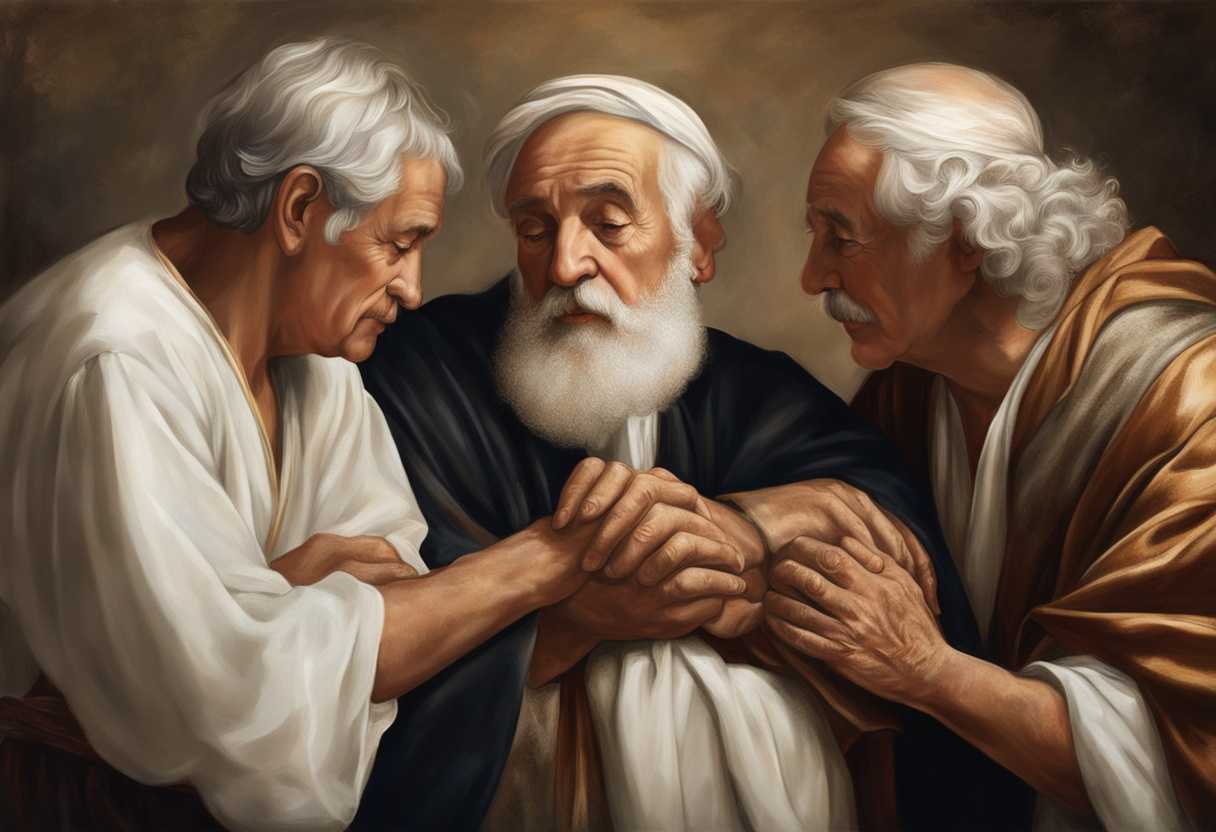
What does Genesis 48:1-20 really mean?
Genesis 48:1-20 is about Jacob adopting Ephraim and Manasseh, blessing them, and symbolizing the transfer of the birthright from the older to the younger son, highlighting God’s sovereign choice in determining blessings and inheritance. 1 After this, Joseph was told, “Behold, your father is ill.” So he took with him his two sons, Manasseh and…
-

What does Psalms 64:5-6 really mean?
Psalms 64:5-6 is about the evildoers plotting and carrying out their wicked intentions in secrecy, fearing not even the repercussions of their actions nor the exposure of their schemes. 5 They hold fast to their evil purpose; they talk of laying snares secretly, thinking, “Who can see them?” 6 They search out injustice, saying, “We…
-

What does Joshua 6:4-5 really mean?
Joshua 6:4-5 is about the divine command to march around the city of Jericho for seven days, demonstrating the power of faith and obedience in bringing down barriers through God’s guidance and intervention. 4 Seven priests shall bear seven trumpets of rams’ horns before the ark. And on the seventh day you shall march around…
-
What does Genesis 9:22-23 really mean?
Genesis 9:22-23 is about the consequences of Ham disrespecting his father Noah by seeing him naked and telling his brothers, highlighting the importance of honoring and showing respect to one’s parents. 22 And Ham, the father of Canaan, saw the nakedness of his father and told his two brothers outside. 23 Then Shem and Japheth…