
Genesis 48:1-20 is about Jacob adopting Ephraim and Manasseh, blessing them, and symbolizing the transfer of the birthright from the older to the younger son, highlighting God’s sovereign choice in determining blessings and inheritance.
1 After this, Joseph was told, “Behold, your father is ill.” So he took with him his two sons, Manasseh and Ephraim.
2 And it was told to Jacob, “Your son Joseph has come to you.” Then Israel summoned his strength and sat up in bed.
3 Then Jacob said to Joseph, “God Almighty appeared to me at Luz in the land of Canaan and blessed me,
4 and said to me, ‘Behold, I will make you fruitful and multiply you, and I will make of you a company of peoples and will give this land to your offspring after you for an everlasting possession.’
5 And now your two sons, who were born to you in the land of Egypt before I came to you in Egypt, are mine; Ephraim and Manasseh shall be mine, as Reuben and Simeon are.
6 And your offspring, whom you father after them, shall be yours. They shall be called by the name of their brothers in their inheritance.
7 As for me, when I came from Paddan, to my sorrow Rachel died in the land of Canaan on the way, when there was still some distance to go to Ephrath, and I buried her there on the way to Ephrath (that is, Bethlehem).
8 When Israel saw Joseph’s sons, he said, “Who are these?”
9 And Joseph said to his father, “They are my sons, whom God has given me here.” And he said, “Bring them to me, please, that I may bless them.”
10 Now the eyes of Israel were dim with age, so that he could not see. So Joseph brought them near him, and he kissed them and embraced them.
11 And Israel said to Joseph, “I never expected to see your face; and behold, God has let me see your offspring also.”
12 Then Joseph removed them from his knees, and he bowed himself with his face to the earth.
13 And Joseph took them both, Ephraim in his right hand toward Israel’s left hand, and Manasseh in his left hand toward Israel’s right hand, and brought them near him.
14 And Israel stretched out his right hand and laid it on the head of Ephraim, who was the younger, and his left hand on the head of Manasseh, crossing his hands (for Manasseh was the firstborn).
15 And he blessed Joseph and said, “The God before whom my fathers Abraham and Isaac walked, the God who has been my shepherd all my life long to this day,
16 the angel who has redeemed me from all evil, bless the boys; and in them let my name be carried on, and the name of my fathers Abraham and Isaac; and let them grow into a multitude in the midst of the earth.”
17 When Joseph saw that his father laid his right hand on the head of Ephraim, it displeased him, and he took his father’s hand to move it from Ephraim’s head to Manasseh’s head.
18 And Joseph said to his father, “Not this way, my father; since this one is the firstborn, put your right hand on his head.”
19 But his father refused and said, “I know, my son, I know. He also shall become a people, and he also shall be great. Nevertheless, his younger brother shall be greater than he, and his offspring shall become a multitude of nations.”
20 So he blessed them that day, saying, “By you Israel will pronounce blessings, saying, ‘God make you as Ephraim and as Manasseh.’” So he put Ephraim before Manasseh.
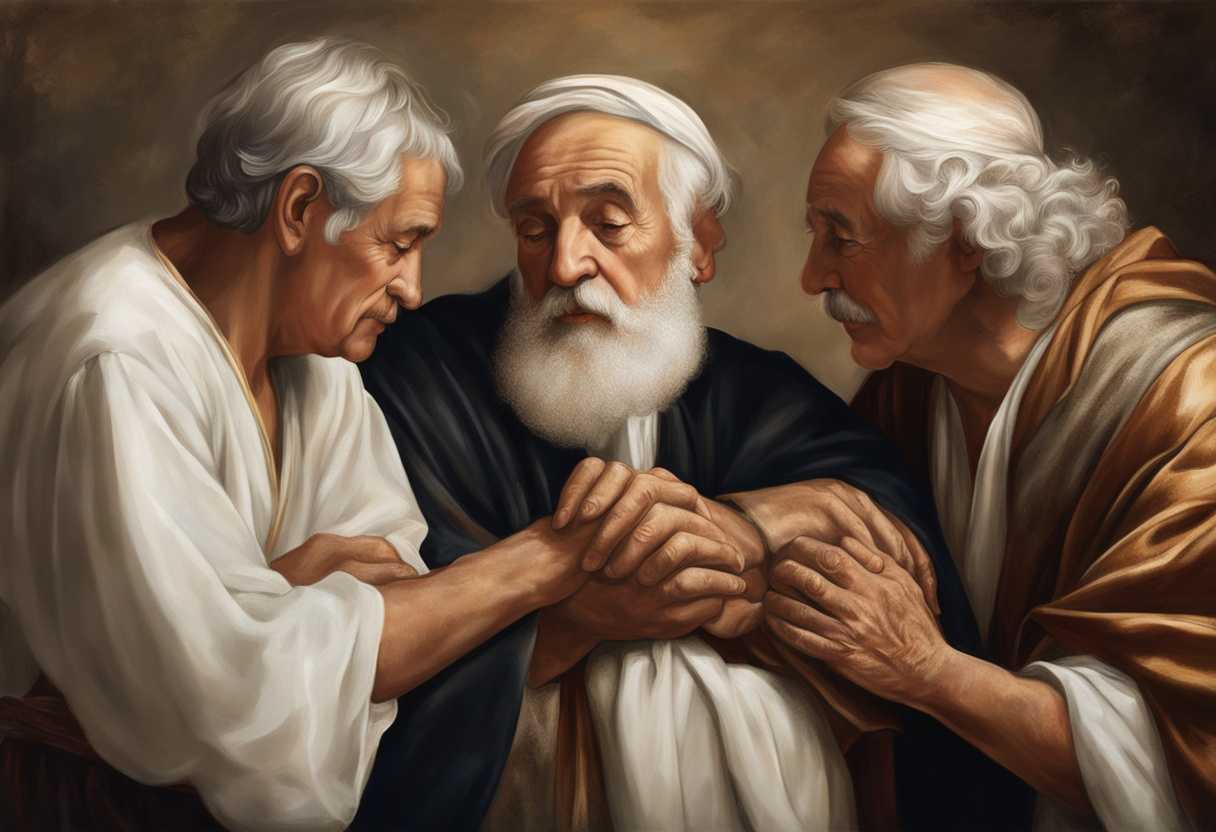
Setting the Scene for Genesis 48:1-20
In Genesis 48:1-20, we find Jacob, also known as Israel, on his deathbed. He calls his son Joseph to his side along with Joseph’s two sons, Manasseh and Ephraim. Jacob is old and nearing the end of his life, and he wants to bless his grandchildren before he passes away. The scene is filled with a sense of solemnity and importance as Jacob imparts his blessings upon the next generation.
The setting is likely a tent or a room in Jacob’s dwelling, with the family gathered around his bed. The atmosphere is heavy with emotion as Jacob reflects on his life and the promises that God has made to him and his descendants. Joseph, Manasseh, and Ephraim listen intently as Jacob speaks, knowing that his words carry great significance and will shape the future of their family. The room is dimly lit, adding to the somber mood of the occasion.
As Jacob blesses Ephraim and Manasseh, he crosses his arms, placing his right hand on Ephraim’s head and his left hand on Manasseh’s head, signifying that the younger Ephraim will be greater than his older brother. This act symbolizes the reversal of traditional expectations and highlights God’s sovereignty in choosing whom He will bless. The scene captures a poignant moment of transition and continuity as the blessings of the patriarchs are passed down to the next generation, ensuring the fulfillment of God’s covenant with His people.
What is Genesis 48:1-20 about?
Imagine being welcomed with open arms into a family, embraced and loved as if you had always belonged. Jacob in this verse not only acknowledges Joseph’s sons as his own but also bestows upon them blessings and inheritance that solidify their place within the family line. This act of adoption is more than just a legal formality; it is a profound declaration of love, acceptance, and inclusion. Recognize and value individuals for the qualities and character they bring to the family, not solely for their biological relations. Jacob’s actions remind us that family is not limited to blood ties but is also about the bonds of love, loyalty, and shared experiences. Through this gesture, Jacob showcases the importance of extending kindness and grace to those who may not have been born into our families but have nonetheless become integral parts of our lives. We can reflect on this verse and ponder the ways in which we can show love and acceptance to those around us, regardless of their familial background. How can we create a sense of belonging and inclusion for others in our communities? How can we redefine the concept of family to encompass not just biology but also chosen relationships built on love and mutual respect? Jacob’s example inspires us to embrace and bless those who come into our lives, fostering a sense of unity and connection that transcends bloodlines.
Understanding what Genesis 48:1-20 really means
In Genesis 48:1-20, we find Jacob in his final days, bestowing blessings upon Joseph’s sons, Ephraim and Manasseh. This passage holds significant themes of legacy, God’s promises, and the reversal of expectations. As Jacob “strengthened himself and sat up on the bed,” we witness his determination and the gravity of the moment as he imparts blessings to the next generation. The mention of God appearing to Jacob in Luz, blessing him, underscores the continuity of God’s covenant and the passing on of blessings from one generation to the next. Jacob’s invocation of the angel who redeemed him signifies his plea for God’s protection and favor to rest upon Ephraim and Manasseh.
The declaration that “His younger brother shall be greater than he” highlights the unexpected elevation of Ephraim over his elder brother, Manasseh, showcasing God’s tendency to work in ways that defy human expectations. This narrative echoes similar instances in biblical passages like Genesis 27:27-29, where blessings are pivotal, and expectations are overturned. Hebrews 11:21 further emphasizes Jacob’s faith in blessing Joseph’s sons, illustrating the importance of trust in God’s promises. Romans 9:12-13 draws parallels between God’s sovereign choices in selecting Jacob over Esau and the preference of Ephraim over Manasseh, underscoring God’s wisdom in His decisions.
The relevance of Genesis 48:1-20 extends to contemporary life, emphasizing the significance of legacy and family in passing down faith and blessings to future generations. It serves as a reminder of God’s sovereignty, prompting reflection on how His plans may diverge from human understanding. This passage encourages believers to hold steadfast to faith in God’s promises, even when circumstances seem contrary. Consider a scenario where a younger sibling unexpectedly assumes a leadership role, akin to Ephraim’s exaltation. This mirrors modern instances where individuals least expected to rise to prominence, illustrating how God’s plans often surpass human logic.
In conclusion, Genesis 48:1-20 imparts valuable lessons on the importance of blessings, the unpredictable nature of God’s workings, and the enduring faithfulness of His promises. It prompts us to trust in God’s divine plans, embracing His wisdom even when it defies human reasoning. As we navigate our lives, may we faithfully transmit our spiritual heritage to the generations that follow, embodying the legacy of faith and trust in God’s unfailing promises.
How can we seek God’s blessing for future generations?
To seek God’s blessing for future generations, we can follow the example set by Jacob in Genesis 48. Jacob called his sons to him, blessed them, and prophesied over each of them. We can ensure that the next generation is equipped to walk in God’s ways and fulfill His purposes by being intentional about passing on blessings, wisdom, and spiritual guidance.
Furthermore, we can pray for God’s protection, guidance, and favor to be upon our children and grandchildren. We can intercede for our descendants, asking God to watch over them, provide for them, and lead them in the path of righteousness, just as Jacob prayed for his grandsons Ephraim and Manasseh.
Lastly, we can lead by example by living lives of faith, obedience, and devotion to God. Our own relationship with God and the choices we make today will have a direct impact on the spiritual legacy we leave for future generations. We can pave the way for His blessings to flow down to our children and their children after them by walking closely with God and following His will.
Application
Let’s emulate Joseph’s reverence for his father by cherishing our family ties and upholding our ancestral traditions. Just as Joseph brought his sons forward to receive blessings, let’s also ensure that we preserve our family’s spiritual legacy. Let’s commit to passing down our faith and values to future generations, securing a strong foundation for our family tree. Will you take the reins in upholding your family’s spiritual heritage today?

Reverend Michael Johnson is an experienced Church Minister with a profound expertise in spirituality and guidance. With a serene presence and a compassionate heart, he has faithfully served his congregation for over 20 years, leading them on a spiritual journey towards inner peace and enlightenment. Reverend Johnson’s extensive knowledge of religious philosophies and profound understanding of human nature have made him a trusted confidant and mentor to many, as he seamlessly weaves his profound wisdom into life teachings. Reverend Johnson’s calming demeanor and empathetic nature continue to uplift and heal souls, nurturing a sense of unity and tranquility within his community.