
1 Chronicles 29:29 is about chronicling the reign of King David, from his early days to his time as king, highlighting his achievements and the events that transpired during his rule.
Now the acts of King David, from first to last, are written in the Chronicles of Samuel the seer, and in the Chronicles of Nathan the prophet, and in the Chronicles of Gad the seer, (1 Chronicles 29:29)
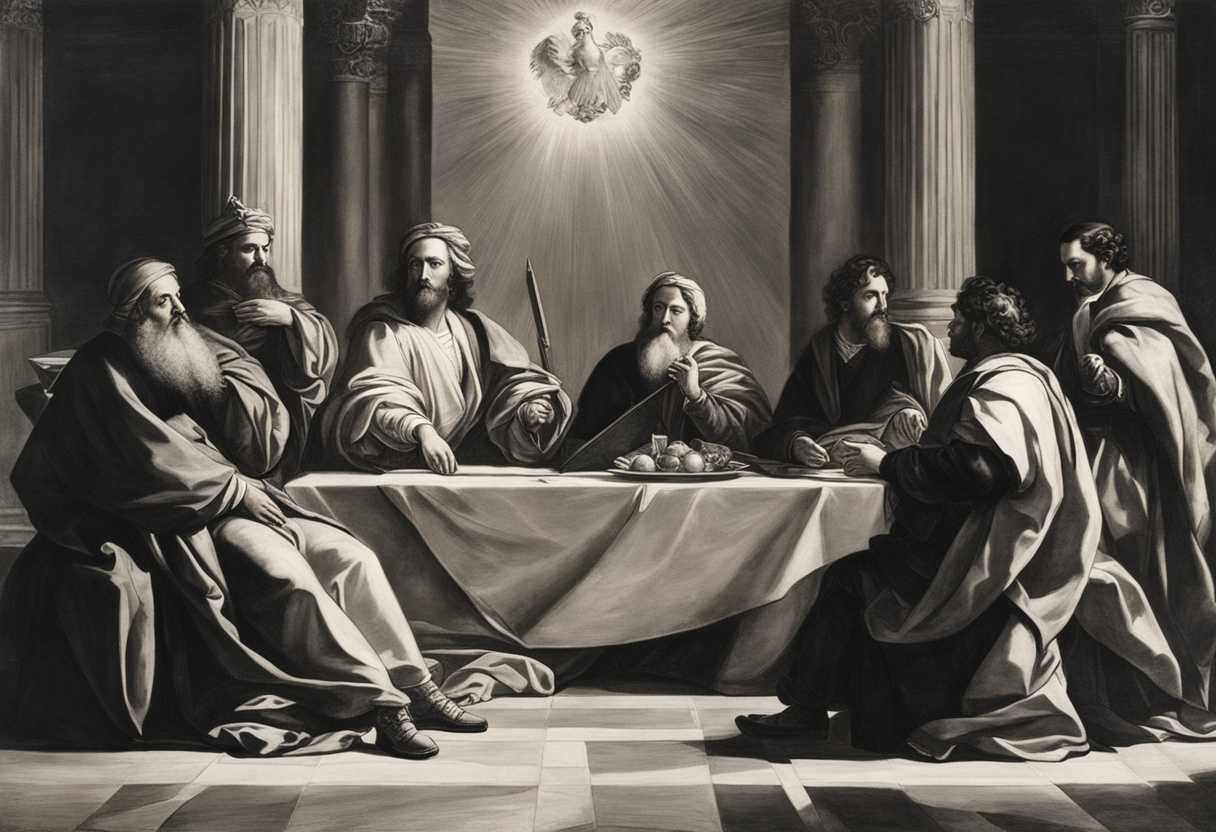
Setting the Scene for 1 Chronicles 29:29
The scene in 1 Chronicles 29:29 takes place in the royal court of King David in ancient Israel. The room is adorned with rich tapestries and golden ornaments, reflecting the opulence of the kingdom. King David, now an elderly man, is seated on his throne, surrounded by his most trusted advisors, including Nathan the prophet and Benaiah the son of Jehoiada. They are gathered to witness the passing of the torch from King David to his son Solomon, who is being anointed as the new king of Israel.
The atmosphere is solemn yet filled with anticipation as King David imparts his final words of wisdom and blessings upon his son. The room is filled with the scent of incense burning in the background, adding a sense of reverence to the occasion. The courtiers and officials present are hushed, hanging on every word spoken by the departing king, knowing that they are witnessing a pivotal moment in the history of their nation. As the ceremony concludes, the torch is officially passed to Solomon, signifying the beginning of a new era for Israel under his reign.
What is 1 Chronicles 29:29 about?
Welcome, dear reader, to this verse which captures the significant events during King David’s reign. As we delve into the narrative, we see a summary of David’s life, his accomplishments, and his legacy. It gives us a glimpse into the power and influence he wielded as a ruler.
Reflect on the historical context and ponder the impact of David’s reign on the people of his time. His burial place’s humility serves as a reminder that even the most powerful must one day return to dust. King David left a meaningful legacy, let us contemplate the brevity of life and its importance. This verse serves as a reminder of the transient nature of power and the significance of how we are remembered in the annals of history. What lessons can we draw from King David’s life and reign? How can we apply these lessons to our own leadership and legacy-building endeavors today? We ponder these questions as we journey through the ancient scriptures and glean wisdom from the tales of old.
Understanding what 1 Chronicles 29:29 really means
To fully understand and appreciate 1 Chronicles 29:29, we can structure our commentary as follows:
- Introduction to the Verse
- Breakdown of Key Phrases
- Cross-references with Other Scriptures
- Relevance to Modern Life
- Anecdote for Deeper Understanding
- Conclusion and Reflection
Introduction to the Verse
1 Chronicles 29:29 mentions the historical records of Samuel the seer, Nathan the prophet, and Gad the seer, highlighting the chronicling of King David’s reign. This verse underscores the importance of documentation and the roles of these prophetic figures in Israel’s history.
Breakdown of Key Phrases
The verse’s significant phrases include “Samuel the seer,” “Nathan the prophet,” and “Gad the seer.” Samuel was instrumental in anointing both Saul and David as kings (1 Samuel 16). Nathan confronted David about his sin with Bathsheba (2 Samuel 12). Gad provided guidance during David’s reign (2 Samuel 24:11). These leaders played crucial roles in guiding the Israelites, emphasizing divine communication through chosen individuals.
Cross-references with Other Scriptures
To understand the importance of prophetic records, we can reference 2 Timothy 3:16, which states that all Scripture is God-breathed and useful for teaching. This aligns with the role of Samuel, Nathan, and Gad, whose lives and messages were integral to God’s communication with His people. Additionally, Hebrews 1:1-2 reminds us that God spoke through prophets in various ways before ultimately speaking through His Son, Jesus Christ. This verse reminds us of the importance of spiritual guidance and accountability in today’s context. We too have spiritual leaders, mentors, and the Bible to guide our lives, just as Israel had its prophets to lead and correct. The need for documentation and remembrance of God’s works in our lives remains crucial. Reflecting on past testimonies strengthens our faith and provides direction. A community struggling with leadership transitions should be considered. Much like Israel, they relied on documented wisdom and spiritual guidance to navigate change. One might recall a church where a beloved pastor retired. The congregation found comfort and direction in the teachings and records left behind, understanding that their spiritual journey was part of a larger, divine narrative.
Conclusion and Reflection
1 Chronicles 29:29 calls us to value spiritual documentation and the wisdom of those God places in our lives. Reflect on the mentors and leaders who have guided you. How have their teachings and lives impacted your faith journey? God’s guidance is continuous, weaving through the past, present, and future as you ponder this.
This verse invites us to think critically about the legacy of faith we are part of and how we can contribute to it for future generations.
How can we pass on spiritual wisdom?
We can pass on spiritual wisdom by acknowledging the importance of recording and preserving teachings and insights. We can also document and share our own spiritual experiences, learnings, and revelations, just as the writings in 1 Chronicles were meant to pass on the wisdom and actions of David. We create a legacy of spiritual wisdom that can benefit future generations by writing down our reflections, prayers, and lessons learned.
Another way to pass on spiritual wisdom is through teaching and mentoring. We can also mentor others in their spiritual journey, just as David mentored and prepared Solomon to succeed him as king. We can help guide and support those who are seeking wisdom and growth in their own faith by sharing our knowledge, experiences, and understanding of spiritual truths.
Lastly, we can pass on spiritual wisdom through living out our beliefs and values. Actions often speak louder than words, and when others see us embodying our spiritual principles in our daily lives, it can inspire and encourage them to seek a deeper understanding of their own faith. We can impact others in a powerful and lasting way by being a living example of our beliefs.
Application
Think of the Bible as the ultimate guidebook for life’s journey, just like a GPS for your daily commute. When you dive into 1 Chronicles 29:29, you’re not just reading history; you’re fueling your soul for the challenges ahead. Make studying the Scriptures as habitual as your morning coffee, letting its wisdom steer your actions and decisions. Imagine the impact on your family and work life when you’re rooted in divine insight. Are you willing to take that step and let God’s word be the compass in your life?

Reverend Michael Johnson is an experienced Church Minister with a profound expertise in spirituality and guidance. With a serene presence and a compassionate heart, he has faithfully served his congregation for over 20 years, leading them on a spiritual journey towards inner peace and enlightenment. Reverend Johnson’s extensive knowledge of religious philosophies and profound understanding of human nature have made him a trusted confidant and mentor to many, as he seamlessly weaves his profound wisdom into life teachings. Reverend Johnson’s calming demeanor and empathetic nature continue to uplift and heal souls, nurturing a sense of unity and tranquility within his community.