
1 Now concerning food offered to idols: we know that “all of us possess knowledge.” This “knowledge” puffs up, but love builds up.
2 If anyone imagines that he knows something, he does not yet know as he ought to know.
3 But if anyone loves God, he is known by God.
4 Therefore, as to the eating of food offered to idols, we know that “an idol has no real existence,” and that “there is no God but one.”
5 For although there may be so-called gods in heaven or on earth—as indeed there are many “gods” and many “lords”—
6 yet for us there is one God, the Father, from whom are all things and for whom we exist, and one Lord, Jesus Christ, through whom are all things and through whom we exist.
7 However, not all possess this knowledge. But some, through former association with idols, eat food as really offered to an idol, and their conscience, being weak, is defiled.
8 Food will not commend us to God. We are no worse off if we do not eat, and no better off if we do.
9 But take care that this right of yours does not somehow become a stumbling block to the weak.
10 For if anyone sees you who have knowledge eating in an idol’s temple, will he not be encouraged, if his conscience is weak, to eat food offered to idols?
11 And so by your knowledge this weak person is destroyed, the brother for whom Christ died.
12 Thus, sinning against your brothers and wounding their conscience when it is weak, you sin against Christ.
13 Therefore, if food makes my brother stumble, I will never eat meat, lest I make my brother stumble.
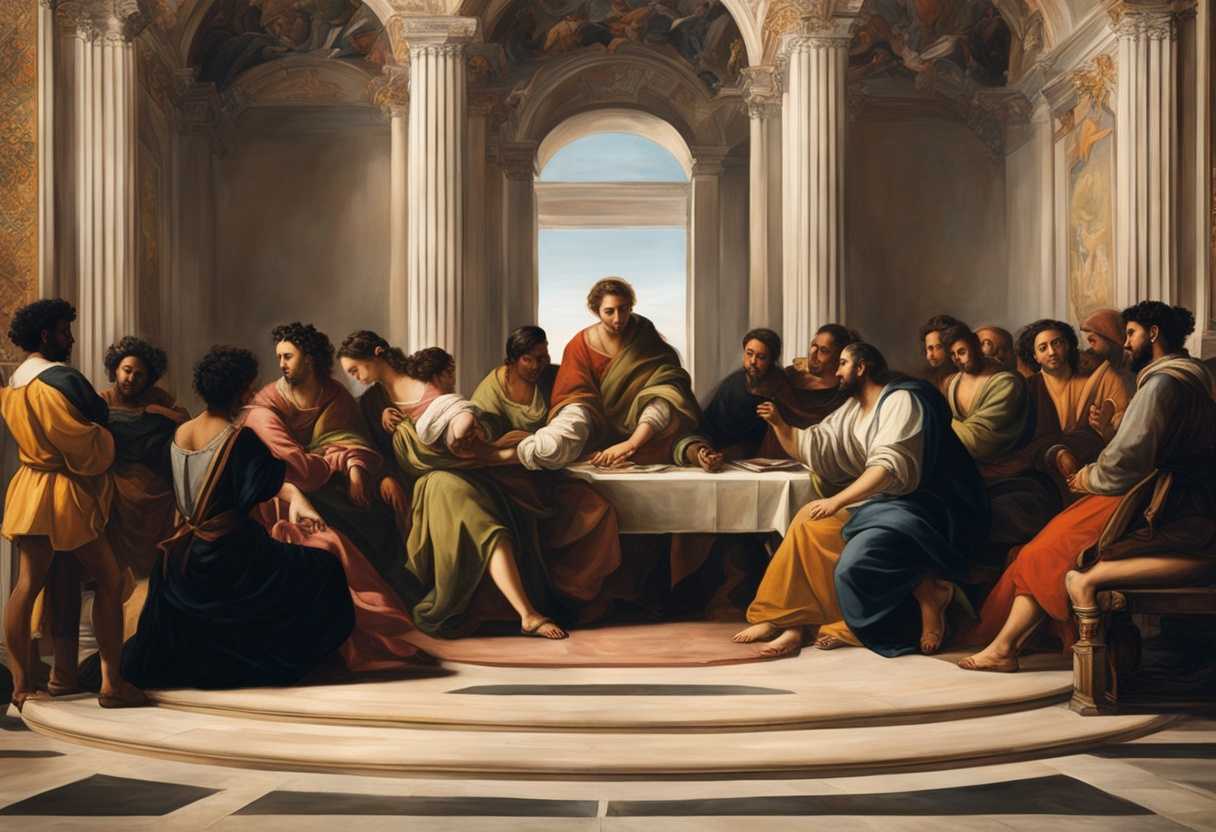
The True Meaning of 1 Corinthians 8
The First Epistle to the Corinthians was written by the Apostle Paul, a former persecutor of the early Christian church who experienced a dramatic conversion and became one of the most influential figures in the spread of Christianity. Paul addresses the issue of food sacrificed to idols in this chapter, causing division and confusion within the Corinthian congregation.
Paul acknowledges that the believers in Corinth have knowledge about the true nature of idols, but he cautions them that this knowledge can lead to a sense of superiority over those who are weaker in the faith. He reminds them that love and consideration for others should be the guiding principle, rather than simply asserting one’s rights or knowledge. This echoes the teachings of Jesus, who emphasized the importance of loving one’s neighbor and putting the needs of others before one’s own (Matthew 22:36-40). Paul will delve deeper into the complexities of this issue as the chapter unfolds. He will draw upon his own experiences and the wisdom he has gained through his encounters with various Christian communities, ultimately seeking to foster unity and spiritual growth within the Corinthian church.
1 Corinthians 8:1-3
The Apostle Paul addresses an issue that was dividing the Corinthian church – the matter of eating food sacrificed to idols in 1 Corinthians 8:1-3. The passage begins with Paul stating, “Now concerning food sacrificed to idols: we know that ‘all of us possess knowledge.’ Knowledge puffs up, but love builds up.” Here, Paul is highlighting the tension between knowledge and love. The Corinthians prided themselves on their knowledge and believed that they had the freedom to eat such food since idols were nothing.
Paul then delves deeper into this issue by stating, “Anyone who claims to know something does not yet have the necessary knowledge; but anyone who loves God is known by him.” Here, Paul is emphasizing that while knowledge is important, it must be accompanied by love. True knowledge is not just intellectual, but it should also be rooted in a love for God and others. The Corinthians were focused on their own rights and knowledge, but they were neglecting the more critical aspect of love.
This passage in 1 Corinthians 8 is significant as it speaks to the broader theme of Christian unity and love. Paul is cautioning the Corinthian believers against causing division and stumbling blocks for others based on their knowledge and freedom. He goes on to explain that even though idols are not real gods, some believers who were formerly idolaters might still struggle with eating food sacrificed to idols due to their past associations. Paul urges the Corinthians to consider the weaker conscience of their brothers and sisters in Christ and to prioritize love over personal rights.
This message is timeless and relevant for Christians today. It reminds believers to prioritize love and unity in the church community over personal preferences or rights. The Bible consistently emphasizes the importance of love for one another. Everyone will know that you are my disciples if you love one another, Jesus says in John 13:35.”” Love is a central theme throughout the Bible, and it is the foundation on which our faith and actions should be built. Christians should cultivate knowledge tempered with love and prioritize unity and love within the body of Christ, as a reminder from 1 Corinthians 8:1-3. It challenges us to consider the impact of our actions on others and to always act in a way that reflects Christ’s love for all.
1 Corinthians 8:4-6
The verse in 1 Corinthians 8:4-6 breaks down into three key sections. “So then, about eating food sacrificed to idols: We know that ‘An idol is nothing at all in the world’ and that ‘There is no God but one. The Corinthians are concerned about whether it is acceptable to eat food sacrificed to idols in this first part. Paul’s response here is clear and firm – he states that an idol is nothing in the world, acknowledging that these “gods” crafted by human hands have no real power or existence. This ties back to the Ten Commandments where God commands His people to have no other gods before Him (Exodus 20:3). Paul stresses the importance of monotheism and the folly of attributing power to false idols by emphasizing the oneness of God.
- “For even if there are so-called gods, whether in heaven or on earth (as indeed there are many ‘gods’ and many ‘lords’), yet for us there is but one God, the Father, from whom all things came and for whom we live; and there is but one Lord, Jesus Christ, through whom all things came and through whom we live.”
Paul acknowledges that while there are many so-called gods and lords, believers in Christ understand that there is only one true God – the Father, who created all things, and one Lord, Jesus Christ, through whom all things were made. This reaffirms the Christian belief in the Triune God – Father, Son, and Holy Spirit – and the foundational truth of Jesus’ divinity. It reinforces the idea that Christians should stay true to their faith in God and Christ, regardless of the false idols or gods present in the world. This concept is echoed in other verses like John 17:3, where Jesus states that eternal life is to know the only true God and Jesus Christ whom He sent.
- “But not everyone possesses this knowledge. Some people are still so accustomed to idols that when they eat sacrificial food they think of it as having been sacrificed to a god, and since their conscience is weak, it is defiled.”
Paul acknowledges that not all believers have the same level of understanding or maturity in their faith. He highlights that some may still struggle with the concept of eating food sacrificed to idols because of their past beliefs and practices. For these individuals, participating in such actions may lead to a sense of guilt or defilement due to their weak conscience. This emphasizes the importance of considering others in the body of Christ and how our actions may impact them spiritually. It also calls for sensitivity and understanding towards those who may still be growing in their faith, reminding us of the biblical principle of bearing with one another in love (Ephesians 4:2).
1 Corinthians 8:7-8
-
Section Breakdown:
a. “But not everyone possesses this knowledge.”
b. “Some people are still so accustomed to idols that when they eat sacrificial food they think of it as having been sacrificed to a god.” -
Commentary:
The first part of this passage emphasizes the idea that not everyone has the same level of understanding or knowledge when it comes to certain matters, in this case, the matter of eating food sacrificed to idols. Paul is addressing the Corinthians, who were living in a society where idol worship was prevalent. He acknowledges that not all of them had reached the point of realizing that idols are nothing and do not have any power. This understanding was crucial, as some believers who were formerly accustomed to idol worship still struggled with the concept of eating food that had been offered to idols. Many in the Corinthian church had come from backgrounds where idol worship was a central part of their lives in the cultural context. For these individuals, eating food that had been sacrificed to idols brought up feelings of guilt or association with their past practices. This posed a dilemma for the early Christian community as they tried to navigate their newfound faith while still grappling with the customs of their previous way of life.
Paul’s message here is a reminder that while knowledge is important, love and understanding for those who are weaker or less informed in their faith are equally crucial. He urges the Corinthians to be mindful of their actions, particularly in situations where it may cause confusion or temptation for others. This speaks to the broader theme of love and consideration for fellow believers that is echoed throughout the Bible. Paul similarly advises believers in Romans 14:15 not to let their eating habits cause another believer to stumble. These verses highlight the complexity of navigating faith in a diverse community and emphasize the importance of empathy, understanding, and sensitivity towards those who may be struggling with different aspects of their beliefs. It reminds us to prioritize love and unity within the body of Christ, even in matters where there may be differences in understanding or practice.
1 Corinthians 8:9-13
The verse in 1 Corinthians 8:9-13 is divided into two main sections: the first part consists of verses 9-10, and the second part includes verses 11-13. The verse opens with the statement, “Be careful, however, that the exercise of your rights does not become a stumbling block to the weak.” This sets the tone for the entire passage, emphasizing the importance of considering others in our actions and decisions, especially in matters that may cause spiritual stumbling for those who are vulnerable in faith. Exercising one’s freedom in a way that may lead a weaker brother or sister to stumble by causing them to sin against their conscience is the focus in verses 9-10. The example given is that of eating food sacrificed to idols, which was a prevalent issue in the Corinthian congregation. Some believers, particularly those who were new in the faith or struggling with their past pagan practices, found it difficult to separate the act of eating such food from participating in idol worship. The apostle Paul is advising the more mature believers to be mindful of their actions so as not to lead the weaker Christians into sin.
Paul’s argument in verses 11-13 further underscores the importance of considering others before oneself. He highlights the gravity of the situation by stating that if our actions cause a weaker brother or sister to stumble, we are sinning against Christ. He emphasizes that if eating certain food causes another to fall, he will never eat meat again, so as not to cause his brother or sister to stumble. This radical statement shows the lengths to which Paul is willing to go to ensure the spiritual well-being of others, even if it means giving up something that is permissible.
This passage in 1 Corinthians 8 provides a timeless lesson on the importance of love, consideration, and selflessness in the Christian community. It teaches us that our freedom in Christ should always be exercised in a way that builds up and edifies others, rather than causing harm. This principle of prioritizing the well-being of others over our own desires is echoed in other parts of the Bible, such as in Philippians 2:3-4, which encourages us to “Do nothing out of selfish ambition or vain conceit. Rather, in humility, value others above yourselves, not looking to your own interests but each of you to the interests of the others.” The overarching message is clear: love should be the guiding principle in how we interact with our fellow believers, putting their spiritual welfare above our own rights and freedoms.
After 1 Corinthians 8
The apostle Paul had addressed the issue of eating food sacrificed to idols. He acknowledged that idols are not real gods, and that believers are free to eat such food. However, he cautioned that this freedom must be exercised with care, lest it cause a weaker brother to stumble. Paul emphasized the importance of love and consideration for others, even if it means forfeiting one’s own rights. We must remember that our actions, though permissible, may have consequences for those around us as we move forward. The strength of our faith should not lead us to disregard the spiritual well-being of our brothers and sisters. Instead, we are called to build one another up, to walk in love, and to seek the good of the community. For in doing so, we honor the Lord and reflect the heart of Christ.

Reverend Michael Johnson is an experienced Church Minister with a profound expertise in spirituality and guidance. With a serene presence and a compassionate heart, he has faithfully served his congregation for over 20 years, leading them on a spiritual journey towards inner peace and enlightenment. Reverend Johnson’s extensive knowledge of religious philosophies and profound understanding of human nature have made him a trusted confidant and mentor to many, as he seamlessly weaves his profound wisdom into life teachings. Reverend Johnson’s calming demeanor and empathetic nature continue to uplift and heal souls, nurturing a sense of unity and tranquility within his community.