
1 Kings 21:21-22 is about the consequences that King Ahab and his household will face for their wickedness and idolatry, as decreed by the prophet Elijah on behalf of the Lord.
21 Behold, I will bring disaster upon you. I will utterly burn you up, and will cut off from Ahab every male, bond or free, in Israel.
22 I will make your house like the house of Jeroboam the son of Nebat, and like the house of Baasha the son of Ahijah, for the anger to which you have provoked me, and because you have made Israel to sin.
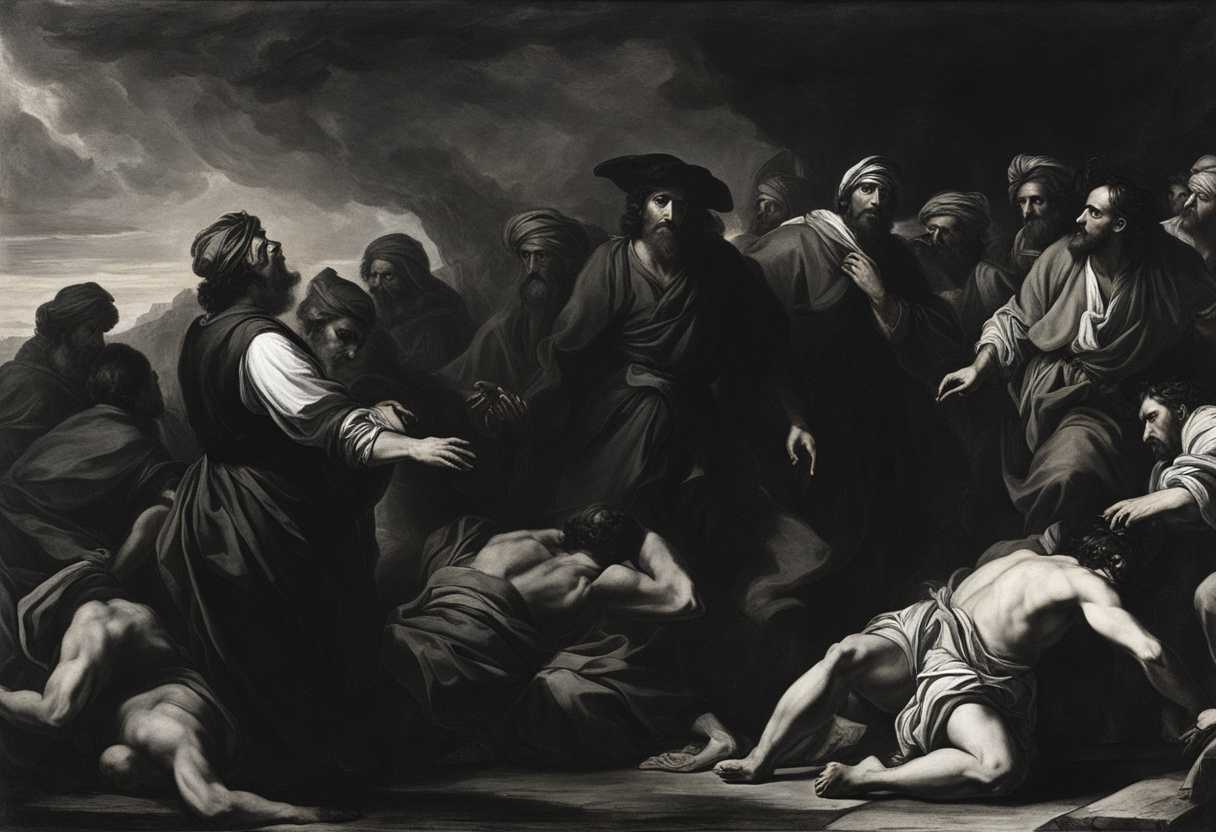
Setting the Scene for 1 Kings 21:21-22
The scene in 1 Kings 21:21-22 takes place in the ancient kingdom of Israel during the reign of King Ahab and Queen Jezebel. King Ahab desired a vineyard owned by Naboth, but Naboth refused to sell it as it was his ancestral inheritance. Queen Jezebel, known for her cunning and manipulation, devised a plan to have Naboth falsely accused of blasphemy and executed so that Ahab could take possession of the vineyard.
In the royal court of King Ahab and Queen Jezebel, we see the couple discussing their plan to seize Naboth’s vineyard. Ahab, a weak and easily influenced king, is persuaded by Jezebel’s ruthless tactics. Jezebel, a foreign queen known for introducing the worship of Baal in Israel, is determined to fulfill her husband’s desires at any cost. The opulent surroundings of the royal court contrast sharply with the injustice and deceit being plotted within its walls.
As the sun sets over the palace, the fate of Naboth hangs in the balance, setting the stage for a tragic chain of events that will ultimately lead to divine retribution against Ahab and Jezebel for their wickedness.
What is 1 Kings 21:21-22 about?
This verse highlights the concept of divine justice and the consequences of one’s actions. It teaches us that God sees and knows everything, and those who choose to do evil will ultimately face the repercussions of their actions. The idea of descendants being cut off emphasizes the long-lasting impact of wrongdoing, extending beyond just the individual committing the act. It serves as a reminder that our actions not only affect ourselves but also those around us, including future generations.
Reflecting on this verse, we are encouraged to consider the importance of our choices and behavior. It prompts us to reflect on whether our actions are aligned with goodness and righteousness or if they lean towards evil and harm. It challenges us to strive for integrity and moral uprightness in all that we do, knowing that there are consequences for our actions, both in the present and for those who may come after us. This verse ultimately serves as a call to responsibility and accountability in our conduct, reminding us that God’s justice is fair and certain.
Understanding what 1 Kings 21:21-22 really means
In the narrative of 1 Kings 21:21-22, we witness the prophet Elijah delivering a stern message from God to King Ahab, condemning him for his sins, notably the unjust acquisition of Naboth’s vineyard through murder. Ahab, swayed by his wife Jezebel, had led Israel astray into idolatry and injustice, provoking divine wrath. The phrases used in this passage carry weighty meanings, such as “I am going to bring disaster on you,” signifying the impending judgment on Ahab for his grave transgressions. The declaration that God will “wipe out your descendants” underscores the severity of the punishment, indicating the complete eradication of Ahab’s lineage as a consequence of his actions.
Moreover, the proclamation that “I will cut off from Ahab every last male in Israel” emphasizes the totality of the judgment, leaving no male heir to continue Ahab’s legacy. The vivid imagery of dogs eating those who die in the city and birds feeding on those who die in the country highlights the ignominy and shame that will befall Ahab’s family—a fate considered deeply dishonorable in ancient Israelite culture. These verses find resonance in other biblical passages like Deuteronomy 28:15-68, which delineates the curses for disobedience, providing a broader context for understanding divine retribution.
The subsequent fulfillment of Elijah’s prophecy in 2 Kings 9:7-10 through Jehu executing judgment on Ahab’s house underscores the certainty of God’s word. Proverbs 6:16-19 further elucidates God’s abhorrence for shedding innocent blood and devising wicked schemes, sins that Ahab and Jezebel are culpable of committing. The relevance of these verses extends to contemporary society, serving as a poignant reminder of accountability and justice. In a world marred by injustice, the assurance that actions have consequences and that divine justice will prevail offers both a sobering reality check and a source of comfort.
Ahab’s narrative also underscores the perils of unchecked influence and the responsibilities that come with power. It cautions against the corrupting nature of authority and underscores the significance of upright leadership. While these verses primarily focus on judgment, they also hint at the possibility of repentance and redemption, as evidenced by Ahab’s temporary remorse in 1 Kings 21:27-29. To illustrate the timeless relevance of this moral lesson, consider a modern-day scenario where a community leader’s greed and exploitation lead to their downfall, mirroring Ahab’s tragic trajectory.
In conclusion, 1 Kings 21:21-22 prompts us to contemplate the importance of integrity, the certainty of divine justice, and the potential for redemption. It urges us to evaluate our actions, pursue justice, and place our trust in God’s righteous judgment. As we navigate the complexities of life, may we heed the warnings from Ahab’s story, striving for righteousness, accountability, and the hope of redemption in the face of our own moral dilemmas.
How can we humble ourselves before God?
To humble ourselves before God is to acknowledge His authority and sovereignty over our lives. It involves recognizing our own limitations and weaknesses in comparison to His infinite wisdom and power. We demonstrate a posture of humility and reverence by submitting ourselves to God’s will and seeking His guidance.
One way to humble ourselves before God is through prayer and meditation. We reflect on His goodness and seek forgiveness for our sins by spending time in His presence. Additionally, engaging in acts of service and worship can also be a way to display humility before God. When we put others’ needs above our own and seek to honor God in all that we do, we are acknowledging His greatness and our dependence on Him. Having a heart that is open to God’s leading and a spirit that is willing to surrender to His plan ultimately involves humility. We can cultivate a humble attitude that reflects our trust and faith in God by living a life characterized by obedience, gratitude, and reverence towards Him.
Application
In the hustle and bustle of life, we often lose sight of what truly matters. Let’s take a moment to pause and reflect on our choices, and realign them with our values and beliefs. Just as we juggle work and family, let us also juggle our spiritual well-being. Are you ready to take that step towards living a life that honors God?

Reverend Michael Johnson is an experienced Church Minister with a profound expertise in spirituality and guidance. With a serene presence and a compassionate heart, he has faithfully served his congregation for over 20 years, leading them on a spiritual journey towards inner peace and enlightenment. Reverend Johnson’s extensive knowledge of religious philosophies and profound understanding of human nature have made him a trusted confidant and mentor to many, as he seamlessly weaves his profound wisdom into life teachings. Reverend Johnson’s calming demeanor and empathetic nature continue to uplift and heal souls, nurturing a sense of unity and tranquility within his community.