
1 Samuel 26:21-25 is about David’s mercy and forgiveness towards King Saul, demonstrating the importance of showing compassion and restraint even towards one’s enemies as an act of faith and obedience to God.
21 Then Saul said, “I have sinned. Return, my son David, for I will no more do you harm, because my life was precious in your eyes this day. Behold, I have acted foolishly, and have made a great mistake.”
22 And David answered and said, “Here is the spear, O king! Let one of the young men come over and take it.
23 The Lord rewards every man for his righteousness and his faithfulness, for the Lord gave you into my hand today, and I would not put out my hand against the Lord’s anointed.
24 Behold, as your life was precious this day in my sight, so may my life be precious in the sight of the Lord, and may he deliver me out of all tribulation.
25 Then Saul said to David, “Blessed be you, my son David! You will do many things and will succeed in them.” So David went his way, and Saul returned to his place.
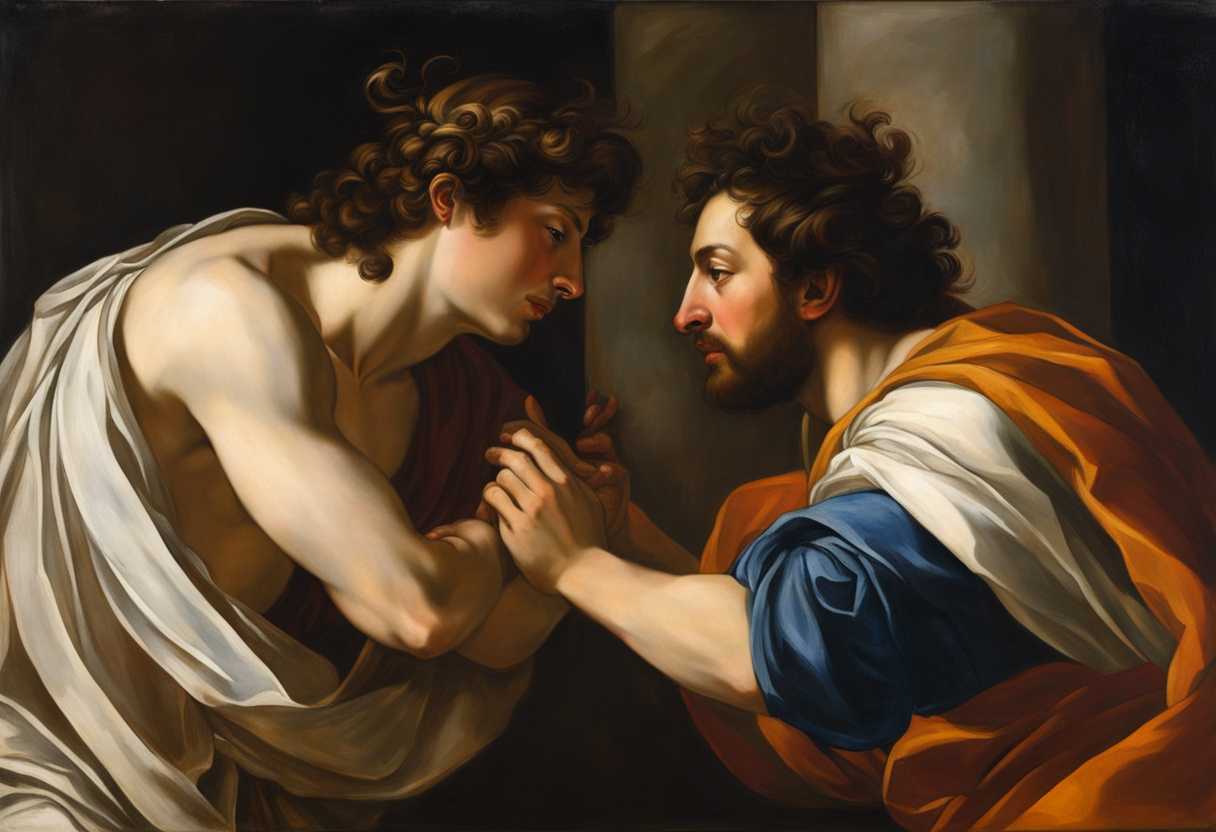
Setting the Scene for 1 Samuel 26:21-25
In 1 Samuel chapter 26, we find David and his loyal companion, Abishai, in a tense and precarious situation. King Saul, consumed by jealousy and paranoia, is relentlessly pursuing David, who is on the run to escape Saul’s wrath. One night, they find themselves in the midst of Saul’s camp, where the king and his men are fast asleep, unaware of David’s presence.
The scene is set in the dead of night, with only the flickering light of torches illuminating the camp. The air is thick with tension as David and Abishai stand at the edge of the camp, gazing down at Saul, who lies defenseless before them. Abishai, eager to defend his friend and leader, urges David to let him strike Saul down once and for all. However, David, guided by his unwavering faith in God’s plan, refuses to harm the anointed king, choosing instead to trust in the Lord’s justice.
As they stand there, surrounded by the slumbering soldiers of Saul’s army, David takes Saul’s spear and water jug as proof of his presence in the camp. In the morning, he calls out to Saul from a safe distance, showing him the items he took and pleading for reconciliation. This poignant moment showcases David’s humility and faith in God’s timing, even in the face of great danger and temptation.
What is 1 Samuel 26:21-25 about?
David demonstrates a powerful display of mercy and faith towards King Saul, his relentless pursuer, in this verse. Despite having the opportunity to harm Saul, who sought to kill him, David chooses instead to spare his life. This act of mercy reflects David’s belief in God’s justice, that ultimately it is up to God to deal with those who have wronged him. David exemplifies a deep faith and a commitment to righteousness by trusting in God’s plan and refraining from seeking revenge.
Isn’t it remarkable how David’s actions challenge us to consider our own responses when faced with injustice? How often do we rely on our own judgment to seek retribution instead of trusting in God’s justice? Through David’s example, we are reminded of the power of forgiveness and the importance of trusting in God’s ultimate plan. His act of sparing Saul’s life serves as a profound lesson in grace, mercy, and faith that we can all learn from and strive to emulate in our own lives.
Understanding what 1 Samuel 26:21-25 really means
In the narrative of David and King Saul, we witness a profound moment where David, despite being pursued by Saul, chooses to spare Saul’s life for the second time. This act showcases David’s reverence for God’s anointed king, setting an example of mercy and respect even in the face of danger. Saul, in a rare moment of humility, acknowledges his wrongdoing by admitting, “I have sinned,” recognizing the gravity of his actions and the mercy extended to him by David.
David’s decision to spare Saul’s life is emphasized by Saul’s acknowledgment, “You have considered my life precious today,” highlighting the value David places on life and his obedience to God’s will. Saul, in a surprising turn of events, blesses David, symbolizing a moment of reconciliation and foresight into David’s future success and righteousness. The prophetic statement, “You will do great things and surely triumph,” underscores God’s favor upon David and his destined path to greatness.
This passage resonates with teachings from the New Testament, such as Matthew 5:44, where Jesus instructs to love enemies and pray for persecutors. David’s actions align with this teaching, demonstrating love and mercy towards Saul instead of seeking vengeance. Romans 12:19 further reinforces the idea of leaving judgment to God and refraining from seeking revenge, a principle embodied by David’s actions towards Saul.
The relevance of this passage extends to contemporary society, where forgiveness and mercy are often overshadowed by a desire for retaliation. It serves as a reminder to trust in God’s justice, believing that He will right the wrongs in His time. Saul’s humility and repentance also highlight the power of admitting wrongdoing and seeking reconciliation, essential virtues for fostering peace and understanding in relationships.
To illustrate the impact of mercy and forgiveness, consider a workplace scenario where a colleague spreads false rumors about you. Instead of seeking retribution, you choose to respond with kindness, offering assistance and understanding. This act of mercy not only resolves the conflict but also leads to reconciliation and a restored relationship, mirroring David’s approach towards Saul and showcasing the transformative power of forgiveness.
In conclusion, 1 Samuel 26:21-25 serves as a poignant reminder of the virtues of mercy, forgiveness, and trust in God’s justice. It challenges us to emulate David’s example of compassion and humility, showing that through forgiveness, reconciliation, and a belief in God’s ultimate justice, we can navigate conflicts with grace and integrity.
How can we show mercy to our enemies?
We can show mercy to our enemies by choosing to not seek revenge or harm them, even when we have the opportunity to do so. Instead, we can choose to forgive them for their actions and show them kindness and compassion. We can demonstrate the same grace and forgiveness that God has shown us in our own lives by extending forgiveness and mercy to our enemies.
We can also show mercy to our enemies by praying for them and asking God to bless them and help them to turn from their harmful ways. We acknowledge that they, too, are children of God and worthy of His love and forgiveness by lifting them up in prayer. Through prayer, we can cultivate a heart of compassion and understanding towards our enemies, ultimately leading us to extend mercy towards them.
Additionally, we can show mercy to our enemies by choosing to let go of any bitterness or resentment we may hold towards them. Holding onto anger and animosity towards our enemies only harms us in the long run, while choosing to forgive and show mercy can bring about healing and freedom. We reflect the love and mercy of God and open the door to the possibility of reconciliation and peace by choosing to show mercy to our enemies.
Application
Take a page from David’s book and let forgiveness be your guiding light in this modern world. Just as he showed grace to Saul, embrace the power of kindness and mercy in your own life. Channel your inner strength to reconcile with those who have caused you pain. Are you ready to break free from the chains of resentment and extend a hand of forgiveness today?

Reverend Michael Johnson is an experienced Church Minister with a profound expertise in spirituality and guidance. With a serene presence and a compassionate heart, he has faithfully served his congregation for over 20 years, leading them on a spiritual journey towards inner peace and enlightenment. Reverend Johnson’s extensive knowledge of religious philosophies and profound understanding of human nature have made him a trusted confidant and mentor to many, as he seamlessly weaves his profound wisdom into life teachings. Reverend Johnson’s calming demeanor and empathetic nature continue to uplift and heal souls, nurturing a sense of unity and tranquility within his community.