
1 Samuel 31:1-13 is about the tragic downfall and death of King Saul and his sons in battle, signaling the end of Saul’s reign and paving the way for David to become king.
1 Now the Philistines fought against Israel, and the men of Israel fled before the Philistines and fell slain on Mount Gilboa.
2 And the Philistines overtook Saul and his sons, and the Philistines struck down Jonathan and Abinadab and Malchi-shua, the sons of Saul.
3 The battle pressed hard against Saul, and the archers found him, and he was badly wounded by the archers.
4 Then Saul said to his armor-bearer, “Draw your sword, and thrust me through with it, lest these uncircumcised come and thrust me through, and mistreat me.” But his armor-bearer would not, for he feared greatly. Therefore Saul took his own sword and fell upon it.
5 And when his armor-bearer saw that Saul was dead, he also fell upon his sword and died with him.
6 Thus Saul died, and his three sons, and his armor-bearer, and all his men, on the same day together.
7 And when the men of Israel who were on the other side of the valley and those beyond the Jordan saw that the men of Israel had fled and that Saul and his sons were dead, they abandoned their cities and fled. And the Philistines came and lived in them.
8 The next day, when the Philistines came to strip the slain, they found Saul and his three sons fallen on Mount Gilboa.
9 They cut off his head and stripped off his armor, and sent messengers throughout the land of the Philistines to carry the good news to the house of their idols and to the people.
10 They put his armor in the temple of Ashtaroth, and they fastened his body to the wall of Beth-shan.
11 But when the inhabitants of Jabesh-gilead heard what the Philistines had done to Saul,
12 all the valiant men arose and went all night and took the body of Saul and the bodies of his sons from the wall of Beth-shan, and they came to Jabesh and burned them there.
13 And they took their bones and buried them under the tamarisk tree in Jabesh and fasted seven days.
Setting the Scene for 1 Samuel 31:1-13
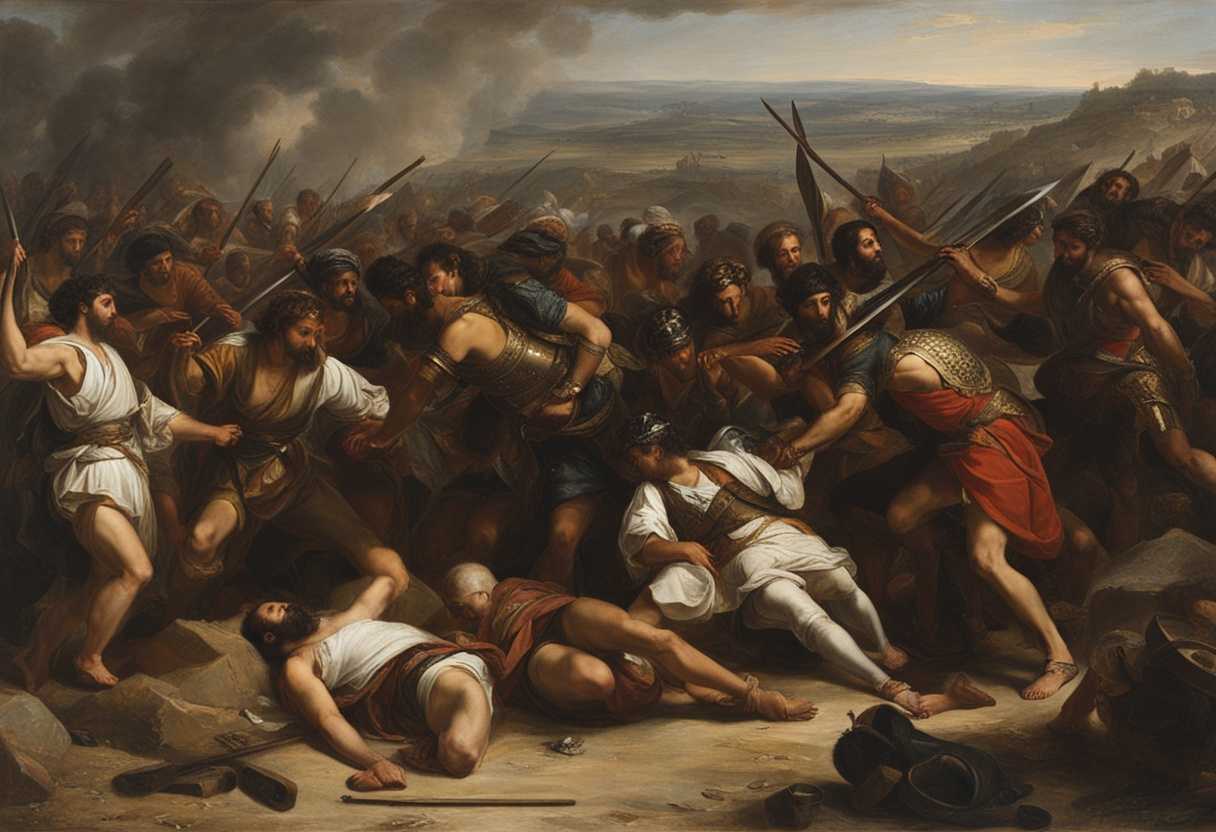
The scene described in 1 Samuel 31:1-13 takes place on Mount Gilboa, a mountain range in Israel. The main characters in this scene are King Saul, his sons Jonathan, Abinadab, and Malchishua, and their loyal soldiers. They find themselves in the midst of a fierce battle against the Philistines, who have the upper hand in the conflict.
Saul and his sons had been engaged in a long-standing feud with the Philistines, and the battle on Mount Gilboa was the climax of their conflict. Despite their bravery and efforts, the Israelites were overwhelmed by the Philistine forces, and Saul’s sons were killed in the battle. In a tragic turn of events, Saul was critically wounded by enemy archers and chose to take his own life rather than be captured by the Philistines.
The scene is one of chaos and despair, with the sounds of battle echoing through the mountains and the cries of the wounded and dying filling the air. The once-mighty King Saul lies mortally wounded on the battlefield, surrounded by the lifeless bodies of his sons and loyal soldiers. It is a somber and tragic moment, marking the end of an era for the Israelites and setting the stage for the rise of David as the future king.
What is 1 Samuel 31:1-13 about?
This verse marks a significant event in the Bible where King Saul and his sons perish in a battle against the Philistines. This tragic outcome has deep spiritual and historical implications as Saul was the first king of Israel, chosen by God but later disobeyed Him, leading to his downfall. The death of Saul and his sons symbolizes the consequences of turning away from God and the importance of obedience in fulfilling one’s divine purpose. It also highlights the harsh realities of war and the sacrifices made in conflicts.
Reflecting on this verse, we can ponder on the themes of responsibility, consequences, and faithfulness. How does Saul’s story serve as a cautionary tale of the dangers of pride and disobedience? What lessons can we draw from this tragic event in terms of leadership, accountability, and trusting in God’s plan? We challenge ourselves to examine our own lives and consider the impact of our choices on our spiritual journey and relationship with God as we delve deeper into this narrative. We should learn from Saul’s mistakes and strive to walk in obedience and humility, always seeking God’s guidance in all that we do.
Understanding what 1 Samuel 31:1-13 really means
The passage from 1 Samuel 31:1-13 paints a somber picture of the tragic end of King Saul and his sons during a battle with the Philistines on Mount Gilboa. As the Philistines fought against Israel, Saul, facing critical wounds and impending capture, chose to take his own life by falling on his sword. This act of desperation reflects Saul’s ultimate despair and the depths of his inner turmoil. The Philistines, upon finding Saul’s body, further dishonored him by desecrating it and displaying it as a trophy, showcasing the brutal realities of war and conquest.
In the midst of this grim scene, the men of Jabesh-gilead emerge as beacons of loyalty and honor. Despite Saul’s flaws and failures, these men courageously retrieve the bodies of Saul and his sons, ensuring they receive a proper burial. This act of bravery and respect towards a fallen leader speaks volumes about the values of loyalty and honor that transcends personal grievances or shortcomings. It serves as a poignant reminder of the enduring impact of honoring those who have served, even in their moments of defeat.
The passage resonates with contemporary themes that are relevant to people today. Saul’s story serves as a cautionary tale about the weight of leadership and the repercussions of straying from God’s guidance. His tragic end also sheds light on the importance of addressing mental health issues and seeking help during times of despair. The actions of the men of Jabesh-gilead underscore the significance of loyalty and honor in relationships, emphasizing the value of standing by those who have faltered and showing them dignity in their downfall.
Reflecting on this passage prompts us to consider the complexities of leadership, the fragility of mental health, and the enduring impact of loyalty and honor. Just as the men of Jabesh-gilead honored Saul and his sons despite their failures, we are encouraged to support and uplift those around us, especially in their moments of weakness. By extending grace and respect to others, even in their times of defeat, we contribute to a culture of compassion and understanding that fosters healing and unity within our communities.
In conclusion, the narrative of King Saul’s tragic demise in 1 Samuel 31:1-13 serves as a poignant reminder of the multifaceted nature of leadership, the importance of mental well-being, and the enduring significance of loyalty and honor. It challenges us to reflect on how we can emulate the actions of the men of Jabesh-gilead in our own lives, by showing compassion and respect to those who have stumbled, and by upholding the values of loyalty and honor in our relationships and communities.
How might our actions influence God’s plan for us?
Our actions can greatly influence God’s plan for us. Our choices and actions can either align us with God’s will or lead us away from it, just as Saul’s decisions led to his downfall and tragic end in battle. We have the power to shape our own destinies through the decisions we make and the paths we choose to follow.
When we listen to God and follow His guidance, we are more likely to experience His blessings and fulfill the purpose He has for us. However, when we turn away from His plan and rely on our own understanding, we may find ourselves facing consequences that are not in line with what God has intended for us. It is important to seek His will in all that we do and trust in His perfect plan for our lives.
Application
In life’s narrative, our choices script our journey. Saul’s tale echoes the weight of obedience and consequence. Let’s navigate our paths with unwavering faith, staying aligned with the higher script. Will you script your story with faith and obedience, defying life’s challenges?

Reverend Michael Johnson is an experienced Church Minister with a profound expertise in spirituality and guidance. With a serene presence and a compassionate heart, he has faithfully served his congregation for over 20 years, leading them on a spiritual journey towards inner peace and enlightenment. Reverend Johnson’s extensive knowledge of religious philosophies and profound understanding of human nature have made him a trusted confidant and mentor to many, as he seamlessly weaves his profound wisdom into life teachings. Reverend Johnson’s calming demeanor and empathetic nature continue to uplift and heal souls, nurturing a sense of unity and tranquility within his community.