
1 Samuel 8:10-22 is about the consequences of the Israelites’ desire for a king to rule over them instead of trusting in God’s guidance, highlighting the dangers of placing human leaders above divine authority.
10 So Samuel told all the words of the Lord to the people who were asking for a king from him.
11 He said, “These will be the ways of the king who will reign over you: he will take your sons and appoint them to his chariots and to be his horsemen and to run before his chariots.
12 He will appoint for himself commanders of thousands and commanders of fifties, and some to plow his ground and to reap his harvest, and to make his implements of war and the equipment of his chariots.
13 He will take your daughters to be perfumers and cooks and bakers.
14 He will take the best of your fields and vineyards and olive orchards and give them to his servants.
15 He will take the tenth of your grain and of your vineyards and give it to his officers and to his servants.
16 He will take your male servants and female servants and the best of your young men and your donkeys, and put them to his work.
17 He will take the tenth of your flocks, and you shall be his slaves.
18 And in that day you will cry out because of your king, whom you have chosen for yourselves, but the Lord will not answer you in that day.”
19 But the people refused to obey the voice of Samuel. And they said, “No! But there shall be a king over us,
20 that we also may be like all the nations, and that our king may judge us and go out before us and fight our battles.”
21 And Samuel heard all the words of the people, and he repeated them in the ears of the Lord.
22 And the Lord said to Samuel, “Obey their voice and make them a king.” Samuel then said to the men of Israel, “Go every man to his city.”
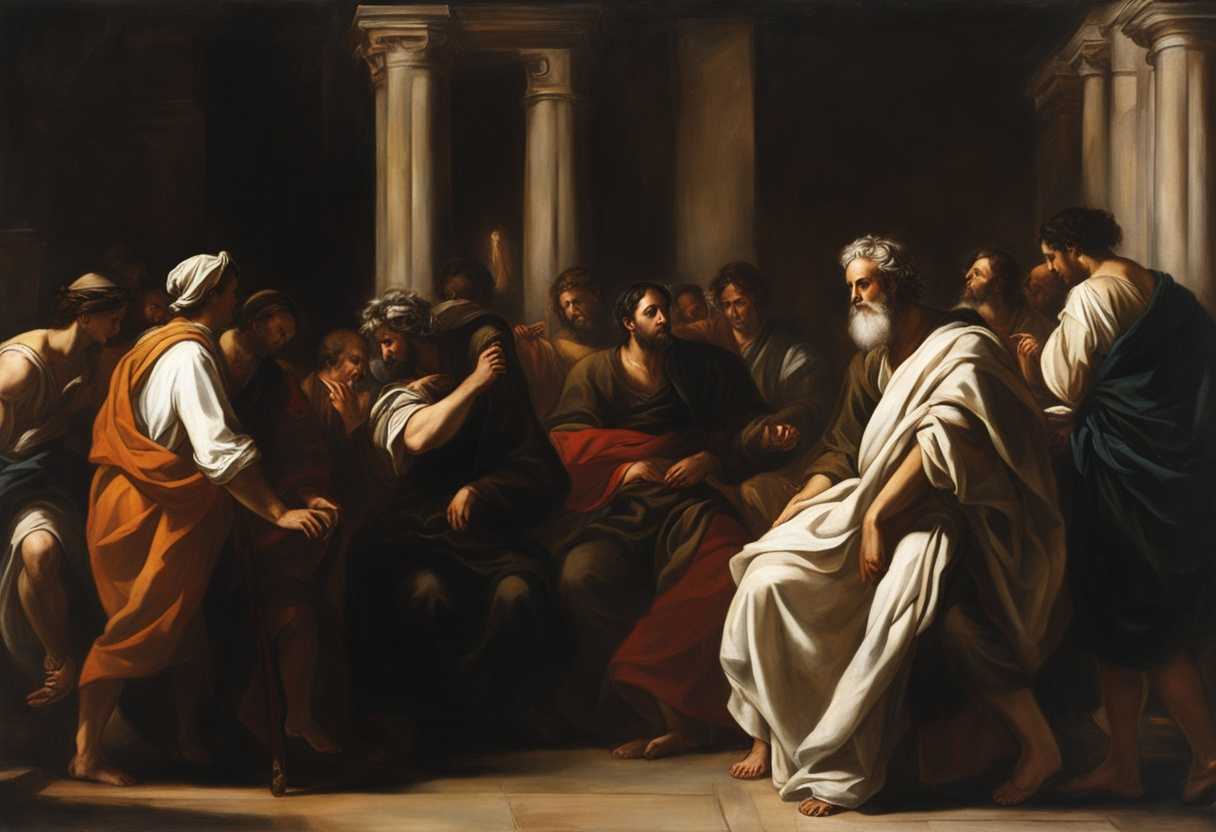
Setting the Scene for 1 Samuel 8:10-22
The scene in 1 Samuel 8:10-22 takes place in the ancient land of Israel during the time of the prophet Samuel. The people of Israel have gathered together in a large assembly, with Samuel standing before them as their leader and judge. The setting is a vast open field, with the sun shining down on the multitude of Israelites who have come from all corners of the land to hear Samuel’s words.
As Samuel addresses the crowd, he recounts the warnings he has received from the Lord about the consequences of appointing a king to rule over them. Despite Samuel’s warnings, the people are insistent on having a king like the other nations around them. The atmosphere is tense as the people debate amongst themselves, some eager for a king to lead them in battle, while others are hesitant about the potential consequences of such a decision.
In the midst of the assembly, key figures such as Samuel, the elders of Israel, and various tribal leaders can be seen discussing the weighty decision before them. The air is filled with a mix of anticipation, uncertainty, and a sense of the changing times as the fate of Israel hangs in the balance.
What is 1 Samuel 8:10-22 about?
This verse serves as a powerful reminder of the dangers of placing our trust in earthly rulers and human institutions rather than in God. It highlights the potential pitfalls of seeking security and guidance from worldly sources, instead of relying on the divine guidance and wisdom that comes from a relationship with God. God is reminding us of the importance of placing our ultimate trust in Him alone by warning Israel of the consequences of having a king.
Think about it this way – when we look to human leaders or earthly systems to provide for our needs and guide us, we are essentially placing our faith in something that is fallible and imperfect. God’s warning to Israel in this verse is a call for us to reevaluate where we place our trust and to recognize that true security and wisdom can only be found in God. So, as we navigate our lives and make decisions, let us remember the lesson from this verse and strive to anchor our faith firmly in God, who is worthy of our complete trust and reliance.
Understanding what 1 Samuel 8:10-22 really means
Commentary Structure:
- Introduction to the Passage
- Historical and Contextual Background
- Key Phrases and Their Meanings
- Cross-References and Further Insights
- Relevance to Contemporary Life
- Anecdotal Illustration
- Reflective Questions and Conclusion
Commentary:
Introduction to the Passage
The passage in 1 Samuel 8:10-22 deals with the Israelites’ request for a king. Samuel, acting as God’s prophet, warns the people about the repercussions of having a human monarchy. This narrative is pivotal as it marks a significant shift in Israel’s governance from judges to kings.
Historical and Contextual Background
At this point in Israel’s history, the nation was under the leadership of judges, who were divinely appointed leaders. Samuel was the last of these judges. The Israelites, influenced by neighboring nations, demanded a king to lead them. This request signified a desire to conform to worldly standards rather than maintaining their unique covenant relationship with God. Understanding this context helps us grasp the gravity of their request and God’s response.
Key Phrases and Their Meanings
Samuel’s warning includes several key phrases: “He will take your sons and appoint them to his chariots and to be his horsemen,” and “He will take the best of your fields and vineyards and olive orchards and give them to his servants.” These phrases illustrate the potential exploitation and loss of freedom that come with a human monarchy. The repetition of “He will take” emphasizes the inevitable cost of their request.
Cross-References and Further Insights
This passage can be cross-referenced with Deuteronomy 17:14-20, where God anticipates Israel’s desire for a king and provides guidelines for a righteous monarchy. Additionally, Jesus’ teachings in Matthew 20:25-28 contrast worldly leadership with servant leadership, highlighting the dangers of power and the importance of humility and service. The passage speaks to the dangers of conforming to societal pressures at the expense of spiritual integrity in today’s world. We often face the temptation to prioritize worldly success over our spiritual values, just as Israel wanted to be like other nations. This narrative reminds us that choosing leaders and systems that honor God’s principles is crucial. A small community church faced pressure to modernize its worship style to attract more attendees. Despite warnings from longtime members about losing the church’s spiritual essence, the leadership decided to conform. Over time, they noticed a decline in genuine fellowship and spiritual growth. This anecdote mirrors Israel’s experience and underscores the importance of maintaining God-centered values. We must ask ourselves as we reflect on this passage: Are we seeking solutions that honor God, or are we succumbing to societal pressures? What are the “kings” in our lives that we have requested, and what has been the cost? Samuel’s warnings are as relevant today as they were then, urging us to consider the long-term implications of our choices. Let us remember that true leadership and governance come from God as we strive to align our decisions with His will.
What does it mean to put our trust in God?
Putting our trust in God means having faith in Him to guide, protect, and provide for us. It involves relying on His wisdom and power, acknowledging His sovereignty over all things, and surrendering our worries and concerns to Him. Trusting in God means believing that He will work all things for our good, even when circumstances may not make sense to us. It requires a deep sense of confidence in His faithfulness and goodness, knowing that He will never leave us nor forsake us.
When we place our trust in God, we entrust our lives into His capable hands, allowing Him to be the ultimate source of our hope and security. This doesn’t mean we sit back and do nothing, but rather it involves actively seeking His will, following His guidance, and leaning on His strength in times of trouble. Trusting in God is a continuous decision to rely on His promises, to anchor our hearts in His love, and to walk in obedience and faith, knowing that He is always with us, working for our best interests in ways we may not always understand.
Application
Imagine trusting your career decisions to someone who doesn’t understand your true potential. That’s what it’s like when you place your faith in human leaders over God. Just as a loving parent guides their child, God’s guidance is always aligned with your best interest. Redirect your daily choices to reflect His wisdom over worldly promises. Can anyone lead your life better than God, who knows you completely?

Reverend Michael Johnson is an experienced Church Minister with a profound expertise in spirituality and guidance. With a serene presence and a compassionate heart, he has faithfully served his congregation for over 20 years, leading them on a spiritual journey towards inner peace and enlightenment. Reverend Johnson’s extensive knowledge of religious philosophies and profound understanding of human nature have made him a trusted confidant and mentor to many, as he seamlessly weaves his profound wisdom into life teachings. Reverend Johnson’s calming demeanor and empathetic nature continue to uplift and heal souls, nurturing a sense of unity and tranquility within his community.