
1 Samuel 1:1-28 is about a woman named Hannah who was barren but fervently prayed to God for a child, demonstrating the power of faith and perseverance in seeking miracles from God.
1 There was a certain man of Ramathaim-zophim of the hill country of Ephraim whose name was Elkanah the son of Jeroham, son of Elihu, son of Tohu, son of Zuph, an Ephrathite.
2 He had two wives. The name of the one was Hannah, and the name of the other, Peninnah. And Peninnah had children, but Hannah had no children.
3 Now this man used to go up year by year from his city to worship and to sacrifice to the Lord of hosts at Shiloh, where the two sons of Eli, Hophni and Phinehas, were priests of the Lord.
4 On the day when Elkanah sacrificed, he would give portions to Peninnah his wife and to all her sons and daughters.
5 But to Hannah he gave a double portion, because he loved her, though the Lord had closed her womb.
6 And her rival used to provoke her grievously to irritate her, because the Lord had closed her womb.
7 So it went on year by year. As often as she went up to the house of the Lord, she used to provoke her. Therefore Hannah wept and would not eat.
8 And Elkanah, her husband, said to her, “Hannah, why do you weep? And why do you not eat? And why is your heart sad? Am I not more to you than ten sons?”
9 After they had eaten and drunk in Shiloh, Hannah rose. Now Eli the priest was sitting on the seat beside the doorpost of the temple of the Lord.
10 She was deeply distressed and prayed to the Lord and wept bitterly.
11 And she vowed a vow and said, “O Lord of hosts, if you will indeed look on the affliction of your servant and remember me and not forget your servant, but will give to your servant a son, then I will give him to the Lord all the days of his life, and no razor shall touch his head.”
12 As she continued praying before the Lord, Eli observed her mouth.
13 Hannah was speaking in her heart; only her lips moved, and her voice was not heard. Therefore Eli took her to be a drunken woman.
14 And Eli said to her, “How long will you go on being drunk? Put your wine away from you.”
15 But Hannah answered, “No, my lord, I am a woman troubled in spirit. I have drunk neither wine nor strong drink, but I have been pouring out my soul before the Lord.
16 Do not regard your servant as a worthless woman, for all along I have been speaking out of my great anxiety and vexation.”
17 Then Eli answered, “Go in peace, and the God of Israel grant your petition that you have made to him.”
18 And she said, “Let your servant find favor in your eyes.” Then the woman went her way and ate, and her face was no longer sad.
19 They rose early in the morning and worshiped before the Lord; then they went back to their house at Ramah. And Elkanah knew Hannah his wife, and the Lord remembered her.
20 And in due time Hannah conceived and bore a son, and she called his name Samuel, for she said, “I have asked for him from the Lord.”
21 The man Elkanah and all his house went up to offer to the Lord the yearly sacrifice and to pay his vow.
22 But Hannah did not go up, for she said to her husband, “As soon as the child is weaned, I will bring him, so that he may appear in the presence of the Lord and dwell there forever.”
23 And Elkanah her husband said to her, “Do what seems best to you; wait until you have weaned him; only, may the Lord establish his word.” So the woman remained and nursed her son until she weaned him.
24 And when she had weaned him, she took him up with her, along with a three-year-old bull, an ephah of flour, and a skin of wine, and she brought him to the house of the Lord at Shiloh.
25 Then they slaughtered the bull, and they brought the child to Eli.
26 And she said, “Oh, my lord! As you live, my lord, I am the woman who was standing here in your presence, praying to the Lord.
27 For this child I prayed, and the Lord has granted me my petition that I made to him.
28 Therefore I have lent him to the Lord. As long as he lives, he is lent to the Lord.” And he worshiped the Lord there.
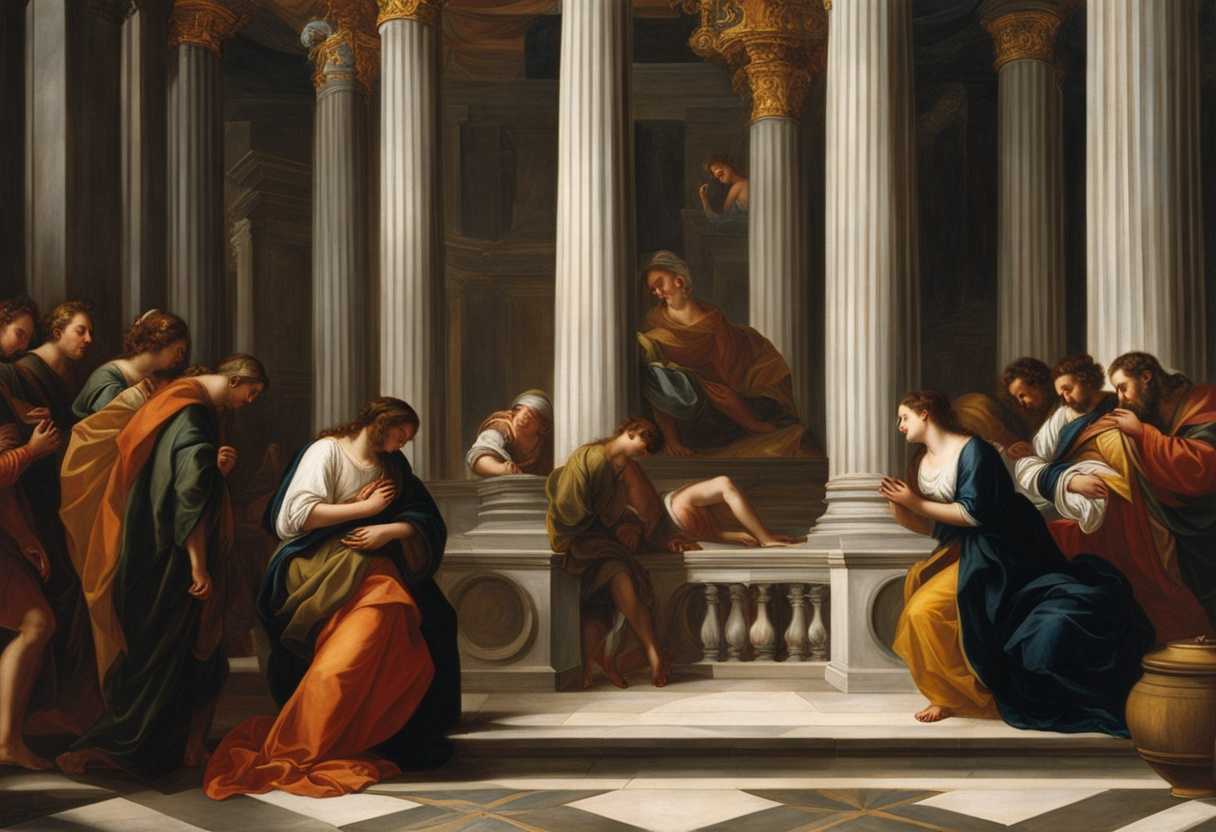
Setting the Scene for 1 Samuel 1:1-28
The scene in 1 Samuel 1:1-28 takes place in the ancient city of Shiloh, a significant religious center for the Israelites at that time. The main characters in this scene are Elkanah, his two wives Hannah and Peninnah, and the priest Eli. Elkanah, a devout man, regularly goes to Shiloh to worship and offer sacrifices to the Lord. However, Hannah, one of his wives, is barren and deeply distressed because she has not been able to conceive a child.
In this particular scene, Elkanah and his family have traveled to Shiloh to offer sacrifices to the Lord. Peninnah, who has children, taunts and provokes Hannah, causing her great sorrow. Hannah, overwhelmed with grief, pours out her heart to the Lord in prayer, making a vow that if she is granted a son, she will dedicate him to the service of the Lord all the days of his life. Eli, the priest, observes Hannah praying silently and initially mistakes her distress for drunkenness. However, upon hearing her explanation, he blesses her and prays for her to receive what she has asked for.
The surroundings in Shiloh are bustling with activity as people from all over come to worship and offer sacrifices. The atmosphere is filled with the smell of incense and the sounds of prayers and hymns. The tension between Hannah and Peninnah is palpable, adding a layer of drama to the scene. Despite the challenges and heartache, this moment in Shiloh becomes a turning point for Hannah as she pours out her soul to the Lord and receives a promise of hope and blessing.
What is 1 Samuel 1:1-28 about?
The power of prayer and faith in action is seen in this verse. Hannah, a woman who longed for a child, turned to God in prayer, pouring out her heart’s desires. Despite facing challenges and feeling hopeless, she did not lose faith in God’s ability to answer her prayers. And God, in His infinite grace and wisdom, blessed her with a son, Samuel, who would play a significant role in His plans.
This verse teaches us the importance of turning to God in times of need, trusting in His timing and provision. It shows us that our prayers are heard and that God is faithful to fulfill His promises. Through Hannah’s story, we are reminded that God can turn our sorrows into joy, our trials into triumphs, and our deepest longings into fulfilled blessings. We are encouraged to dedicate our lives to serving God wholeheartedly, knowing that He has a purpose and a plan for each of us, just as Hannah dedicated Samuel to God’s service.
Understanding what 1 Samuel 1:1-28 really means
Introduction and Context
This passage from 1 Samuel 1:1-28 introduces us to the story of Hannah, a woman who is deeply distressed by her inability to have children. Her heartfelt prayer and vow to God lead to the birth of Samuel, who would later become a significant prophet in Israel. To fully appreciate this narrative, we need to understand the cultural and historical context of ancient Israel, where a woman’s worth was often measured by her ability to bear children.
Key Themes and Phrases
A key phrase in this passage is Hannah’s vow: “O Lord of hosts, if you will indeed look on the affliction of your servant and remember me and not forget your servant, but will give to your servant a son, then I will give him to the Lord all the days of his life.” This plea highlights several significant themes: desperation, faith, and dedication. Hannah’s prayer is not just a request but a promise of commitment and sacrifice.
Desperation and Faith
Hannah’s desperation is palpable. Her rival, Peninnah, provokes her to the point of tears. Yet, amidst her suffering, Hannah’s faith in God remains unshaken. This echoes the sentiments found in Psalm 34:18, “The Lord is close to the brokenhearted and saves those who are crushed in spirit.” Hannah’s situation reminds us that even in our deepest anguish, God is near and attentive to our cries.
Dedication and Sacrifice
Hannah’s vow to dedicate her son to the Lord signifies immense personal sacrifice. She is willing to give up her most desired blessing as a testament to her gratitude and devotion. This mirrors Abraham’s willingness to sacrifice Isaac in Genesis 22, demonstrating that true faith often requires profound personal sacrifice.
Relevance Today
How does this ancient story resonate with us today? Many people face situations that seem hopeless, whether they are related to health, relationships, or personal goals. Like Hannah, we might feel provoked by circumstances or individuals around us. Yet, her story teaches us about the power of fervent prayer and unwavering faith. It challenges us to consider what we might be willing to sacrifice to demonstrate our dedication to God. I once counseled a modern woman who struggled with infertility for years. Despite her sorrow, she remained active in her church, constantly praying and seeking God’s will. Eventually, she decided to foster children, opening her home to those in need. Through her sacrifice, she found fulfillment and purpose, much like Hannah. Her story, like Hannah’s, is a testament to the transformative power of faith and dedication. 1 Samuel 1:1-28 is a profound narrative that speaks to our hearts about the nature of faith, the power of prayer, and the essence of true sacrifice. It calls us to reflect on our own lives, to seek God earnestly in our distress, and to be willing to dedicate our blessings back to Him. May we find encouragement and strength to face our challenges with faith and a willingness to serve as we meditate on Hannah’s story.
How can we find comfort in times of distress?
Hannah poured out her heart to God in prayer, finding comfort in times of distress, just as in the passage from 1 Samuel. We allow God to work in our lives and bring us peace by humbling ourselves before Him and sharing our deepest sorrows and fears with Him. Through prayer, we not only express our feelings but also strengthen our relationship with God, knowing that He hears and understands our every concern.
Another source of comfort in times of distress is trusting in God’s plan and timing, just as Hannah did when she vowed to dedicate her son to the Lord. We demonstrate our faith in His sovereignty and wisdom by surrendering our desires and worries to God. Even when our circumstances seem overwhelming, we can find solace in knowing that God is in control and has a purpose for everything that happens in our lives.
Furthermore, finding comfort in the support and encouragement of those around us can help lift our spirits during difficult times. Understanding friends or family members can provide a sense of companionship and strength, just as Eli offered words of reassurance to Hannah. We can find comfort in the midst of distress and experience God’s comforting presence through the caring gestures of others by surrounding ourselves with a community of faith and love.
Application
Think about the way Hannah never wavered, just like you staying strong in work challenges or family commitments. She poured her heart out, relentlessly seeking help. You can do the same; lay your dreams and struggles before God. Trust that in His timing, you’ll see the answers unfold. Are you ready to embrace this kind of faith in your everyday battles?

Reverend Michael Johnson is an experienced Church Minister with a profound expertise in spirituality and guidance. With a serene presence and a compassionate heart, he has faithfully served his congregation for over 20 years, leading them on a spiritual journey towards inner peace and enlightenment. Reverend Johnson’s extensive knowledge of religious philosophies and profound understanding of human nature have made him a trusted confidant and mentor to many, as he seamlessly weaves his profound wisdom into life teachings. Reverend Johnson’s calming demeanor and empathetic nature continue to uplift and heal souls, nurturing a sense of unity and tranquility within his community.