
2 Corinthians 11:16-33 is about Paul defending his apostleship, boasting in his weaknesses to show the power of Christ, and persevering through trials and hardships for the sake of the gospel.
16 I repeat, let no one think me foolish. But even if you do, accept me as a fool, so that I too may boast a little.
17 What I am saying with this boastful confidence, I say not as the Lord would, but as a fool.
18 Since many boast according to the flesh, I too will boast.
19 For you gladly bear with fools, being wise yourselves.
20 For you bear it if someone makes slaves of you, or devours you, or takes advantage of you, or puts on airs, or strikes you in the face.
21 To my shame, I must say, we were too weak for that!
22 Are they Hebrews? So am I. Are they Israelites? So am I. Are they offspring of Abraham? So am I.
23 Are they servants of Christ? I am a better one—I am talking like a madman—with far greater labors, far more imprisonments, with countless beatings, and often near death.
24 Five times I received at the hands of the Jews the forty lashes less one.
25 Three times I was beaten with rods. Once I was stoned. Three times I was shipwrecked; a night and a day I was adrift at sea;
26 on frequent journeys, in danger from rivers, danger from robbers, danger from my own people, danger from Gentiles, danger in the city, danger in the wilderness, danger at sea, danger from false brothers;
27 in toil and hardship, through many a sleepless night, in hunger and thirst, often without food, in cold and exposure.
28 And, apart from other things, there is the daily pressure on me of my anxiety for all the churches.
29 Who is weak, and I am not weak? Who is made to fall, and I am not indignant?
30 If I must boast, I will boast of the things that show my weakness.
31 The God and Father of the Lord Jesus, he who is blessed forever, knows that I am not lying.
32 In Damascus, the governor under King Aretas was guarding the city of Damascus in order to seize me.
33 but I was let down in a basket through a window in the wall and escaped his hands.
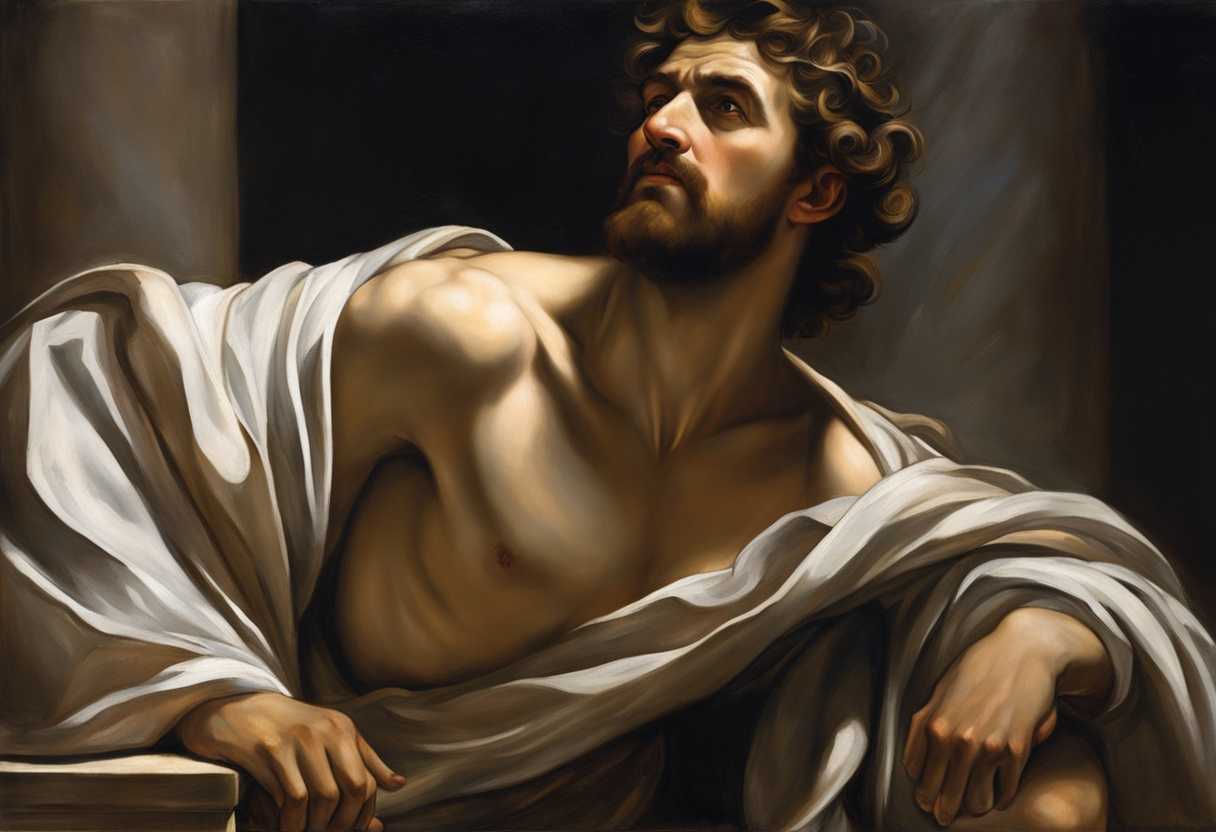
Setting the Scene for 2 Corinthians 11:16-33
In 2 Corinthians chapter 11, the apostle Paul finds himself in a vulnerable position, defending his ministry and authority against false apostles who have infiltrated the Corinthian church. The scene is set in a bustling marketplace in Corinth, where Paul stands amidst a crowd of merchants and traders, his voice rising above the din as he passionately recounts his sufferings for the sake of the gospel.
Surrounded by a diverse group of listeners, including believers and skeptics alike, Paul shares the hardships he has endured in his service to Christ. He speaks of being beaten, shipwrecked, and facing danger from various sources. Despite the challenges he has faced, Paul’s resolve remains unshaken, his faith unwavering as he continues to proclaim the truth of the gospel.
As Paul speaks, his words carry a weight of authority and conviction, drawing the attention of those around him. His message is not just a defense of his own ministry but a powerful testimony to the transformative power of God’s grace in the face of adversity. The scene is charged with emotion and tension, as Paul lays bare his vulnerabilities and weaknesses, yet emerges as a beacon of strength and faith in the midst of opposition.
What is 2 Corinthians 11:16-33 about?
Paul is emphasizing the idea of finding strength in weakness in this verse. He is essentially saying that when faced with challenges, such as hardships and persecutions, for the sake of Christ, he does not dwell on his struggles, but rather boasts in them. Why would someone boast about weaknesses and hardships, you may wonder? Paul is highlighting the notion that when we are weak, we have the opportunity to rely on God’s strength and grace. It is through our weaknesses that God’s power is made perfect. Paul is illustrating how he is able to see God’s strength shining through his struggles by boasting in his weaknesses.
Furthermore, by boasting in his weaknesses and hardships, Paul is demonstrating a level of humility and authenticity in his faith. Instead of trying to appear strong and flawless, he openly acknowledges his struggles and vulnerabilities. This vulnerability allows him to connect more deeply with others and serves as a powerful testimony to the transformative power of Christ in his life. It challenges us to consider how we view our own weaknesses and hardships. Do we try to hide them or do we embrace them as opportunities for God to work in and through us? Paul’s example encourages us to shift our perspective and find strength in our weaknesses, knowing that God’s power is at work in our lives.
Understanding what 2 Corinthians 11:16-33 really means
In 2 Corinthians 11:16-33, we find the apostle Paul in a unique position, defending his apostleship against criticisms and challenges. The context of this passage reveals a tumultuous situation in Corinth, where false apostles were undermining Paul’s authority and influence within the church. Feeling compelled to address these attacks, Paul embarks on a defense of his ministry, highlighting his credentials and the hardships he endured for the sake of the Gospel.
Paul’s use of irony in stating, “I repeat, let no one take me for a fool. But if you do, then tolerate me just as you would a fool, so that I may do a little boasting,” showcases his reluctance to boast but his willingness to do so to make a point. He emphasizes his shared heritage with his critics, asserting his identity as a Hebrew, an Israelite, and a descendant of Abraham. Through these statements, Paul asserts his legitimacy as an apostle and his deep connection to the Jewish faith.
The passage also delves into Paul’s sufferings, highlighting his endurance through hardships such as imprisonment, beatings, and near-death experiences. Paul’s dedication to his mission is evident as he recounts the numerous trials he faced in his service to Christ. His empathy for the weak and those led into sin further underscores his compassionate nature and his profound sense of solidarity with others’ struggles.
Drawing parallels to other biblical passages such as Philippians 3:4-8, Acts 9:15-16, and 1 Corinthians 4:9-13, we gain a broader perspective on Paul’s perspective on his sufferings and the divine calling that sustained him through adversity. These passages illuminate the depth of Paul’s commitment to his faith and the challenges he encountered along the way.
The relevance of Paul’s experiences to modern believers is profound. His perseverance and unwavering dedication serve as a source of inspiration for those facing trials and opposition in their own lives. The importance of authenticity and integrity in leadership, as exemplified by Paul, resonates strongly in today’s world, where moral character and steadfastness are often tested.
In conclusion, Paul’s example in 2 Corinthians 11:16-33 urges us to reflect on our own faith journeys and the trials we may encounter. By drawing strength from his experiences and finding inspiration in his unwavering commitment to Christ, we can navigate challenges with resilience and grace. Let us take heart in Paul’s words and find solace in the knowledge that God’s strength is made perfect in our weakness.
How can we boast in our weaknesses?
We can boast in our weaknesses because it is through our weaknesses that God’s power is made perfect. When we acknowledge our shortcomings and vulnerabilities, we demonstrate our dependence on God’s strength and grace. We open ourselves up to experiencing the transforming power of God in our lives by embracing our weaknesses.
Boasting in our weaknesses also allows us to shift the focus away from ourselves and onto God. It is a recognition that our own abilities and strengths are limited, but God’s power is limitless. When we boast in our weaknesses, we are essentially acknowledging that our worth and success come not from ourselves, but from God working through us.
Therefore, boasting in our weaknesses is a way to demonstrate our trust in God’s provision and sovereignty. It is a declaration of faith that despite our imperfections and limitations, God’s grace is more than sufficient to carry us through any challenges or trials we may face.
Application
Think about your busy life, juggling work and family. Paul faced immense struggles but kept pushing forward for the gospel. Look at your own challenges: Are you ready to stand firm and share your faith, despite obstacles? Paul’s resilience is our blueprint—let’s stay strong and committed. Will you rise above the difficulties and carry on this vital mission?

Reverend Michael Johnson is an experienced Church Minister with a profound expertise in spirituality and guidance. With a serene presence and a compassionate heart, he has faithfully served his congregation for over 20 years, leading them on a spiritual journey towards inner peace and enlightenment. Reverend Johnson’s extensive knowledge of religious philosophies and profound understanding of human nature have made him a trusted confidant and mentor to many, as he seamlessly weaves his profound wisdom into life teachings. Reverend Johnson’s calming demeanor and empathetic nature continue to uplift and heal souls, nurturing a sense of unity and tranquility within his community.