
2 Kings 18:19-20 is about the Assyrian king’s taunting of King Hezekiah of Judah, questioning the reliance on God for deliverance and highlighting the futility of trusting in political alliances or human strength when facing overwhelming adversity.
19 And the Rabshakeh said to them, “Say to Hezekiah, ‘Thus says the great king, the king of Assyria: On what do you rest this trust of yours?
20 You say (but they are but empty words), ‘I have counsel and strength for war.’ Now on whom do you rely, that you have rebelled against me?
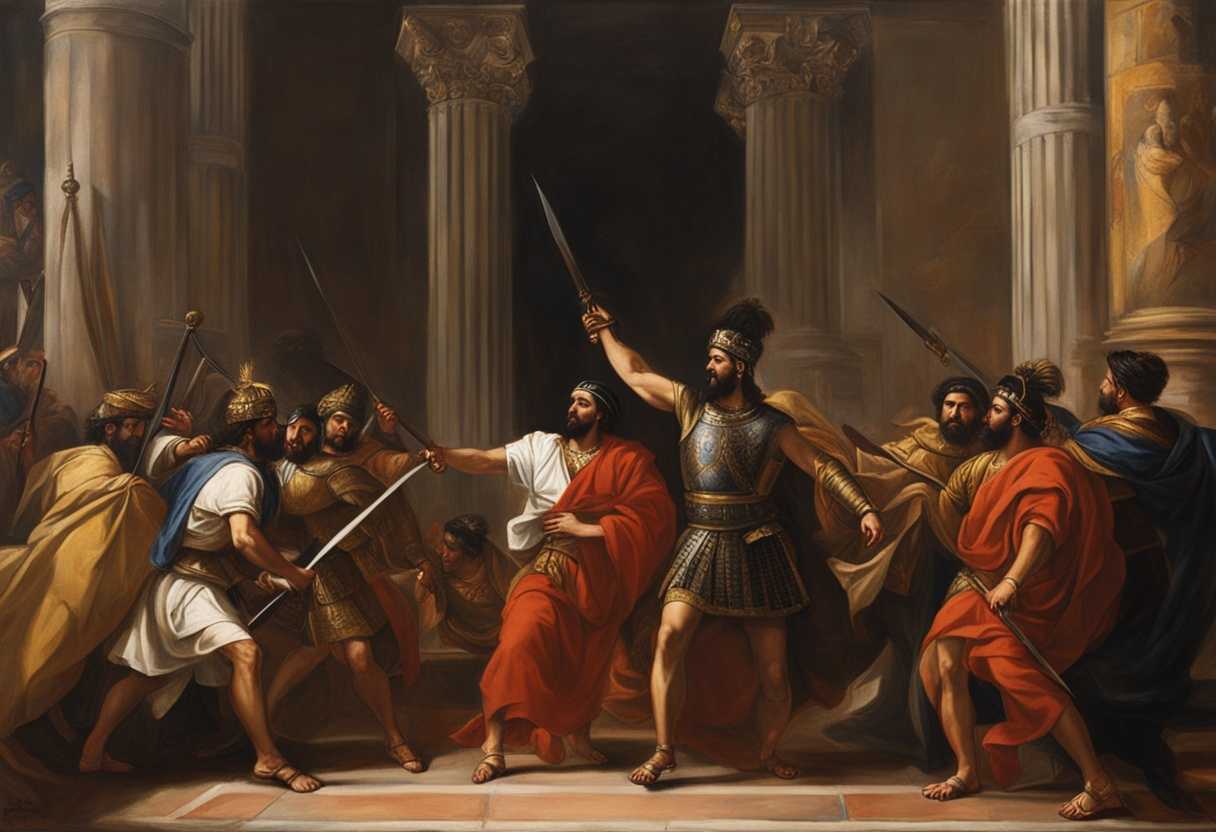
Setting the Scene for 2 Kings 18:19-20
In the ancient city of Jerusalem, a tense atmosphere enveloped the royal palace as King Hezekiah faced a dire situation. The Assyrian Empire, under the ruthless leadership of King Sennacherib, had set its sights on Judah, threatening to conquer the city and subjugate its people. The air was thick with anxiety as Hezekiah, a king known for his faithfulness to God and his efforts to reform the worship practices in Judah, gathered his advisors and military leaders in the grand hall of the palace. The walls, adorned with intricate carvings and tapestries depicting the glory of Judah, seemed to echo the weight of the impending crisis. Outside, the sounds of the bustling city were overshadowed by the distant rumble of Assyrian forces, a constant reminder of the threat looming just beyond the city gates.
Among those present was Eliakim, the palace administrator, who had been appointed by Hezekiah to manage the affairs of the kingdom. His brow furrowed with concern as he listened to the taunts of the Assyrian envoys, who had come to deliver a message of intimidation. The envoys, led by the Rabshakeh, spoke in a loud voice, aiming to instill fear in the hearts of the people. They mocked the God of Israel, questioning His ability to save them from the might of Assyria. The tension in the room was palpable as Hezekiah’s officials exchanged worried glances, knowing that the fate of their city rested on the king’s response to this audacious challenge.
As the sun began to set, casting a golden hue over the city, Hezekiah stood resolute, his heart anchored in faith despite the overwhelming odds. He knew that the Assyrians were not just threatening his kingdom; they were challenging the very sovereignty of God. With a deep breath, he prepared to send a message to the prophet Isaiah, seeking divine guidance in this moment of crisis. The flickering torches illuminated the faces of those gathered, revealing a mix of fear and determination. In that moment, the king understood that the battle was not merely against flesh and blood but against the spiritual forces that sought to undermine the covenant between God and His people. The scene was set for a pivotal moment in Judah’s history, where faith would be tested, and the power of God would soon be revealed.
What is 2 Kings 18:19-20 about?
This verse captures a pivotal moment in the relationship between human trust and divine assurance. The Assyrian king’s taunting of Hezekiah serves as a potent reminder of the external pressures and challenges we often face in our lives. Have you ever found yourself in a situation where your faith was questioned? Perhaps you felt the weight of skepticism from those around you, just as Hezekiah did. The Assyrian king seeks to undermine Hezekiah’s confidence not only in his own leadership but, more importantly, in the power of his God. Our tendency to rely on visible strength and tangible alliances, rather than placing our ultimate trust in the divine, illustrates a broader human struggle. This verse moreover invites us to reflect on the nature of our faith. Is it genuine and steadfast, or does it waver in the face of adversity? Hezekiah’s response to the Assyrian king’s challenge speaks volumes about his character and faith. He is presented with a choice in confronting such a formidable enemy: to draw upon his own resources or to lean into his relationship with God. What does this say about the authenticity of our own beliefs? When faced with challenges, do we find ourselves seeking security in the world around us, or do we anchor ourselves in our faith? Encouragingly, this passage serves as both a warning and an invitation. It warns us against the allure of skepticism and the perceived strength of alliances based solely on human power. It invites us to explore the depths of our faith and to recognize that, in moments of doubt, our relationship with the divine can be our greatest source of strength.
Understanding what 2 Kings 18:19-20 really means
In 2 Kings 18:19-20, we encounter a pivotal moment during King Hezekiah’s reign, a time marked by the looming threat of the Assyrian Empire. The Assyrian envoy’s challenge to Hezekiah’s representatives is not merely a political maneuver; it is a profound test of faith. The envoy’s questions, particularly, “What is this confidence that you say you have?” compel us to examine the foundations of our own faith. How often do we find ourselves in situations where our beliefs are questioned, either by others or by our own doubts?
This passage highlights a critical theme: the challenge to maintain faith amidst overwhelming external pressures. The Assyrian representative’s skepticism serves as a mirror reflecting our own struggles. When faced with crises—be it personal, financial, or spiritual—do we cling to our faith, or do we waver? The tension between trusting in God and relying on human wisdom is palpable. The envoy’s assertion that Hezekiah’s reliance on God is misguided prompts us to consider where we place our trust. Are we swayed by the allure of worldly solutions, or do we stand firm in our belief that God is our ultimate source of strength?
The related passages, such as Isaiah 36-37 and Psalm 20:7, further illuminate this theme. They remind us that the struggle to trust in God is not a new phenomenon. Hezekiah’s response, rooted in prayer and reliance on divine guidance, serves as a model for us today. In a world filled with uncertainty, we often find ourselves in situations reminiscent of Hezekiah’s dilemma. How do we respond when the odds seem stacked against us?
Consider the story of Sarah, a young woman who faced job loss during a recession. Her experience resonates with many of us who have encountered moments of doubt and fear. While friends urged her to take any available job, Sarah chose to wait for an opportunity that aligned with her values. Her journey illustrates the importance of trusting in God’s timing and provision, even when external pressures suggest otherwise. Are we willing to wait for God’s best, or do we succumb to the immediate solutions that the world offers?
The phrases within this passage invite deeper reflection. The question, “You say you have counsel and might for war,” serves as a reminder that while we may seek advice from worldly sources, true strength comes from God. It challenges us to evaluate the sources of our confidence. Are we relying on our own understanding, or are we seeking divine wisdom? The reference to Egypt symbolizes the temptation to place our trust in temporary alliances rather than in God’s eternal promises. How often do we find ourselves looking to the “Egypts” of our lives for security?
In conclusion, 2 Kings 18:19-20 encourages us to reflect on our sources of confidence and strength. As we navigate our own challenges, let us remember that our ultimate trust should be in God, who is faithful and sovereign. Just as Hezekiah faced adversity with a heart inclined toward God, we too are called to articulate our faith and rely on divine wisdom. In moments of crisis, may we find the courage to stand firm, trusting that God will provide for our needs and guide us through the storms of life. How can we cultivate a faith that withstands the tests of our time?
What does true trust in God look like today?
True trust in God today manifests as unwavering faith in His power and promises, even when faced with insurmountable challenges or adversity. It means recognizing that human wisdom and strength are insufficient and that real security comes from relying on a higher authority. This can be demonstrated through prayer, where individuals seek guidance and express their dependence on God in situations that seem impossible or threatening. Trusting in God in times of uncertainty requires letting go of control and fully surrendering to His plan, understanding that He knows the best path forward.
Furthermore, true trust involves a firm conviction in the truth of God’s character and His intentions for humanity. This translates into a lifestyle of obedience and faithfulness, where actions align with beliefs. Individuals who trust in God will often act with courage and integrity, not driven by fear or societal pressures but by a deep-seated belief in divine justice and support. This might look like advocating for others, standing firm in one’s values, or simply being a source of hope and encouragement to those around them.
Finally, true trust is reflected in a peace that surpasses understanding, providing assurance during turbulent times. It means maintaining a positive outlook despite hardships, knowing that God works all things for good. This peace is contagious and can inspire those around to also lean into faith amid chaos. Thus, genuine trust encompasses a relationship with God that is characterized by dialogue, willingness to obey, and a steadfast heart that rests in divine providence and protection, serving as a beacon of hope in today’s world.
Application
Life is like a high-stakes meeting at work where your ideas are challenged. When doubts arise, will you lean on your team for support or succumb to pressure? Just like in a family, your faith can be the glue that holds everyone together during tough times. Don’t let the noise of the world drown out your belief in something greater. Stand strong, put your trust in the divine rather than just human solutions. Are you ready to face those doubts with unwavering faith?

Reverend Michael Johnson is an experienced Church Minister with a profound expertise in spirituality and guidance. With a serene presence and a compassionate heart, he has faithfully served his congregation for over 20 years, leading them on a spiritual journey towards inner peace and enlightenment. Reverend Johnson’s extensive knowledge of religious philosophies and profound understanding of human nature have made him a trusted confidant and mentor to many, as he seamlessly weaves his profound wisdom into life teachings. Reverend Johnson’s calming demeanor and empathetic nature continue to uplift and heal souls, nurturing a sense of unity and tranquility within his community.