
2 Kings 9:11-13 is about the swift and decisive fulfillment of divine judgement upon the evil deeds of Jezebel and the house of Ahab, serving as a warning of the inevitable consequences for those who stray from the path of righteousness.
11 When Jehu came out to the servants of his master, they said to him, “Is all well? Why did this mad fellow come to you?” And he said to them, “You know the fellow and his talk.”
12 And they said, “That is not true; tell us now.” And he said, “Thus and so he spoke to me, saying, ‘Thus says the Lord, I anoint you king over Israel.’”
13 Then in haste every man of them took his garment and put it under him on the bare steps, and they blew the trumpet and proclaimed, “Jehu is king.”
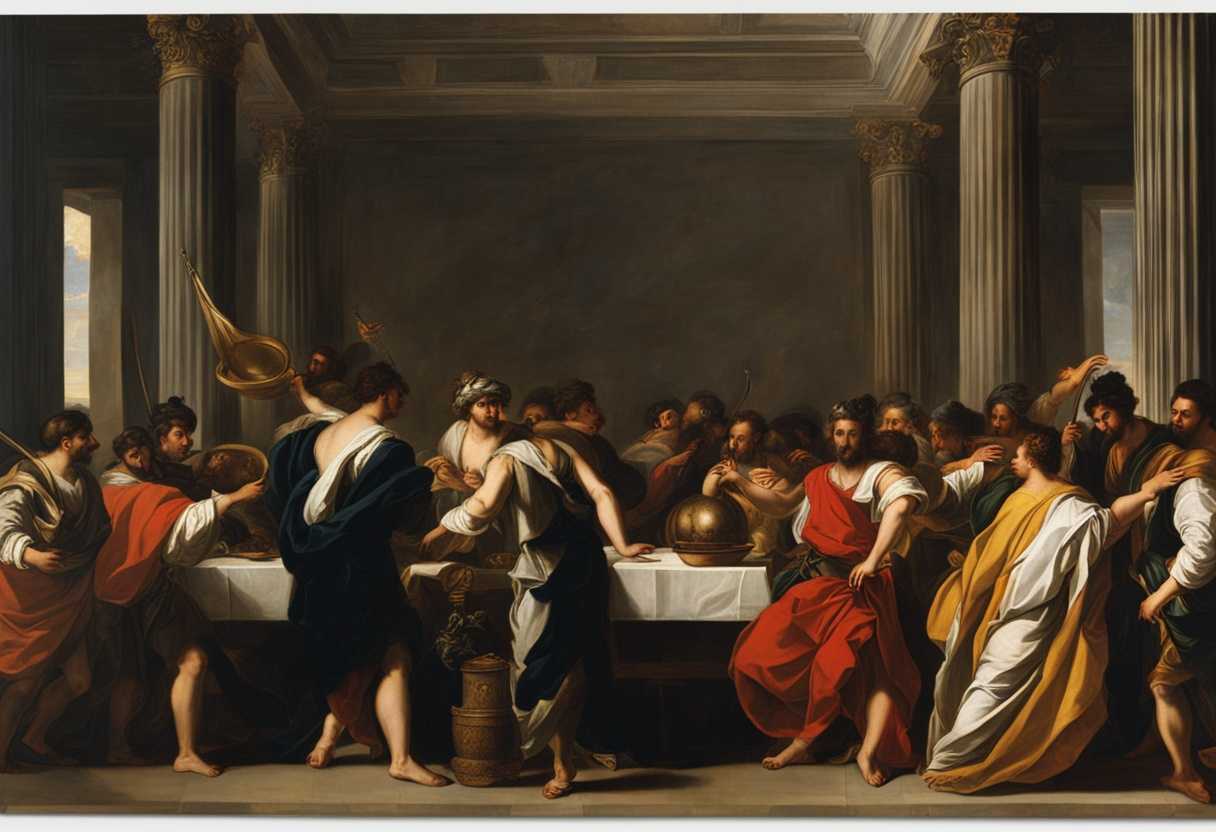
Setting the Scene for 2 Kings 9:11-13
In 2 Kings chapter 9, we find ourselves in the city of Jezreel, a place filled with political intrigue and tension. Queen Jezebel, known for her wickedness and manipulation, is residing in the royal palace. The scene is set in the courtyard of the palace, where messengers are coming and going, delivering important news and updates to the queen.
Among those present is Jehu, a military commander who has been anointed as king by the prophet Elisha. Jehu is accompanied by his fellow soldiers, who are loyal to him and ready to carry out his orders. The atmosphere is charged with anticipation as Jehu prepares to confront Queen Jezebel and execute God’s judgment upon her and the house of Ahab.
As the sun sets over the city, casting long shadows across the courtyard, Jehu receives the final instructions from Elisha’s messenger. With determination in his eyes, he sets off towards the palace, ready to confront the queen and bring about the downfall of the wicked rulers who have led the nation astray. The tension is palpable as the stage is set for a dramatic showdown between good and evil in the heart of Jezreel.
What is 2 Kings 9:11-13 about?
Jehu carries out the divine will by killing Joram and Ahaziah, just as Elijah and Elisha had predicted in this verse. This moment serves as a powerful reminder of the undeniable power of prophecy and the importance of heeding the words of the prophets. It underscores the belief that God’s word is unchanging and will come to pass, no matter the circumstances or obstacles that may stand in its way. We reflect on this verse, prompting us to consider the significance of prophecy in our lives. How does it shape our understanding of God’s plan and purpose for us? How do we respond when faced with the realization that what has been foretold will inevitably come to pass? These questions challenge us to contemplate our faith and the ways in which we choose to align ourselves with the divine will. Jehu fulfills prophecy by carrying out the deaths of Joram and Ahaziah, ultimately serving as a poignant reminder of the importance of faith and obedience in the face of God’s will. It encourages us to trust in the promises of prophecy and to walk in alignment with the path that has been set before us, knowing that God’s plan will always come to fruition in due time.
Understanding what 2 Kings 9:11-13 really means
In the historical context of the divided kingdom of Israel and Judah, we find ourselves in a pivotal moment as Jehu, a commander in the army, is anointed king by a prophet sent by Elisha. This anointing signifies God’s direct intervention in the leadership of Israel, aiming to cleanse the house of Ahab and establish justice. The skepticism and confusion of Jehu’s fellow officers are evident in their question, “Is all well? Why did this mad fellow come to you?” The term “mad fellow” reflects their disbelief and possibly their fear of prophetic messages, highlighting the tension surrounding Jehu’s sudden rise to power.
Jehu’s response, “Thus says the Lord, I anoint you king over Israel,” underscores the divine authority behind his anointing. It serves as a reminder that God is the ultimate authority in choosing leaders and intervening in human affairs. The immediate acceptance and recognition of Jehu’s kingship by his fellow officers, who laid their garments under him and blew the trumpet, symbolize respect, submission, and the acknowledgment of God’s will. This act of obedience signifies the importance of honoring God’s appointed leaders and following His divine guidance.
Drawing parallels with other biblical passages, such as the anointing of David by Samuel in 1 Samuel 16:13 and Elijah’s instruction to anoint Jehu in 1 Kings 19:16, we see a consistent theme of God’s sovereign choice of leaders. Romans 13:1 further reinforces this idea by stating that all authority is ultimately from God. These passages collectively emphasize the divine orchestration of leadership and the importance of submitting to God’s appointed authorities.
The relevance of this passage to contemporary society is profound. In a world marked by political and social upheaval, it serves as a reminder that God is sovereign over all authorities. It encourages us to trust in His plan, even when human leaders may seem flawed or situations appear uncertain. Just as Jehu’s anointing brought stability and direction to Israel, we are reminded to have faith in God’s ultimate purposes, knowing that His will shall prevail in the midst of chaos and uncertainty.
Imagine a community grappling with a leadership crisis, unsure of whom to follow. A respected elder steps forward, claiming divine guidance on the right leader. Initially met with skepticism, the elder’s conviction and the positive changes that follow gradually win over the community, echoing the initial doubts and eventual acceptance seen in Jehu’s anointing. This anecdote illustrates the transformative power of faith in God’s appointed leaders and His overarching plan for His people.
In conclusion, the story of Jehu’s anointing serves as a powerful lesson on divine intervention, the recognition of God’s authority in leadership, and the necessity of trusting in His providential plans. It challenges us to look beyond immediate circumstances, placing our faith in the unseen yet steadfast workings of God’s will. As we navigate the complexities of leadership and authority in our lives, may we find solace in the assurance that God’s sovereignty reigns supreme, guiding us through tumultuous times with unwavering certainty.
How does our loyalty to leaders affect our destiny?
Our loyalty to leaders can greatly impact our destiny. Jehu’s loyalty to King Joram led him to take action according to God’s will in the context of 2 Kings 9:11-13. Jehu’s loyalty to his leader shaped his destiny by positioning him to fulfill the prophetic word and ultimately become king himself. This loyalty played a crucial role in the fulfillment of God’s plan for the nation of Israel at that time.
Similarly, in our own lives, the loyalty we show to our leaders and those in authority can influence the direction of our lives. It can open up opportunities for growth, advancement, and blessings, as well as align us with God’s plan for us. However, it is important to discern when loyalty to a leader conflicts with loyalty to God and His truths. Our ultimate loyalty should always be to God, and aligning ourselves with His will is what truly determines our destiny in the grand scheme of things. Our loyalty to leaders can shape our destiny in significant ways. We see that loyalty to leaders can position us to fulfill God’s plans in our lives by following the example of Jehu in the referenced passage. It is crucial to be discerning in our loyalty, ensuring that it aligns with God’s truth and will for our lives. Our loyalty to God should ultimately take precedence, guiding us towards a destiny that is in accordance with His purpose for us.
Application
Are you alert to the signs indicating God’s work in your life? Let’s not miss the chance to act boldly for our faith, like the bystanders in 2 Kings 9:11-13. Let’s be brave and obedient, ready to take a leap of faith when God nudges us. Will you seize the opportunities to make a difference for the Lord?

Reverend Michael Johnson is an experienced Church Minister with a profound expertise in spirituality and guidance. With a serene presence and a compassionate heart, he has faithfully served his congregation for over 20 years, leading them on a spiritual journey towards inner peace and enlightenment. Reverend Johnson’s extensive knowledge of religious philosophies and profound understanding of human nature have made him a trusted confidant and mentor to many, as he seamlessly weaves his profound wisdom into life teachings. Reverend Johnson’s calming demeanor and empathetic nature continue to uplift and heal souls, nurturing a sense of unity and tranquility within his community.