
2 Samuel 3:13-16 is about the political maneuvering and familial strife that led to the eventual division and conflict within the kingdom of Israel as David negotiated with Abner to bring Michal, Saul’s daughter and David’s former wife, back to him, highlighting the complex dynamics of power, relationships, and loyalty in the biblical narrative.
13 And he said, “Good; I will make a covenant with you. But one thing I require of you; that is, you shall not see my face unless you first bring Michal, Saul’s daughter, when you come to see my face.”
14 Then David sent messengers to Ish-bosheth, Saul’s son, saying, “Give me my wife Michal, for whom I paid the bridal price of a hundred foreskins of the Philistines.”
15 And Ish-bosheth sent and took her from her husband Paltiel the son of Laish.
16 And her husband went with her, weeping after her all the way to Bahurim. Then Abner said to him, “Go, return.” And he returned.
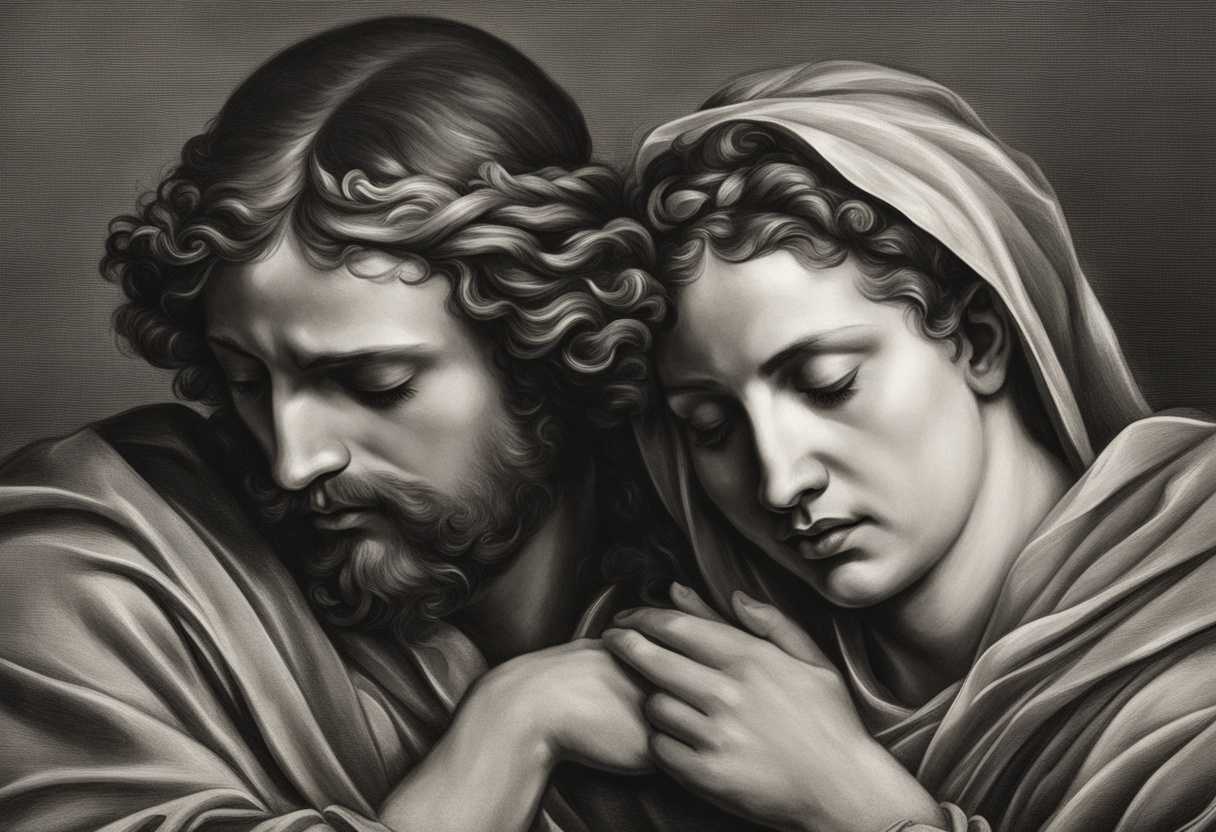
Setting the Scene for 2 Samuel 3:13-16
In 2 Samuel chapter 3, we find ourselves in the midst of a tense political situation in ancient Israel. The scene unfolds in Hebron, a significant city in the region, known for its historical and strategic importance. The main characters in this particular passage are Abner, the commander of Saul’s army, and David, who has been anointed as the future king of Israel.
Abner, seeking to solidify his position and power, decides to make a bold move by reaching out to David. He approaches David with a proposal to unite the kingdom under his rule, recognizing David’s growing influence and military prowess. The meeting takes place in a public setting, likely in the presence of witnesses and advisors from both sides, adding to the tension and intrigue of the moment.
As Abner and David engage in negotiations and discussions about the future of the kingdom, the atmosphere is charged with anticipation and uncertainty. The outcome of this meeting will have far-reaching consequences for the political landscape of Israel, setting the stage for the eventual unification of the kingdom under David’s rule.
What is 2 Samuel 3:13-16 about?
This verse encapsulates the complexities of loyalty, betrayal, and power dynamics within the biblical narrative. Abner, despite aligning with David to unite Israel, ultimately falls victim to the retaliatory actions of Joab. The verse reflects the ever-shifting alliances and conflicts that punctuate political and personal relationships, even amidst the pursuit of a greater goal.
We see the tragic consequences of power struggles and personal vendettas play out in this verse. It prompts us to ponder the fragility of trust and the consequences of betrayal, as well as the price individuals may pay in the pursuit of power or revenge. What does it mean to honor alliances and commitments in the face of personal grievances? How does this story resonate with our own experiences of navigating relationships and power dynamics in our lives today? Human nature and the moral dilemmas that arise in the pursuit of unity and leadership are complexities that we should reflect on.
Understanding what 2 Samuel 3:13-16 really means
In the narrative of the power struggle between the houses of Saul and David, we find a poignant moment where David, in negotiations with Abner, the commander of Saul’s army, asserts his claim to his first wife, Michal, Saul’s daughter. The phrase “Give me my wife Michal” encapsulates David’s insistence on his rightful spouse, emphasizing the significance of lawful marriage and the sanctity of covenant relationships. Furthermore, David recalls the bride price he paid for Michal, a hundred Philistine foreskins, underscoring his rightful claim and the sacrifices he made in the past to secure their union.
The emotional depth of the situation is palpable as Michal’s husband follows her, weeping all the way to Bahurim, showcasing the personal cost and turmoil involved in political maneuvers. This humanizes the characters and reminds us of the emotional complexities that often accompany power struggles and personal decisions. The interconnectedness of political power and personal relationships is a theme that resonates throughout this passage and invites us to consider the multifaceted nature of human interactions.
Drawing parallels to other biblical passages, such as 1 Samuel 18:25-27 and 1 Samuel 25:44, provides additional context to David and Michal’s story, enriching our understanding of their relationship dynamics. Jesus’ teaching on marriage in Matthew 19:6 further reinforces the sanctity of marital bonds, echoing David’s determination to reclaim Michal as his wife and uphold the divine institution of marriage. These connections deepen our appreciation for the ethical and moral dimensions at play in this narrative.
In a contemporary context, the narrative of David and Michal prompts reflection on the importance of honoring commitments and covenants in our own lives. It serves as a poignant reminder of the emotional and relational complexities that can arise from political or personal decisions, urging us to navigate such situations with integrity, empathy, and compassion. The enduring nature of true commitment and love, exemplified by David’s unwavering pursuit of Michal, inspires us to cherish and uphold the relationships that matter most to us.
Consider a modern scenario where a couple faces separation due to external circumstances, akin to David and Michal’s plight. The emotional turmoil and longing experienced in such situations mirror the challenges faced by biblical figures, underscoring the enduring nature of commitment and love. Ultimately, this passage from 2 Samuel 3:13-16 invites us to contemplate the complexities of human relationships and the significance of honoring our commitments with sincerity and empathy. It calls us to navigate our own relational landscapes with grace, understanding, and a steadfast commitment to the covenants we hold dear.
Should we strive for reconciliation and unity with enemies?
The verses you provided demonstrate the importance of striving for reconciliation and unity with enemies. Abner takes the initiative in this passage to reach out to David in order to make amends and establish peace between their factions. This act of seeking reconciliation exemplifies the idea of putting differences aside and working towards unity, even with former adversaries. We can demonstrate characteristics like forgiveness, humility, and a desire for peace by actively pursuing reconciliation with enemies. We can take steps to repair fractured connections and strive for unity, even in the face of past conflicts or animosities, just as Abner did with David. Embracing reconciliation with enemies can lead to healing, growth, and the possibility of building stronger relationships in the future. These verses remind us of the power of reconciliation in overcoming divisions and fostering unity. Rather than harboring grudges or perpetuating conflicts, making efforts to reconcile with enemies can bring about positive change and create opportunities for mutual understanding and cooperation. Striving for reconciliation and unity with enemies ultimately aligns with the values of forgiveness, compassion, and the pursuit of peace.
Application
Embrace the power of reconciliation in your own life. Just like a skilled mediator in a tough meeting at work, take the initiative to mend broken relationships. Extend the olive branch of forgiveness to those who need it most, just as David did with Abner. Are you willing to make that first move towards reconciliation today?

Reverend Michael Johnson is an experienced Church Minister with a profound expertise in spirituality and guidance. With a serene presence and a compassionate heart, he has faithfully served his congregation for over 20 years, leading them on a spiritual journey towards inner peace and enlightenment. Reverend Johnson’s extensive knowledge of religious philosophies and profound understanding of human nature have made him a trusted confidant and mentor to many, as he seamlessly weaves his profound wisdom into life teachings. Reverend Johnson’s calming demeanor and empathetic nature continue to uplift and heal souls, nurturing a sense of unity and tranquility within his community.