
2 Samuel 6:14-23 is about King David’s joyful and unrestrained worship before the Lord as he brings the Ark of the Covenant to Jerusalem while highlighting the tension between sacred devotion and societal expectations, ultimately illustrating that true worship may provoke criticism but is rooted in a genuine relationship with God.
14 And David danced before the Lord with all his might. And David was wearing a linen ephod.
15 So David and all the house of Israel brought up the ark of the Lord with shouting and with the sound of the horn.
16 As the ark of the Lord came into the city of David, Michal the daughter of Saul looked out of the window and saw King David leaping and dancing before the Lord, and she despised him in her heart.
17 And they brought in the ark of the Lord and set it in its place, inside the tent that David had pitched for it. And David offered burnt offerings and peace offerings before the Lord.
18 And when David had finished offering the burnt offerings and the peace offerings, he blessed the people in the name of the Lord of hosts.
19 And distributed among all the people, the whole multitude of Israel, both men and women, a cake of bread, a portion of meat, and a cake of raisins to each one. Then all the people departed, each to his house.
20 And David returned to bless his household. But Michal the daughter of Saul came out to meet David and said, “How the king of Israel honored himself today, uncovering himself today before the eyes of his servants’ female servants, as one of the vulgar fellows shamelessly uncovers himself!”
21 And David said to Michal, “It was before the Lord, who chose me above your father and above all his house, to appoint me as prince over Israel, the people of the Lord—and I will make merry before the Lord.
22 I will make myself yet more contemptible than this, and I will be abased in your eyes.
23 And Michal the daughter of Saul had no child to the day of her death.
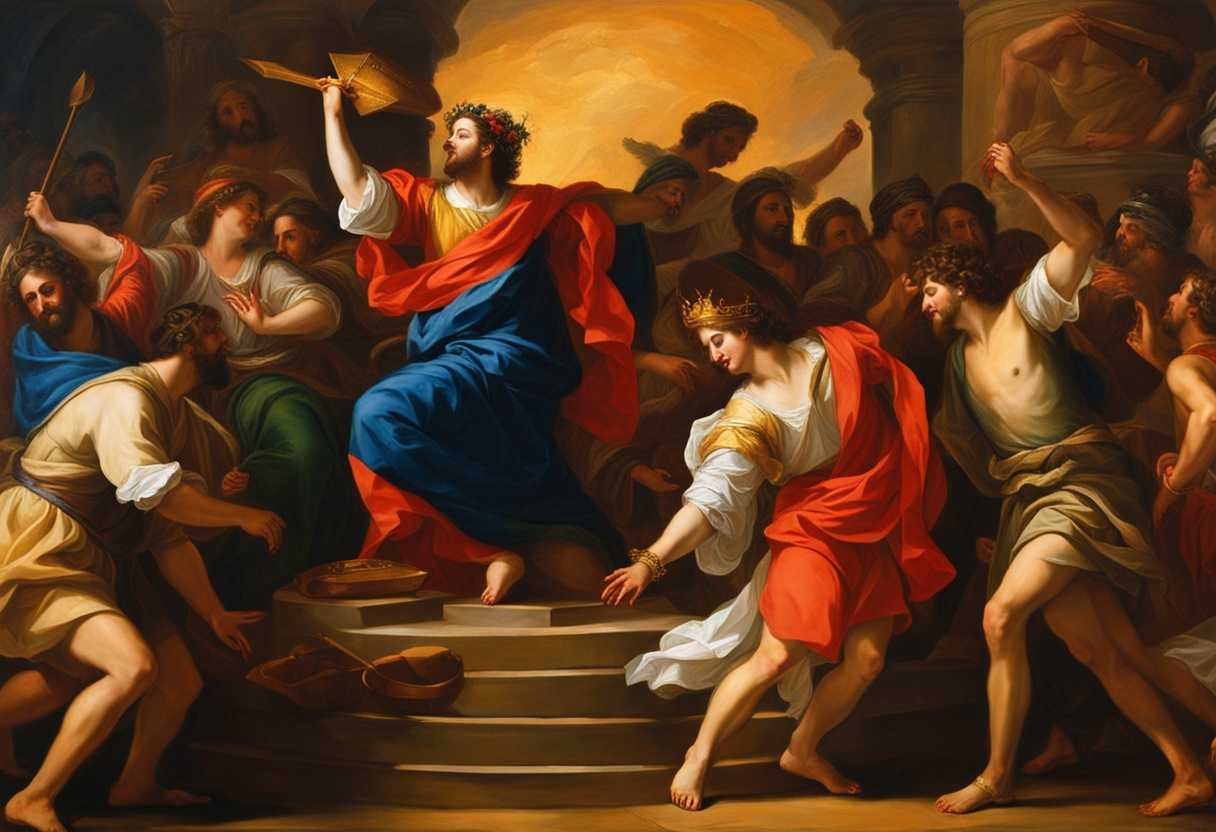
Setting the Scene for 2 Samuel 6:14-23
The scene unfolds in the heart of Jerusalem, a city that has recently been established as the capital of Israel under King David’s reign. The air is electric with excitement as the people gather to witness a momentous occasion: the return of the Ark of the Covenant to its rightful place among the Israelites. The Ark, a sacred chest that symbolizes God’s presence, had been absent from the nation for years, and its return is a powerful sign of divine favor. As the sun begins to set, casting a warm golden hue over the city, David, adorned in a simple linen ephod, dances with unrestrained joy before the Ark, his heart overflowing with gratitude and reverence.
Surrounding David is a throng of Israelites, their faces alight with celebration. Musicians play jubilant tunes on harps and lyres, while others shout and sing praises to God. The atmosphere is filled with the sounds of laughter and the rhythmic beating of drums, creating a festive ambiance that resonates through the streets. Among the crowd is Michal, David’s wife, who watches from a window in their palace. Her expression is one of disapproval and disdain as she witnesses her husband’s uninhibited display of worship. She is a daughter of Saul, the former king, and her perspective is colored by the royal decorum she was raised to uphold, contrasting sharply with David’s exuberant expression of faith.
As the procession continues, David’s dance becomes a symbol of his deep connection to God and his commitment to leading the people in worship. However, Michal’s reaction reveals a tension between the sacred and the secular, the royal and the humble. When David returns home, he is met with her scornful words, which cut deeply. She chastises him for what she perceives as a lack of dignity, but David responds with a passionate declaration of his devotion to God, emphasizing that his worship is not bound by societal expectations. This moment encapsulates the struggle between personal faith and public perception, setting the stage for the unfolding narrative of David’s reign and his relationship with both God and his family.
What is 2 Samuel 6:14-23 about?
We witness a moment that beautifully encapsulates the contrast between personal devotion and societal norms in this fascinating passage. David, in his exuberance, chooses to dance joyfully before the Lord, celebrating not just a religious event, but his deep, personal connection to God. This action signifies a profound expression of worship that transcends conventional boundaries. One might wonder, what does it mean for us to express our faith in such uninhibited ways? We often allow cultural expectations to stifle our enthusiasm for spiritual experiences in our own lives.
On the other hand, we have Michal, David’s wife, who looks upon his display of worship with disdain. Her reaction underscores the tension that can arise when personal convictions clash with societal expectations. Michal’s disapproval prompts us to consider how often we might be inclined to judge others based on external behavior rather than understand the heart behind their actions. Isn’t it fascinating to think about how personal expressions of faith can be misunderstood or rejected by those around us? This moment serves as a powerful reminder that our worship can sometimes create friction, especially when it diverges from the norm. Through this lens, we can reflect on how we might embrace authentic worship in our lives, irrespective of how it may be perceived by society. How might we encourage one another to be bold in our expressions of faith, just as David was?
Understanding what 2 Samuel 6:14-23 really means
In 2 Samuel 6:14-23, we witness a transformative moment in King David’s life as he brings the Ark of the Covenant to Jerusalem. This event is not merely a historical account; it encapsulates the essence of worship, joy, and the complexities of human relationships. David’s exuberant celebration serves as a reminder of the joy that comes from being in the presence of God, but it also highlights the misunderstandings that can arise when our expressions of faith are not shared by those around us.
The Ark of the Covenant was a powerful symbol of God’s presence among His people. David’s determination to bring it to Jerusalem reflects his deep commitment to establishing a central place of worship. This act signifies not only his desire for God’s presence to dwell among the nation but also his recognition of the importance of worship in the life of Israel. How often do we prioritize our own spiritual practices and communal worship in our lives today?
When we read that “David danced before the Lord with all his might,” we see a vivid picture of unrestrained joy and devotion. This phrase challenges us to consider our own expressions of worship. Are we willing to express our inner joy and reverence for God openly? David’s choice to wear a linen ephod, a priestly garment, further emphasizes that worship transcends social status. It reminds us that leaders, whether in the church or in our communities, should exemplify a heart of worship.
However, the passage also introduces a critical perspective through Michal, Saul’s daughter, who “looked down from her window.” Her disdain for David’s joyful worship serves as a poignant reminder that not everyone will understand or appreciate our expressions of faith. This disconnect can lead to tension in our relationships. How do we respond when others criticize our worship? Are we quick to defend ourselves, or do we seek to understand their perspective?
The relevance of this passage extends into our contemporary lives. In a world where expressions of faith can be met with skepticism, David’s example encourages us to worship freely and authentically. It challenges us to reflect on our own willingness to celebrate God’s presence and to consider how we respond to the worship of others. Are we supportive and encouraging, or do we find ourselves judging those who express their faith differently?
I recall a moment during a church service when a member began to dance joyfully in the aisle. Reactions varied; some were taken aback, while others joined in the celebration. This experience mirrored David’s own, illustrating the diverse responses that worship can evoke. It reminded me of the importance of embracing joy in worship, regardless of how it might be perceived by others.
In conclusion, this passage serves as a powerful reminder of the significance of authentic worship and the joy that comes from being in God’s presence. It challenges us to embrace our faith wholeheartedly, to celebrate God’s goodness, and to be mindful of how we respond to the worship of others. By doing so, we can cultivate a community that honors God and encourages one another in our spiritual journeys. How can we foster an environment where all expressions of faith are welcomed and celebrated?
How can I express my faith authentically?
To express your faith authentically, embrace joy and vulnerability in your worship. Allow yourself to fully engage with your beliefs, celebrating the moments of connection with the divine without concern for societal expectations. This might mean expressing gratitude through music, dance, or other forms of creative worship that resonate with you, recognizing that your personal relationship with your faith is a unique and genuine experience.
It’s also important to be grounded and humble, remaining aware of how your expressions of faith can impact those around you. While personal enthusiasm is vital, it is equally crucial to respect the perspectives and practices of others in your community. Engaging in open conversations about faith can foster understanding and unity, reminding you that authenticity does not require perfection but rather an honest reflection of your journey.
Finally, your actions outside of worship should reflect your beliefs. Living out your faith through kindness, service, and compassion towards others demonstrates the core values of your beliefs, allowing your authentic self to shine through in everyday interactions. You create a life that embodies your faith, inviting others to witness its transformative power in a relatable and accessible way.
Application
Think of your life like a busy workplace, where you can either follow the crowd or truly shine. King David celebrated wildly when the Ark came to Jerusalem, ignoring how others saw him, focusing instead on his love for God. Just like in a family, we sometimes hold back our true feelings, fearing judgment. What if you let your spirit soar, letting genuine joy and devotion lead you in worship instead of worrying about what others think? It’s time to break free from those expectations. Are you ready to embrace your true self and celebrate authentically?

Reverend Michael Johnson is an experienced Church Minister with a profound expertise in spirituality and guidance. With a serene presence and a compassionate heart, he has faithfully served his congregation for over 20 years, leading them on a spiritual journey towards inner peace and enlightenment. Reverend Johnson’s extensive knowledge of religious philosophies and profound understanding of human nature have made him a trusted confidant and mentor to many, as he seamlessly weaves his profound wisdom into life teachings. Reverend Johnson’s calming demeanor and empathetic nature continue to uplift and heal souls, nurturing a sense of unity and tranquility within his community.