
2 Maccabees 4:18-22 is about the corrupt actions of Jason, a high priest who sought to Hellenize the Jewish community by introducing Greek customs and neglecting traditional Jewish practices, symbolizing the struggle between maintaining cultural identity and succumbing to outside influences.
18 And the extreme Hellenization and increase of foreign customs, through the excessive wickedness of those who were ungrateful toward their own nation and regarded the divine decrees with contempt, led to the following disaster.
19 But for all this, his heart did not change, nor did he humble himself before the Lord.
20 And so he was carried in a litter, plainly showing the manifest power of God.
21 But after the death of Seleucus, when Antiochus called Epiphanes took the kingdom, Jason the brother of Onias obtained the high priesthood by corruption,
22 It is better to be ungodly and have many children, than to be godly and have no children.
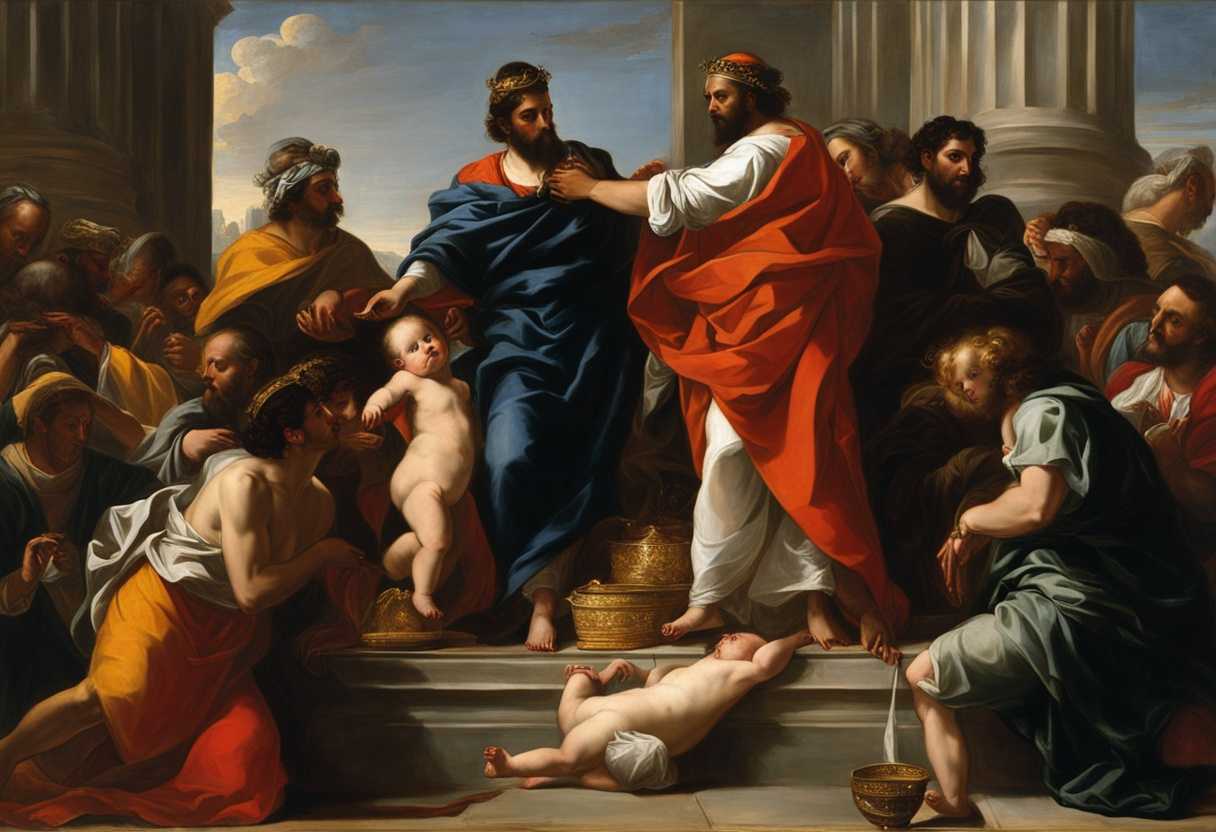
Setting the Scene for 2 Maccabees 4:18-22
In 2 Maccabees 4:18-22, the scene unfolds in the royal court of Jerusalem during the reign of King Antiochus IV Epiphanes. The king’s trusted official, Menelaus, who had been appointed as high priest through corrupt means, is confronted by the righteous and zealous Onias III. Menelaus had used his position for personal gain, betraying his own people and their faith by introducing Greek customs and practices into the temple.
Surrounded by opulence and luxury, Menelaus and his supporters are confronted by Onias III, who stands as a symbol of resistance against the Hellenization of the Jewish people. The tension in the room is palpable as Onias III accuses Menelaus of sacrilege and corruption, calling for a return to the true worship of God. The clash between these two figures represents a larger struggle for the soul of the Jewish people, torn between loyalty to their traditions and the allure of Greek culture.
As the confrontation unfolds, the room is filled with the weight of history and the echoes of prophets past, as the fate of the Jewish people hangs in the balance. The scene serves as a powerful reminder of the constant struggle between faithfulness and compromise, and the enduring importance of standing up for one’s beliefs in the face of adversity.
What is 2 Maccabees 4:18-22 about?
The verse you provided points to the consequences of corruption and greed in the context of desecrating the temple in Jerusalem. It speaks to the idea that when individuals prioritize their desires for power, wealth, or personal gain over values such as faith, righteousness, and respect for sacred spaces, they can cause harm and destruction. The desecration of the temple in Jerusalem represents a significant betrayal of the spiritual and communal significance it held for the people.
Reflecting on this verse, we are prompted to consider the enduring relevance of the message it conveys. How do corruption and greed continue to impact societies and institutions today? Are there parallels in our modern world where selfish actions lead to the degradation of what is considered holy or important? We can appreciate the value of integrity, humility, and selflessness by contemplating these questions. Let us be mindful of the dangers of corruption and greed, and let us strive to cultivate virtues that honor and protect what is sacred in our own lives and communities.
Understanding what 2 Maccabees 4:18-22 really means
The Book of 2 Maccabees offers a glimpse into a tumultuous period in Jewish history when the influence of Greek culture posed a significant threat to the religious practices of the Jewish people. In these verses, we witness Jewish leaders, including the high priest Menelaus, participating in Greek athletic games held in Tyre, events intertwined with pagan rituals and idolatry. The presence of the king at these games underscores the political pressure exerted on Jewish leaders to conform to Hellenistic practices, highlighting the delicate balance they faced between upholding their faith and appeasing external influences.
The mention of these games held every five years in Tyre sheds light on the pervasive nature of Hellenistic culture and its clash with Jewish religious traditions. Menelaus’s involvement in these activities, despite his esteemed position as high priest, symbolizes a stark departure from the expected role of religious leaders in safeguarding Jewish laws and customs. The narrative serves as a cautionary tale, illustrating the dangers of compromising one’s beliefs under societal or political pressures.
Drawing parallels to other biblical passages, such as 1 Maccabees 1:11-15, Romans 12:2, and Daniel 1:8, we find consistent themes of resisting cultural assimilation and maintaining religious integrity in the face of adversity. These texts urge believers to remain steadfast in their faith, even when confronted with challenges that may tempt them to abandon their convictions for the sake of acceptance or personal gain. The story of Menelaus and the Jewish leaders resonates with contemporary struggles to uphold moral and spiritual values amidst a secular world that often promotes conflicting ideologies.
Consider a scenario where a devout individual navigates a corporate environment rife with practices contrary to their faith, akin to the predicament faced by Menelaus. This professional must grapple with the choice of either compromising their beliefs to advance their career or standing firm in their convictions, risking potential setbacks. Their decision mirrors the resilience displayed by figures like Daniel, who prioritized fidelity to their beliefs over worldly temptations, setting a profound example for others to follow.
In conclusion, the passage from 2 Maccabees serves as a timeless reminder of the significance of faithfulness and integrity in the midst of cultural pressures. It prompts introspection among readers, encouraging them to evaluate areas in their lives where they may be susceptible to compromising their values. Ultimately, the narrative underscores the importance of living out one’s faith authentically, irrespective of external influences, and emphasizes the enduring relevance of moral steadfastness in a world that often challenges one’s convictions.
How do we guard against the influence of worldly desires?
We can guard against the influence of worldly desires by staying true to our faith and values. Worldly desires often lead us astray from the path of righteousness and can cloud our judgment. We can resist the temptations that come with worldly desires by grounding ourselves in our beliefs and principles. It is important to constantly remind ourselves of what is truly important in life and to prioritize our spiritual well-being over fleeting worldly pleasures.
Additionally, surrounding ourselves with a strong support system of like-minded individuals can help keep us accountable and on track. Associating with people who share our values and goals makes us less likely to be swayed by the lure of worldly desires. It is important to choose our companions wisely and to seek out relationships that uplift and inspire us, rather than lead us down the path of temptation.
Practicing self-discipline and mindfulness can also help guard against the influence of worldly desires. We can better identify when we are being swayed by temptations and make a conscious effort to steer ourselves back on course by being aware of our thoughts and actions. Developing a strong sense of self-control and inner strength can help us resist the pull of worldly desires and stay true to our spiritual beliefs.
Application
When you dig deep into 1 Maccabees 4:18-22, it’s a beacon urging you to examine your soul. Embrace self-reflection and change, honor your core beliefs, and stay firm. It’s time to align your deeds with the lessons of the Bible. How will you act upon this awakening in your journey?

Reverend Michael Johnson is an experienced Church Minister with a profound expertise in spirituality and guidance. With a serene presence and a compassionate heart, he has faithfully served his congregation for over 20 years, leading them on a spiritual journey towards inner peace and enlightenment. Reverend Johnson’s extensive knowledge of religious philosophies and profound understanding of human nature have made him a trusted confidant and mentor to many, as he seamlessly weaves his profound wisdom into life teachings. Reverend Johnson’s calming demeanor and empathetic nature continue to uplift and heal souls, nurturing a sense of unity and tranquility within his community.